
HSE-111 · Lesson 8 of 12 · 24 min
CPR for children and infants
Cardiac arrest in children and infants is much less common than in adults, but when it happens it is devastating, and the actions of the people nearby are just as important. Many workplaces have contact with children: schools, child care centres, recreation facilities, pools, retail stores, health care, transport and hospitality. Parents and caregivers also bring their skills home. This lesson gives an awareness-level overview of how CPR differs for children and infants. As with adult CPR, the techniques must be practised hands-on with an instructor; pediatric manikins are used to teach the right depth and hand positions.
Who counts as an infant or a child?
For CPR purposes, an infant is a baby under 1 year old, not including newborns at birth, whose care is covered in specialized neonatal training. A child is from 1 year old until puberty. Signs of puberty include breast development in girls and underarm or chest hair in boys. Once a young person shows signs of puberty, use adult CPR techniques. For AED pads, a separate guide applies: pediatric pads or child mode for children under about 8 years old or 25 kg (55 lb), as Lesson 7 explained.
Why children are different
Adults usually go into cardiac arrest because of a sudden heart rhythm problem. Children and infants usually do not. Their cardiac arrests are most often the end of a process that starts with a breathing problem or a lack of oxygen: choking, drowning, severe asthma, respiratory infections such as bronchiolitis or pneumonia, suffocation, sudden unexpected infant death, injuries and poisoning. By the time a child's heart stops, the blood has very little oxygen left. That is why rescue breaths are especially important for children and infants, and why the 2025 Heart and Stroke Foundation and American Heart Association guidelines renewed their emphasis on lay rescuers giving breaths, and on dispatchers coaching breaths, in pediatric CPR.
Children's hearts do sometimes stop because of a heart rhythm problem, for example in an inherited heart condition, a heart problem present from birth, or a blow to the chest during sport. In these cases an AED is life-saving, and AEDs should be available wherever children play competitive sport.
Recognizing cardiac arrest in a child or infant
The two-question test is the same: is the child unresponsive, and are they breathing normally? For an infant, check responsiveness by tapping the soles of the feet and calling out, rather than shaking. Check breathing for no more than 10 seconds. Infants and young children breathe faster than adults: a normal resting rate is roughly 30 to 60 breaths a minute in an infant and 20 to 40 in a young child, so a slow rate can be a danger sign. Gasping is not normal breathing.
Health care providers may check for a pulse and begin CPR in a child or infant whose heart rate is very slow with signs of poor circulation, even if the heart has not stopped completely. Lay rescuers do not need to check for a pulse: an unresponsive child or infant who is not breathing normally needs CPR.
Sequence for a child or infant
If you are alone and have a phone, call 9-1-1 on speaker and start CPR. If you have no phone, give about 2 minutes of CPR first, then leave to call 9-1-1 and get an AED, taking an infant with you if possible. If someone else is present, send them to call and fetch an AED while you start CPR. If you are trained and willing, give compressions and breaths at 30:2; health care providers working in pairs use 15:2. If you are unable or unwilling to give breaths, give compressions only: any CPR is better than none.
Compressions for a child
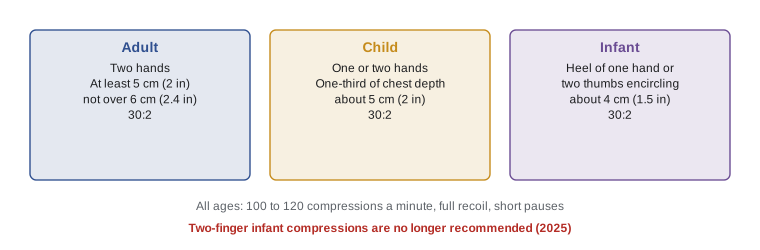
For a child, use the heel of one hand in the centre of the chest on the lower half of the breastbone, or both hands as for an adult if the child is large or you cannot push deep enough with one. Push to a depth of about one-third of the depth of the chest, which is about 5 cm (2 inches) in most children, at a rate of 100 to 120 a minute, allowing full recoil.
Compressions for an infant
The 2025 guidelines changed how infants should be compressed. The two-finger technique that was taught for many years is no longer recommended, because studies showed it often failed to reach the right depth. Instead, use either the heel of one hand on the lower half of the breastbone, or the two-thumb encircling technique, in which both hands wrap around the infant's chest and the thumbs press on the lower half of the breastbone. The two-thumb technique is preferred when there are two rescuers; the heel of one hand is preferred when the rescuer cannot encircle the chest. Push about one-third of the depth of the chest, about 4 cm (1.5 inches), at 100 to 120 a minute.
Breaths for children and infants
Open the airway with a gentle head tilt-chin lift. For infants, tilt the head only to a neutral, sniffing position; tilting too far can close the soft airway. For a child, pinch the nose and seal your mouth over the child's mouth. For an infant, cover both the mouth and nose with your mouth if you can. Give each breath over about one second with just enough air to make the chest rise. Infants need only small puffs. Pocket masks come in pediatric sizes.
| Adult (puberty and older) | Child (1 year to puberty) | Infant (under 1 year) | |
|---|---|---|---|
| Check response | Tap shoulders and shout | Tap shoulders and shout | Tap soles of feet and call out |
| Hand position | Two hands, lower half of breastbone | One or two hands, lower half of breastbone | Heel of one hand, or two thumbs encircling |
| Depth | At least 5 cm (2 in), not over about 6 cm (2.4 in) | About one-third of chest depth, about 5 cm (2 in) | About one-third of chest depth, about 4 cm (1.5 in) |
| Rate | 100 to 120 per minute | 100 to 120 per minute | 100 to 120 per minute |
| Ratio (lay rescuer) | 30:2 | 30:2 | 30:2 |
| Alone without a phone | Call first, then CPR | About 2 minutes of CPR, then call | About 2 minutes of CPR, then call |
| AED pads | Adult pads | Pediatric pads under about 8 years or 25 kg (55 lb), else adult pads | Pediatric pads if available, else adult pads, front and back |
Worked problem
Measuring depth as a fraction of the chest
An infant's chest measures about 11 cm (4.3 inches) from front to back, and a 6-year-old's about 15 cm (5.9 inches). Using the one-third rule, what compression depth is the target for each, and how does it compare with the commonly taught figures of about 4 cm (1.5 inches) and 5 cm (2 inches)?
Show solution
- Infant: \(11 \div 3 \approx 3.7\) cm (\(4.3 \div 3 \approx 1.4\) inches), close to the commonly taught 4 cm (1.5 inches).
- Child: \(15 \div 3 = 5\) cm (\(5.9 \div 3 \approx 2\) inches), matching the commonly taught 5 cm (2 inches).
- The one-third rule adjusts automatically for size; the fixed figures are easier to remember.
Answer: About 3.7 cm (1.4 inches) for the infant and 5 cm (2 inches) for the child. Both match the guideline figures closely, which is why manikin practice is the best way to learn how deep one-third feels.
Preventing cardiac arrest in children
Because most pediatric cardiac arrests start with a breathing problem or an injury, prevention and early action are especially effective. Workplaces and facilities that care for children can reduce risk with active supervision around water, barriers and lifeguards at pools, safe sleep practices for infants in child care, food and small-object policies to prevent choking, medication and chemical storage out of reach, and plans for children with known conditions such as severe allergies, asthma or heart conditions. Recognizing and responding to breathing difficulty early, covered in HSE-110, can prevent a child's heart from ever stopping.
Sports and sudden cardiac arrest in young people
Sudden cardiac arrest in young athletes is rare but receives wide attention, and it has driven many of the school and sports AED laws discussed in Lesson 11. A sudden blow to the chest from a ball or puck at a critical moment in the heartbeat can trigger ventricular fibrillation, a condition called commotio cordis. Inherited heart conditions can also cause collapse during exertion. Any young person who collapses suddenly during sport and is unresponsive and not breathing normally should be assumed to be in cardiac arrest: call 9-1-1, start CPR and use an AED immediately. Coaches, officials and parents at games are often the first responders.
Emotional impact
Giving CPR to a child is one of the most distressing experiences a rescuer can have, whatever the outcome. It is normal to feel shaken, to replay events and to have difficulty sleeping afterward. Lesson 11 discusses post-event support, and HSE-109 Psychological Health and Safety discusses how workplaces can support people after traumatic events.
Child care and school settings
Child care centres, schools and recreation programs often have specific requirements for staff first aid and CPR training that include infant and child CPR, set by provincial, territorial or state licensing rules. Programs should check that staff training covers the ages of the children in their care, that pediatric AED pads or a child key are kept with each AED, and that emergency plans include how to contact parents and how to supervise the other children while staff respond. Drills that include a child-sized manikin help staff practise the different techniques.
Finally, keep pediatric equipment checks on the same schedule as adult AED checks, so that child pads are present, in date and easy to find.
Common mistakes
MistakeUsing two fingers for infant compressions.
InsteadUse the heel of one hand or the two-thumb encircling technique, as in the 2025 guidelines.
MistakePushing too gently on a child because they seem fragile.
InsteadPush about one-third of the chest depth: about 5 cm (2 inches) for a child and 4 cm (1.5 inches) for an infant.
MistakeLeaving immediately to call when alone without a phone.
InsteadGive about 2 minutes of CPR first, then call.
MistakeTilting an infant's head far back to open the airway.
InsteadUse a neutral, sniffing position for infants.
MistakeSkipping breaths for a child when trained and able.
InsteadBreaths are especially important because pediatric arrests usually start with a lack of oxygen.
Summary and key terms
- Infants are under 1 year old; children are from 1 year to puberty; use adult techniques after puberty.
- Pediatric cardiac arrests usually start with a breathing problem, so rescue breaths are especially important.
- Check infants by tapping the soles of the feet; lay rescuers do not check a pulse.
- Alone without a phone, give about 2 minutes of CPR before calling.
- Child: one or two hands, about one-third of chest depth, about 5 cm (2 inches).
- Infant: heel of one hand or two-thumb encircling, about one-third of chest depth, about 4 cm (1.5 inches); the two-finger technique is no longer recommended.
- Rate is 100 to 120 a minute and the lay rescuer ratio is 30:2 for all ages.
- Infant
- For CPR, a baby under 1 year old, excluding newborns at birth.
- Child
- For CPR, from 1 year old until signs of puberty.
- Puberty
- The stage at which adult CPR techniques are used, shown by breast development or underarm or chest hair.
- Two-thumb encircling technique
- Compressing an infant's breastbone with both thumbs while the hands wrap around the chest.
- One-third rule
- Compressing a child's or infant's chest about one-third of its depth.
- Sniffing position
- A neutral head position used to open an infant's airway.
- Commotio cordis
- Cardiac arrest caused by a blow to the chest at a critical moment in the heartbeat.
- Bronchiolitis
- A common viral chest infection in infants that can cause breathing difficulty.
- 15:2
- The compression-to-breath ratio used by two trained providers for children and infants.
- Pediatric manikin
- A training model of a child or infant used to practise CPR.
Practice problems
Work each problem on paper first, then reveal the answer to check.
What age range is an infant for CPR?
Show answer
Under 1 year old, excluding newborns at birth.
When do you switch to adult CPR techniques?
Show answer
When the young person shows signs of puberty.
Why are breaths especially important for children?
Show answer
Their cardiac arrests usually start with a breathing problem or lack of oxygen.
How do you check an infant's responsiveness?
Show answer
Tap the soles of the feet and call out.
What compression depth is used for a child?
Show answer
About one-third of chest depth, about 5 cm (2 inches).
What techniques are recommended for infant compressions in 2025?
Show answer
The heel of one hand or the two-thumb encircling technique.
Which infant technique is no longer recommended?
Show answer
The two-finger technique.
Alone with an infant in cardiac arrest and no phone, what do you do?
Show answer
Give about 2 minutes of CPR, then call 9-1-1, taking the infant if possible.
What compression rate is used for children and infants?
Show answer
100 to 120 a minute.
What is commotio cordis?
Show answer
Cardiac arrest from a blow to the chest at a critical moment in the heartbeat.
Lesson quiz · 5 questions
Score 60% or more to complete this lesson.
Create a free account to save your progress, take quizzes and earn a certificate.