
HSE-111 · Lesson 3 of 12 · 25 min
Calling for help, dispatcher-assisted CPR and getting an AED
Once you recognize cardiac arrest, three things need to happen as fast as possible: emergency services must be called, an AED must be brought to the person, and CPR must start. If several people are present, these can happen at the same time. If you are alone, you must decide what to do first. This lesson explains how to activate the emergency response, how 9-1-1 dispatchers help callers give CPR, how to find and fetch an AED quickly, and the legal protection that exists for people who help.
If others are present: delegate clearly
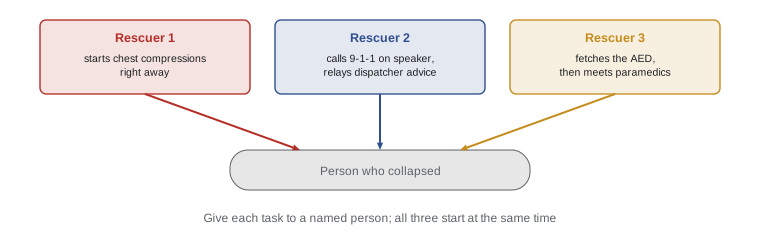
In an emergency, people often stand and watch, each assuming someone else has already called. This is sometimes called the bystander effect. Break it by giving clear, specific instructions to named people. Point at someone and say: "You in the blue jacket, call 9-1-1, put it on speaker and bring the phone here. You, get the AED from the lunchroom and come straight back." Then start compressions. Specific instructions to identified people get faster results than shouting "Someone call an ambulance!"
At a workplace, the emergency plan should also say who else to notify: the first aid team, security or reception so they can meet the ambulance at the entrance and guide paramedics to the right floor, and a supervisor. These tasks should not delay the 9-1-1 call itself.
If you are alone with an adult
Most phones can now call emergency services hands-free on speaker. If you are alone with an adult who has collapsed, call 9-1-1 on your phone, put it on speaker beside you and start CPR while you talk to the dispatcher. If an AED is close by and you know exactly where it is, guidelines suggest getting it before starting CPR when you are alone with an adult, because in adults the most common cause of sudden collapse is a heart rhythm problem that a shock may correct. If you have no phone, you may have to leave briefly to call and fetch an AED, then return and start CPR.
If you are alone with a child or infant
In children and infants, cardiac arrest is more often caused by a breathing problem such as choking, drowning or a respiratory illness. A short period of CPR, including rescue breaths, may restore oxygen and prevent the heart from stopping completely. If you are alone with an unresponsive child or infant who is not breathing normally and you have a phone, call 9-1-1 on speaker and start CPR right away. If you have no phone, give about 2 minutes of CPR before leaving to call for help, and carry an infant with you if you can. Lesson 8 covers CPR for children and infants.
What the dispatcher will ask
Emergency call-takers follow structured questions to send the right help as quickly as possible. Expect to be asked for the location first, because if the call drops, they can still send help. Be ready with the full civic address, the building name or number, the entrance to use, the floor and room, and a callback number. On a large industrial site, a farm or a highway, describe landmarks, highway distance markers, gate numbers or GPS coordinates; many phones can display them. Then the dispatcher will ask what happened, whether the person is awake and whether they are breathing normally. Answer the breathing question precisely: say if the person is gasping.
Phones can also share location automatically. In both Canada and the US, wireless calls to 9-1-1 provide location information to the call centre, and the move to Next Generation 9-1-1 networks is improving accuracy and adding features such as text messaging for people who are deaf, hard of hearing or speech impaired. Do not rely on automatic location alone, especially inside large buildings: always state where you are.
| Dispatcher asks | Have ready |
|---|---|
| Where is the emergency? | Civic address, building, entrance, floor and room, landmarks or site gate |
| What number are you calling from? | Your callback number |
| What happened? | Person collapsed suddenly, or other cause such as drowning or electric shock |
| Is the person awake? | No reaction to tap and shout |
| Are they breathing normally? | Not breathing, or gasping, snoring or gurgling |
| Is an AED available? | Where it is and who is bringing it |
Dispatcher-assisted CPR
Dispatchers in many communities are trained to recognize cardiac arrest from the caller's answers and to coach the caller through CPR over the phone. This is called dispatcher-assisted CPR or telephone CPR. The dispatcher will usually instruct you to put the phone on speaker, place the person on their back on a firm surface, put the heel of your hand in the centre of the chest and push hard and fast, often counting out loud with you to keep the rate between 100 and 120 compressions a minute. For adults, dispatchers usually coach hands-only CPR, which is easier to teach over the phone. For children and infants, the 2025 guidelines encourage dispatchers to coach rescue breaths as well, because their cardiac arrests are more often caused by a lack of oxygen.
Dispatcher-assisted CPR has been shown to increase bystander CPR rates and survival. It means that even someone with no training can give CPR. Stay on the line, follow instructions and keep compressing until the dispatcher tells you to stop, an AED is ready, paramedics take over, or the person starts to wake up, move or breathe normally.
Worked problem
How much time does delegation save?
A worker collapses in an office. In scenario A, a single co-worker calls 9-1-1 (1 minute), then walks to the AED cabinet and back (3 minutes), then starts CPR. In scenario B, three co-workers act at once: one calls on speaker, one starts CPR within 30 seconds, one fetches the AED, which arrives after 3 minutes. For each, how long after the collapse does CPR start, and when is the AED ready, allowing 1 minute to switch it on and attach the pads?
Show solution
- Scenario A: CPR starts at \(1 + 3 = 4\) minutes. The AED is already there, so it is ready at about \(4 + 1 = 5\) minutes, but the person has had no CPR for the first 4 minutes.
- Scenario B: CPR starts at 0.5 minutes. The AED arrives at 3 minutes and is ready at about \(3 + 1 = 4\) minutes.
- Difference in time without circulation: \(4 - 0.5 = 3.5\) minutes less in scenario B.
Answer: Delegation starts CPR about 3.5 minutes sooner and gets the AED ready about a minute sooner. Using the commonly cited 7 to 10 per cent per minute estimate, those minutes could make a large difference to survival.
Finding an AED
An AED is only useful if people know where it is. AEDs in public places and workplaces are usually mounted in wall cabinets with a recognizable sign: a white heart with a lightning bolt on a green background is widely used, defined in the international standard for safety signs. Look near main entrances, reception desks, elevators, lunchrooms, gyms and security offices. Many cabinets have an alarm that sounds when opened; that is normal, so do not let it stop you.
In Canada, many provinces and communities maintain registries of public AEDs that 9-1-1 dispatchers can use to direct callers to the nearest device. Some jurisdictions and emergency services use smartphone apps that alert trained volunteers to nearby cardiac arrests and show the location of registered AEDs. Manitoba's Defibrillator Public Access Act requires AEDs at designated public places to be registered, and other provinces encourage voluntary registration. A workplace that has an AED should register it with the local or provincial registry if one exists, and keep its information current.
Good Samaritan protection
A common fear is being sued for helping. In Canada, every province and territory protects people who provide emergency help in good faith. Statutes such as Ontario's Good Samaritan Act, 2001, Alberta's Emergency Medical Aid Act and British Columbia's Good Samaritan Act protect volunteers who help without expecting payment from liability for harm unless they are grossly negligent. Ontario's Chase McEachern Act (Heart Defibrillator Civil Liability), 2007, specifically protects people who use an AED in good faith in an emergency, and other provinces have similar AED provisions. Quebec's Charter of Human Rights and Freedoms goes further: it places a duty on everyone to help a person whose life is in peril, if they can do so without serious risk to themselves or others, and its Civil Code protects people who help from liability except for intentional or gross fault. In practice, lawsuits against bystanders who give CPR are extremely rare.
Good Samaritan protections generally apply to people acting voluntarily. Workers who are designated first aiders and are performing their job duties are usually covered instead by their employer's responsibilities and insurance; the workplace program described in Lesson 11 should make this clear. Either way, the law is designed to encourage people to help.
Consent
A person in cardiac arrest is unresponsive and cannot give consent. The law treats this as implied consent: it is assumed that a reasonable person would want life-saving help. You do not need to ask anyone's permission to start CPR. If a family member objects or shows you a valid do-not-resuscitate document, follow the dispatcher's advice; in most workplaces and public places, start CPR unless there is a clear and valid reason not to.
Planning the call at work
Workplaces can make the call faster by preparing it in advance. Post the full civic address, the nearest cross-street and the entrance paramedics should use beside every phone and at each AED cabinet. On large sites, number the gates and doors and give these numbers to the local emergency service. Make sure internal phone systems can dial 9-1-1 directly without a prefix, or post the prefix clearly. Decide in advance who meets the ambulance and who holds the elevator, and include these roles in drills so they happen automatically.
Finally, remember that the caller has an important job even after help is on the way. Keeping the line open lets the dispatcher update the arriving crew, coach compressor switches and tell you when paramedics are close.
Common mistakes
MistakeShouting "Someone call 9-1-1!" to a crowd.
InsteadPoint to a specific person and give a specific task.
MistakeHanging up after giving the address.
InsteadStay on the line, use speaker mode and follow the dispatcher's CPR coaching.
MistakeGiving a vague location such as "the warehouse".
InsteadGive the full address, entrance, floor and room, landmarks or gate numbers.
MistakeNot opening an AED cabinet because the alarm sounds.
InsteadThe alarm is normal; take the AED to the person.
MistakeNot helping because of fear of being sued.
InsteadGood Samaritan and AED laws protect people who help in good faith.
Summary and key terms
- Calling 9-1-1, starting CPR and getting an AED should happen at the same time whenever possible.
- Give specific tasks to named people to overcome the bystander effect.
- Alone with an adult: call on speaker and start CPR, getting a nearby AED if you know where it is.
- Alone with a child or infant and no phone: give about 2 minutes of CPR, then call.
- Give the dispatcher an exact location and describe breathing precisely.
- Dispatchers can coach CPR by phone; stay on the line and follow instructions.
- Good Samaritan and AED laws protect people who help in good faith, and implied consent applies to unresponsive people.
- Bystander effect
- The tendency of people in a group to assume someone else will act.
- Dispatcher-assisted CPR
- CPR given by a caller while being coached over the phone by a 9-1-1 call-taker.
- Speaker mode
- Using a phone hands-free so CPR can continue while talking.
- AED cabinet
- A wall-mounted box holding an AED, often with an alarm and a standard sign.
- AED registry
- A database of AED locations that dispatchers and apps can use.
- Next Generation 9-1-1
- Updated emergency call networks with better location data and text support.
- Good Samaritan law
- Law protecting people who help in an emergency in good faith.
- Implied consent
- The legal assumption that an unresponsive person would want life-saving care.
- Callback number
- The phone number the dispatcher can use to reach you if the call drops.
- Gross negligence
- Conduct showing a serious disregard for safety; not protected by Good Samaritan laws.
Practice problems
Work each problem on paper first, then reveal the answer to check.
Why give specific tasks to named people?
Show answer
To overcome the bystander effect and make sure each task gets done.
You are alone with an adult who collapses, and you have a phone. What do you do?
Show answer
Call 9-1-1 on speaker and start CPR, getting a nearby AED first if you know exactly where it is.
You are alone with an unresponsive infant who is not breathing and you have no phone. What do you do?
Show answer
Give about 2 minutes of CPR, then go to call, carrying the infant if you can.
What does the dispatcher usually ask first?
Show answer
The location of the emergency.
What is dispatcher-assisted CPR?
Show answer
CPR coached over the phone by the 9-1-1 call-taker.
When can you stop CPR?
Show answer
When an AED is ready to analyze, paramedics take over, the person starts to wake or breathe normally, or the dispatcher tells you to.
What symbol marks an AED?
Show answer
A white heart with a lightning bolt on a green background.
Why register a workplace AED?
Show answer
So dispatchers and apps can direct people to it.
Do you need permission to give CPR to an unresponsive person?
Show answer
No. Implied consent applies.
What do Good Samaritan laws generally not protect?
Show answer
Gross negligence or wilful misconduct.
Lesson quiz · 5 questions
Score 60% or more to complete this lesson.
Create a free account to save your progress, take quizzes and earn a certificate.