
HSE-111 · Lesson 1 of 12 · 25 min
Sudden cardiac arrest and the chain of survival
Every day, people who were working, shopping, coaching a game or climbing stairs collapse without warning because their heart has suddenly stopped pumping blood. This is sudden cardiac arrest. Without help, a person in cardiac arrest dies within minutes. With immediate CPR and an early shock from an automated external defibrillator (AED), many survive and return to work and family life. What happens in the first few minutes, before paramedics arrive, is usually done by the people who happen to be nearby: co-workers, customers, family members and strangers. This course is about preparing you to be one of those people.
This is an awareness course. It explains what cardiac arrest is, how CPR and AEDs work, what the current guidelines recommend and how workplaces organize to respond. It does not certify you in CPR or AED use, and reading cannot replace practising compressions on a manikin with an instructor who can correct your hand position, depth and rate. Hands-on CPR and AED courses are offered by the Canadian Red Cross, St. John Ambulance, the Heart and Stroke Foundation of Canada through its training centres, and the Lifesaving Society. Many workplaces require certified training as part of first aid certification under provincial and territorial regulations, which HSE-110 First Aid Awareness introduced.
Cardiac arrest is not the same as a heart attack
The terms are often confused, even in news reports, but they describe different problems. A heart attack is a circulation problem: a blocked coronary artery cuts off blood to part of the heart muscle, which begins to die. The person is usually awake and breathing, often with chest pain or pressure, shortness of breath, nausea or a cold sweat, and the symptoms may build over minutes or hours. HSE-110 explained first aid for a heart attack: call 9-1-1, keep the person resting and follow the dispatcher's advice.
Sudden cardiac arrest is an electrical problem. The heart's rhythm becomes chaotic or stops, so the heart quivers or stands still instead of pumping. Blood flow to the brain stops, and within seconds the person collapses, becomes unresponsive and stops breathing normally. A heart attack can trigger cardiac arrest, and it is one of the commonest causes, but cardiac arrest can also be caused by inherited heart conditions, heart muscle disease, drug overdose, drowning, electrocution, a blow to the chest at a particular moment in the heartbeat, severe blood loss or a lack of oxygen.
| Heart attack | Sudden cardiac arrest | |
|---|---|---|
| What goes wrong | Blocked artery starves heart muscle of blood | Heart rhythm fails; heart stops pumping |
| Onset | Minutes to hours, sometimes with warning symptoms | Sudden collapse within seconds |
| Responsiveness | Usually awake and talking | Unresponsive |
| Breathing | Breathing, may be short of breath | Not breathing, or only gasping |
| What bystanders do | Call 9-1-1, rest, follow dispatcher advice, be ready for CPR | Call 9-1-1, start CPR immediately, use an AED as soon as it arrives |
Why minutes matter
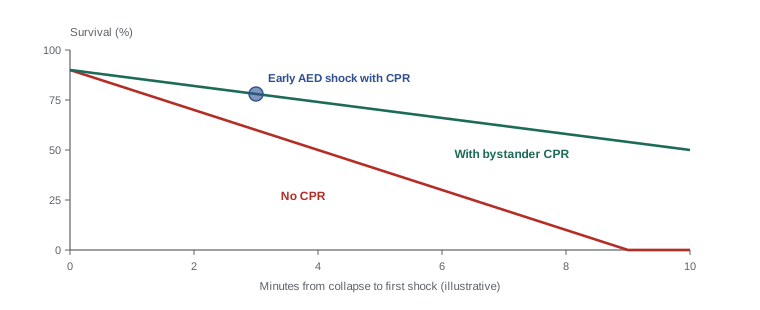
When the heart stops, the brain has no oxygen supply. Unconsciousness follows within about 10 to 20 seconds. After about 4 to 6 minutes without circulation, brain cells begin to suffer damage, and the damage becomes more severe with each passing minute. A commonly cited estimate is that a person's chance of surviving falls by roughly 7 to 10 per cent for every minute that passes without CPR and defibrillation. The exact figure varies between studies and situations, but the message is consistent: every minute of delay costs lives. Bystander CPR slows the decline by moving some oxygen-rich blood to the brain and heart, buying time until an AED arrives.
Paramedics cannot usually arrive in time to prevent this decline on their own. Even in cities, the interval from a 9-1-1 call to a paramedic reaching the patient's side is often 8 to 10 minutes or more once you count the time to answer the call, dispatch, drive, park, find the right floor and reach the person. In rural, remote and industrial settings it can be much longer. That is why the response in the first minutes belongs to the people already on scene.
Worked problem
How quickly does the chance of survival fall?
Use the commonly cited estimate that, without CPR or defibrillation, the chance of survival falls by about 10 percentage points per minute from a starting point of roughly 90 per cent at the moment of collapse from a shockable rhythm. Estimate the chance at 3 minutes and at 8 minutes, and explain what this simple model leaves out.
Show solution
- At 3 minutes: \(90 - 3 \times 10 = 60\) per cent.
- At 8 minutes: \(90 - 8 \times 10 = 10\) per cent.
- The model is a rough teaching aid, not a prediction for any one person. Real survival depends on the cause of arrest, age and health, whether the arrest was witnessed and how good the CPR is.
- Studies show that with good bystander CPR the decline is much slower, often described as roughly 3 to 4 per cent per minute.
Answer: About 60 per cent at 3 minutes and about 10 per cent at 8 minutes without help. The numbers are illustrative, but they show why CPR and an AED must start long before paramedics can arrive.
The chain of survival
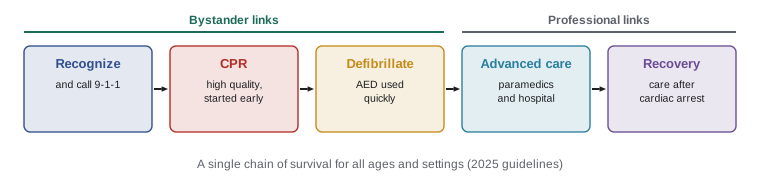
The chain of survival is a way of showing the sequence of actions that gives a person in cardiac arrest the best chance. Each link depends on the one before it, and a weak link anywhere reduces the chance of survival. In its 2025 guidelines, the American Heart Association returned to a single chain of survival for all cardiac arrests, regardless of the person's age or whether the arrest happens in or out of hospital, replacing the separate chains it had used for adults, children and in-hospital arrests. The Heart and Stroke Foundation of Canada's 2025 guidelines, developed from the same international evidence reviews, use a similar sequence.
The links are: early recognition of cardiac arrest and activation of emergency services; early, high-quality CPR; rapid defibrillation with an AED; advanced care by paramedics and hospital teams; and care after cardiac arrest, including recovery and rehabilitation. Bystanders control the first three links. The fourth and fifth depend on emergency medical services and hospitals, but they only matter if the first three have kept the person alive.
Where the guidelines come from
CPR guidelines are not invented by any one organization. The International Liaison Committee on Resuscitation (ILCOR) brings together resuscitation councils from around the world to review the scientific evidence, publishing consensus statements on science and treatment recommendations. The Heart and Stroke Foundation of Canada is a founding member of ILCOR and, working with the American Heart Association, publishes the guidelines used for CPR training in Canada. The most recent major update was released in October 2025. Training organizations such as the Canadian Red Cross, St. John Ambulance and the Lifesaving Society update their courses to reflect these guidelines.
Guidelines change as evidence improves, and this matters for anyone who trained years ago. Ideas that were once taught, such as checking for a pulse before starting CPR, giving long sequences of breaths before compressions, or using a two-finger technique on infants, have been removed or changed. If your certificate is more than a couple of years old, a refresher course is the best way to bring your skills up to date.
How common is cardiac arrest, and who survives?
The Heart and Stroke Foundation estimates that there are about 60,000 cardiac arrests a year in Canada, roughly one every nine minutes, most of them outside hospital. In most communities fewer than 1 in 10 people who have a cardiac arrest outside hospital survive. Survival varies widely between communities, and the places with the best results are those where bystanders start CPR quickly, AEDs are easy to find and emergency services are well organized. Heart and Stroke reports that CPR combined with an AED can double a person's chance of survival or more.
Most cardiac arrests outside hospital happen at home, where the people most likely to need CPR skills are family members. A significant minority happen in public places and workplaces, where trained co-workers and accessible AEDs make a large difference. Arrests that are witnessed, where someone sees the person collapse, have much better outcomes because CPR and defibrillation can start immediately.
Barriers that stop bystanders from helping
Research on why bystanders do not start CPR identifies several common barriers: not recognizing that the person is in cardiac arrest, especially when they are gasping; fear of doing it wrong or of hurting the person; fear of legal consequences; worry about infection from breaths; and, for women in cardiac arrest, reluctance to expose or touch the chest. Studies have found that women are less likely than men to receive bystander CPR in public. Each of these barriers can be reduced. Dispatchers are trained to recognize cardiac arrest and to coach callers through compressions. Hands-only CPR removes the need for breaths in adults. Good Samaritan laws in both countries protect people who help in good faith. And the risk of harm from CPR to a person in cardiac arrest is far smaller than the certainty of death without it.
The role of the workplace
Workplaces are ideal places to strengthen the chain of survival. Workers are present for many hours a day, they can be trained together, AEDs can be placed and maintained, and emergency procedures can be practised. A workplace with trained responders, a well-placed AED and a clear plan can achieve far better outcomes than the community average. Later lessons describe how to build such a program and the laws that apply in each country.
Common mistakes
MistakeUsing "heart attack" and "cardiac arrest" as if they mean the same thing.
InsteadA heart attack is a blocked artery in a person who is usually awake; cardiac arrest is a sudden collapse with no normal breathing.
MistakeWaiting for paramedics before doing anything.
InsteadCall 9-1-1, start CPR immediately and send for an AED; paramedics usually take several minutes to arrive.
MistakeBelieving that an old CPR certificate means your skills are current.
InsteadGuidelines change; take regular refresher training.
MistakeTreating this awareness course as CPR certification.
InsteadComplete a hands-on course with a recognized training provider.
MistakeHolding back because you are afraid of hurting the person.
InsteadA person in cardiac arrest will die without CPR; doing something is far better than doing nothing.
Summary and key terms
- Sudden cardiac arrest is an electrical failure that stops the heart pumping; a heart attack is a blocked artery.
- A person in cardiac arrest collapses, is unresponsive and is not breathing normally.
- The chance of survival falls by roughly 7 to 10 per cent a minute without CPR and defibrillation.
- The 2025 guidelines use a single chain of survival: recognize and call, CPR, rapid defibrillation, advanced care and post-arrest care.
- Bystanders control the first three links of the chain.
- Guidelines are based on ILCOR evidence reviews and updated every few years, most recently in October 2025.
- This course builds awareness; hands-on certified training is needed to perform CPR with confidence.
- Sudden cardiac arrest
- The sudden loss of effective heart pumping, usually from an abnormal heart rhythm.
- Heart attack
- Damage to heart muscle caused by a blocked coronary artery.
- CPR
- Cardiopulmonary resuscitation: chest compressions, with or without rescue breaths, to keep blood flowing.
- AED
- Automated external defibrillator: a portable device that analyzes the heart rhythm and delivers a shock if needed.
- Defibrillation
- An electric shock that stops a chaotic heart rhythm so a normal rhythm can restart.
- Chain of survival
- The linked sequence of actions that gives the best chance of surviving cardiac arrest.
- ILCOR
- International Liaison Committee on Resuscitation, which reviews resuscitation science worldwide.
- Witnessed arrest
- A cardiac arrest that someone sees happen.
- Out-of-hospital cardiac arrest
- A cardiac arrest that happens in the community rather than in hospital.
- Bystander CPR
- CPR started by someone on scene before emergency services arrive.
Practice problems
Work each problem on paper first, then reveal the answer to check.
Name two differences between a heart attack and cardiac arrest.
Show answer
A heart attack is a blocked artery and the person is usually awake and breathing; in cardiac arrest the person collapses, is unresponsive and is not breathing normally.
Roughly how quickly does survival fall without CPR or defibrillation?
Show answer
By about 7 to 10 per cent per minute (a commonly cited estimate).
List the links of the 2025 chain of survival.
Show answer
Recognize and activate emergency services, high-quality CPR, rapid defibrillation, advanced care, post-arrest care and recovery.
Which links can bystanders control?
Show answer
The first three: recognition and calling, CPR and early defibrillation.
Why do paramedics rarely arrive in time on their own?
Show answer
Call handling, dispatch, travel and access often take 8 to 10 minutes or more.
What is ILCOR?
Show answer
The International Liaison Committee on Resuscitation, which reviews the evidence behind CPR guidelines.
When were the latest major CPR guidelines released?
Show answer
October 2025.
Why do witnessed arrests have better outcomes?
Show answer
CPR and defibrillation can start immediately.
Give two common reasons bystanders do not start CPR.
Show answer
Not recognizing gasping as cardiac arrest, fear of harm or legal consequences, worry about breaths, reluctance to touch a woman's chest.
Does this course certify you in CPR?
Show answer
No. It builds awareness; certification needs a hands-on course.
Lesson quiz · 5 questions
Score 60% or more to complete this lesson.
Create a free account to save your progress, take quizzes and earn a certificate.