
HSE-111 · Lesson 7 of 12 · 25 min
Using an AED and special situations
All AEDs work in the same basic way, even though models look different. The device talks you through every step, and many also show pictures or text on a screen. Your job is to switch it on, follow the prompts, attach the pads to bare skin in the right places, keep everyone clear during analysis and shocks, and keep CPR going between them. This lesson walks through the steps in order and then covers the situations that sometimes make people hesitate: water, hairy chests, implanted devices, medication patches, jewellery and metal surfaces. Children's pads are introduced here and covered further in Lesson 8.
Step 1: keep CPR going and switch the AED on
As soon as the AED arrives, place it beside the person's head or shoulder on the side away from the person giving compressions, open it and switch it on. Some models switch on automatically when the lid is opened. If there are two rescuers, one continues compressions while the other prepares the AED; compressions should continue until the moment the AED is ready to analyze. If you are alone, stop compressions only as long as you need to attach the pads.
Step 2: expose the chest and prepare the skin
The pads must stick firmly to bare, dry skin. Remove or cut away clothing from the chest; most AED cases contain a rescue kit with scissors, a razor, a towel and gloves. Bras with metal underwires should be moved or cut away from where the pads go; the 2025 guidelines note that adjusting a bra rather than removing it may be reasonable if the pads can still be placed on bare skin in the correct positions. Remove necklaces only if they are in the way of the pads; otherwise leave them.
Step 3: attach the pads
Peel the backing off each pad and press it firmly onto the skin, smoothing it so there are no air bubbles. The pads have pictures showing where they go. For adults, the standard anterior-lateral placement puts one pad on the upper right chest, below the collarbone and to the right of the breastbone, and the other on the lower left side of the chest, a few centimetres below the armpit, over the ribs. An alternative anterior-posterior placement puts one pad on the centre of the chest and one on the back between the shoulder blades. Either placement is acceptable; follow the pictures on the pads. For women, place the side pad below or beside the breast, not on breast tissue.
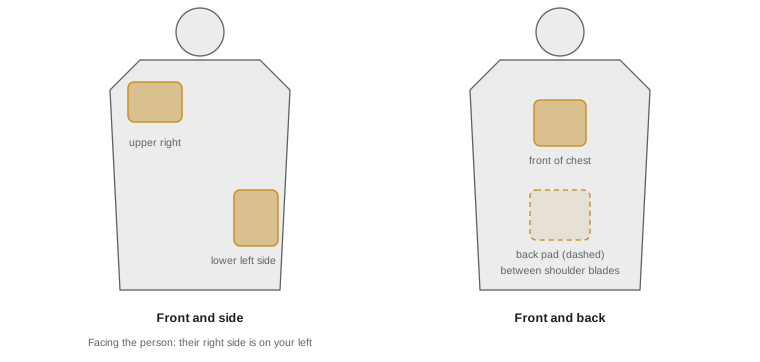
Once the pads are attached, many AEDs begin analyzing automatically. Others ask you to plug the pad connector into the device or press an analyze button.
Step 4: stand clear for analysis
When the AED says it is analyzing, stop compressions, take your hands off and make sure no one is touching the person. Say clearly, "Everybody clear", and look along the person's body to check. Movement, including compressions, a moving vehicle or someone holding the person's hand, can interfere with the analysis.
Step 5: shock if advised, then resume CPR immediately
If the AED advises a shock, it will charge and then either tell you to press the flashing shock button or deliver the shock automatically after a countdown. Before the shock, say "Stand clear" again and check that no one is touching the person. After the shock, the person's body may jerk; this is normal. Immediately resume CPR, starting with compressions. Do not wait to check for breathing or a pulse; even when a shock restores a normal rhythm, the heart usually pumps weakly at first and benefits from continued compressions. If no shock is advised, resume CPR immediately as well.
Step 6: keep going
The AED will reanalyze about every 2 minutes and tell you when to stop compressions. Leave the pads on and the AED switched on, even if the person starts to recover, because cardiac arrest can recur. Continue until paramedics take over and tell you to stop, or until the person clearly starts to breathe normally, move or wake up. If they start breathing normally, place them in the recovery position with the pads still attached and monitor them closely.
| Step | What to do | What to say |
|---|---|---|
| 1 | Switch on the AED; keep compressions going | "AED is here, keep going." |
| 2 | Expose and dry the chest; shave dense hair at pad sites if needed | |
| 3 | Apply pads to bare skin as pictured; connect if needed | |
| 4 | Hands off during analysis | "Everybody clear." |
| 5 | Shock if advised; resume compressions immediately | "Stand clear. Shocking." Then "Restart compressions." |
| 6 | Follow prompts every 2 minutes; switch compressors | "Switch at the next analysis." |
Special situations
Several situations need a small adjustment. None of them is a reason not to use the AED.
Water and wet skin. Water conducts electricity and can reduce the shock's effectiveness or let current travel across the skin. If the person is lying in water, move them to a drier area if you can. Quickly wipe the chest dry before applying the pads. Snow, rain and small puddles are not a reason to delay. You can use an AED on a wet deck or in the rain once the chest is dry and no one is touching the person during the shock.
Hairy chest. Dense chest hair can stop the pads sticking, which prevents analysis. Use the razor in the rescue kit to shave quickly where the pads go. If there is no razor, press one pad down hard and pull it off quickly to remove hair, then apply a new pad if a spare set is available.
Implanted pacemakers and defibrillators. Many people have a small device implanted under the skin, often below the left collarbone, visible as a hard lump with a scar. Do not place a pad directly over it; place the pad a few centimetres away or use the anterior-posterior position. If an implanted defibrillator is shocking the person, you may see their muscles jerk; wait 30 to 60 seconds for it to finish its cycle before applying an AED shock if CPR is under way. It is safe to touch a person whose implanted defibrillator fires, though you may feel a tingle.
Medication patches. Patches on the skin, such as nitroglycerin, nicotine or pain medication, can block the shock or cause burns if a pad is placed over them. Wearing gloves, remove any patch where a pad will go and wipe the skin.
Jewellery and piercings. Metal jewellery does not need to be removed unless it is under a pad position. Body piercings should be avoided by the pads.
Metal surfaces. Using an AED on a metal surface such as a grated floor, a stretcher or a bleacher is safe as long as no one is touching the person and the pads do not touch the metal.
Pregnancy. An AED can and should be used on a pregnant person in cardiac arrest, with standard pad positions. Lesson 10 explains an extra step to help blood flow during CPR.
AEDs and children
Many AEDs come with pediatric pads, or have a key or switch for a child mode, which reduces the shock energy. Guidelines advise using pediatric pads or a child mode for infants and young children up to about 8 years old or 25 kg (55 lb) if available. If they are not available, use adult pads: an adult shock is better than no shock. Never use pediatric pads on an adult; the reduced energy will usually not be enough. On a small child, if the pads would touch or overlap on the front of the chest, use the anterior-posterior position, with one pad on the chest and one on the back.
Worked problem
From collapse to first shock
A worker collapses in a plant. Times: collapse 0:00; CPR starts 0:30; AED arrives 2:45; switched on 2:55; chest exposed and shaved 3:25; pads on 3:45; analysis 3:45 to 3:55; shock 4:05; CPR resumes 4:10. (a) What is the time to first shock? (b) How long were compressions paused around the shock? (c) Where could time be saved?
Show solution
- (a) Collapse to shock: 4 minutes 5 seconds.
- (b) If compressions stopped at 3:45 for analysis and resumed at 4:10, the pause was 25 seconds.
- (c) Compressions could continue while a second rescuer exposes the chest and applies the pads, so the only pause is for analysis and the shock. Preparing the skin while CPR continues and keeping a razor in the AED case would save time.
- If the pads were placed while compressions continued, the pause might be about 10 to 15 seconds: analysis plus charging and the shock.
Answer: First shock at about 4 minutes, with a 25-second pause. With one rescuer compressing while another prepares the AED, the pause could be cut to about 10 to 15 seconds.
When the AED gives an error
If the AED says to check the pads, press them down firmly, make sure the chest is dry, shave if needed and check the connector is plugged in. If it reports a low battery, continue to follow its prompts; most AEDs can still deliver several shocks with a low battery warning. If the AED fails completely, continue CPR until paramedics arrive. Lesson 11 explains the daily and monthly checks that prevent these problems.
Practising with a trainer AED
Training AEDs look and talk like real AEDs but cannot deliver a shock. They let learners practise the whole sequence, including opening the case, applying pads to a manikin and following prompts, until it becomes familiar. Many organizations keep a trainer unit for refresher sessions and drills. Never use a training unit or training pads in a real emergency, and keep them clearly labelled and stored apart from the real AED.
Above all, do not let uncertainty about any special situation delay the first shock. When in doubt, follow the voice prompts.
Common mistakes
MistakeStopping compressions for a long time while setting up the AED.
InsteadKeep compressions going until the AED is ready to analyze.
MistakePlacing pads over clothing, a wet chest or a medication patch.
InsteadPads go on bare, dry skin; remove patches with gloves.
MistakePlacing a pad directly over an implanted device.
InsteadPlace the pad a few centimetres away or use the front and back positions.
MistakeChecking for breathing or a pulse right after a shock.
InsteadResume compressions immediately after a shock.
MistakeUsing pediatric pads on an adult.
InsteadUse adult pads for adults; adult pads may be used on a child if pediatric pads are unavailable.
Summary and key terms
- Switch the AED on and follow its prompts; keep compressions going while it is prepared.
- Pads go on bare, dry skin, either upper right and lower left side, or front and back.
- Keep everyone clear during analysis and shock, and say so out loud.
- Resume compressions immediately after a shock or a no-shock decision.
- Dry wet skin, shave dense hair, avoid implanted devices and remove medication patches under pad sites.
- AEDs can be used safely on metal surfaces and on pregnant people.
- Use pediatric pads or child mode for young children if available, otherwise adult pads; never pediatric pads on adults.
- Anterior-lateral placement
- Pads on the upper right chest and the lower left side of the chest.
- Anterior-posterior placement
- Pads on the front of the chest and on the back between the shoulder blades.
- Rescue kit
- Scissors, razor, towel and gloves kept with an AED.
- Pediatric pads
- Smaller pads or an attenuator that reduce the shock for young children.
- Child mode
- An AED setting that reduces shock energy for children.
- Implanted pacemaker
- A device under the skin that controls a slow heart rate.
- Implantable cardioverter-defibrillator
- An implanted device that can shock the heart from inside the body.
- Medication patch
- A skin patch that releases medication, which must not lie under an AED pad.
- Analysis
- The AED's automatic check of the heart rhythm.
- Stand clear
- The instruction that no one may touch the person during analysis or shock.
Practice problems
Work each problem on paper first, then reveal the answer to check.
What should happen while one rescuer prepares the AED?
Show answer
Another rescuer keeps giving compressions.
Describe the standard adult pad positions.
Show answer
One on the upper right chest below the collarbone; one on the lower left side below the armpit.
What is the alternative pad position?
Show answer
One on the front of the chest and one on the back between the shoulder blades.
The person is lying in a puddle. What do you do?
Show answer
Move them to a drier spot if possible, wipe the chest dry and use the AED.
The pads will not stick to a hairy chest. What do you do?
Show answer
Shave the pad sites with the rescue kit razor.
You see a lump with a scar below the left collarbone. What do you do?
Show answer
Place the pad a few centimetres away or use the front and back positions.
What do you do immediately after a shock?
Show answer
Resume compressions.
When should pediatric pads be used?
Show answer
For infants and young children up to about 8 years old or 25 kg (55 lb), if available.
Can you use an AED on a metal floor?
Show answer
Yes, if no one touches the person and the pads do not touch the metal.
The person starts breathing normally. What do you do with the AED?
Show answer
Leave the pads on and the AED on, place them in the recovery position and monitor.
Lesson quiz · 5 questions
Score 60% or more to complete this lesson.
Create a free account to save your progress, take quizzes and earn a certificate.