
HSE-111 · Lesson 10 of 12 · 25 min
Special circumstances: drowning, opioids, pregnancy, cold, trauma and electricity
The core of CPR is the same in almost every cardiac arrest: call for help, push hard and fast, use an AED. But some causes of cardiac arrest call for extra steps, extra caution or a different emphasis. This lesson covers the special circumstances most likely to arise at work and in the community: drowning, opioid overdose, pregnancy, hypothermia, trauma, electric shock and lightning, and severe allergic reactions. In each, scene safety comes first and CPR remains the foundation.
Drowning
Drowning is respiratory impairment from being submerged or immersed in liquid. Cardiac arrest from drowning is caused by a lack of oxygen, so restoring breathing is especially important. The first priority is rescuing the person without becoming a second victim. Untrained rescuers should follow the principle of reach, throw, don't go: reach with a pole, branch or rope, or throw something that floats, rather than entering the water. Only those trained in water rescue, such as lifeguards, should go into the water. Workplaces near water, including docks, pools, construction over water and water treatment plants, need rescue equipment and trained personnel.
Once the person is out of the water and on a firm surface, check responsiveness and breathing. If they are unresponsive and not breathing normally, start CPR. Trained rescuers should give rescue breaths as part of CPR, and some programs, especially lifesaving courses, teach giving initial rescue breaths before starting compressions in drowning, because oxygen is the immediate need. Follow the sequence taught in your certified course. Do not try to drain water from the lungs or give abdominal thrusts to remove water; this wastes time and can cause vomiting. Vomiting is common in drowning: turn the person on their side to clear it and continue. Wipe the chest dry before attaching AED pads. Anyone who has been rescued from drowning should be assessed in hospital, even if they seem to recover, because breathing problems can develop hours later.
Opioid overdose
Opioid overdoses, many involving fentanyl and other potent synthetic opioids in the illicit drug supply, have become a leading cause of death among working-age adults in both Canada and the US. Opioids suppress the brain's drive to breathe. A person who has overdosed may be very drowsy or unresponsive, with slow, shallow or no breathing, choking or gurgling sounds, pinpoint pupils, and blue or grey lips, skin or nail beds. If breathing stops, the heart will stop soon after from a lack of oxygen.
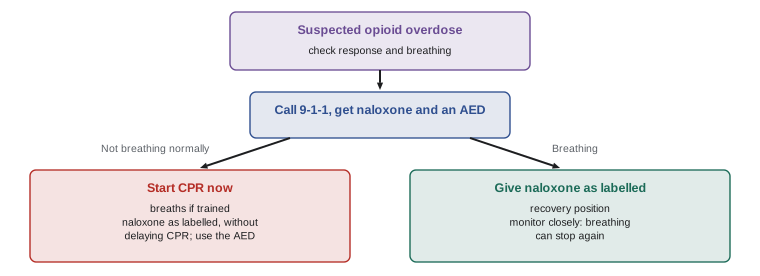
The 2025 American Heart Association guidelines include, for the first time, an algorithm for suspected opioid emergencies that covers naloxone use by the public, and the Heart and Stroke Foundation's 2025 guidelines reinforce public access to naloxone and train lay rescuers to respond. Naloxone reverses the effects of opioids for a period of time. The key steps are: check responsiveness and breathing; call 9-1-1; if the person is unresponsive and not breathing normally, start CPR, with breaths if you are trained, because the problem is a lack of oxygen; give naloxone as soon as it is available, following the instructions on the package, but do not let it delay CPR. If the person is unresponsive but breathing, give naloxone, place them in the recovery position and monitor closely; they may stop breathing again, and the effects of naloxone can wear off before the opioid's effects do.
In Canada, naloxone is available without a prescription, and free take-home kits are offered through many pharmacies and community programs; Ontario requires naloxone kits in certain at-risk workplaces under its Occupational Health and Safety Act. The federal Good Samaritan Drug Overdose Act provides some protection from simple drug possession charges for people who call 9-1-1 for an overdose. Nasal spray and injectable forms are available; use only as the label directs.
Pregnancy
Cardiac arrest during pregnancy is rare but involves two lives. Call 9-1-1 immediately and tell the dispatcher the person is pregnant, because specialized help may be needed urgently. Give high-quality CPR with standard hand position and use the AED with standard pad placement; shocks are safe and important. After about 20 weeks of pregnancy, the enlarged uterus can press on the large blood vessels in the abdomen when the person is lying flat, reducing blood return to the heart and making CPR less effective. Trained rescuers relieve this with manual uterine displacement: while others give compressions, one rescuer uses their hands to push the uterus gently toward the person's left side. If there are not enough rescuers, focus on compressions and the AED. Do not delay CPR to position the person.
Hypothermia
Severe hypothermia, in which body temperature falls dangerously low, can slow the heart and breathing so much that a person appears dead. Cold also protects the brain to some extent, and people have survived prolonged cardiac arrest from hypothermia with full recovery. Check breathing for a little longer than usual, up to about 10 seconds, because breathing may be very slow and shallow. If the person is unresponsive and not breathing normally, start CPR and use the AED as usual. Handle the person gently, because rough movement can trigger dangerous rhythms in a very cold heart. Remove wet clothing, insulate them from the ground and cover them, and move them to a warm place if possible without delaying CPR. HSE-110 covered first aid for hypothermia and frostbite in people who have not arrested.
Trauma
Cardiac arrest after severe injury, such as a fall from height, a vehicle crash or a crush injury, is often caused by massive blood loss or severe injury to the chest or head, and survival is lower than in arrests from heart rhythm problems. Bystanders should still give CPR and use an AED. If there is life-threatening external bleeding, control it at the same time if there are enough rescuers, using direct pressure and tourniquets as HSE-110 described. Minimize movement of the head and neck if a spinal injury is possible, but do not let this stop you from opening the airway or giving compressions.
Electric shock
Electrical injuries can cause cardiac arrest by triggering ventricular fibrillation or by stopping breathing. Never touch a person who may still be in contact with an electrical source. Switch off and isolate the power at the panel or disconnect, or for high-voltage lines, keep well back and call the utility and 9-1-1; distances of at least 10 m (33 ft) are often advised from downed high-voltage lines, and only utility crews should approach. Once the scene is safe, start CPR and use an AED if the person is unresponsive and not breathing normally. Electrical injuries can cause deep burns and internal damage even when the skin looks normal, so anyone who has had a significant shock needs medical assessment.
Lightning
A lightning strike can cause immediate cardiac arrest. People struck by lightning do not carry an electrical charge and are safe to touch, but the area may still be dangerous while the storm continues, so move to a safer location if you can do so quickly. If several people have been struck, the usual triage priorities are reversed: give care first to those who appear to be in cardiac arrest, because people who are moving and breathing are likely to survive, while those in arrest may be saved by prompt CPR, especially as their heart may restart but their breathing may not. This is called reverse triage.
Severe allergic reaction
Anaphylaxis can close the airway and drop blood pressure until the heart stops. HSE-110 explained how to help a person use their own epinephrine auto-injector before that happens. If the person becomes unresponsive and is not breathing normally, start CPR and use an AED. If an auto-injector is available and the person has not received it, follow the device's instructions and local protocols, but do not delay CPR.
| Situation | Key extra step | Caution |
|---|---|---|
| Drowning | Breaths are especially important; follow course sequence | Reach, throw, don't go; dry chest for AED |
| Opioid overdose | Give naloxone as labelled; breaths if trained | Never delay CPR for naloxone; may re-sedate |
| Pregnancy | Tell 9-1-1; trained rescuers displace uterus to the left | Standard compressions and AED; do not delay CPR |
| Hypothermia | Handle gently; insulate and warm | Breathing may be very slow; keep going |
| Trauma | Control severe bleeding while CPR continues | Limit head movement, but airway and compressions come first |
| Electric shock | Isolate power before touching | Stay well back from high-voltage lines |
| Lightning | Reverse triage: those in arrest first | Victims are safe to touch; storm may continue |
Worked problem
Planning naloxone coverage
A community health organization runs three sites. Its risk assessment estimates that each site might see about 2 suspected overdoses a year among clients and visitors. Each naloxone nasal spray kit contains two doses, and the organization wants enough so that each site can treat two overdoses before restocking, assuming up to two doses may be needed per person. How many doses and kits should each site hold, and how many kits overall?
Show solution
- Doses per site: 2 overdoses × up to 2 doses each = 4 doses.
- Kits per site: \(4 \div 2 = 2\) kits.
- Overall: \(2 \times 3 = 6\) kits.
- The plan should also cover expiry dates, storage within the labelled temperature range, training, signs and restocking after use.
Answer: 4 doses, or 2 kits, per site and 6 kits overall, with checks of expiry dates and storage. Naloxone is stored with the AED and first aid kit so responders have everything together.
Confined spaces and hazardous atmospheres
A worker who collapses in a confined space such as a tank, vault or silo may have been overcome by a toxic gas or a lack of oxygen. Rescuers who enter without the right equipment often become victims themselves, and many confined space deaths are would-be rescuers. Never enter a confined space to help unless you are part of a trained rescue team using the required atmospheric testing, ventilation and respiratory protection. Call for the designated rescue service, and give CPR once the person has been brought out to fresh air.
Allergic and medical emergencies before arrest
Many of the special circumstances in this lesson give warning signs before the heart stops: a person who is drowsy and breathing slowly after taking drugs, a worker shivering uncontrollably in the cold, a person with swelling and wheezing after a bee sting. Acting early on these signs, using the first aid covered in HSE-110, can prevent cardiac arrest altogether. Call 9-1-1 early and be ready to start CPR if the person becomes unresponsive and stops breathing normally.
Common mistakes
MistakeSwimming out to rescue a drowning person without training.
InsteadReach or throw something that floats; only trained rescuers should enter the water.
MistakeWaiting for naloxone before starting CPR on a person who is not breathing.
InsteadStart CPR immediately; give naloxone when available without delaying CPR.
MistakeNot using an AED on a pregnant person.
InsteadUse the AED with standard pad positions; shocks are safe and important.
MistakeTouching a person still in contact with an electrical source.
InsteadIsolate the power first, and keep back from high-voltage lines.
MistakeGiving care first to lightning victims who are moving and talking.
InsteadUse reverse triage: help those in cardiac arrest first.
Summary and key terms
- In drowning, rescue safely and give CPR with breaths if trained; wipe the chest dry for the AED.
- In opioid overdose, start CPR if not breathing normally and give naloxone as labelled without delaying CPR.
- In pregnancy, tell 9-1-1, give standard CPR and AED shocks, and trained rescuers displace the uterus to the left.
- In hypothermia, handle gently, keep going and warm the person without delaying CPR.
- In trauma, control severe bleeding while CPR continues.
- In electric shock, isolate the power before touching; lightning victims are safe to touch.
- With multiple lightning victims, use reverse triage and help those in cardiac arrest first.
- Drowning
- Respiratory impairment from submersion or immersion in liquid.
- Reach, throw, don't go
- A safe rescue principle for untrained people at water emergencies.
- Opioid
- A class of drugs, including fentanyl, that can suppress breathing.
- Naloxone
- A medication that temporarily reverses the effects of opioids.
- Manual uterine displacement
- Pushing the uterus to the person's left during CPR in pregnancy to improve blood flow.
- Hypothermia
- A dangerously low body temperature.
- Reverse triage
- Treating apparently lifeless lightning victims first.
- Anaphylaxis
- A severe, life-threatening allergic reaction.
- Isolation
- Switching off and locking out an energy source before approaching.
- Re-sedation
- The return of opioid effects after naloxone wears off.
Practice problems
Work each problem on paper first, then reveal the answer to check.
What does "reach, throw, don't go" mean?
Show answer
Untrained rescuers reach or throw a flotation aid rather than entering the water.
Why are breaths especially important in drowning?
Show answer
The cardiac arrest is caused by a lack of oxygen.
List three signs of opioid overdose.
Show answer
Unresponsiveness, slow or no breathing, pinpoint pupils, blue or grey lips, gurgling sounds.
Should naloxone delay CPR?
Show answer
No. Start CPR and give naloxone when available.
Why monitor a person after naloxone?
Show answer
Naloxone can wear off before the opioid, and breathing may stop again.
What extra step do trained rescuers take in pregnancy?
Show answer
Manual uterine displacement to the person's left.
How should a hypothermic person be handled?
Show answer
Gently, because rough movement can trigger dangerous heart rhythms.
What must be done before touching an electric shock victim?
Show answer
Isolate the power source.
Are lightning victims safe to touch?
Show answer
Yes; they carry no charge.
What is reverse triage?
Show answer
Helping lightning victims in cardiac arrest before those who are moving and breathing.
Lesson quiz · 5 questions
Score 60% or more to complete this lesson.
Create a free account to save your progress, take quizzes and earn a certificate.