
HSE-111 · Lesson 11 of 12 · 26 min
Workplace AED programs and the law in Canada
An AED on a wall does not save lives by itself. It saves lives when it can be reached quickly, when its battery and pads are ready, when people nearby know where it is and are willing to use it, and when the workplace has thought through what happens before, during and after a cardiac arrest. This is the work of an AED program, sometimes called a public access defibrillation program. This lesson explains the elements of a good program and the legal framework that applies in your country.
Deciding whether and where to place AEDs
Start with a needs assessment, as for first aid in HSE-110. Factors that point toward having AEDs include a large number of workers or visitors, older workers or clients, physically demanding work, electrical hazards, public spaces such as lobbies, gyms, arenas and transit stations, remote locations far from paramedics, and long emergency response times. Many organizations now treat an AED as standard equipment in any workplace with more than a handful of people, much like a fire extinguisher.
Placement is about time. Guidance from resuscitation organizations commonly aims for an AED to be retrieved and brought to the person within about 3 minutes, which means it should be within about a 1.5-minute walk each way. In practice, place AEDs in visible, central, well-signed locations along normal walking routes: main entrances, reception, elevator lobbies, cafeterias, gyms and high-risk work areas. On multi-floor buildings, consider an AED on every floor or every few floors near the elevators. On large industrial sites, consider vehicles and remote work areas. AEDs should be unlocked and accessible to everyone whenever the area is occupied; an AED locked in an office is of little use at night.
Worked problem
How far apart should AEDs be?
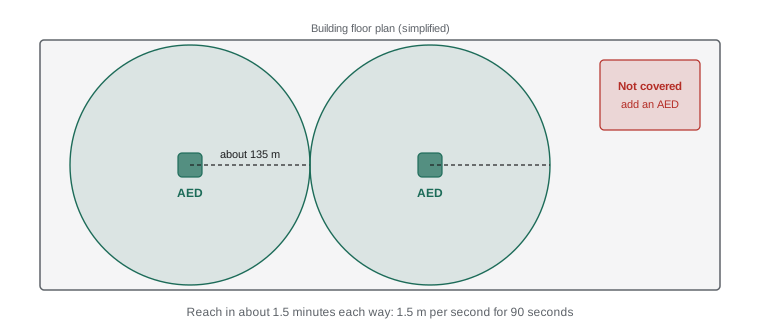
A distribution centre is 400 m long. Assume a brisk walking speed of 1.5 m per second and allow 3 minutes for the round trip to fetch an AED. (a) How far can someone walk in each direction? (b) Ignoring obstructions, how many AEDs placed along the centre line are needed to cover the full length? (c) Why might you need more?
Show solution
- (a) Each direction gets 1.5 minutes, or 90 seconds: \(1.5 \times 90 = 135\) m.
- (b) Each AED covers 135 m on either side, a span of 270 m. Two AEDs cover up to 540 m, so 2 are enough for 400 m if placed at about 100 m and 300 m from one end.
- (c) Racking, conveyors, doors and stairs lengthen real routes; mezzanines, outside yards and docks may also need coverage. Walk the routes with a stopwatch to check.
Answer: About 135 m each way; 2 AEDs in theory, but real walking routes usually mean adding a third or relocating units after timing the routes.
Maintenance: the AED must be ready
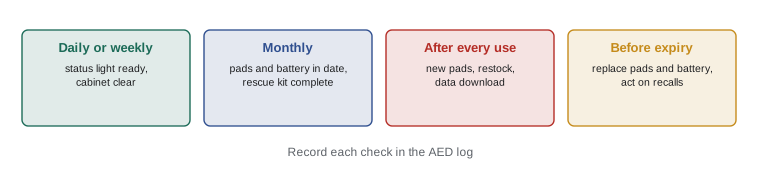
AEDs run regular self-tests and show a status indicator, often a green light, check mark or hourglass, that tells you whether the device is ready. A red light, an X, a beeping alarm or a blank display means it needs attention. Batteries and pads have expiry dates, commonly every two to five years depending on the model; pads are single-use and must be replaced after every use. A designated person should check every AED on a regular schedule, recording the results.
| Frequency | Check |
|---|---|
| Daily or weekly | Status indicator shows ready; cabinet accessible; no alarms |
| Monthly | Pads and battery in date; spare pads (including pediatric if needed); rescue kit with razor, scissors, gloves, towel and pocket mask; cabinet and signs in good condition |
| After every use | Replace pads; check battery; restock rescue kit; download event data if required; return to service promptly |
| As scheduled | Replace battery and pads before expiry; follow manufacturer service requirements; act on recalls and safety notices |
Worked problem
Budgeting an AED program
A company buys 4 AEDs at $1,900 each, 4 wall cabinets with alarms at $250 each and signs at $40 each. Pads cost $90 a set and are replaced every 2 years; batteries cost $350 and are replaced every 4 years. CPR and AED training for 20 workers costs $110 each every 2 years. What is the first-year cost and the average annual cost over 8 years, assuming no uses?
Show solution
- Equipment: \(4 \times (1900 + 250 + 40) = 4 \times 2190 = 8760\).
- Training in year 1: \(20 \times 110 = 2200\). First-year total: \(8760 + 2200 = 10\,960\).
- Over 8 years: pads replaced at years 2, 4 and 6 (new sets at purchase): \(3 \times 4 \times 90 = 1080\). Batteries replaced at year 4: \(4 \times 350 = 1400\). Training 4 times: \(4 \times 2200 = 8800\).
- Total: \(8760 + 1080 + 1400 + 8800 = 20\,040\). Average per year: \(20\,040 \div 8 \approx 2505\).
Answer: About $10,960 in the first year and about $2,500 a year on average over 8 years. Prices are illustrative and vary widely by model and supplier.
People: training, awareness and drills
Every worker should know where the nearest AED is and that anyone may use it. A core group of responders should be trained in CPR and AED use through a recognized course and keep certification current, usually by retraining every one to three years depending on the provider and regulation. Refresher sessions in between help skills stick; CPR skills fade within months without practice. Include AED locations in orientation, post them on floor plans, and run drills: a simulated cardiac arrest that tests calling 9-1-1, fetching the AED, meeting paramedics at the door and timing each step reveals problems such as locked doors, missing keys or unclear addresses before a real event does.
The legal framework
In Canada, AEDs are governed by a patchwork of provincial and territorial laws, workplace first aid regulations and guidelines. There is no general federal or provincial requirement for every workplace to have an AED. The main legal elements are:
- Mandatory placement in some places. Manitoba was the first province to require AEDs, under its Defibrillator Public Access Act, which requires AEDs to be installed and registered in designated high-traffic public places such as gyms, arenas, community centres, schools, airports and shopping malls. Ontario passed the Defibrillator Registration and Public Access Act, 2020, which would require AEDs in designated premises once regulations are made; check its current status, as it was not yet in force at last review. Private member's bills proposing similar requirements have been introduced in other provinces.
- Civil liability protection. Ontario's Chase McEachern Act (Heart Defibrillator Civil Liability), 2007, and similar provisions in other provinces' Good Samaritan or AED laws protect people who use an AED in good faith in an emergency from civil liability, except for gross negligence. Quebec's Civil Code and Charter, described in Lesson 3, apply there.
- Workplace first aid and OHS law. Provincial first aid regulations, such as Ontario's Regulation 1101, BC's Schedule 3-A and Alberta's OHS Code, set CPR training requirements for first aiders as part of first aid certification. Several provinces, including BC and Alberta, publish guidance encouraging employers to consider AEDs based on their hazards, workforce and response times. Under the general duty to protect workers in OHS legislation, an employer's hazard assessment may point to an AED as a reasonable precaution.
- Registration. Manitoba requires designated AEDs to be registered, and registries in other provinces and communities accept voluntary registration so that dispatchers can direct callers. Registering helps your AED reach people beyond your own workforce.
After an event
When an AED is used, the work does not end when the ambulance leaves. Steps include: replacing the pads and checking the battery so the AED is back in service quickly; restocking the rescue kit; downloading the event data from the AED if the manufacturer or emergency service requests it, because it records the rhythm and the timing of shocks and CPR, which helps hospital teams; completing incident and first aid records; and reporting to the workplace safety regulator or workers' compensation board if required.
Responders also need support. Giving CPR is physically and emotionally intense, and outcomes are often poor despite everyone's best efforts. Responders may feel guilt, replay events or worry they did something wrong. A short, supportive debrief soon after the event, focused on what happened, what went well and what could be improved rather than on blame, helps people process the experience. Offer access to an employee assistance program or other support, and follow up in the days and weeks afterward. HSE-109 covers psychological support after traumatic events. Survivors and their families, too, may want to meet and thank the responders, and workplaces can help arrange this if everyone wishes it.
Reviewing the program
A good AED program is reviewed at least annually and after every use or drill: are AEDs in the right places, are inspections being done and recorded, are enough people trained on every shift, do the 9-1-1 instructions on posters and in the emergency plan give the right address and entrance, and have changes to the building, the workforce or the law been accounted for?
Inspecting and recording
Keep a simple log for each AED with its location, serial number, the dates of each inspection, the expiry dates of pads and batteries, any problems found and corrective action taken. A tag on the cabinet showing the last inspection date reminds the checker and reassures users. Wireless monitoring systems offered by some manufacturers can report status automatically, but a regular in-person check is still needed to confirm the cabinet is accessible, the rescue kit is complete and the signs are visible.
Program managers should also keep a list of trained responders on each shift, with their certification expiry dates, and arrange retraining before certificates lapse. When responders leave or change shifts, the list and the coverage plan need updating.
Finally, involve workers in the program. People are more likely to use an AED they have seen, touched and practised with. Short demonstrations at staff meetings, a visible map of AED locations and a named program contact who answers questions all help turn an AED on the wall into an AED that gets used when it matters.
Common mistakes
MistakeLocking the AED in an office that is closed outside business hours.
InsteadPlace AEDs where they are accessible whenever the area is occupied.
MistakeBuying an AED and never checking it.
InsteadCheck the status indicator regularly and replace pads and batteries before they expire.
MistakeAssuming the law requires nothing, so nothing is needed.
InsteadBase the decision on a needs assessment; OHS general duties may point to an AED.
MistakePutting the AED back in its cabinet with used pads.
InsteadReplace pads and restock after every use.
MistakeIgnoring responders' wellbeing after an event.
InsteadDebrief supportively and offer ongoing support.
Summary and key terms
- An AED program covers placement, maintenance, training, drills, records and after-event care.
- Aim for an AED to be reached and brought back within about 3 minutes.
- Check status indicators regularly and replace pads and batteries before expiry and after every use.
- Manitoba requires AEDs and registration in designated public places; Ontario's 2020 Act awaits regulations.
- Provincial Good Samaritan and AED liability laws protect good-faith users.
- First aid regulations set CPR training levels; OHS general duties may point to AEDs.
- Responders need supportive debriefing and follow-up after an event.
- AED program
- The organized plan for placing, maintaining and using AEDs and training responders.
- Public access defibrillation
- Making AEDs available for use by the public before paramedics arrive.
- Needs assessment
- An analysis of workplace risks and response times to decide on first aid and AED needs.
- Status indicator
- The light or symbol showing whether an AED has passed its self-test.
- Self-test
- The automatic check an AED runs on its battery and circuits.
- Event data
- The record of rhythm, shocks and CPR stored by an AED during use.
- Debrief
- A supportive discussion after an event to review what happened and support those involved.
- Civil liability
- Legal responsibility to pay damages for harm caused to another person.
- Registry
- A database of AED locations used by dispatchers and apps.
- Drill
- A practice exercise that tests the emergency response.
Practice problems
Work each problem on paper first, then reveal the answer to check.
What is the common target time for retrieving an AED?
Show answer
About 3 minutes for the round trip.
At 1.5 m per second (about 5 feet per second), how far can you walk in 90 seconds?
Show answer
About 135 m (about 450 feet).
What does a red light or an X on an AED usually mean?
Show answer
The AED has failed a self-test or needs attention.
What must be done after every AED use?
Show answer
Replace the pads, check the battery, restock the kit and return it to service.
Why run drills?
Show answer
To find problems such as locked doors or unclear addresses before a real emergency.
Which province first required AEDs in public places?
Show answer
Manitoba.
What does Ontario's Chase McEachern Act do?
Show answer
Protects people who use an AED in good faith from civil liability, except gross negligence.
Do provincial first aid regulations require CPR training?
Show answer
Yes, as part of first aid certification for designated first aiders.
Why download AED event data?
Show answer
It records rhythms, shocks and CPR, which helps hospital teams.
What should a post-event debrief focus on?
Show answer
What happened, what went well and what to improve, without blame, and support for responders.
Lesson quiz · 5 questions
Score 60% or more to complete this lesson.
Create a free account to save your progress, take quizzes and earn a certificate.