
HSE-111 · Lesson 4 of 12 · 24 min
High-quality chest compressions
Chest compressions are the heart of CPR. When the heart has stopped, pushing hard and fast on the centre of the chest squeezes the heart between the breastbone and the spine and raises the pressure inside the chest, pushing blood out to the brain and the heart muscle. When you release, the chest springs back and blood flows back into the heart, ready for the next compression. Even good compressions only produce a fraction of normal blood flow, which is why quality matters so much: shallow, slow or frequently interrupted compressions move very little blood. This lesson explains what the guidelines mean by high-quality compressions and why each element matters.
The five elements of high-quality compressions
Resuscitation guidelines describe high-quality CPR using a few measurable targets. For adults, the 2025 American Heart Association and Heart and Stroke Foundation guidelines keep the same core targets as the previous edition:
- push at a rate of 100 to 120 compressions per minute;
- push to a depth of at least 5 cm (2 inches) but not more than about 6 cm (2.4 inches) in an adult;
- let the chest come all the way back up after each compression, without leaning on it;
- keep interruptions as short as possible, aiming for compressions during most of the time CPR is under way;
- avoid giving too much air when rescue breaths are given.
Each of these is backed by evidence linking it to survival. They are also measurable: CPR feedback devices and many modern AEDs can measure rate, depth and recoil, and the 2025 guidelines recommend feedback devices in training to help learners reach the targets.
Getting into position
The person must be lying on their back on a firm, flat surface. A bed, sofa or soft mattress absorbs much of the force; if you can, move the person to the floor quickly. Kneel beside the person's chest. Remove or open clothing so you can see where to put your hands; for a woman, the 2025 guidelines note that it may be reasonable to adjust a bra rather than remove it, although AED pads must go on bare skin. Studies show bystanders are less likely to give CPR to women in public, partly from worry about exposing the chest. Do not let that delay CPR.
Place the heel of one hand in the centre of the chest, on the lower half of the breastbone, and put the heel of your other hand on top. Interlock your fingers and keep them off the ribs. Position your shoulders directly above your hands, lock your elbows and keep your arms straight. Push down using your body weight, bending at the hips rather than the elbows. This uses your large muscles and lets you keep going longer.
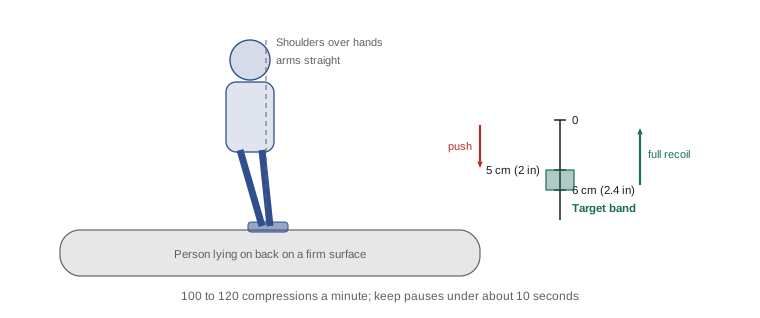
Rate: 100 to 120 per minute
Compressions that are too slow do not maintain enough pressure to move blood. Compressions that are too fast tend to become shallow, and the heart does not have time to refill between them. The target of 100 to 120 a minute is a bit under two compressions a second. Many songs have a tempo in this range, and trainers often use them as a guide; a metronome or the AED's prompts can also help. Counting aloud helps you keep a steady rhythm and lets others know where you are in the cycle.
Depth: at least 5 cm
Depth is the element bystanders most often get wrong: almost everyone pushes too gently at first. Compressing an adult chest 5 cm (2 inches) takes much more force than people expect, often the equivalent of a substantial part of your body weight. Very deep compressions beyond about 6 cm (2.4 inches) are associated with more injuries without added benefit, but in practice untrained rescuers rarely push too deep. The 2025 guidelines confirm that adults with obesity should receive compressions with the same technique and targets as other adults.
Full recoil
After each compression, release the pressure fully so the chest returns to its normal position. Leaning on the chest, even slightly, keeps pressure in the chest high, stops the heart refilling and reduces blood flow to the heart muscle. Keep your hands in contact with the chest, but take your weight off it between compressions. Leaning becomes more common as rescuers tire.
Minimizing interruptions
When compressions stop, blood pressure falls almost immediately, and it takes several compressions after restarting to build it back up. Every pause therefore costs more than its own length. Pauses happen for rescue breaths, for the AED to analyze the rhythm and deliver a shock, for switching rescuers and sometimes for no good reason at all, such as checking whether the person is breathing again. The goal is to keep pauses short, ideally under about 10 seconds, and to restart compressions immediately after a shock without waiting to check for a pulse or breathing.
Resuscitation teams measure the chest compression fraction: the proportion of the total CPR time during which compressions are actually being given. Guidelines encourage a fraction of at least 60 per cent, and well-organized teams often achieve 80 per cent or more.
Worked problem
Counting compressions and compression fraction
A rescuer gives hands-only CPR at 110 compressions a minute for 2 minutes. (a) How many compressions is that? (b) In a second scenario, rescuers giving 30:2 CPR spend 18 seconds on 30 compressions and 7 seconds on two breaths per cycle. What is the chest compression fraction? (c) Over a 10-minute resuscitation, the team also loses 60 seconds to AED analysis, a shock and switching. What is the overall compression fraction if the rest of the time follows the 30:2 pattern?
Show solution
- (a) \(110 \times 2 = 220\) compressions.
- (b) Each cycle lasts \(18 + 7 = 25\) seconds, of which 18 are compressions: \(18 \div 25 = 0.72\), or 72 per cent.
- (c) Total time is 600 seconds. Time available for cycles is \(600 - 60 = 540\) seconds. Compression time is \(540 \times 0.72 \approx 389\) seconds. Fraction: \(389 \div 600 \approx 0.65\), or 65 per cent.
Answer: (a) 220 compressions. (b) 72 per cent. (c) About 65 per cent: above the 60 per cent minimum, but shorter pauses for breaths, analysis and switching would raise it.
Fatigue and switching rescuers
Giving effective compressions is physically demanding. Studies show that compression depth starts to fall within one to two minutes, often before the rescuer notices they are tiring. For this reason, guidelines recommend that when more than one rescuer is present, they switch roles about every 2 minutes, or sooner if the rescuer is tired. AEDs analyze the rhythm about every 2 minutes, which provides a natural moment to switch. Plan the switch so it takes only a few seconds: the next rescuer kneels on the opposite side, ready, and takes over as soon as the first rescuer stops.
| Element | Adult target | Common error |
|---|---|---|
| Rate | 100 to 120 per minute | Too fast and shallow, or slowing as rescuer tires |
| Depth | At least 5 cm (2 in), not more than about 6 cm (2.4 in) | Too shallow, especially at first |
| Recoil | Full chest recoil after each compression | Leaning on the chest |
| Interruptions | As few and as short as possible; under about 10 seconds | Long pauses to check, talk or swap |
| Hand position | Heel of hand on lower half of breastbone | Hands too low (over the stomach) or on the ribs |
| Switching | About every 2 minutes when possible | One rescuer continuing until exhausted |
Will I hurt the person?
Rib fractures and bruising are common after effective CPR, especially in older adults, and you may feel or hear a crack. Do not stop: keep going with correct hand position and depth. Injuries from CPR are rarely serious, and they are far less important than restoring circulation. Studies of people who received CPR but turned out not to be in cardiac arrest have found that serious injuries are uncommon. The guidelines are clear that the benefit of CPR in someone who may be in cardiac arrest far outweighs the risk.
When to stop
Continue compressions without stopping, except for short pauses for breaths or AED analysis, until one of the following happens: the AED tells you to stand clear for analysis or a shock; trained help such as paramedics takes over; the person shows obvious signs of life, such as waking, moving purposefully, opening their eyes or breathing normally; the scene becomes unsafe; or you are too exhausted to continue and no one can take over. Do not stop CPR to check whether the person has a pulse.
Mechanical CPR devices
Some paramedic services use mechanical devices that deliver compressions automatically. The 2025 guidelines say they should not be used routinely for adult cardiac arrest, but may be considered when high-quality manual compressions are difficult or dangerous, such as in a moving ambulance or a hazardous environment, provided interruptions are kept short. They are not part of bystander CPR.
Practising compressions safely
Compressions are practised on manikins, never on a real person who is not in cardiac arrest, because full-depth compressions on a healthy person can cause injury. Feedback manikins show whether each compression reaches the target depth and rate and whether the chest is allowed to recoil. Most learners discover in their first session that they were pushing too gently or too fast, and the immediate feedback lets them correct it. Short practice sessions of a few minutes every few months, sometimes called low-dose, high-frequency training, help maintain the skill between full courses.
Compressions in awkward places
Real arrests do not always happen in open, flat spaces. A person may collapse in a narrow corridor, a washroom stall, a vehicle or between machines. If you cannot kneel beside the chest, move the person to a more open space if this can be done quickly, for example by pulling them by the clothing at the shoulders. If they cannot be moved, do the best compressions you can from the position available, including from above the head if necessary, until help arrives to move them. Do not spend long trying to find the perfect position.
Counting aloud in groups, such as "one and two and three", up to 30, helps you keep a steady rhythm and tells a partner when to switch.
Common mistakes
MistakeGiving CPR on a soft bed or sofa.
InsteadMove the person to the floor or another firm surface if you can do so quickly.
MistakePushing too gently.
InsteadPush hard: at least 5 cm (2 inches) in an adult.
MistakeLeaning on the chest between compressions.
InsteadLet the chest come all the way back up after each compression.
MistakeStopping repeatedly to check for breathing or a pulse.
InsteadKeep compressing until an AED, paramedics or obvious signs of life tell you to stop.
MistakeStopping when you feel a rib crack.
InsteadCheck your hand position and keep going; rib fractures are common and less important than circulation.
Summary and key terms
- Compressions move blood by squeezing the heart and raising pressure in the chest.
- Push in the centre of the chest at 100 to 120 compressions a minute.
- Push at least 5 cm (2 inches) deep in an adult, but not more than about 6 cm (2.4 inches).
- Let the chest recoil fully and keep interruptions short, ideally under about 10 seconds.
- Aim for a chest compression fraction of at least 60 per cent; good teams reach 80 per cent or more.
- Switch compressors about every 2 minutes because depth falls as rescuers tire.
- Rib fractures are common and are not a reason to stop.
- Chest compression
- Pushing down on the breastbone to move blood when the heart has stopped.
- Compression rate
- The number of compressions per minute; target 100 to 120.
- Compression depth
- How far the chest is pushed down; at least 5 cm (2 inches) in adults.
- Recoil
- The chest returning to its normal position between compressions.
- Leaning
- Leaving weight on the chest between compressions, which reduces blood flow.
- Chest compression fraction
- The share of CPR time during which compressions are given.
- Hands-only CPR
- CPR with compressions but no rescue breaths.
- Feedback device
- A device that measures CPR rate, depth and recoil and shows the rescuer.
- Breastbone
- The flat bone in the centre of the chest, also called the sternum.
- Mechanical CPR device
- A machine that delivers compressions automatically, used by some paramedic services.
Practice problems
Work each problem on paper first, then reveal the answer to check.
What is the target compression rate?
Show answer
100 to 120 compressions per minute.
What is the target depth for an adult?
Show answer
At least 5 cm (2 inches), not more than about 6 cm (2.4 inches).
Where do you place your hands?
Show answer
Heel of one hand on the lower half of the breastbone, other hand on top.
Why must the chest recoil fully?
Show answer
So the heart can refill with blood before the next compression.
How long should pauses in compressions be?
Show answer
As short as possible, ideally under about 10 seconds.
How often should rescuers switch?
Show answer
About every 2 minutes, or sooner if tired.
How many compressions are given in 1.5 minutes at 120 a minute?
Show answer
180.
A team compresses for 400 seconds out of a 600-second resuscitation. What is the compression fraction?
Show answer
About 67 per cent.
You feel a rib crack. What do you do?
Show answer
Check hand position and keep going.
Why should the person be on a firm surface?
Show answer
A soft surface absorbs the force and reduces compression depth.
Lesson quiz · 5 questions
Score 60% or more to complete this lesson.
Create a free account to save your progress, take quizzes and earn a certificate.