
HSE-106 · Lesson 5 of 12 · 25 min
Contamination, spills and floor cleaning
Most slips happen on floors that are perfectly safe when clean and dry. What turns them into hazards is contamination: water from rain, cleaning or processes; oil and grease; food and drink; dust, powders and sawdust; plastic film, packaging and paper; leaves and grit. Controlling contamination is therefore the single most effective way to prevent slips. This lesson covers how to stop contaminants reaching the floor in the first place, how to respond quickly when they do, and how to clean floors so that cleaning itself does not create new hazards. Chemical spill response for hazardous products, such as solvents and corrosives, is covered in other safety courses; this lesson focuses on contaminants as slip hazards.
Know your contaminants
Different contaminants affect friction in different ways. Water reduces friction on smooth floors but is less of a problem on textured ones. Oils, grease and fats are much worse: they spread into thin films that are very hard to break through, and they persist after a quick wipe. Fine dry powders such as flour, sawdust, talc, plastic pellets and some dusts act like tiny ball bearings, especially on smooth floors. Loose items such as paper, plastic film, labels, packaging straps and fruit or vegetable waste can slide underfoot. Soapy water and some cleaning chemicals are particularly slippery because they reduce surface tension and help liquid spread.
| Contaminant | Typical sources | Effect on slip risk |
|---|---|---|
| Water | Rain, snowmelt, mopping, condensation, leaks, washing | Moderate to high on smooth floors |
| Oil and grease | Kitchens, vehicle areas, machinery, food processing | Very high; films persist |
| Food and drink | Cafeterias, retail, break rooms, patient areas | High; often combined with water or fat |
| Dry powders and dust | Flour, sawdust, cement, plastic pellets, talc | High on smooth floors |
| Loose material | Plastic wrap, paper, cardboard, banding, leaves | High; can slide or tangle |
| Cleaning residues | Soap or detergent not rinsed, excessive polish | High until dry or removed |
Prevent contamination at the source
The best spill is the one that never happens. Following the hierarchy of controls, start by asking how each contaminant reaches the floor and whether that pathway can be removed or reduced.
- Fix leaks promptly: roofs, plumbing, refrigeration units, ice machines, hydraulic equipment and vehicles.
- Contain processes: use drip trays, splash guards, enclosures, lids and catch pans; route drain lines into drains, not onto floors.
- Control condensation: insulate cold pipes, ventilate humid areas and manage doors between cold and warm spaces.
- Redesign handling: use sealed containers, pumps instead of pouring, spill-proof lids for drinks and bins with liners.
- Stop tracking: use entrance matting systems and canopies to capture water and grit at doors.
- Provide drainage: slope wet-process floors to drains, keep drains clear, and use raised gratings or false floors where wet work is unavoidable.
- Plan layout: locate sinks, dishwashers, ice machines and fryers so their drips land on suitable floors, and keep walkways out of splash zones.
These engineering controls work without anyone having to remember to do something, which makes them far more reliable than relying on people to spot and clean every spill.
Entrance matting
Studies by flooring and matting manufacturers suggest that a large share of the dirt and moisture inside a building is tracked in on feet at entrances. A well-designed entrance matting system removes most of it before it reaches interior floors. A complete system usually has three zones: an exterior scraper zone outside the door to remove coarse grit and snow; a scraper-wiper zone just inside the door to remove finer dirt and moisture; and a wiper or drying zone to dry the soles. Guidance commonly recommends a total length of several metres, enough for each foot to contact the mat a few times; longer systems are needed where traffic or weather is heavy.
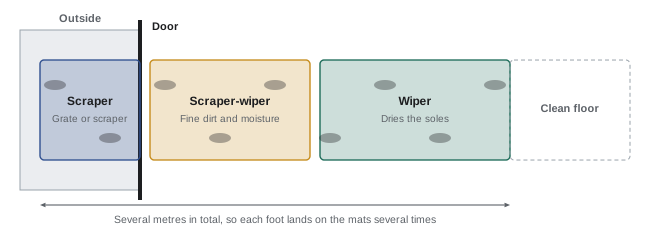
Mats themselves can become trip hazards. They must lie flat, with tapered edges that do not curl, and they must not slide on the floor. Recessed mat wells are best because the mat surface is flush with the floor. Mats should be large enough for the traffic, changed or cleaned when saturated, and replaced when worn. Never stack mats on top of each other or leave a wet mat curled at the edge. In winter, many organizations use a mat rental service that swaps saturated mats for dry ones on a schedule.
Responding to spills
Even with good prevention, spills will happen. The goal is to find them quickly, protect people from them immediately, and clean them up properly. A simple procedure everyone knows is more effective than a complicated one few people remember.
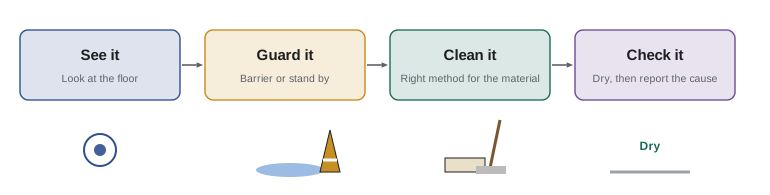
- See it: everyone is responsible for noticing spills and contamination, not only cleaners. Encourage workers to look at the floor as they walk.
- Guard it: stay with the spill or place a barrier or cone so nobody walks through it. If you must leave to get supplies, block the area first or ask someone to stand guard.
- Clean it: use the right method for the contaminant: absorbent pads or granules for oils; a mop and then a dry mop or squeegee for water; a dustpan and broom or a vacuum for powders. Pick up solids first. Do not just spread a liquid around.
- Check it: make sure the floor is dry and residue-free before removing the barrier. Report the cause if it is likely to happen again, such as a leaking machine.
Spill kits with absorbent, gloves, bags, a dustpan and cones should be placed near where spills are most likely, such as kitchens, beverage areas, workshops and loading docks. In retail and food service, some organizations use regular floor sweeps on a schedule, with each sweep recorded on a log, so that hazards are found within a defined time. These records are also important evidence if a customer later claims they slipped.
Worked problem
How often should the floor be checked?
A supermarket produce aisle has a history of spills from wet vegetables and dropped grapes. Over six months there were 3 customer falls and 14 recorded spills found during inspections. The aisle is currently checked every 2 hours. Management wants to reduce the time a spill can remain on the floor to an average of no more than 15 minutes. Assuming spills occur at random, roughly how often should the aisle be checked?
Show solution
- If checks occur every \( T \) minutes and spills occur at random times, the average time a spill waits before the next check is about \( T \div 2 \).
- Current interval: 120 minutes, so the average wait is about 60 minutes.
- Target average wait: 15 minutes, so \( T \div 2 = 15 \) and \( T = 30 \) minutes.
- Combine more frequent checks with source controls: mats and drip trays at the misting display, and bags for loose grapes.
Answer: Check about every 30 minutes, and add source controls so fewer spills occur in the first place.
Cleaning without creating hazards
Cleaning floors is essential, but wet cleaning is itself one of the most common causes of slips. Cleaners are at high risk because they work on wet floors every day, and other workers and visitors can walk onto a freshly mopped floor without realizing it is wet.
- Schedule wet cleaning for low-traffic times, such as before opening or after closing, wherever possible.
- Clean one side of a corridor at a time, so a dry path remains.
- Use barriers and wet floor signs while the floor is wet, and remove them promptly when it is dry, so that people continue to take the signs seriously.
- Use the right amount and type of cleaning chemical, diluted as the manufacturer specifies. Too much detergent leaves a slippery residue.
- Rinse where required and dry the floor with a squeegee, dry mop or floor dryer.
- Choose methods that leave less water on the floor, such as microfibre flat mops or auto-scrubbers that pick up the solution as they go.
- Degrease kitchen floors properly: hot water and a mop alone often spread grease. Use a suitable degreaser, scrub with a deck brush and rinse.
- Change mop water regularly; dirty water redeposits grease and grime.
Cleaners should wear slip-resistant footwear suited to the floors they work on, and they should be trained in the correct use of chemicals and equipment, including the hazards on the product labels and safety data sheets.
Warning signs: useful but limited
Wet floor signs warn people of a temporary hazard. They do not make the floor less slippery. Studies of pedestrian behaviour show that people often ignore signs, especially if signs are left out all day or appear when the floor is dry. A sign is most effective when it is placed only when needed, positioned so people see it before they reach the wet area, combined with a physical barrier where possible, and removed as soon as the hazard is gone. A sign must never be used as a substitute for cleaning up a spill or fixing a leak. Some organizations use retractable barriers or cones that physically block a wet area, which is more effective than a single sign.
Cleaning schedules and responsibility
A cleaning schedule specifies what is cleaned, how, how often, with what products and by whom. It should be based on the contamination each area receives: a kitchen floor may need cleaning several times a shift, while an office corridor may need it daily. Where cleaning is contracted out, the contract should specify slip-resistance outcomes, products, methods and response times for spills, and the host employer should check that the contractor's workers are trained and that their methods suit the floors. Responsibility for spills during the day must also be clear: if cleaners work only at night, who deals with a spill at noon? The answer should be everyone, with spill kits and training to match.
Contamination from people and processes
Some contamination comes from the way people work rather than from equipment. Workers carrying drinks between areas, eating at workstations, carrying wet mops or dripping parts, or walking from wash bays into dry areas spread liquids across floors. Simple rules help: lids on drinks outside break rooms, defined areas for eating, drip trays or bags for wet parts, and boot wash or drying stations between wet and dry zones. In health care, spills of body fluids need both slip control and infection control, so cleaners and staff must follow the facility's procedures for personal protective equipment and disinfection as well as drying the floor.
Measuring how well spill control works
Leading indicators help show whether spill and cleaning controls are working. Useful measures include the number of spills found during inspections in each area, the average time from a spill being reported to it being cleaned up, the percentage of spill kits fully stocked when checked, the percentage of scheduled floor checks completed on time, and the number of repeat spills from the same source. A rising count of spills from one machine is a strong signal that the source needs fixing. These numbers are easy to collect if the floor sweep log or reporting system records the location and cause of each spill.
Mats in wet work areas
In areas that are wet most of the time, such as dish rooms, food preparation areas and wash bays, drainage mats with open holes let liquid fall through so workers stand above it. These mats must be lifted and cleaned regularly, because grease and food trapped beneath them become slippery and unhygienic, and they must lie flat with tapered edges so that they do not become trip hazards themselves.
Common mistakes
MistakeRelying on cleaners to find every spill.
InsteadMake everyone responsible for spotting, guarding and reporting spills.
MistakeMopping grease with hot water only.
InsteadUse a suitable degreaser, scrub and rinse.
MistakeLeaving wet floor signs out all day.
InsteadPlace signs only while the floor is wet and remove them promptly.
MistakeUsing extra detergent for a cleaner floor.
InsteadDilute as directed; residue makes floors slippery.
MistakeCleaning spills repeatedly without fixing the source.
InsteadReport and fix leaks, drips and process problems.
Summary and key terms
- Contamination turns safe floors into slip hazards.
- Oils, grease and fine powders are especially slippery.
- Prevent contamination at the source with repairs, containment and drainage.
- A three-zone entrance matting system captures water and grit at doors.
- Spill response: see it, guard it, clean it, check it.
- Wet cleaning should keep a dry path and use methods that leave less water.
- Signs warn but do not remove the hazard; remove them when the floor is dry.
- Contamination
- Material on a floor that reduces friction.
- Drip tray
- Tray that catches leaks from equipment.
- Entrance matting system
- Series of mats that remove grit and moisture at doors.
- Scraper zone
- Outer matting zone that removes coarse dirt.
- Wiper zone
- Inner matting zone that dries soles.
- Spill kit
- Supplies for containing and cleaning spills.
- Absorbent
- Material that soaks up liquids.
- Floor sweep log
- Record of scheduled floor inspections.
- Degreaser
- Cleaning product that removes oils and fats.
- Auto-scrubber
- Machine that scrubs and picks up cleaning solution.
Practice problems
Work each problem on paper first, then reveal the answer to check.
Why are oils worse than water?
Show answer
They form persistent films that are hard to break through.
Name three ways to prevent contamination at the source.
Show answer
Fix leaks, drip trays, splash guards, drainage, matting.
What are the three zones of entrance matting?
Show answer
Scraper, scraper-wiper and wiper (drying).
What are the four steps of spill response?
Show answer
See it, guard it, clean it, check it.
If checks are every 60 minutes, how long does a random spill wait on average?
Show answer
About 30 minutes.
How can you keep a corridor usable while mopping?
Show answer
Clean one side at a time.
Why remove wet floor signs promptly?
Show answer
So people continue to take them seriously.
What problem does excess detergent cause?
Show answer
A slippery residue.
How should dry powder spills be cleaned?
Show answer
Sweep or vacuum; do not spread with a wet mop first.
Why keep floor sweep logs?
Show answer
To ensure regular checks and provide evidence for claims.
Lesson quiz · 5 questions
Score 60% or more to complete this lesson.
Create a free account to save your progress, take quizzes and earn a certificate.