
HSE-106 · Lesson 4 of 12 · 27 min
Floors, walking surfaces and slip resistance
The floor is where every slip and trip begins. A floor that is suitable for its use, correctly installed, kept in good repair and cleaned properly prevents most same-level falls before anyone needs to think about footwear or warning signs. A floor that is too smooth for wet conditions, uneven, damaged or poorly maintained creates hazards that no amount of caution will fully control. This lesson looks at the properties of walking surfaces, how slip resistance is measured, how to choose and maintain floors for different areas, and how to find and fix trip hazards such as changes in level, holes and damaged coverings.
What makes a floor slip resistant
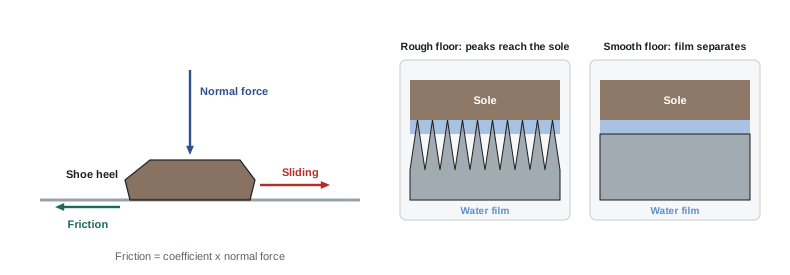
Slip resistance depends on the interaction between the floor surface, the shoe sole and anything between them. On a clean, dry floor, most common flooring materials offer more than enough friction for normal walking. The problem arises when a contaminant such as water, oil, grease, food or dust gets between the shoe and the floor. A liquid film can separate the two surfaces, like a tire hydroplaning on a wet road, and dramatically reduce friction.
Two features of a floor surface help it resist slipping when wet. The first is surface roughness at a small scale, called microroughness: tiny peaks that can break through a thin liquid film and make direct contact with the sole. The second is texture at a larger scale, called macroroughness or profile, such as grooves, studs, embossing or aggregate, which gives the liquid somewhere to go and lets the sole make contact. Smooth, glossy surfaces such as polished stone, glazed ceramic tile, sealed concrete with a high-gloss coating and vinyl with a polish build-up can look attractive but become very slippery when wet. Matte, textured and gritted surfaces generally perform better.
Roughness wears down with traffic and cleaning, and it can be filled by dirt or by polish and sealers. A floor that tested well when new may be much more slippery a few years later. This is why slip resistance should be checked over the life of a floor, not only at installation.
Static and dynamic friction
Friction is usually described by two coefficients. The static coefficient of friction (SCOF) is the ratio of the force needed to start an object sliding to the normal force. The dynamic coefficient of friction (DCOF), sometimes called kinetic friction, is the ratio of the force needed to keep it sliding. For most materials, DCOF is lower than SCOF. Modern slip resistance research favours dynamic measurements because a slip involves the foot already moving across the floor at heel strike. Older test methods and guidance often used static values, which is one reason published numbers can be confusing.
How slip resistance is measured
Several types of instruments, called tribometers or slipmeters, measure slip resistance. They work in different ways and give different numbers, so a result means little unless you know which method was used.
| Method | How it works | Notes |
|---|---|---|
| Pendulum (British pendulum) | A swinging arm with a rubber slider sweeps across the floor; the energy lost gives a pendulum test value (PTV) | Widely used in the UK, Australia and New Zealand; works on wet and dry floors in the field; PTV of 36 or more is generally considered low slip potential |
| Drag sled (horizontal pull) | A weighted sled with a test foot is pulled across the floor; the pull force divided by the weight gives a COF | Simple and portable; static versions are affected by "sticktion" on wet surfaces and are now considered unreliable for wet testing |
| Digital tribometer (e.g. BOT-3000E) | A self-propelled device drags a sensor across the floor and records the dynamic COF | Used for ANSI A326.3 testing of hard surface flooring in North America |
| Inclined plane (ramp test) | People walk on a sample that is tilted until they slip, in a laboratory | Used in German DIN standards (R ratings R9 to R13); laboratory only |
| Articulated strut and variable incidence tribometers | Measure friction at an angle simulating heel strike | Validated under ASTM F2508 against reference surfaces |
ANSI A326.3, American National Standard Test Method for Measuring Dynamic Coefficient of Friction of Hard Surface Flooring Materials, is widely used for tile and other hard flooring in North America. The 2021 revision introduced different minimum values for different conditions: 0.42 for level interior spaces expected to be walked on when dry or occasionally wet, and higher values for interior spaces that are frequently wet, exterior areas and areas exposed to oils and greases, ranging up to about 0.55. These values are for the product as tested in a laboratory with a specified test liquid; they do not guarantee performance after installation, contamination and wear. ASTM F2508 sets a procedure for validating tribometers against reference surfaces so that results can be trusted.
Canada has no national regulatory value for floor slip resistance, and Canadian OHS regulations generally require floors to be slip-resistant or free of slipping hazards without giving a number. Canadian employers and designers commonly use ANSI A326.3, the pendulum method and manufacturers' data, and the ceramic tile industry (for example the Terrazzo, Tile and Marble Association of Canada) provides guidance on DCOF testing.
Worked problem
Reading a slip resistance report
A hospital is choosing tile for a staff corridor that is mopped daily and sometimes has spills, and for a shower room that is wet most of the time. Tile A has a wet DCOF of 0.44 by ANSI A326.3. Tile B has a wet DCOF of 0.58. Field testing of the existing corridor floor gave a wet DCOF of 0.31. Which tile suits each area, and what does the field result suggest?
Show solution
- Corridor: level interior, expected to be walked on wet occasionally; the minimum is 0.42. Tile A (0.44) meets it narrowly; Tile B (0.58) gives more margin.
- Shower room: frequently wet, a higher category; Tile B (0.58) is appropriate, Tile A is not.
- Existing corridor at 0.31 wet: below the minimum, so the floor is likely slippery when wet.
- Before replacing, check for polish build-up or residue, which can lower friction; deep cleaning or a slip-resistant treatment may restore it.
Answer: Use Tile B in the shower room and preferably in the corridor; the existing corridor floor needs investigation and treatment or replacement.
Choosing floors for each area
The right floor depends on the use of the area, what contaminants are likely and how the floor will be cleaned. Designers and facility managers should think about the worst foreseeable condition, not the best. A lobby that is dry in summer may be soaked with melting snow in winter. A kitchen floor will meet grease, water and food every day.
| Area | Typical contaminants | Floor considerations |
|---|---|---|
| Offices and corridors | Occasional water, coffee, dust | Carpet or resilient flooring; avoid high-gloss finishes; plan for entrance matting |
| Entrances and lobbies | Rain, snow, slush, grit | Textured surface; recessed entrance matting systems; drainage |
| Commercial kitchens | Grease, oil, water, food | Quarry tile with grit, textured resin or similar; drains and slope; frequent degreasing |
| Washrooms and showers | Water, soap | Textured tile or sheet flooring with high wet slip resistance; drainage |
| Warehouses and loading docks | Dust, plastic wrap, oil, rain at doors | Concrete with suitable finish or coating; clear marking; dock seals and canopies |
| Food processing | Water, blood, fat, cleaning chemicals | Heavy textured resin or tile; drainage; washdown-compatible |
| Health care | Body fluids, cleaning solutions, water | Resilient flooring with good wet slip resistance; spill response |
Coatings, polishes and treatments
Floor finishes, sealers and polishes can increase or decrease slip resistance. Some high-gloss polishes leave a smooth film that is slippery when wet, while slip-resistant floor finishes include additives designed to maintain friction. Polish applied too thickly, or built up over many applications without stripping, can fill the texture of the floor. Ontario's industrial establishments regulation specifically prohibits applying a finish to floors that makes them slippery. When choosing a finish, ask the supplier for slip resistance test data, and follow the manufacturer's instructions for application and maintenance.
Several treatments can improve the slip resistance of existing floors: chemical etching of tile or stone to create microroughness, slip-resistant coatings containing grit, anti-slip tapes and strips for stair edges and ramps, and grinding or shot-blasting concrete. Each has advantages and drawbacks. Etching can make floors harder to clean, coatings wear and need renewal, and tapes can lift and become trip hazards if not maintained. Test the floor before and after treatment and keep monitoring it.
Changes in level and trip hazards
A trip happens when the toe or heel catches on something the person did not expect or did not see. Because toe clearance is so small, quite minor defects can cause trips. Common trip hazards in floors include raised edges between floor coverings, lifted tiles, cracked or heaved concrete, holes, gaps around drains and covers, loose or curled mats and carpet, thresholds, small steps that are hard to see and expansion joints.
Accessibility standards provide useful benchmarks for acceptable changes in level. A change of up to about 6 millimetres (1/4 inch) can generally be left vertical. A change between about 6 and 13 millimetres (1/4 to 1/2 inch) should be given a bevel with a slope no steeper than 1 in 2. A change of more than about 13 millimetres should be treated as a ramp or step, with suitable slope, marking and handrails. These benchmarks come from accessibility standards (such as CSA B651 in Canada and the ADA Standards in the US) and are good practice for all walking surfaces.
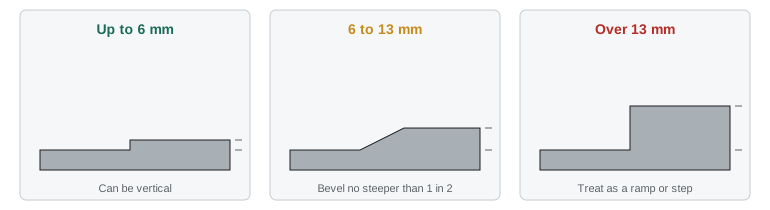
A single step, or a step of unusual height, is particularly dangerous because people do not expect it. Where a single step cannot be removed, mark its edge with a contrasting nosing strip, improve the lighting, add a handrail and consider a ramp. Abrupt changes in floor surface from high-friction to low-friction material, for example stepping from carpet onto polished tile, can also cause slips because the walker does not adjust their gait in time. Transition strips, matting and consistent materials help.
Maintaining floors
Floors need planned maintenance as well as cleaning. A maintenance program should include regular inspection for damage, wear and changes in slip resistance; prompt repair of holes, cracks, lifted tiles and loose coverings; stripping and refinishing on a schedule; replacement of worn mats and stair nosings; and periodic slip resistance testing in high-risk areas. Repairs should be made safely: guard the area, use barriers and signs, and do not leave a damaged area unprotected overnight. Repairs to floor structures should be done by competent people.
Temporary trip hazards, such as hoses, extension cords, tools and stock during deliveries, need just as much attention as permanent defects. Lessons 10 and 11 cover cords, clutter and housekeeping.
Setting up a slip resistance testing program
For sites with high-risk floors, such as hospitals, food plants, shopping centres and commercial kitchens, a simple testing program helps catch problems before they cause injuries. Choose one validated test method and stay with it so that results can be compared over time. Test new floors after installation to establish a baseline, then retest at set intervals, such as annually, and after any change in cleaning products, finishes or methods. Test in the locations where people actually walk and slip, such as entrance zones, around sinks and fryers, and along main traffic routes, and test both dry and with the contaminant most likely in that area. Record the results on a floor plan, and set trigger values that lead to action, such as deep cleaning, a change in finish or replacement.
Testing should be done by a trained person following the instrument manufacturer's procedures, because technique strongly affects results. Many flooring and cleaning suppliers offer testing services, and independent consultants can provide testing where results may be used in legal disputes.
Gratings, metal plates and special surfaces
Some walking surfaces need particular attention. Steel plates, manhole covers, drain grates, trench covers and diamond plate can become very slippery when wet, oily or icy. Serrated bar grating, perforated plank and abrasive-coated plates provide much better grip on industrial platforms and walkways. Painted lines and floor graphics on concrete can be more slippery than the surrounding surface unless a slip-resistant additive is used in the paint. Wooden decks and boardwalks grow algae and moss in damp, shaded locations and may need anti-slip strips or regular cleaning. Temporary surfaces on construction sites, such as plywood over openings, must be secured, marked and strong enough for the loads, and openings must be covered or guarded as covered in the working-at-heights course.
Buying flooring well
Most of the long-term slip performance of a floor is decided when it is specified and bought. Purchasing staff and designers should ask suppliers for slip resistance data for the intended conditions, check that the cleaning method recommended by the flooring manufacturer matches what the site can actually do, and involve the people who clean and work on the floor in the decision. Life-cycle cost, including cleaning effort and replacement, often favours a slightly more expensive surface that stays safe longer.
Common mistakes
MistakeChoosing flooring for appearance alone.
InsteadChoose for the worst foreseeable condition, including wet and greasy contamination.
MistakeComparing slip resistance numbers from different test methods.
InsteadOnly compare results from the same method and test liquid.
MistakeAssuming a floor keeps its new-floor slip resistance.
InsteadRoughness wears and fills; test periodically.
MistakeApplying more polish to make floors look better.
InsteadUse slip-resistant finishes, apply correctly and strip build-up.
MistakeIgnoring small lips and single steps.
InsteadLevel, bevel or mark changes in level following accessibility benchmarks.
Summary and key terms
- Contaminants between sole and floor cause most slips by reducing friction.
- Microroughness and texture help a floor resist slipping when wet.
- Dynamic COF is now preferred; results depend on the test method.
- ANSI A326.3 sets DCOF minimums starting at 0.42 for level interior areas.
- Choose floors for the worst foreseeable condition in each area.
- Polish build-up can make floors slippery; use suitable finishes.
- Changes in level over about 6 mm should be given a bevel or treated as a ramp or step.
- Tribometer
- Instrument that measures friction or slip resistance.
- SCOF
- Static coefficient of friction, to start sliding.
- DCOF
- Dynamic coefficient of friction, to keep sliding.
- Microroughness
- Fine surface texture that breaks through liquid films.
- Macroroughness
- Larger texture such as grooves or studs.
- Pendulum test value
- Slip resistance result from a pendulum tester.
- Contaminant
- Material between shoe and floor that reduces friction.
- Change in level
- Vertical difference in a walking surface.
- Bevel
- Sloped edge that smooths a small change in level.
- Nosing
- Front edge of a stair tread or step.
Practice problems
Work each problem on paper first, then reveal the answer to check.
Why do wet floors cause slips?
Show answer
A liquid film separates sole and floor, reducing friction.
Which is usually lower, static or dynamic COF?
Show answer
Dynamic COF.
What is the ANSI A326.3 minimum for level interior areas?
Show answer
0.42 DCOF.
Can a pendulum result be compared with a drag sled result?
Show answer
No, the methods differ.
Give two reasons a floor loses slip resistance over time.
Show answer
Wear of texture, polish or dirt build-up.
What floor features help in wet areas?
Show answer
Textured, matte surfaces, drainage.
How should a 10 mm change in level be treated?
Show answer
Bevel it at no steeper than 1 in 2.
Why is a single unexpected step dangerous?
Show answer
People do not expect it and may misstep.
Name a treatment to improve slip resistance of existing tile.
Show answer
Chemical etching, grit coating, anti-slip strips.
What standard validates tribometers?
Show answer
ASTM F2508.
Lesson quiz · 5 questions
Score 60% or more to complete this lesson.
Create a free account to save your progress, take quizzes and earn a certificate.