
HSE-106 · Lesson 8 of 12 · 25 min
Ladders and step stools
Ladders are among the most familiar tools at work and at home, and among the most misused. Falls from ladders cause many serious injuries and deaths every year, often from quite low heights: a fall of two or three metres onto a hard floor can fracture the skull, spine, pelvis or wrists. Many ladder falls happen during short, routine tasks such as changing a light bulb, reaching a high shelf, cleaning gutters or accessing a mezzanine. This lesson gives awareness-level guidance on choosing the right type of ladder, inspecting it, setting it up at the correct angle, climbing and working safely, and knowing when a ladder is the wrong tool. Workers who use ladders as part of work at height, or who need fall protection while working from ladders, need the more detailed training in the working-at-heights course.
Is a ladder the right tool?
Before using a ladder, ask whether there is a safer way to do the job. Following the hierarchy of controls, it may be possible to eliminate the need to work at height, for example by using a long-handled tool from the ground, lowering a light fixture on a winch, storing frequently used items at lower levels or installing equipment where it can be maintained from the floor. If work at height is necessary, a work platform such as a mobile elevating work platform, a rolling stair with handrails, a podium step or a scaffold provides a stable surface with guardrails and is usually safer than a ladder for tasks that take more than a few minutes or need both hands.
Ladders are generally best suited to short-duration, light work where the worker can maintain three points of contact, and as a means of access between levels. Tasks that need two hands, heavy tools or materials, a lot of force, or long periods on the ladder are better done from a platform.
Types of ladders
| Type | Description | Typical uses |
|---|---|---|
| Step stool | Short, self-supporting, usually with one to three steps | Reaching shelves and cupboards |
| Stepladder | Self-supporting, A-frame, hinged at the top | General maintenance and installation on a level floor |
| Platform ladder | Stepladder with a large standing platform and a guard rail or hand rail at the top | Longer tasks at moderate height; more stable standing position |
| Extension ladder | Non-self-supporting, two or more sections that slide to adjust length; leans against a support | Access to roofs and upper levels; work on walls |
| Straight (single) ladder | Non-self-supporting, fixed length | Access and short tasks against a support |
| Multi-position (articulating) ladder | Hinged sections that lock into several configurations | Versatile, but locks must be checked each time |
| Fixed ladder | Permanently attached to a structure | Access to roofs, tanks, pits and equipment |
Ladders are made of wood, aluminum or fibreglass. Aluminum is light and strong but conducts electricity, so it must never be used near energized electrical equipment or overhead power lines. Fibreglass is non-conductive when clean and dry and is the usual choice for electrical work. Wooden ladders are less common today and must not be painted, because paint can hide cracks and defects.
Ratings and standards
In Canada, portable ladders are covered by CSA Z11, Portable ladders, which sets design, testing and marking requirements and classifies ladders by grade according to the load they are designed to carry. Many provincial OHS regulations require ladders to meet CSA Z11 or an equivalent standard. Grades include Grade 1AA (special heavy duty, 170 kg or 375 lb), Grade 1A (extra heavy duty, 136 kg or 300 lb), Grade 1 (heavy duty, 113 kg or 250 lb), Grade 2 (medium duty, 102 kg or 225 lb) and Grade 3 (light duty, 91 kg or 200 lb). Grade 3 ladders are intended for household use and are generally not suitable for work.
The rated load includes the person, their clothing and personal equipment and any tools and materials carried. A worker weighing 95 kg (210 lb) wearing boots and a tool belt and carrying a box of fixtures can easily exceed 113 kg (250 lb). Always check the label before use.
Inspection
Inspect a ladder before each use and remove it from service if it is damaged. A quick pre-use check covers:
- Rails: no cracks, bends, splits, dents or corrosion.
- Rungs and steps: tight, not bent, cracked or missing, and free of oil, grease, mud and paint.
- Feet: slip-resistant pads or shoes present and in good condition, appropriate for the surface.
- Locks and spreaders: stepladder spreaders lock fully; extension ladder rung locks and ropes work; multi-position hinges lock.
- Labels: duty rating and instruction labels present and legible.
A damaged ladder should be tagged "Do not use" and removed from service until repaired by a competent person or destroyed. Do not try to repair a bent rail or straighten a rung.
Many provincial regulations require ladders to be inspected before use and maintained in good condition, and require defective ladders to be removed from service.
Setting up an extension ladder: the 4 to 1 rule
A leaning ladder must be set at the correct angle. Too steep and it can tip backward; too shallow and the base can slide out. The standard rule is that for every 4 units of height to the point where the ladder rests, the base should be 1 unit out from the wall. This gives an angle of about 75 degrees from the ground.
Here \( h \) is the height from the ground to the top support point and \( d \) is the distance from the base of the ladder to the wall. A simple field check is to stand at the base with your toes against the ladder feet and stretch your arms out straight: your palms should just reach the rung in front of you at shoulder height.
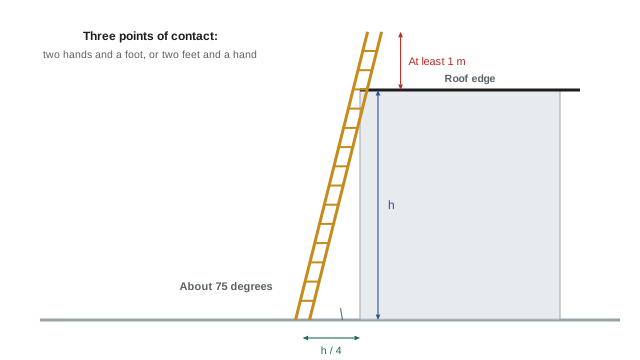
When a ladder is used to reach an upper level, such as a roof or platform, its side rails should extend at least about 1 metre (3 feet) above the landing so the worker has something to hold when stepping on and off. The ladder should be secured at the top, and at the bottom where possible, to stop it slipping or moving sideways.
Worked problem
Setting up a ladder to a roof
A maintenance worker needs to reach a flat roof whose edge is 5.2 m above the ground. They will use an extension ladder. How far from the wall should the base be, and how long must the ladder be when extended so it extends 1 m above the roof edge?
Show solution
- Base distance: \( d = 5.2 \div 4 = 1.3 \) m.
- Length to the roof edge along the ladder: \( \sqrt{5.2^2 + 1.3^2} = \sqrt{27.04 + 1.69} = \sqrt{28.73} \approx 5.36 \) m.
- Add 1 m extension above the edge: \( 5.36 + 1.0 \approx 6.4 \) m of working length.
- Extension ladders lose some length because the sections overlap, so check the manufacturer's maximum working length; a ladder sold as 7.3 m (24 ft) typically provides less than its nominal length.
Answer: Set the base about 1.3 m from the wall and use a ladder with a working length of at least about 6.4 m, secured at the top.
Setting up a stepladder
A stepladder must be fully opened with the spreaders locked, and all four feet must be on a firm, level surface. Never use a stepladder folded and leaned against a wall, because the feet are not designed for that angle and can slip. Do not stand on the top cap or the step below it unless the ladder is designed for it (manufacturer labels mark the highest standing level), and do not use the rear cross-bracing as steps unless it is a two-sided ladder designed for climbing on both sides. Position the stepladder so that you face the work and do not have to overreach.
Climbing and working safely
- Maintain three points of contact while climbing: two hands and one foot, or two feet and one hand, on the ladder at all times.
- Face the ladder when climbing up or down.
- Do not carry tools or materials in your hands while climbing; use a tool belt, a hoist line or hand them up.
- Keep your belt buckle (your centre of gravity) between the side rails; do not overreach. Get down and move the ladder instead.
- Only one person on a ladder at a time unless it is designed for more.
- Do not stand on the top three rungs of an extension ladder.
- Wear footwear with clean, slip-resistant soles; clean mud or grease off before climbing.
- Do not use a ladder in strong wind, on ice or on a slippery or unstable surface.
- Keep the area around the base clear, and barricade it or post a spotter in traffic areas or near doors. Lock or guard any door that could open into the ladder.
- Stay well away from overhead power lines; keep at least the minimum approach distance set by your jurisdiction, typically several metres, and use non-conductive ladders near electrical hazards.
Step stools and makeshift climbing
Step stools are useful for reaching shelves and cupboards, but they must be stable and rated for the load. Many falls happen when people improvise instead: standing on chairs (especially chairs with wheels or swivels), boxes, buckets, desks, shelving, forklifts, pallets or the forks of a lift truck. These are not designed to be stood on and can tip, collapse or roll. Provide step stools and platform ladders where people regularly need to reach high places, and make improvised climbing unacceptable. Storing frequently used items between knee and shoulder height reduces the need to climb at all.
Fixed ladders
Fixed ladders on buildings, tanks and equipment must meet provincial requirements for rung spacing, clearances and, above certain heights, safety cages or fall protection systems. Many provinces now prefer or require fall arrest systems such as rigid rails or cables with a sliding fall arrester instead of cages, which do not reliably stop a fall. Requirements vary, so check your regulation and consult the working-at-heights course.
Ladder storage, transport and training
Ladders are damaged more often by poor storage and transport than by use. Store ladders horizontally on racks with enough support points to prevent sagging, in a dry place away from heat and chemicals, and secure them so they cannot fall. Fibreglass degrades in sunlight over time, showing as a rough surface with exposed fibres, which reduces its electrical resistance and strength. When transporting ladders on vehicles, secure them at several points and protect them from rubbing and impact. Ladders that have been dropped, blown over or involved in a fall should be inspected by a competent person before reuse.
Workers who use ladders should be trained in selection, inspection, set-up and safe use, with hands-on practice. Training should cover the specific ladders used on site, including multi-position ladders, whose locks can be misunderstood, and should be repeated when new types of ladders are introduced or when a worker is seen using a ladder unsafely.
Ladders on uneven or soft ground
Outdoors and on construction sites, the ground under a ladder is often soft, sloping or uneven. Never prop a ladder foot on bricks, boxes or scrap. Use ladder levellers designed for the ladder, spike feet on soft ground and wide base plates where needed, and check that the ladder does not sink or rock before climbing. On slippery hard surfaces, check that the rubber feet are in good condition, and have the ladder footed by a second person or tied off where it cannot be secured at the top.
Common mistakes
MistakeUsing a household-grade ladder at work.
InsteadChoose a ladder with a duty rating suitable for the person, tools and materials.
MistakeSetting a ladder too steep or too shallow.
InsteadUse the 4 to 1 rule: base out 1 unit for every 4 units of height.
MistakeCarrying tools in your hands while climbing.
InsteadMaintain three points of contact; use a tool belt or hoist line.
MistakeStanding on a chair or box to reach a high shelf.
InsteadUse a step stool or platform ladder, or store items lower.
MistakeUsing an aluminum ladder near electrical equipment.
InsteadUse a non-conductive fibreglass ladder and keep clear of power lines.
Summary and key terms
- Consider eliminating work at height or using a platform before choosing a ladder.
- CSA Z11 grades ladders by load; Grade 1 or better suits most work.
- The rated load includes the person, clothing, tools and materials.
- Inspect ladders before each use and remove damaged ones from service.
- Set leaning ladders at 4 to 1 and extend them about 1 m (3 ft) above the landing.
- Keep three points of contact and your belt buckle between the rails.
- Never improvise with chairs, boxes or shelving; provide step stools.
- Stepladder
- Self-supporting A-frame ladder.
- Extension ladder
- Adjustable leaning ladder with sliding sections.
- Duty rating
- Maximum load a ladder is designed to carry.
- Spreader
- Brace that locks a stepladder open.
- 4 to 1 rule
- Base one unit out for every four units of height.
- Three points of contact
- Two hands and a foot, or two feet and a hand, on the ladder.
- Working length
- Usable length of an extended ladder.
- Fixed ladder
- Ladder permanently attached to a structure.
- Ladder safety system
- Rail or cable with a sliding arrester on a fixed ladder.
- Step stool
- Short, self-supporting step for reaching shelves.
Practice problems
Work each problem on paper first, then reveal the answer to check.
What should you consider before using a ladder?
Show answer
Whether the task can be done from the ground or a platform.
What does a ladder's duty rating include?
Show answer
The person, clothing, tools and materials.
A ladder rests 6 m up a wall. How far out should the base be?
Show answer
1.5 m.
What angle does the 4 to 1 rule give?
Show answer
About 75 degrees.
How far should a ladder extend above a landing?
Show answer
About 1 m (3 ft).
What are three points of contact?
Show answer
Two hands and one foot or two feet and one hand.
Why not lean a folded stepladder against a wall?
Show answer
Its feet are not designed for that and can slip.
Which ladder material suits electrical work?
Show answer
Fibreglass.
What should you do with a ladder that has a cracked rail?
Show answer
Tag it and remove it from service.
Name three things people improvise on instead of ladders.
Show answer
Chairs, boxes, buckets, desks, shelving, forks.
Lesson quiz · 5 questions
Score 60% or more to complete this lesson.
Create a free account to save your progress, take quizzes and earn a certificate.