
HSE-106 · Lesson 12 of 12 · 27 min
Investigating falls and building a prevention program
When someone slips, trips or falls, the organization has two jobs: to look after the injured person and to learn why it happened so that it does not happen again. A good investigation looks past the obvious, such as "the floor was wet" or "the worker was not watching", to the conditions and decisions that allowed the hazard to exist. This final lesson explains how to respond to a fall, how to investigate it, how to find root causes and choose effective corrective actions, and how to pull together everything in this course into a site-wide slip, trip and fall prevention program. The lesson ends with a capstone case study.
Immediate response
When someone falls, the first priority is the person. Do not rush to move them if they may have a head, neck or back injury, or a fracture. Call for first aid, and call emergency services if the injury appears serious, the person has hit their head and is confused or drowsy, cannot get up, or is in severe pain. Protect others from the same hazard by guarding the area, for example by standing by a spill or blocking off a stair. Once the person has been cared for, preserve the scene as far as practical: take photos of the floor, the lighting, the footwear and any objects involved before anything is cleaned up or moved, unless doing so would leave a danger in place.
In Canada, serious injuries may need to be reported to the OHS regulator immediately, and the scene may need to be preserved until an inspector releases it. Ontario, for example, requires the employer to notify the Ministry immediately of a critical injury or death and not disturb the scene except to save life, relieve suffering or prevent further injury. Workers' compensation boards require employers to report injuries that result in lost time or health care within a short period, typically three days, and workers must report injuries to their employer promptly.
Gathering the facts
An investigation gathers information from four main sources: people, the physical scene, records and the sequence of events.
- People: interview the injured person (when they are able), witnesses, the supervisor, cleaners and maintenance staff. Ask open questions about what they were doing, what they saw, what was different that day and what they think would have prevented it. Interview people separately and promptly, and focus on facts rather than blame.
- Scene: photograph and measure the area: the floor surface and condition, any contaminant and its source, changes in level, lighting levels, handrails, mats, cords, weather and the route taken. Note the footwear worn and its condition. Consider slip resistance testing if the floor is suspected.
- Records: check cleaning logs, floor sweep logs, inspection reports, maintenance requests, previous incidents and near misses in the same location, snow removal records, training records and footwear policy.
- Sequence: build a timeline of events leading up to the fall, including the task, the timing, staffing and anything unusual.
Finding root causes
The immediate cause of most falls is simple to state: the worker slipped on a wet floor, tripped on a cord or missed a step. The useful question is why those conditions existed and why they were not found and fixed. Two common techniques help.
The five whys technique asks "why?" repeatedly until it reaches a cause that management can act on. It is simple but works best when the investigator is open to several branches of answers rather than one chain.
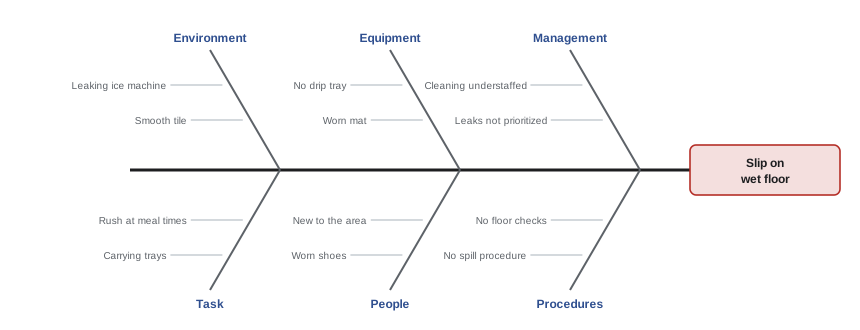
A cause category diagram, often called a fishbone or Ishikawa diagram, groups possible causes under headings such as environment, equipment, task, people, procedures and management. It encourages investigators to consider all categories rather than stopping at the first plausible cause.
Worked problem
Five whys for a slip
A dishwasher in a hospital kitchen slipped near the dish machine and sprained a wrist. Use the five whys technique to look for root causes.
Show solution
- Why did she slip? The floor near the dish machine was wet and greasy.
- Why was it wet and greasy? Water and food residue drip from racks as they are moved from the machine to the drying shelves, and a door seal on the machine leaks.
- Why do racks drip onto the floor? There is no drip tray or drainboard between the machine and the shelves, and the floor drain is two metres away.
- Why was the leaking seal not repaired? A maintenance request was submitted three weeks ago but was not prioritized because leaks were considered minor.
- Why are leaks considered minor? The maintenance priority system does not recognize slip hazards, and slip incidents in the kitchen have not been tracked.
Answer: Root causes include the layout (no drainboard), the maintenance priority system and the lack of slip incident tracking; corrective actions should address these as well as the wet floor itself.
Choosing corrective actions
Corrective actions should follow the hierarchy of controls and address the root causes, not just the immediate cause. For the dish room example, an action plan might include repairing the door seal immediately and changing the maintenance priority system so that leaks creating slip hazards are treated as urgent (organizational); installing a drainboard and drip trays between the machine and shelves and relocating or adding a floor drain (engineering); replacing the smooth tile with a high wet slip resistance floor when the area is next renovated (substitution); adding a squeegee and anti-fatigue drainage matting suitable for wet areas (engineering); confirming that dish room staff have suitable slip-resistant footwear (PPE); and tracking slip incidents and near misses in the kitchen monthly (administrative).
Each action should have an owner and a target date, and it should be followed up to confirm that it was done and that it worked. A good check is to ask: if we had done this before the incident, would it have prevented it? And could the same thing happen somewhere else? Share the lessons learned with similar areas and sites.
| Weak action | Stronger action |
|---|---|
| Remind staff to be careful | Remove the source of contamination |
| Add a wet floor sign permanently | Install drainage, drip trays or matting |
| Discipline the injured worker | Fix the conditions and systems that made the slip likely |
| Retrain everyone on walking safely | Change the task so loads do not block vision; provide carts |
| Clean the spill | Clean the spill and fix the leak, then check other units for the same fault |
Building a site prevention program
The lessons in this course fit together into a slip, trip and fall prevention program. A practical program for most sites includes:
- Leadership commitment and a named coordinator, with slip, trip and fall prevention included in the health and safety policy and objectives.
- A hazard assessment of floors, stairs, ladders, outdoor areas, lighting and tasks, using incident data, inspections and worker input.
- Floor management: suitable flooring for each area, slip resistance testing where needed, planned maintenance and prompt repairs.
- Contamination control: source controls, entrance matting, spill response procedures and kits, and cleaning methods that keep floors dry.
- A footwear policy for areas where floors are likely to be wet or greasy, with support for purchase and replacement.
- Stairs, ramps and ladders: maintained, well lit, with handrails and guards, and ladder selection, inspection and training.
- A winter maintenance plan with priority routes, triggers, materials and records.
- Lighting, cord management, storage and 5S housekeeping standards.
- Inspections, hazard and near-miss reporting, and incident investigation.
- Training for workers, supervisors, cleaners and contractors.
- Measurement and review using both leading and lagging indicators.
Capstone case study
A regional distribution centre has 260 workers across two shifts, a staff entrance and a visitor lobby, a cafeteria, a two-level office area connected by an interior stair, a racking area with order pickers, six loading docks and a large parking lot. In the past year it recorded 12 slip, trip and fall injuries in about 520,000 hours worked: five in the parking lot and at the staff entrance between December and March, three in the cafeteria, two on the office stair, one from a step stool in the stockroom and one tripping over shrink wrap in the racking area. Near-miss reporting is rare. The site manager asks you to recommend a prevention plan.
Worked problem
Capstone: analysis and plan
Calculate the slip, trip and fall injury rate, identify the main patterns and propose priority actions using the hierarchy of controls.
Show solution
- Rate: \( 12 \times 200\,000 \div 520\,000 \approx 4.6 \) slip, trip and fall injuries per 100 full-time workers.
- Pattern 1, winter: 5 of 12 injuries (about 42 per cent) were in the parking lot and staff entrance in winter. Actions: written winter plan with priority routes from parking to the staff entrance, anti-icing before storms, snow storage downhill, downspout rerouting, lighting check at shift change times, entrance matting system with winter mats, cleats for yard workers.
- Pattern 2, cafeteria: 3 injuries. Actions: find sources (ice machine, drink station, tray return), add drip trays and mats, spill kit and response procedure, check floor slip resistance and finish, scheduled floor checks at meal times.
- Pattern 3, office stair: 2 injuries. Actions: inspect for uniform risers, worn nosings and lighting; add contrasting slip-resistant nosings and a second handrail; discourage carrying files on stairs.
- Other: replace the step stool with a rated platform step and store frequently used items lower; add shrink wrap bins at picking stations and include walkways in daily 5S checks.
- Systems: introduce a QR-code hazard and near-miss reporting system, monthly committee inspections including night shift and outdoor areas, track leading indicators, and set a target to halve slip, trip and fall injuries within two years.
Answer: The rate is about 4.6 per 100 workers. Winter conditions, cafeteria contamination and the office stair account for most injuries; a plan combining source controls, a winter program, stair upgrades, housekeeping and better reporting should reduce them substantially.
Where to go from here
This course has given you awareness of the main causes and controls for slips, trips and falls on the same level, and an introduction to stairs, ladders and edges. If your work involves working at height, using fall protection equipment, working on roofs, scaffolds or elevated platforms, or supervising such work, complete the working-at-heights course and any training required by your jurisdiction. Other courses in the safety stream cover hazard recognition and risk assessment, personal protective equipment, fire safety and emergency preparedness, and incident investigation in more depth.
Communicating findings
An investigation is only valuable if its lessons reach the people who can act on them. Prepare a short report that describes what happened, the causes found and the actions agreed, without naming or blaming individuals unnecessarily. Share it with the health and safety committee or representative, the supervisors and workers in the area, and other sites with similar hazards. Brief safety talks based on real local incidents are often more memorable than generic training. Follow up publicly on the actions taken, so that workers see that reporting and investigation lead to real improvements.
Return to work
Supporting the injured worker's recovery and return to work is part of a good response. Early, regular contact, modified duties that respect medical restrictions and a gradual return plan reduce the length and cost of absences and help the worker feel valued. Workers' compensation boards and insurers in both countries encourage or require employers to cooperate in return to work. A worker returning after a fall is also a valuable source of insight into what happened and what would help, provided the conversation is supportive rather than blaming.
Common mistakes
MistakeMoving a fallen person who may have a head or spinal injury.
InsteadCall for first aid or emergency services and keep them still unless in danger.
MistakeCleaning up the scene before gathering evidence.
InsteadPhotograph and record the scene first, while keeping others safe.
MistakeStopping the investigation at "worker not careful".
InsteadAsk why repeatedly to find conditions and system causes.
MistakeChoosing reminders and signs as corrective actions.
InsteadUse stronger controls from the hierarchy and address root causes.
MistakeClosing actions without checking they worked.
InsteadFollow up and verify effectiveness, and share lessons with other areas.
Summary and key terms
- Care for the injured person first and guard the hazard.
- Report critical injuries to the regulator and claims to the compensation board on time.
- Gather facts from people, the scene, records and the sequence of events.
- Use five whys and cause category diagrams to find root causes.
- Choose corrective actions from the hierarchy of controls and verify them.
- A prevention program combines floors, contamination, footwear, stairs, ladders, winter, lighting and housekeeping.
- Measure progress with leading and lagging indicators.
- Immediate cause
- Condition or act directly leading to an incident.
- Root cause
- Underlying system cause that allowed the hazard.
- Five whys
- Technique of asking why repeatedly to reach root causes.
- Fishbone diagram
- Diagram grouping possible causes by category.
- Corrective action
- Action to prevent recurrence.
- Timeline
- Sequence of events leading to an incident.
- Witness
- Person who saw or knows about the incident.
- Scene preservation
- Keeping the incident site unchanged for investigation.
- Verification
- Checking that a corrective action was done and works.
- Prevention program
- Organized set of controls and activities to prevent falls.
Practice problems
Work each problem on paper first, then reveal the answer to check.
What is the first priority after a fall?
Show answer
The injured person.
Why photograph the scene before cleaning?
Show answer
To preserve evidence of the conditions.
Name the four sources of information in an investigation.
Show answer
People, scene, records, sequence of events.
What is the purpose of the five whys?
Show answer
To reach a root cause management can act on.
Give three fishbone categories.
Show answer
Environment, equipment, task, people, procedures, management.
Why is "remind staff to be careful" a weak action?
Show answer
It does not change the hazard.
A site has 8 falls in 400,000 hours. What is the rate?
Show answer
4.0 per 100 full-time workers.
What question tests a corrective action?
Show answer
Would it have prevented this incident?
Name five elements of a prevention program.
Show answer
Leadership, assessment, floors, contamination, footwear, stairs, winter, housekeeping, inspections, training.
Which course covers fall protection equipment in detail?
Show answer
The working-at-heights course.
Lesson quiz · 5 questions
Score 60% or more to complete this lesson.
Create a free account to save your progress, take quizzes and earn a certificate.