
HSE-106 · Lesson 6 of 12 · 25 min
Footwear, slip-resistant soles and personal factors
Footwear is the other half of the friction equation. The same floor can be safe for a worker in a suitable shoe and treacherous for a worker in a smooth leather sole or a worn-out sneaker. Footwear is personal protective equipment, which places it near the bottom of the hierarchy of controls: it does not remove the hazard and it depends on the right shoe being chosen, worn, maintained and replaced. But on floors that will inevitably be wet or greasy, such as commercial kitchens, food processing plants, washrooms and outdoor routes in winter, good footwear is an essential part of the solution. This lesson explains how soles provide grip, how slip resistance of footwear is tested and claimed, how to choose and look after footwear, and how personal factors such as fatigue, distraction and health affect fall risk.
How a sole grips
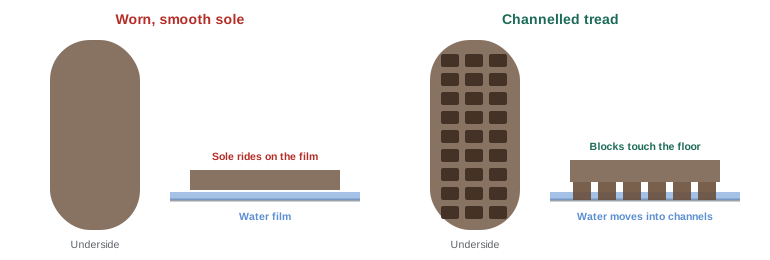
A shoe sole grips a floor in two ways. On a dry surface, adhesion between the rubber and the floor and the deformation of the rubber around small surface features both provide friction. On a wet surface, the sole needs to push the liquid out of the way so that the rubber can contact the floor. This is the same problem a car tire faces on a wet road, and the solutions are similar.
- Tread pattern: channels and grooves give liquid somewhere to go. Patterns with many small, sharp-edged elements and channels that run to the edge of the sole clear liquid well; flat, smooth soles do not.
- Sole compound: softer rubber compounds generally grip better on smooth, wet surfaces, but they wear faster. Some compounds are formulated for oil resistance, which means the sole will not swell or degrade in oil; oil resistance is not the same as slip resistance on oil.
- Contact area and heel design: a heel with a defined edge and tread at the back helps at heel strike, when most slips start. Rounded, smooth or very hard heels are poor.
- Cleanliness and wear: a tread clogged with grease, mud or food loses its ability to clear liquid, and a worn tread behaves like a smooth sole.
Testing and claims
Slip resistance of footwear is tested in laboratories by pressing a shoe onto a reference floor surface covered with a test liquid, sliding it and measuring the friction. Common methods include ASTM F2913, Standard Test Method for Measuring the Coefficient of Friction for Evaluation of Slip Performance of Footwear and Test Surfaces, and ISO 13287. European safety footwear standards use markings such as SRA, SRB and SRC (older) or SR (newer), which indicate testing on specified surfaces and liquids. The results are useful for comparing shoes under the same conditions, but they do not predict performance on every floor and contaminant.
In Canada, CSA Z195, Protective footwear, sets requirements for toe protection, sole puncture resistance, electrical properties and metatarsal protection, with markings such as the green triangle for Grade 1 toe protection with puncture-resistant sole. Slip resistance is assessed separately; some CSA-certified footwear also carries a slip-resistance claim based on test methods such as ASTM F2913. Provincial OHS regulations require protective footwear where there is a hazard of foot injury, and several regulations, such as the federal COHSR section 2.15 and Newfoundland and Labrador's, specifically mention non-slip footwear for wet floors.
Be cautious with marketing terms. A label that says "slip resistant" or "non-slip" may be based on a test, on a manufacturer's internal method or on nothing at all. Ask suppliers which test method and test surface were used, what result was achieved, and whether independent laboratories carried out the testing. Where possible, trial the shoes with workers on the actual floors and contaminants before buying in bulk.
Choosing footwear for the job
The right footwear depends on the floors, contaminants, tasks and other hazards. A hazard assessment should identify what workers will walk on and what else their feet need protection from.
| Work environment | Footwear considerations |
|---|---|
| Commercial kitchens and food service | Slip-resistant soles tested on oily or greasy surfaces; closed toe; water-resistant uppers; easy to clean |
| Health care | Slip-resistant soles; closed toe and heel; light and supportive for long shifts; cleanable |
| Food processing and wet plants | Rubber or polyurethane boots with slip-resistant tread; toe protection if needed; chemical compatibility |
| Warehousing and industry | Protective toe and sole as required; slip resistance on dusty or oily concrete; ankle support |
| Outdoor winter work | Insulated boots with deep, flexible tread; compatible ice cleats for icy surfaces |
| Offices and retail | Flat or low-heeled, closed shoes with grippy soles; avoid smooth leather soles and high heels on hard floors |
Fit and comfort matter as much as grip. Shoes that are too loose let the foot slide inside; shoes that hurt encourage workers to switch to something more comfortable and less safe. Workers who stand or walk all day need cushioning and support. Offer several models and sizes, including women's sizes and widths, and allow a trial period. High heels, open-backed shoes, flip-flops, smooth leather or plastic soles and shoes with worn-down heels should not be worn on floors where contamination is likely.
Worked problem
Choosing a footwear policy
A restaurant group had 11 kitchen slip injuries last year among 180 kitchen workers working about 330,000 hours. It is considering a policy requiring certified slip-resistant shoes, subsidized at $60 per pair per year. Published case studies of similar programs report reductions of around half in slip injuries, and the average direct cost of a kitchen slip claim is about $12,000. Estimate the current rate, the possible savings and the program cost.
Show solution
- Current rate: \( 11 \times 200\,000 \div 330\,000 \approx 6.7 \) slip injuries per 100 full-time workers.
- Possible reduction of about half: about 5 or 6 fewer injuries a year.
- Direct savings: \( 5.5 \times 12\,000 \approx 66\,000 \) dollars, before indirect costs.
- Program cost: \( 180 \times 60 = 10\,800 \) dollars a year.
- The program pays for itself many times over, but it should be combined with floor cleaning, degreasing and matting improvements.
Answer: A rate of about 6.7 per 100 workers; savings in the order of $66,000 a year against a cost of about $11,000.
Maintaining and replacing footwear
Slip-resistant soles lose their grip as they wear. Workers should inspect their footwear regularly and replace it when the tread is worn smooth, especially at the heel; when the sole is cracked, split or separating from the upper; when the tread is clogged with material that cannot be cleaned out; or when the footwear no longer fits or supports the foot. In heavy-use environments such as kitchens, slip-resistant shoes may need replacement every six to twelve months. Clean soles regularly to remove grease and debris from the tread channels.
Employers should make replacement easy: a replacement allowance, an on-site supplier, or a voucher program. A policy that requires workers to buy expensive footwear without support often leads to workers wearing worn-out shoes for too long.
Traction devices for ice and snow
On ice, even the best rubber sole provides little grip. Traction devices such as ice cleats, crampons and slip-on studs fit over footwear and provide metal spikes, studs or coils that bite into ice and packed snow. They can dramatically reduce falls for outdoor workers such as delivery drivers, postal workers, parking attendants and maintenance staff. However, they become slippery and dangerous on hard indoor floors, tile and smooth concrete, so workers must remove them before entering buildings or vehicles, or use designs with retractable studs. Lesson 9 covers winter hazards in more detail.
Personal factors
Footwear is one personal factor among several. The way a person walks, looks, feels and thinks affects their risk of slipping, tripping and falling and their ability to recover balance.
- Attention and distraction: walking while reading a phone, tablet or paperwork takes the eyes off the walking surface. Distraction is a factor in many trips and missteps, especially on stairs.
- Hurrying: rushing lengthens the stride and increases friction demand, and leaves less time to see hazards. Time pressure is often an organizational problem rather than a personal choice.
- Carrying: loads block the view of the floor and occupy the hands that might grab a handrail.
- Fatigue: long shifts, night work and physically demanding tasks slow reaction times and reduce attention.
- Vision: poor eyesight, bifocal or progressive lenses (which can blur the view of steps) and moving between bright and dark areas affect hazard detection.
- Health and medication: conditions affecting balance, joints, muscles or the inner ear, and medications that cause drowsiness or dizziness, increase risk. Alcohol and cannabis impair balance and judgement.
- Familiarity: people new to an area do not know where hazards are, but people very familiar with an area may stop noticing changes.
These factors are not a reason to blame workers. They are realities that a good fall prevention program plans for: by reducing time pressure, providing carts and trolleys so loads do not block vision, improving lighting, keeping stairs free of distractions, accommodating workers with health conditions, and designing workplaces that are forgiving of normal human limitations.
Training and culture
Training on slips, trips and falls should be practical and short. Workers need to know the hazards in their area, how to report and respond to spills, which footwear is required and why, how to use handrails and carry loads safely on stairs, and how to walk on ice. Supervisors should reinforce safe practices, model them and act quickly on reports. A culture where workers feel responsible for picking up a piece of plastic from the floor or standing by a spill until it is cleaned is one of the strongest defences against slips and trips.
Older workers and accommodation
The workforce in both Canada and the United States is getting older, and many organizations now employ people well into their sixties and seventies. Ageing brings changes that matter for falls: slower reaction times, reduced muscle strength and joint flexibility, changes in vision such as reduced contrast sensitivity and slower adaptation to darkness, and a higher chance that a fall will cause a fracture. These changes vary greatly between individuals, and older workers often compensate with experience and caution. Good fall prevention benefits everyone but especially older workers: better lighting and contrast, handrails on both sides of stairs, consistent floor surfaces, fewer single steps, and tasks that avoid climbing and carrying heavy loads.
Workers with temporary or permanent conditions that affect balance or mobility, such as pregnancy, recovery from injury, inner ear disorders or the side effects of medication, may need accommodation, such as reassignment away from ladders or wet floors, or extra rest breaks. Employers have legal duties to accommodate disabilities under human rights or disability law, and a confidential process for workers to request changes is part of a good program.
Visitors, contractors and the public
Footwear policies usually apply only to employees, but visitors, contractors, patients and customers walk the same floors. This is one more reason why floor controls, cleaning and matting must do most of the work. Where visitors enter high-risk areas, such as a commercial kitchen or a production floor, site rules can require suitable footwear or provide overshoes with slip-resistant soles, and escorts can steer them along safe routes.
Footwear programs work best when they are explained, not just imposed. Tell workers why the footwear is needed, which floors and contaminants it is chosen for, and how to tell when it needs replacing, and listen to complaints about comfort, which often signal that a different model is needed.
Common mistakes
MistakeAssuming "oil resistant" means "slip resistant on oil".
InsteadOil resistance concerns the sole material; check slip test data separately.
MistakeBuying footwear based only on a marketing label.
InsteadAsk for the test method and results, and trial footwear on real floors.
MistakeWearing slip-resistant shoes until they fall apart.
InsteadReplace them when the tread, especially the heel, wears smooth.
MistakeWearing ice cleats indoors.
InsteadRemove cleats before walking on hard indoor floors.
MistakeTreating personal factors as blame.
InsteadDesign work to reduce hurrying, carrying and distraction.
Summary and key terms
- Footwear is PPE: essential on wet or greasy floors but not a substitute for floor controls.
- Tread channels clear liquid; soft compounds grip smooth wet floors.
- Footwear slip resistance is tested by methods such as ASTM F2913 and ISO 13287.
- CSA Z195 covers protective features; slip resistance is assessed separately.
- Fit, comfort and replacement are part of an effective footwear program.
- Ice cleats work outdoors on ice but are dangerous on hard indoor floors.
- Distraction, hurrying, carrying, fatigue, vision and health all affect fall risk.
- Tread pattern
- Arrangement of grooves and blocks on a sole.
- Sole compound
- Rubber or polymer material of the sole.
- Oil resistant
- Sole material that resists degradation by oil.
- Slip-resistant footwear
- Footwear tested to provide grip on contaminated surfaces.
- ASTM F2913
- Test method for slip performance of footwear.
- Traction device
- Cleat or stud attachment for walking on ice.
- Heel strike
- Moment the heel contacts the floor, when slips often start.
- Hazard assessment
- Evaluation of hazards to select controls and PPE.
- Distraction
- Diversion of attention from the walking surface.
- Replacement allowance
- Employer funding for regular footwear replacement.
Practice problems
Work each problem on paper first, then reveal the answer to check.
What does a tread pattern do on a wet floor?
Show answer
Channels liquid away so the sole contacts the floor.
Is oil resistance the same as slip resistance on oil?
Show answer
No.
Name a test method for footwear slip resistance.
Show answer
ASTM F2913 or ISO 13287.
When should slip-resistant shoes be replaced?
Show answer
When the tread, especially the heel, is worn smooth or the sole is damaged.
Where should ice cleats not be worn?
Show answer
On hard indoor floors.
Name three personal factors in falls.
Show answer
Distraction, hurrying, carrying, fatigue, vision, health.
Why trial footwear before buying in bulk?
Show answer
To check grip, fit and comfort on the actual floors.
What footwear features suit a commercial kitchen?
Show answer
Slip-resistant soles tested on grease, closed toe, cleanable.
Why do bifocal lenses matter on stairs?
Show answer
They can blur the view of the steps.
How can an employer support a footwear policy?
Show answer
Subsidies, replacement allowances, choice of models and sizes.
Lesson quiz · 5 questions
Score 60% or more to complete this lesson.
Create a free account to save your progress, take quizzes and earn a certificate.