
HSE-102 · Lesson 2 of 12 · 25 min
The GHS and the WHMIS legal framework
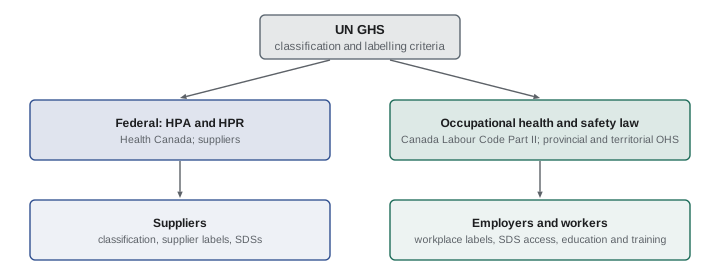
WHMIS is not a single law. It is a system created by a combination of federal legislation that controls suppliers and federal, provincial and territorial occupational health and safety legislation that controls employers and workers. Understanding this structure explains why the rules for labels and safety data sheets are the same everywhere in Canada, while the details of worker education, workplace labels and enforcement can vary between jurisdictions. This lesson explains the Globally Harmonized System on which WHMIS is based, the federal Hazardous Products Act and Hazardous Products Regulations, the role of federal, provincial and territorial OHS laws, recent amendments, confidential business information, enforcement and where to find authoritative information.
The structure of the GHS
The Globally Harmonized System, published by the United Nations and revised every two years, has three main parts. First, it sets criteria for classifying chemicals into hazard classes and categories: physical hazards such as flammable liquids and gases under pressure, health hazards such as acute toxicity and carcinogenicity, and environmental hazards such as hazards to the aquatic environment. Second, it sets standard elements for communicating hazards on labels: pictograms, signal words, hazard statements and precautionary statements. Third, it sets a standard 16-section format for safety data sheets. The GHS is often described as a "building block" approach, because countries can choose which hazard classes and categories to adopt for each sector, such as workplaces, consumer products, transport and pesticides. This explains why the GHS version adopted for workplaces in one country may differ slightly from another country's or from the transport rules.
| GHS element | What it standardizes |
|---|---|
| Classification criteria | How to decide whether a chemical is hazardous, and how severe |
| Hazard classes and categories | Types of hazard, divided by severity (Category 1 is most severe) |
| Label elements | Pictograms, signal words, hazard statements, precautionary statements |
| Safety data sheet format | 16 sections in a fixed order |
| Building blocks | Countries choose which classes and categories to adopt |
Hazard classes and categories
In the GHS, a hazard class describes the type of hazard, such as flammable liquids, acute toxicity or skin corrosion/irritation. Each class is divided into categories, numbered from 1 for the most severe, and sometimes subcategories such as 1A and 1B. For example, a flammable liquid with a very low flash point and boiling point is Category 1, and one with a higher flash point is Category 3 or 4. The category determines which pictogram, signal word and hazard statement go on the label. Importantly, in the GHS the lower number means the greater hazard, which is the opposite of some older systems and of some other rating schemes, such as the NFPA 704 diamond, where 4 is the most severe. This difference is a common source of confusion, which Lesson 7 returns to.
WHMIS: federal legislation for suppliers
The federal Hazardous Products Act (HPA) and the Hazardous Products Regulations (HPR), administered by Health Canada, set the rules for suppliers. A supplier is a person who, in the course of business, sells or imports a hazardous product. Suppliers must classify each product they sell or import for use in Canadian workplaces according to the criteria in the HPR, which are based on the GHS. If the product is hazardous, they must provide a supplier label and an SDS that meet the HPR's content and format requirements, in both English and French. Health Canada enforces these requirements through inspections, sampling and compliance actions. Because supplier rules are federal, a supplier label or SDS that meets the HPR is valid in every province and territory.
WHMIS: occupational health and safety legislation for employers
The requirements for employers, such as workplace labels, SDS availability, worker education and training and the control of hazardous products, are set by occupational health and safety legislation. Federally regulated workplaces, such as banks, airlines, interprovincial transport, telecommunications and federal government departments, follow Part II of the Canada Labour Code and the Canada Occupational Health and Safety Regulations. All other workplaces follow the OHS act and WHMIS regulations of their province or territory, such as Ontario's Regulation 860, Alberta's OHS Code Part 29, British Columbia's OHS Regulation Part 5 and Quebec's Regulation respecting information on hazardous products. These laws are broadly consistent because they are coordinated through intergovernmental agreements, but details vary, for example in how often training must be reviewed and in specific requirements for workplace labels and laboratory samples. Provincial and territorial OHS inspectors enforce employer WHMIS duties, and labour inspectors enforce them in federally regulated workplaces.
Updates and alignment with GHS revisions
WHMIS 2015 came into force on February 11, 2015, replacing the original WHMIS 1988 system with GHS-based classification, labels and SDSs, with a transition period that ended on December 1, 2018. Health Canada later amended the Hazardous Products Regulations to align with the seventh revised edition of the GHS and some provisions of the eighth. The amendments came into force on December 15, 2022, and were published in the Canada Gazette, Part II, on January 4, 2023, with a three-year transition period that ended on December 14, 2025. They added a new physical hazard class for chemicals under pressure; renamed the flammable aerosols class to aerosols and added a Category 3 for non-flammable aerosols; divided flammable gases Category 1 into subcategories 1A and 1B and repealed the separate pyrophoric gases class, moving those gases into flammable gases Category 1A; and changed several SDS and label information requirements, including rules on disclosing ingredient concentrations as ranges. Since the transition ended, supplier labels and SDSs must meet the amended requirements.
| Date | Milestone |
|---|---|
| October 31, 1988 | Original WHMIS comes into force |
| February 11, 2015 | WHMIS 2015 (GHS-based) comes into force |
| December 1, 2018 | Transition to WHMIS 2015 complete |
| December 15, 2022 | HPR amendments (GHS Rev. 7, part of Rev. 8) in force |
| December 14, 2025 | Transition to amended HPR ends |
Confidential business information
Suppliers may want to protect the identity or concentration of an ingredient as confidential business information. Under the Hazardous Materials Information Review Act, a supplier or employer can file a claim with Health Canada for an exemption from disclosing certain information on the SDS or label, such as the chemical name or exact concentration of an ingredient. Health Canada reviews the claim and the accuracy of the SDS, and the claim registry number must appear on the SDS. Even when information is protected, the SDS must still disclose the hazards and safe handling information, and health professionals can obtain confidential information in emergencies. Since the 2022 amendments, suppliers can also disclose concentrations as prescribed ranges without filing a claim.
Enforcement and penalties
Health Canada inspectors verify that suppliers comply with the HPA and HPR, and can order corrective action, stop sales or prosecute. Provincial, territorial and federal OHS inspectors check employer compliance during workplace inspections and investigations, and can issue orders, stop-work orders and, in some jurisdictions, administrative penalties or tickets; serious violations can lead to prosecution with significant fines. WHMIS deficiencies, such as missing labels, outdated SDSs and lack of worker education, are among the most common orders issued by OHS inspectors.
Where to find authoritative information
Reliable sources include Health Canada's WHMIS pages and technical guidance on the HPR; the WHMIS.org portal, maintained by federal, provincial and territorial governments; the Canadian Centre for Occupational Health and Safety (CCOHS), which publishes fact sheets, an OSH Answers service and free and paid courses; your provincial or territorial OHS regulator; and the Canada Labour Code and its regulations for federal workplaces. When questions arise about a specific product, the supplier is usually the best source, through the emergency and contact details on the SDS.
Worked problem
Which rules apply?
A company manufactures industrial cleaners in Ontario, sells them to customers across Canada, and also has a warehouse in Manitoba and an office in a federally regulated bank building. Which WHMIS rules apply to each activity?
Show solution
- As a supplier selling hazardous products, the company must meet the federal HPA and HPR for classification, supplier labels and SDSs, valid everywhere in Canada.
- At its Ontario factory, it must also meet Ontario's OHS Act and Regulation 860 as an employer.
- At the Manitoba warehouse, it follows Manitoba's OHS legislation and WHMIS rules as an employer.
- If the company itself occupied federally regulated premises, the Canada Labour Code would apply there; a provincially regulated business renting office space in a bank building is still provincially regulated.
Answer: Federal HPR for supplier labels and SDSs everywhere; provincial OHS rules for each workplace as an employer.
Why harmonization helps workers
Harmonization brings practical benefits on the shop floor. A worker who moves between employers, or between Canada and the United States, sees the same pictograms, signal words and SDS layout everywhere. Products imported from Europe, Asia and elsewhere increasingly arrive with GHS-based labels and SDSs, though they must still meet the specific national requirements. Training materials can be shared and updated more easily. And because classification criteria are common, the same product should receive the same classification no matter who prepares the SDS, making comparisons between products more reliable. In practice, differences remain between countries in which categories are adopted, in specific label and SDS details, and in language requirements, so suppliers must still prepare country-specific versions.
Regulatory cooperation between Canada and the United States
Canada and the United States have worked together through a Regulatory Cooperation Council to align their workplace chemical rules, so that, as far as possible, a single label and SDS can meet both countries' requirements. Health Canada publishes a list of the remaining variances between the Hazardous Products Regulations and the Hazard Communication Standard, such as Canada's bilingual requirement, Canada's biohazardous infectious materials class, differences in how confidential business information is handled and some differences in classification criteria and label elements. For workers, the practical message is that labels and SDSs from either country look very similar, but they are not always interchangeable without review.
The life cycle of hazard information
It helps to picture how hazard information flows. A manufacturer develops or obtains data on a chemical, classifies it, and writes the label and SDS. Distributors pass these along. The employer receives the product, checks the label and SDS, adds the product to the inventory, decides on controls, trains workers and labels any containers it fills. Workers read labels, use the SDS and follow procedures. When new data appear, such as a study showing a new health effect, the information flows back down the chain through updated SDSs, labels and training. Each link in the chain must work for the system to protect people.
What changes for workers when rules are updated
When classification rules change, workers may notice new pictograms or hazard statements on familiar products, revised SDSs with different section 2 information, or changed PPE recommendations. These changes do not necessarily mean the product itself has changed; they may reflect new criteria or new data. Employers should explain significant changes in training, update workplace labels and procedures, and replace old SDSs. If you notice that a label or SDS has changed, read it carefully rather than assuming it says the same thing as before, and ask your supervisor what the change means for your work.
Hazard communication beyond the law
Legal requirements set the minimum. Many organizations go further: choosing products with fewer hazards, publishing plain-language summaries, translating information into the languages their workers speak, adding hazard information to work instructions, and involving workers in reviewing new products. These practices make hazard communication more effective and often reduce incidents and costs.
Thinking about jurisdiction at your workplace
To apply the legal framework, ask three questions about your own workplace: Which occupational health and safety law applies to my employer? Who supplies the hazardous products we use, and do their labels and SDSs meet national requirements? Where can I find my jurisdiction's guidance on hazard communication? Your supervisor, safety committee or the regulator's website can answer these questions, and knowing the answers helps you understand which rules your training is based on.
Common mistakes
MistakeAssuming the GHS is itself a law.
InsteadRemember each country adopts it through its own legislation.
MistakeConfusing GHS categories with NFPA ratings.
InsteadIn the GHS, Category 1 is the most severe.
MistakeThinking provincial rules change supplier labels.
InsteadSupplier rules are federal; employer rules are provincial, territorial or federal OHS.
MistakeIgnoring rule updates and transition dates.
InsteadMake sure labels, SDSs and training reflect current requirements.
MistakeTreating withheld ingredient information as hiding hazards.
InsteadHazards and precautions must still be disclosed.
Summary and key terms
- The GHS sets classification criteria, label elements and the SDS format.
- Hazard classes are divided into categories; Category 1 is most severe.
- The federal HPA and HPR govern suppliers; OHS laws govern employers.
- Federal, provincial and territorial OHS laws set workplace WHMIS duties.
- HPR amendments aligned with GHS Rev. 7; the transition ended December 14, 2025.
- Confidential business information claims go to Health Canada.
- Regulators enforce requirements, and authoritative guidance is freely available.
- Hazard class
- Type of physical, health or environmental hazard.
- Hazard category
- Severity level within a hazard class.
- Building block approach
- Countries choosing which GHS elements to adopt.
- Supplier
- Person who sells or imports hazardous products.
- HPA
- Hazardous Products Act (Canada).
- HPR
- Hazardous Products Regulations (Canada).
- HCS
- Hazard Communication Standard (United States).
- State plan
- OSHA-approved state occupational safety program.
- Confidential business information
- Protected ingredient identity or concentration.
- Transition period
- Time allowed to change to new requirements.
Practice problems
Work each problem on paper first, then reveal the answer to check.
Name the three main parts of the GHS.
Show answer
Classification criteria, label elements, SDS format.
In the GHS, which category is most severe?
Show answer
Category 1.
What does the building block approach allow?
Show answer
Countries choose which classes and categories to adopt.
Who administers the HPA and HPR?
Show answer
Health Canada.
Which law covers WHMIS in federally regulated workplaces?
Show answer
Canada Labour Code Part II and the COHSR.
When did WHMIS 2015 come into force?
Show answer
February 11, 2015.
When did the transition to the amended HPR end?
Show answer
December 14, 2025.
Name one new hazard category added in recent updates.
Show answer
Flammable gases 1A/1B, non-flammable aerosols Category 3, chemicals under pressure or desensitized explosives.
Must hazards be disclosed when an ingredient is confidential?
Show answer
Yes.
Name an authoritative information source.
Show answer
Health Canada, WHMIS.org, CCOHS, the provincial OHS regulator.
Lesson quiz · 5 questions
Score 60% or more to complete this lesson.
Create a free account to save your progress, take quizzes and earn a certificate.