
HSE-102 · Lesson 3 of 12 · 28 min
Physical hazard classes
Physical hazards arise from a product's physical and chemical properties: its tendency to burn, explode, react, release pressure or corrode. Physical hazards cause many of the most dramatic workplace incidents, such as flash fires from solvent vapour, explosions of dust or gas, and cylinders that become projectiles. Classification tells you not only that a product has a physical hazard, but how severe it is, which determines the label and the precautions. This lesson explains the main physical hazard classes, their categories and the properties that define them, such as flash point, and how to use classification information to choose safe handling and storage.
How physical hazards are classified
Under the Hazardous Products Regulations, a supplier classifies a product by comparing its properties, usually measured by standard tests, with the criteria for each physical hazard class in Part 7 of the HPR. If the product meets the criteria for a class, it is assigned to the appropriate category. A product can belong to several classes; for example, a solvent can be both a flammable liquid and a health hazard. WHMIS includes most GHS physical hazard classes, plus a WHMIS-specific class, physical hazards not otherwise classified, for hazards that do not fit the other classes but can cause serious injury or death, such as products that react with water to release a toxic gas.
The physical hazard classes
| Hazard class | What it means | Example |
|---|---|---|
| Flammable gases | Gases that ignite in air (Categories 1A, 1B, 2) | Propane, hydrogen, acetylene |
| Aerosols | Pressurized spray products (Categories 1–3; 3 is non-flammable) | Spray paint, lubricant sprays |
| Oxidizing gases | Gases that cause or intensify fire | Oxygen, nitrous oxide |
| Gases under pressure | Compressed, liquefied, refrigerated or dissolved gases in containers | Nitrogen, carbon dioxide, refrigerants |
| Chemicals under pressure | Liquids or solids pressurized with gas, not aerosols | Some pressurized coatings and cleaners |
| Flammable liquids | Liquids with flash point up to 93 °C (Categories 1–4) | Gasoline, acetone, diesel |
| Flammable solids | Solids that ignite easily or worsen fire through friction | Magnesium powder, matches |
| Self-reactive substances and mixtures | Thermally unstable; may decompose violently | Some blowing agents |
| Pyrophoric liquids and solids | Ignite within five minutes of contact with air | Some organometallics |
| Self-heating substances and mixtures | Heat up on their own in air | Oily rags, activated charcoal |
| Substances that emit flammable gas on contact with water | Release flammable gas with water | Calcium carbide, sodium |
| Oxidizing liquids and solids | Cause or intensify fire by releasing oxygen | Hydrogen peroxide, nitrates |
| Organic peroxides | Unstable oxidizers that may explode or burn rapidly | Benzoyl peroxide, MEKP |
| Corrosive to metals | Damage or destroy metals | Hydrochloric acid |
| Combustible dusts | Fine particles that can explode when dispersed | Flour, sugar, wood, metal dusts |
| Simple asphyxiants | Displace oxygen | Nitrogen, argon, helium |
| Physical hazards not otherwise classified | Other serious physical hazards | Water-reactive toxic gas release |
Flammable liquids and flash point
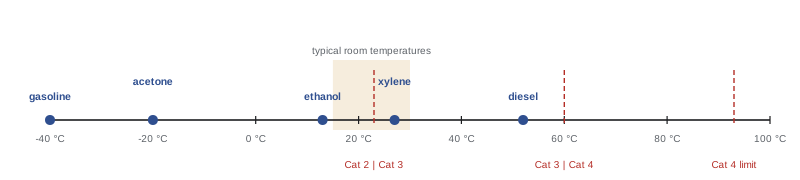
Flammable liquids are among the most common hazardous products in workplaces. What burns is not the liquid itself but the vapour above it, mixed with air. The flash point is the lowest temperature at which a liquid gives off enough vapour to form an ignitable mixture with air near its surface. A liquid with a flash point below room temperature, such as gasoline (around −40 °C) or acetone (about −20 °C), produces ignitable vapour at all normal working temperatures; one with a high flash point, such as diesel (above about 52 °C), needs to be heated before its vapour can ignite. The initial boiling point also matters, because liquids with low boiling points evaporate quickly. The GHS uses both to assign categories:
| Category | Criteria | Signal word | Example |
|---|---|---|---|
| 1 | Flash point below 23 °C and initial boiling point at or below 35 °C | Danger | Diethyl ether |
| 2 | Flash point below 23 °C and initial boiling point above 35 °C | Danger | Acetone, gasoline, ethanol |
| 3 | Flash point from 23 °C to 60 °C | Warning | Diesel fuel, some kerosenes, xylene |
| 4 | Flash point above 60 °C up to 93 °C | Warning (no pictogram) | Some heating oils |
Other important properties include the lower and upper flammable (explosive) limits, the range of vapour concentrations in air that can burn: below the lower limit the mixture is too lean, above the upper limit too rich. For gasoline, the range is roughly 1.4 % to 7.6 % by volume. The autoignition temperature is the temperature at which the vapour ignites without a spark or flame, important near hot surfaces. Vapour density compared with air indicates whether vapours sink and collect in low areas such as pits and drains, as most solvent vapours do, or rise.
Worked problem
Classifying a solvent
A cleaning solvent has a flash point of 15 °C and an initial boiling point of 78 °C. Which flammable liquid category applies, and what does this mean for use at a workshop temperature of 20 °C?
Show solution
- The flash point is below 23 °C and the boiling point is above 35 °C, so it is Category 2.
- The label will carry the flame pictogram, the signal word Danger and the hazard statement "Highly flammable liquid and vapour".
- At 20 °C, the liquid is above its flash point, so it gives off ignitable vapour at normal working temperatures.
- Keep containers closed, eliminate ignition sources, ventilate, bond and ground during transfer, and store in a flammables cabinet.
Answer: Category 2: highly flammable, producing ignitable vapour at room temperature, so ignition control and ventilation are essential.
Gases under pressure and chemicals under pressure
Gas cylinders hold gases at high pressure: a typical industrial cylinder of nitrogen or argon may be filled to about 15 to 20 megapascals (2,200 to 3,000 psi). If a cylinder valve breaks off, the escaping gas can turn the cylinder into a projectile capable of penetrating walls. Liquefied gases such as propane and carbon dioxide are stored as liquids under pressure and expand enormously when released: one litre of liquid propane produces about 270 litres of gas. Refrigerated liquefied gases, such as liquid nitrogen at −196 °C, cause severe cold burns and can displace oxygen rapidly when they evaporate. The gas cylinder pictogram warns of these pressure hazards, which are in addition to any flammability, toxicity or oxidizing hazards of the gas itself. Chemicals under pressure, a newer class, cover liquids and solids packaged under pressure with a gas that are not aerosols, which can spray forcefully or rupture.
Oxidizers and organic peroxides
Oxidizers do not necessarily burn themselves, but they supply oxygen that makes other materials burn more intensely, or ignite materials that would not normally burn. Examples include oxygen, nitrous oxide, hydrogen peroxide at higher concentrations, nitrates, chlorates, perchlorates and pool chlorine products. Storing oxidizers next to flammable or combustible materials, such as solvents, oils, wood, paper and cloth, can turn a small fire into a large one or cause spontaneous ignition. Oxygen-enriched atmospheres, for example near leaking oxygen cylinders, make clothing and hair burn fiercely. Organic peroxides combine fuel and oxidizer in one molecule and are thermally unstable; some must be kept refrigerated to prevent violent decomposition, and their SDSs specify a self-accelerating decomposition temperature (SADT) above which they become dangerous.
Reactive, pyrophoric and self-heating materials
Some materials react dangerously on their own or with air or water. Pyrophoric materials ignite within minutes of exposure to air, and must be handled under inert gas. Self-heating materials, such as rags soaked with linseed oil or oil-based stains, can generate enough heat as they oxidize to ignite spontaneously, which is why oily rags must be stored in approved, closed metal containers or laid flat to dry outdoors according to the product instructions. Water-reactive materials, such as sodium, calcium carbide and some metal hydrides, release flammable gases when wet; firefighting with water can make such fires worse. Self-reactive materials can decompose explosively when heated. These hazards are less common in most workplaces but can be catastrophic, so their SDSs require careful attention.
Combustible dust
Many solids that are not hazardous in bulk become explosive as fine dust dispersed in air: flour, sugar, grain, wood, plastics, coal, aluminium, magnesium and many pharmaceuticals and chemicals. A combustible dust explosion needs fuel (dust), oxygen, an ignition source, dispersion and confinement, sometimes called the dust explosion pentagon. A small primary explosion often shakes accumulated dust from beams and ledges into the air, causing a much larger secondary explosion. Major incidents, such as the 2008 sugar refinery explosion in Georgia, United States, which killed 14 workers, show the consequences. Controls include housekeeping to prevent accumulation, dust collection, controlling ignition sources, and explosion venting or suppression. Products that can form combustible dust during processing, such as by cutting or grinding, may carry the hazard statement "May form combustible dust concentrations in air".
Simple asphyxiants
Simple asphyxiants, such as nitrogen, argon, helium and carbon dioxide at high concentrations, are not toxic in the usual sense, but they displace oxygen. Normal air contains about 20.9 % oxygen; below about 19.5 %, many jurisdictions consider the atmosphere oxygen-deficient, and below about 10 %, people can lose consciousness within seconds without warning, because the body does not sense lack of oxygen. Asphyxiation in confined spaces, such as tanks, pits and rooms where inert gases are used or stored, has killed many workers and would-be rescuers. Gas detection, ventilation, confined space procedures and never entering to rescue without proper equipment save lives.
Worked problem
Oxygen displacement in a small room
A cylinder releases 3 cubic metres of nitrogen into a closed storage room of 15 cubic metres. Estimate the resulting oxygen concentration, assuming the gas mixes evenly and air is displaced.
Show solution
- Fraction of the room replaced by nitrogen: \(3/15 = 0.2\).
- Oxygen remaining: \(20.9 \times (1 - 0.2) \approx 16.7\,\%\).
- This is below 19.5 %, so the atmosphere is oxygen-deficient and dangerous; in reality the gas may concentrate in low areas, making it worse.
Answer: About 16.7 % oxygen: oxygen-deficient and dangerous, requiring ventilation and gas testing before entry.
Using classification information
Physical hazard classification guides practical decisions: which products need flammables cabinets or ventilated storage; which must be separated from each other; where ignition sources must be controlled; which areas need gas detection; how much may be stored in a work area under fire codes; and what firefighting methods are appropriate. Classification information appears on labels, in SDS section 2, and in detail in section 9 (physical and chemical properties) and section 10 (stability and reactivity). Lesson 11 covers storage and compatibility in practice.
Static electricity and ignition sources
Many fires involving flammable liquids start not from obvious flames but from static electricity. Liquids flowing through pipes, hoses and filters, or being poured or sprayed, can build up electrical charge, as can people walking on insulating floors or wearing synthetic clothing. A static discharge of only a fraction of a millijoule can ignite many solvent vapours, far less energy than a person can feel. This is why bonding and grounding, conductive containers and floors, and slow filling rates are standard precautions when handling flammable liquids. Other ignition sources include open flames, welding and cutting, hot surfaces such as heaters and engine exhausts, sparks from tools and electrical equipment, and chemical reactions that produce heat. In areas where flammable vapours may be present, electrical equipment must be rated for hazardous locations.
Hot work and confined spaces
Two activities deserve special mention because they combine physical hazards in dangerous ways. Hot work, such as welding, cutting and grinding, can ignite flammable vapours, residues in containers and combustible dust, sometimes long after the work has stopped, which is why hot work permits, fire watches and gas testing are required. Confined spaces, such as tanks, vessels, pits and silos, can accumulate flammable vapours, toxic gases and oxygen-deficient atmospheres, and are covered by separate regulations requiring atmospheric testing, ventilation, permits and rescue plans. Hazard communication information, especially SDS sections 2, 9 and 10, is a key input to planning both activities.
Classification and quantity
Classification does not depend on quantity: a small bottle of a Category 1 flammable liquid has the same classification as a drum of it. However, the consequences of an incident and the controls required increase with the amount stored and used. Fire codes, for example, set maximum quantities for work areas and require special rooms for larger amounts. When planning work, consider both the classification and how much of the product is present.
Physical hazards and everyday products
Many everyday products have physical hazards. Aerosol cans of lubricant, paint and cleaner are pressurized and usually flammable; they can burst if heated, for example in a hot vehicle, and must never be punctured or incinerated. Hand sanitizers based on alcohol are flammable liquids. Pool chemicals are often strong oxidizers. Batteries can release hydrogen gas while charging. Recognizing these hazards in common products helps prevent incidents at work and at home.
Reading physical hazard information on the SDS
Physical hazard information is spread across several SDS sections: section 2 gives the classification, section 5 explains fire hazards and suitable extinguishing media, section 7 gives handling and storage precautions, section 9 gives properties such as flash point and vapour pressure, and section 10 describes reactivity and incompatibilities. Reading these sections together gives a complete picture.
Common mistakes
MistakeTreating diesel and gasoline as equally hazardous.
InsteadCompare flash points; gasoline gives off ignitable vapour far below room temperature.
MistakeStoring oxidizers next to flammables.
InsteadSeparate them according to compatibility.
MistakeLeaving oily rags in a pile.
InsteadUse approved closed metal containers.
MistakeAssuming inert gases are harmless.
InsteadRecognize oxygen displacement and test the atmosphere.
MistakeLetting dust accumulate on ledges.
InsteadControl combustible dust with housekeeping and collection.
Summary and key terms
- Physical hazards come from a product's physical and chemical properties.
- Products are classified into classes and categories by standard criteria.
- Flash point and boiling point set flammable liquid categories 1 to 4.
- Gases under pressure can become projectiles and displace oxygen.
- Oxidizers intensify fires; organic peroxides are unstable.
- Pyrophoric, self-heating and water-reactive materials need special handling.
- Combustible dust and simple asphyxiants cause serious incidents.
- Flash point
- Lowest temperature at which vapour can ignite near the surface.
- Initial boiling point
- Temperature at which a liquid starts to boil.
- Flammable limits
- Range of vapour concentration in air that can burn.
- Autoignition temperature
- Temperature at which vapour ignites without a flame.
- Vapour density
- Weight of vapour compared with air.
- Oxidizer
- Substance that causes or intensifies fire.
- Pyrophoric
- Igniting spontaneously in air.
- Self-heating
- Heating up through reaction with air.
- Combustible dust
- Fine particles that can explode when dispersed.
- Simple asphyxiant
- Gas that displaces oxygen.
Practice problems
Work each problem on paper first, then reveal the answer to check.
What is flash point?
Show answer
The lowest temperature at which a liquid gives off ignitable vapour.
Category of a liquid with flash point 30 °C?
Show answer
Category 3.
Category of a liquid with flash point 10 °C and boiling point 80 °C?
Show answer
Category 2.
Why do solvent vapours collect in pits?
Show answer
Most are heavier than air.
How much gas does one litre of liquid propane produce?
Show answer
About 270 litres.
Why are oxidizers dangerous near flammables?
Show answer
They supply oxygen that intensifies fire.
How can oily rags ignite?
Show answer
By self-heating as they oxidize.
Name the five elements of a dust explosion.
Show answer
Fuel, oxygen, ignition, dispersion, confinement.
Oxygen level considered deficient?
Show answer
Below about 19.5 %.
Oxygen after 2 m³ of argon fills a 20 m³ room?
Show answer
About 18.8 %.
Lesson quiz · 5 questions
Score 60% or more to complete this lesson.
Create a free account to save your progress, take quizzes and earn a certificate.