
HSE-102 · Lesson 5 of 12 · 26 min
Pictograms, signal words and hazard statements
Labels and safety data sheets communicate hazards through a small set of standard elements: pictograms that can be recognized at a glance, signal words that indicate severity, hazard statements that describe the nature of the hazard, and precautionary statements that tell you what to do. Because these elements are standardized by the GHS, they look and read the same on products from different suppliers and countries. Recognizing them quickly and understanding what each one means is the most practical skill in hazard communication. This lesson explains each pictogram, the signal words Danger and Warning, hazard statements and their codes, precautionary statements, and the rules that decide which elements appear when a product has several hazards.
What a pictogram is
A GHS pictogram is a black symbol on a white background within a red diamond-shaped border, a square set on one of its points. Each pictogram represents one or more hazard classes. Pictograms must be large enough to be clearly visible and the red border must be visible; on small containers or where the label is printed in one colour, the border rules are set by regulation. A single product may carry several pictograms if it has several hazards. Some hazard categories, such as flammable liquids Category 4 and the lactation category of reproductive toxicity, carry no pictogram at all, so the absence of a pictogram does not always mean the absence of a hazard.
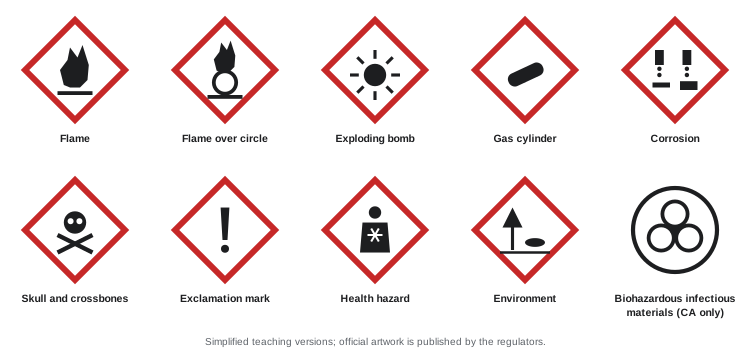
The pictograms and their meanings
| Pictogram | Hazards it represents |
|---|---|
| Flame | Flammable gases, aerosols, liquids and solids; pyrophoric, self-heating, self-reactive, water-reactive and organic peroxides |
| Flame over circle | Oxidizing gases, liquids and solids |
| Exploding bomb | Self-reactive substances and organic peroxides (severe types) |
| Gas cylinder | Gases under pressure; chemicals under pressure |
| Corrosion | Corrosive to metals, skin corrosion, serious eye damage |
| Skull and crossbones | Acute toxicity, Categories 1–3 |
| Exclamation mark | Acute toxicity Category 4, skin and eye irritation, skin sensitization, STOT single exposure Category 3 |
| Health hazard | Respiratory sensitization, mutagenicity, carcinogenicity, reproductive toxicity, STOT, aspiration hazard |
| Environment | Aquatic toxicity (not mandatory under WHMIS) |
| Biohazardous infectious materials | Organisms and toxins that cause disease (WHMIS-specific; circle, not diamond) |
Some symbols are easily confused. The flame over a circle represents oxidizers, which feed a fire, while the plain flame represents materials that burn. The exclamation mark represents less severe health hazards, while the health hazard pictogram, a human silhouette with a star-like burst on the chest, represents serious and often chronic health effects. The corrosion pictogram shows liquid damaging a surface and a hand, covering both metal corrosion and severe skin and eye damage.
Signal words
A signal word indicates the relative severity of the hazard. There are only two: Danger, for more severe hazards, and Warning, for less severe ones. A label carries only one signal word: if a product has hazards that call for both, Danger is used. Some hazard categories carry no signal word. Signal words appear prominently on supplier labels, usually near the product identifier, and in section 2 of the SDS. Older systems and other contexts, such as consumer products, may use other words such as "Caution", but these are not GHS signal words.
Hazard statements
Hazard statements are standardized phrases that describe the nature and, where relevant, the degree of the hazard. Each hazard class and category has assigned statements, such as "Highly flammable liquid and vapour" for flammable liquids Category 2, "Causes severe skin burns and eye damage" for skin corrosion Category 1, "Fatal if inhaled" for acute inhalation toxicity Categories 1 and 2, and "May cause cancer" for carcinogenicity Category 1. In the GHS, each statement has a code: H2xx codes for physical hazards, H3xx for health hazards and H4xx for environmental hazards, for example H225 for highly flammable liquid and vapour and H314 for severe skin burns and eye damage. Codes help translators and SDS authors but are not required to appear on labels, and many labels omit them. Hazard statements can be combined, such as "Fatal if swallowed or in contact with skin".
| Code | Hazard statement | Class and category |
|---|---|---|
| H220 | Extremely flammable gas | Flammable gas, Category 1A |
| H225 | Highly flammable liquid and vapour | Flammable liquid, Category 2 |
| H226 | Flammable liquid and vapour | Flammable liquid, Category 3 |
| H280 | Contains gas under pressure; may explode if heated | Gas under pressure |
| H302 | Harmful if swallowed | Acute oral toxicity, Category 4 |
| H314 | Causes severe skin burns and eye damage | Skin corrosion, Category 1 |
| H317 | May cause an allergic skin reaction | Skin sensitization, Category 1 |
| H330 | Fatal if inhaled | Acute inhalation toxicity, Categories 1–2 |
| H350 | May cause cancer | Carcinogenicity, Category 1 |
| H372 | Causes damage to organs through prolonged or repeated exposure | STOT repeated exposure, Category 1 |
Precautionary statements
Precautionary statements describe recommended measures to minimize or prevent harm. They are grouped into four types, with GHS codes beginning with P:
- Prevention (P2xx): for example "Keep away from heat, hot surfaces, sparks, open flames and other ignition sources. No smoking", "Wear protective gloves and eye protection", "Do not breathe vapours", "Use only outdoors or in a well-ventilated area".
- Response (P3xx): for example "IF ON SKIN (or hair): Take off immediately all contaminated clothing. Rinse skin with water", "IF IN EYES: Rinse cautiously with water for several minutes. Remove contact lenses, if present and easy to do. Continue rinsing", "IF INHALED: Remove person to fresh air", "Call a poison centre or doctor".
- Storage (P4xx): for example "Store in a well-ventilated place. Keep container tightly closed", "Store locked up", "Protect from sunlight".
- Disposal (P5xx): for example "Dispose of contents and container in accordance with local regulations".
Precautionary statements can be combined and adapted with specific information, such as the type of gloves or the extinguishing medium. Together with the hazard statements, they form the core of the label's safety message.
Precedence rules
When a product has several hazards, precedence rules avoid cluttering the label with redundant elements. Key rules include:
- If the skull and crossbones applies, the exclamation mark is not used for acute toxicity, and is not used for skin or eye irritation if the corrosion pictogram also applies.
- If the corrosion pictogram applies for skin or eye effects, the exclamation mark is not used for skin or eye irritation.
- If the health hazard pictogram applies for respiratory sensitization, the exclamation mark is not used for skin sensitization or skin and eye irritation.
- Only one signal word is used: Danger takes precedence over Warning.
- All applicable hazard statements are included, though some combined statements and precedence rules reduce duplication.
Worked problem
Choosing label elements
A cleaning concentrate is classified as skin corrosion Category 1, serious eye damage Category 1, acute oral toxicity Category 4 and STOT single exposure Category 3 (respiratory irritation). Which pictograms and signal word should appear?
Show solution
- Skin corrosion and serious eye damage: corrosion pictogram, signal word Danger.
- Acute oral toxicity Category 4 and STOT SE 3: exclamation mark, signal word Warning.
- Precedence: the exclamation mark is not used for skin or eye irritation when corrosion applies, but it is still used for acute toxicity Category 4 and respiratory irritation, which corrosion does not cover.
- Only one signal word: Danger.
Answer: Corrosion and exclamation mark pictograms, signal word Danger, with hazard statements for burns, eye damage, harm if swallowed and respiratory irritation.
Recognizing pictograms in practice
Pictograms are designed to be understood quickly, but they still need learning. Studies of hazard communication have found that workers often misinterpret some pictograms: the health hazard silhouette, for example, is sometimes mistaken for something else, and the flame over circle is confused with the flame. Training that shows real products from the workplace, quizzes on matching pictograms to hazards, and posters near storage areas help. When you see a pictogram, train yourself to ask three questions: What kind of hazard is this? How severe is it, according to the signal word and statements? What precautions does the label tell me to take?
Language and legibility
In Canada, supplier labels must be in both English and French, which can be on a single bilingual label or on separate English and French labels; all elements must be legible and not obscured. Employers may need to provide information in other languages, or use other means, so that all workers understand the hazards; workplace education must be effective for the people receiving it. Labels must remain legible for the life of the container, so damaged, faded or chemically attacked labels must be replaced.
Matching pictograms to hazard classes: practice
A useful exercise is to work backward from pictograms to possible hazards. If you see the gas cylinder, you know the product contains gas under pressure, and you should check the label for other pictograms that indicate whether the gas is also flammable, oxidizing or toxic. If you see the corrosion pictogram on a product used for cleaning floors, it may be a strong alkali or acid that can cause severe burns and eye damage. If you see the health hazard silhouette on a paint, check the hazard statements for whether it is a sensitizer, carcinogen or reproductive toxicant. If you see only the exclamation mark, the product may irritate skin or eyes, cause allergic skin reactions or be harmful if swallowed. The hazard statements always give the precise meaning, but recognizing the pictogram first tells you what to look for.
Pictograms in other systems
Workers may see similar-looking symbols from other systems. Transport of dangerous goods labels use coloured diamonds with symbols and numbers at the bottom, and some of their symbols resemble GHS pictograms; for example, the transport flammable liquid label is a red diamond with a white or black flame and the number 3. Consumer product labels may use symbols such as a skull or flame inside an octagon, triangle or diamond with words like "Danger", "Warning" or "Caution", under consumer product rules. Older WHMIS 1988 symbols, enclosed in circles, may still be seen on very old containers, and should prompt a check for a current label and SDS. Pesticide labels use their own approved formats. Training should help workers distinguish these systems.
Using the label as a reminder, not a manual
Labels are designed to remind and alert, not to teach everything about a product. A precautionary statement such as "Wear protective gloves" does not specify which gloves; a statement such as "Use only in a well-ventilated area" does not say how much ventilation is enough. These details come from the SDS, the employer's procedures and training. The label is the first step, prompting the user to check that the right protections are in place.
Precautionary statements that are often misunderstood
Some precautionary statements are commonly misunderstood. "Use only outdoors or in a well-ventilated area" does not mean simply opening a door; it means enough air movement to keep vapour concentrations low, which may require mechanical ventilation. "Avoid breathing dust, fume, gas, mist, vapours or spray" may require local exhaust or respiratory protection, not just care. "Wear protective gloves" requires gloves suitable for the specific product. "Keep container tightly closed" applies even during short breaks, because open containers keep releasing vapour. "Do not eat, drink or smoke when using this product" also means washing hands before doing so. "Store locked up" applies to highly toxic products that should be accessible only to authorized people. When in doubt about what a statement requires, check the SDS and ask your supervisor.
Supplemental information on labels
Labels may also include supplemental information, such as instructions for use, the net quantity, a lot number, a statement that a product may form combustible dust, or the percentage of ingredients with unknown toxicity. This information can be useful, but it must not contradict or obscure the required hazard information. Marketing claims such as "natural" or "green" do not mean a product is non-hazardous; the classification and the hazard statements are what count.
Testing your recognition
Before moving on, test yourself. Without looking at the table, name the pictogram used for each of these: a solvent that is highly flammable; an acid that causes severe skin burns; a gas cylinder of oxygen; a product that may cause cancer; a cleaner that causes eye irritation; a pesticide that is fatal if swallowed. Then check your answers: flame; corrosion; gas cylinder plus flame over circle; health hazard; exclamation mark; skull and crossbones. If any answers surprised you, review the pictogram meanings again, since quick and accurate recognition is the goal.
Signal words in context
Signal words help you prioritize. When you see Danger, slow down and check that every precaution is in place before starting: the product may cause severe burns, be fatal if inhaled, be highly flammable or cause cancer. When you see Warning, the hazards are less severe but still real, such as irritation, sensitization or harm if swallowed. Never treat a Warning product carelessly, because repeated low-level exposures can still cause lasting harm.
Common mistakes
MistakeConfusing the flame with the flame over circle.
InsteadRemember flame over circle means oxidizer.
MistakeTreating the exclamation mark as harmless.
InsteadIt still indicates hazards such as irritation and sensitization.
MistakeAssuming no pictogram means no hazard.
InsteadSome categories have no pictogram; read the statements.
MistakeIgnoring precautionary statements.
InsteadFollow prevention, response, storage and disposal advice.
MistakeExpecting both Danger and Warning on a label.
InsteadOnly the more severe signal word appears.
Summary and key terms
- Pictograms are black symbols in red diamond borders, each covering hazard classes.
- WHMIS uses the GHS pictograms plus a biohazard symbol; environment is optional.
- Signal words are Danger (more severe) and Warning (less severe); only one appears.
- Hazard statements describe the hazard; GHS codes start with H.
- Precautionary statements cover prevention, response, storage and disposal (P codes).
- Precedence rules avoid redundant pictograms.
- Training helps workers recognize pictograms correctly.
- Pictogram
- Symbol in a red diamond border representing hazards.
- Signal word
- Danger or Warning, indicating severity.
- Hazard statement
- Standard phrase describing a hazard.
- H code
- GHS code for a hazard statement.
- Precautionary statement
- Standard phrase describing protective measures.
- P code
- GHS code for a precautionary statement.
- Precedence
- Rules deciding which elements appear when several apply.
- Exclamation mark
- Pictogram for less severe health hazards.
- Health hazard pictogram
- Silhouette pictogram for serious health effects.
- Flame over circle
- Pictogram for oxidizers.
Practice problems
Work each problem on paper first, then reveal the answer to check.
Describe a GHS pictogram.
Show answer
Black symbol on white within a red diamond border.
Which pictogram indicates oxidizers?
Show answer
Flame over circle.
Which pictogram covers carcinogens?
Show answer
Health hazard.
Which pictogram covers acute toxicity Category 4?
Show answer
Exclamation mark.
What are the two signal words?
Show answer
Danger and Warning.
What does H314 mean?
Show answer
Causes severe skin burns and eye damage.
Name the four types of precautionary statements.
Show answer
Prevention, response, storage, disposal.
If corrosion applies, is the exclamation mark used for skin irritation?
Show answer
No.
Do all hazard categories have a pictogram?
Show answer
No; for example, flammable liquid Category 4 has none.
In what languages must Canadian supplier labels be?
Show answer
English and French.
Lesson quiz · 5 questions
Score 60% or more to complete this lesson.
Create a free account to save your progress, take quizzes and earn a certificate.