
HSE-102 · Lesson 12 of 12 · 25 min
Roles, worker education and the WHMIS program
WHMIS works only when everyone involved does their part: suppliers provide accurate labels and SDSs, employers create the conditions for safe work and educate workers, and workers apply what they learn and speak up. This final lesson brings the course together. It explains the duties of suppliers, employers, supervisors and workers; what worker education and training must include and how often it must be reviewed; how to build and maintain a WHMIS program, including chemical inventories, labelling, SDS management and purchasing controls; the role of joint health and safety committees and representatives; inspections and continuous improvement; and the capstone project.
Duties of suppliers
Suppliers who sell or import hazardous products for use in Canadian workplaces must classify each product according to the HPR, prepare a compliant supplier label and SDS in English and French, provide them with or before the product, and update them when significant new data become available (SDS within 90 days and label within 180 days). They must keep records of sales for six years and provide information to Health Canada on request.
Duties of employers
Employers must make sure that every hazardous product in the workplace has a supplier label or workplace label as required; obtain and keep current SDSs and make them readily available; educate and train workers who work with or near hazardous products; ensure that the education and training are effective, so that workers can apply them; review education and training at least annually, or more often if required by the jurisdiction, and whenever conditions change or new information becomes available; consult the joint health and safety committee or representative on the program; and control exposures and hazards according to OHS law.
Duties of supervisors and workers
Supervisors translate the program into daily practice: making sure workers have been trained on the products they use, enforcing safe procedures and PPE use, checking that containers are labelled and SDSs are available, responding to reports, and setting an example. Workers must take part in education and training, follow safe work procedures, use controls and PPE properly, not remove or deface labels, report hazards such as missing labels, damaged containers, leaks and symptoms, and ask questions when unsure. Workers also have the right to refuse work they believe is dangerous, under the procedures of their jurisdiction, and must not face reprisal for raising safety concerns.
What worker education and training must include
WHMIS regulations distinguish two parts. Education is general instruction on WHMIS: the elements of WHMIS, the information on supplier and workplace labels and SDSs and its purpose, the hazards of the products the worker uses, and the meaning of pictograms and other information. This course can contribute to the general education element. Training is workplace-specific instruction on the procedures for the safe use, storage, handling and disposal of the hazardous products the worker uses or is exposed to, procedures for emergencies involving them, procedures for products in pipes and vessels, and procedures for products produced in the workplace. Education and training must be effective: employers should verify, for example through questions, demonstrations or observation, that workers can find and understand the information and apply the procedures. Records of education and training are expected or required in most jurisdictions.
| Part | Content | Provided by |
|---|---|---|
| General education | WHMIS elements, labels, SDSs, pictograms, hazard classes | Employer, often with generic courses like this one |
| Workplace-specific training | Safe use, storage, handling, disposal and emergency procedures for actual products | Employer, supervisors and qualified trainers |
| Review | At least annually and when conditions or information change | Employer with the JHSC or representative |
Building a WHMIS program
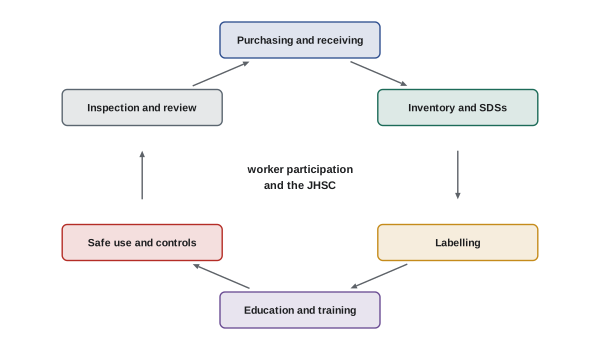
Most jurisdictions do not require a single written WHMIS document, but a written program is good practice and helps demonstrate compliance. A program typically includes:
- Responsibilities: who manages the program, maintains SDSs, provides training and inspects.
- Chemical inventory: a list of every hazardous product by location, with links to SDSs.
- Purchasing and receiving controls: approval of new products, checking for safer alternatives, and confirming that labels and SDSs arrive with products.
- Labelling procedures: supplier label checks, workplace labels, decanting rules, pipes and vessels.
- SDS management: how SDSs are obtained, updated, stored and accessed.
- Education and training: content, delivery, verification and records.
- Exposure control and emergency procedures linked to the hazards.
- Contractors and visitors: how hazard information is shared.
- Inspection, audit and review schedule.
Participation and committees
Joint health and safety committees (JHSCs) or health and safety representatives, required in most workplaces above a certain size, have a role in WHMIS: employers must consult them on the development and review of education and training, and committee members often take part in workplace inspections that check labels, SDS access and storage. Workers can raise concerns with their committee, supervisor or, if unresolved, the OHS regulator.
Inspections and continuous improvement
Regular inspections keep a hazard communication program working. A simple inspection checklist might include: Are all containers labelled and labels legible? Are SDSs available and current for every product in the inventory? Are new products appearing that are not in the inventory? Are incompatible products segregated? Are spill kits, eyewash stations and safety showers in place and tested? Do workers know where to find SDSs and how to use them? Can workers explain the hazards of the products they use? Findings should be recorded, assigned and corrected, and trends reviewed. Incidents and near misses involving hazardous products, such as spills, exposures and mislabelled containers, should be investigated to find root causes and improve the program.
Worked problem
A quick program audit
During an inspection of a small manufacturing shop, you find: three spray bottles with no labels, an SDS binder last updated four years ago, a new cutting fluid in use that is not on the inventory, and two workers who cannot say what the flame over circle means. What should be done?
Show solution
- Unlabelled bottles: identify the contents, label them or dispose of them safely; remind staff of decanting rules.
- SDS binder: request current SDSs from suppliers for all products, and set up a review process.
- New cutting fluid: add it to the inventory, obtain the SDS, assess hazards and controls, and route future purchases through approval.
- Training gap: provide refresher education on pictograms and verify understanding.
- Record findings, assign actions with dates, and follow up.
Answer: Label or remove unknown containers, update SDSs, control new products through purchasing and inventory, retrain, and track corrective actions.
Capstone project
The capstone asks you to apply the course to a real or realistic workplace area, such as a maintenance shop, a cleaning cupboard, a laboratory bench, a print room or a warehouse aisle. Your project should include:
- A chemical inventory of at least ten hazardous products, with product identifiers, locations, quantities and SDS revision dates.
- For three of the products, a one-page hazard summary drawn from the label and SDS: classification, pictograms, signal word, key hazard and precautionary statements, PPE, storage requirements, incompatibilities and first aid.
- A storage and segregation plan for the area, using SDS section 10.
- A workplace label you design for one decanted product, meeting your jurisdiction's requirements.
- A short spill response procedure for one of the products.
- An inspection checklist for the area, completed once, with corrective actions.
- A brief reflection, of about 300 words, on the most important improvements you identified.
Discuss your findings with your supervisor or safety committee, since real hazards you identify should be corrected.
Contractors, visitors and shared workplaces
Many workplaces host contractors, temporary workers and visitors who may encounter hazardous products. Before work begins, the host employer should tell contractors about the hazardous products in their work areas, provide access to SDSs, explain labelling systems and emergency procedures, and coordinate on products that contractors bring with them, which must also be labelled and have SDSs available. Temporary agency workers must receive education and training on the products they work with, with the host and the agency clarifying responsibilities. In shared workplaces, such as construction sites and multi-tenant buildings, coordination between employers is essential.
Non-routine tasks
Non-routine tasks, such as cleaning tanks, maintenance on process equipment, responding to unusual spills or working with a product for the first time, often carry greater hazards than everyday work, and the usual procedures may not apply. Before such tasks, supervisors should review the SDSs of the products involved, consider residues and by-products, plan controls, PPE and emergency arrangements, and brief the workers. Permits, such as confined space and hot work permits, often apply. Many serious chemical incidents occur during non-routine tasks.
Measuring program performance
Organizations can track indicators to see whether hazard communication is working: the percentage of products with current SDSs, the number of unlabelled containers found in inspections, training completion and verification rates, the number of chemical incidents and near misses, results of exposure monitoring, and worker feedback. Indicators help focus effort where it is most needed and show improvement over time.
Your role in a culture of hazard communication
Hazard communication is ultimately about culture as much as rules. In workplaces with a strong safety culture, workers read labels as a matter of habit, ask questions about unfamiliar products, remind colleagues when containers are unlabelled, and report problems without fear. Supervisors respond to reports quickly and treat them as useful information rather than complaints. Managers invest in safer products, good ventilation and effective training. You contribute to this culture every time you read a label before using a product, check the SDS for an unfamiliar task, label a container you fill, or speak up about a hazard.
Keeping your knowledge current
Products, rules and knowledge change. Keep your hazard communication knowledge current by attending refresher training, reading updated SDSs, following notices from your employer and regulator, and asking about new products before using them. If you change jobs or workplaces, expect new products and procedures, and make sure you receive workplace-specific training before starting work with hazardous products.
Course review
Over the course, you have learned why hazard communication matters and how the GHS and national laws structure it; how physical and health hazards are classified; how to read pictograms, signal words and statements on labels; how supplier and workplace labels work; how to find and use information on SDSs; how exposure is controlled; how to handle, store and respond to hazardous products; and how roles, training and programs fit together. Combined with your employer's workplace-specific training, this knowledge will help you protect yourself and others.
Questions to ask on your first day with a new product
When you are asked to use a product for the first time, ask: What is it, and where is its SDS? What are its main hazards? What controls and PPE do I need? How should I store it and dispose of it? What should I do if it spills or if I am exposed? Who can I ask if I have questions? If you cannot get answers, do not start the work until you do. These questions put the right to know into practice every day.
Final reminder
This course is an awareness-level course. It does not replace workplace-specific training on your employer's products and procedures, or any certified training required for your job. Use it as a foundation, and build on it with the training, procedures and supervision your workplace provides.
Where to go for help
If you have questions about a product, start with the label and SDS, then ask your supervisor, your joint health and safety committee or safety representative, or your safety department. Regulators and organizations such as occupational health and safety agencies and poison centres also provide reliable information.
Common mistakes
MistakeTreating hazard communication as a one-time training event.
InsteadReview and refresh as products and conditions change.
MistakeLetting products enter the workplace without review.
InsteadControl purchasing and update the inventory.
MistakeTraining without checking understanding.
InsteadVerify that workers can apply what they learned.
MistakeForgetting contractors and non-routine tasks.
InsteadShare hazard information and plan special tasks.
MistakeIgnoring near misses.
InsteadInvestigate and improve the program.
Summary and key terms
- Suppliers classify, label and provide SDSs; employers label, provide SDSs and educate.
- Supervisors and workers apply procedures, use controls and report hazards.
- Education covers WHMIS generally; training covers workplace-specific procedures.
- Review education and training at least annually and when conditions change.
- Programs include inventories, purchasing controls, labelling, SDS management and training.
- Committees, inspections and investigations drive continuous improvement.
- The capstone applies the course to a real work area.
- Chemical inventory
- List of hazardous products by location.
- Education
- General instruction on the hazard communication system.
- Training
- Workplace-specific instruction on procedures.
- Written program
- Document describing how hazard communication is managed.
- Non-routine task
- Infrequent task with special hazards.
- Purchasing control
- Review of new products before they enter the workplace.
- JHSC
- Joint health and safety committee.
- Inspection checklist
- List of items checked during inspections.
- Near miss
- Event that could have caused harm but did not.
- Continuous improvement
- Ongoing review and strengthening of the program.
Practice problems
Work each problem on paper first, then reveal the answer to check.
Name two supplier duties.
Show answer
Classify products, provide labels and SDSs, update them.
Name three employer duties.
Show answer
Labels, SDS access, education and training, controls, review.
Name two worker duties.
Show answer
Participate in training, follow procedures, use PPE, report hazards.
What is the difference between WHMIS education and training?
Show answer
Education is general; training is workplace-specific.
How often must education and training be reviewed?
Show answer
At least annually and when conditions change.
Why control purchasing?
Show answer
To keep the inventory and SDSs complete and choose safer products.
Name three inspection checklist items.
Show answer
Labels, SDSs, segregation, spill kits, eyewash, worker knowledge.
What should happen after a near miss?
Show answer
Investigation and improvement.
How is training effectiveness verified?
Show answer
Questions, demonstrations or observation.
Name three capstone components.
Show answer
Inventory, hazard summaries, storage plan, label, spill procedure, checklist, reflection.
Lesson quiz · 5 questions
Score 60% or more to complete this lesson.
Create a free account to save your progress, take quizzes and earn a certificate.