
HSE-102 · Lesson 2 of 12 · 25 min
The GHS and the HazCom legal framework
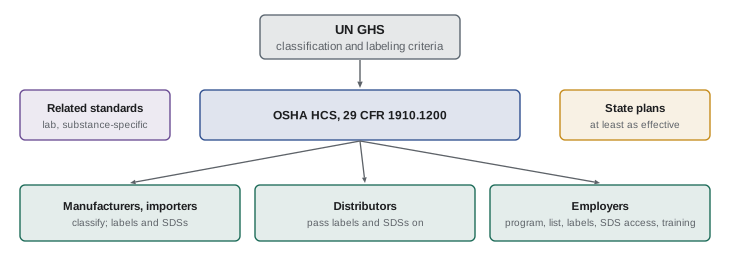
The Hazard Communication Standard is a federal OSHA regulation, 29 CFR 1910.1200, with parallel provisions for construction (29 CFR 1926.59), shipyards and marine terminals. It sets uniform national requirements for how chemical manufacturers and importers classify chemicals and prepare labels and safety data sheets, and for how employers inform and train their employees. Some states operate their own OSHA-approved state plans, which must be at least as effective as federal OSHA and may add requirements. This lesson explains the Globally Harmonized System on which HazCom is based, the structure of the standard, the 2012 and 2024 updates, trade secrets, state plans, enforcement and where to find authoritative information.
The structure of the GHS
The Globally Harmonized System, published by the United Nations and revised every two years, has three main parts. First, it sets criteria for classifying chemicals into hazard classes and categories: physical hazards such as flammable liquids and gases under pressure, health hazards such as acute toxicity and carcinogenicity, and environmental hazards such as hazards to the aquatic environment. Second, it sets standard elements for communicating hazards on labels: pictograms, signal words, hazard statements and precautionary statements. Third, it sets a standard 16-section format for safety data sheets. The GHS is often described as a "building block" approach, because countries can choose which hazard classes and categories to adopt for each sector, such as workplaces, consumer products, transport and pesticides. This explains why the GHS version adopted for workplaces in one country may differ slightly from another country's or from the transport rules.
| GHS element | What it standardizes |
|---|---|
| Classification criteria | How to decide whether a chemical is hazardous, and how severe |
| Hazard classes and categories | Types of hazard, divided by severity (Category 1 is most severe) |
| Label elements | Pictograms, signal words, hazard statements, precautionary statements |
| Safety data sheet format | 16 sections in a fixed order |
| Building blocks | Countries choose which classes and categories to adopt |
Hazard classes and categories
In the GHS, a hazard class describes the type of hazard, such as flammable liquids, acute toxicity or skin corrosion/irritation. Each class is divided into categories, numbered from 1 for the most severe, and sometimes subcategories such as 1A and 1B. For example, a flammable liquid with a very low flash point and boiling point is Category 1, and one with a higher flash point is Category 3 or 4. The category determines which pictogram, signal word and hazard statement go on the label. Importantly, in the GHS the lower number means the greater hazard, which is the opposite of some older systems and of some other rating schemes, such as the NFPA 704 diamond, where 4 is the most severe. This difference is a common source of confusion, which Lesson 7 returns to.
The Hazard Communication Standard
The Hazard Communication Standard (HCS), 29 CFR 1910.1200, applies to chemical manufacturers, importers, distributors and employers. Its main sections cover the purpose and scope; definitions; hazard classification by manufacturers and importers (paragraph (d)); the employer's written hazard communication program (e); labels and other forms of warning (f); safety data sheets (g); employee information and training (h); and trade secrets (i). Mandatory appendices set out the classification criteria for health hazards (Appendix A) and physical hazards (Appendix B), label elements (Appendix C) and SDS content (Appendix D). OSHA enforces the standard through inspections, and in federal OSHA states the standard applies directly; in state-plan states, the state's equivalent rule applies.
State plans and other OSHA standards
About half of US states and territories operate OSHA-approved state plans, such as California's Cal/OSHA, Washington's Department of Labor and Industries and Michigan's MIOSHA. State plans must adopt standards at least as effective as federal OSHA, usually by adopting the HCS directly or with additions; some states also cover state and local government workers, whom federal OSHA does not. Some states have additional right-to-know laws, for example California's Proposition 65, which requires warnings about chemicals known to the state to cause cancer or reproductive harm. Other OSHA standards interact with HazCom, including the laboratory standard (29 CFR 1910.1450), which has its own chemical hygiene plan requirements; substance-specific standards for chemicals such as lead, benzene, formaldehyde and silica, which include their own labeling and training provisions; and the respiratory protection and personal protective equipment standards.
Updates and alignment with GHS revisions
OSHA revised the HCS in 2012 (published March 26, 2012) to align with the third revised edition of the GHS, replacing the earlier performance-oriented rule with specific classification criteria, standardized label elements and the 16-section SDS format, with compliance dates phased in through 2016. OSHA then updated the standard to align with the seventh revised edition of the GHS, with some provisions from the eighth, in a final rule published on May 20, 2024, and effective July 19, 2024. The 2024 update added new hazard categories such as flammable gases Category 1A and 1B and non-flammable aerosols Category 3, and a hazard class for desensitized explosives; clarified how hazards from downstream use must be considered; added flexibility for labeling small containers and for labels on bulk shipments and containers released for shipment; and changed several SDS requirements, including allowing concentration ranges for trade secret ingredients. In January 2026, OSHA extended the compliance dates by four months: manufacturers, importers and distributors must update substances by May 19, 2026, and mixtures by November 19, 2027, and employers must update workplace labeling, programs and training within six months of each, by November 20, 2026, for substances and May 19, 2028, for mixtures. During the transition, compliance with either the 2012 or the 2024 version is generally accepted.
| Date | Milestone |
|---|---|
| 1983 | Original HCS issued for manufacturing |
| 1987 | HCS expanded to nearly all industries |
| March 26, 2012 | HCS 2012 (GHS Rev. 3) published |
| May 20, 2024 | HCS 2024 update (GHS Rev. 7, part of Rev. 8) published; effective July 19, 2024 |
| May 19, 2026 | Substances: manufacturers, importers, distributors must comply (extended) |
| November 20, 2026 | Substances: employer updates due (extended) |
| November 19, 2027 | Mixtures: manufacturers, importers, distributors must comply (extended) |
| May 19, 2028 | Mixtures: employer updates due (extended) |
Trade secrets
Chemical manufacturers, importers and employers may withhold the specific chemical identity or exact concentration of an ingredient as a trade secret, as long as the SDS states that information has been withheld and still discloses the hazards and protective measures. The 2024 update requires that, when concentration is withheld, a prescribed concentration range be given instead. Health professionals, employees and their representatives can obtain trade secret information in medical emergencies immediately and, in non-emergencies, by written request with a statement of need and a confidentiality agreement, under the procedures in paragraph (i) of the standard.
Enforcement and penalties
OSHA inspectors check compliance with the HCS during workplace inspections, and HazCom has for many years ranked among the most frequently cited OSHA standards. Penalties are adjusted annually for inflation; for serious violations, the maximum is in the range of about $16,000 per violation, and for willful or repeated violations about ten times that amount. State-plan states set their own penalties, which must be at least as effective. Common citations include the lack of a written program, missing or inadequate labels, missing SDSs and inadequate training.
Where to find authoritative information
Reliable sources include OSHA's Hazard Communication page, with the standard, guidance documents, QuickCards and model training programs; OSHA's small business guide to HazCom; your state plan's website, if you are in a state-plan state; NIOSH resources, including the NIOSH Pocket Guide to Chemical Hazards; and the Federal Register for the text and preamble of rule changes. When questions arise about a specific chemical, the manufacturer or importer is usually the best source, through the emergency and contact details on the SDS.
Worked problem
Which rules apply?
A company manufactures industrial cleaners in Ohio, sells them across the United States, and also has a warehouse in Washington State and a laboratory in California. Which HazCom rules apply to each activity?
Show solution
- As a chemical manufacturer, the company must classify its chemicals and provide HCS-compliant labels and SDSs, valid nationwide.
- At the Ohio factory, federal OSHA enforces the HCS for its employees.
- At the Washington warehouse, the state plan enforces its equivalent rules, which must be at least as effective.
- At the California laboratory, Cal/OSHA rules apply, including its laboratory and hazard communication requirements, plus Proposition 65 warning obligations where relevant.
Answer: HCS supplier duties nationwide; federal OSHA or the relevant state plan for each workplace as an employer.
Why harmonization helps workers
Harmonization brings practical benefits on the shop floor. A worker who moves between employers, or between Canada and the United States, sees the same pictograms, signal words and SDS layout everywhere. Products imported from Europe, Asia and elsewhere increasingly arrive with GHS-based labels and SDSs, though they must still meet the specific national requirements. Training materials can be shared and updated more easily. And because classification criteria are common, the same product should receive the same classification no matter who prepares the SDS, making comparisons between products more reliable. In practice, differences remain between countries in which categories are adopted, in specific label and SDS details, and in language requirements, so suppliers must still prepare country-specific versions.
Regulatory cooperation between Canada and the United States
Canada and the United States have worked together through a Regulatory Cooperation Council to align their workplace chemical rules, so that, as far as possible, a single label and SDS can meet both countries' requirements. Health Canada publishes a list of the remaining variances between the Hazardous Products Regulations and the Hazard Communication Standard, such as Canada's bilingual requirement, Canada's biohazardous infectious materials class, differences in how confidential business information is handled and some differences in classification criteria and label elements. For workers, the practical message is that labels and SDSs from either country look very similar, but they are not always interchangeable without review.
The life cycle of hazard information
It helps to picture how hazard information flows. A manufacturer develops or obtains data on a chemical, classifies it, and writes the label and SDS. Distributors pass these along. The employer receives the product, checks the label and SDS, adds the product to the inventory, decides on controls, trains workers and labels any containers it fills. Workers read labels, use the SDS and follow procedures. When new data appear, such as a study showing a new health effect, the information flows back down the chain through updated SDSs, labels and training. Each link in the chain must work for the system to protect people.
What changes for workers when rules are updated
When classification rules change, workers may notice new pictograms or hazard statements on familiar products, revised SDSs with different section 2 information, or changed PPE recommendations. These changes do not necessarily mean the product itself has changed; they may reflect new criteria or new data. Employers should explain significant changes in training, update workplace labels and procedures, and replace old SDSs. If you notice that a label or SDS has changed, read it carefully rather than assuming it says the same thing as before, and ask your supervisor what the change means for your work.
Hazard communication beyond the law
Legal requirements set the minimum. Many organizations go further: choosing products with fewer hazards, publishing plain-language summaries, translating information into the languages their workers speak, adding hazard information to work instructions, and involving workers in reviewing new products. These practices make hazard communication more effective and often reduce incidents and costs.
Thinking about jurisdiction at your workplace
To apply the legal framework, ask three questions about your own workplace: Which occupational health and safety law applies to my employer? Who supplies the hazardous products we use, and do their labels and SDSs meet national requirements? Where can I find my jurisdiction's guidance on hazard communication? Your supervisor, safety committee or the regulator's website can answer these questions, and knowing the answers helps you understand which rules your training is based on.
Common mistakes
MistakeAssuming the GHS is itself a law.
InsteadRemember each country adopts it through its own legislation.
MistakeConfusing GHS categories with NFPA ratings.
InsteadIn the GHS, Category 1 is the most severe.
MistakeAssuming federal OSHA rules are the whole story.
InsteadCheck state plans and related standards too.
MistakeIgnoring rule updates and transition dates.
InsteadMake sure labels, SDSs and training reflect current requirements.
MistakeTreating withheld ingredient information as hiding hazards.
InsteadHazards and precautions must still be disclosed.
Summary and key terms
- The GHS sets classification criteria, label elements and the SDS format.
- Hazard classes are divided into categories; Category 1 is most severe.
- 29 CFR 1910.1200 governs manufacturers, importers, distributors and employers.
- State plans must be at least as effective as federal OSHA.
- The 2024 update aligns with GHS Rev. 7, with compliance dates extended into 2026–2028.
- Trade secrets may be withheld but hazards must be disclosed.
- Regulators enforce requirements, and authoritative guidance is freely available.
- Hazard class
- Type of physical, health or environmental hazard.
- Hazard category
- Severity level within a hazard class.
- Building block approach
- Countries choosing which GHS elements to adopt.
- Supplier
- Person who sells or imports hazardous products.
- HPA
- Hazardous Products Act (Canada).
- HPR
- Hazardous Products Regulations (Canada).
- HCS
- Hazard Communication Standard (United States).
- State plan
- OSHA-approved state occupational safety program.
- Confidential business information
- Protected ingredient identity or concentration.
- Transition period
- Time allowed to change to new requirements.
Practice problems
Work each problem on paper first, then reveal the answer to check.
Name the three main parts of the GHS.
Show answer
Classification criteria, label elements, SDS format.
In the GHS, which category is most severe?
Show answer
Category 1.
What does the building block approach allow?
Show answer
Countries choose which classes and categories to adopt.
What is the citation of the HCS?
Show answer
29 CFR 1910.1200.
Name a state-plan state.
Show answer
California, Washington, Michigan and others.
When was HCS 2012 published?
Show answer
March 26, 2012.
When was the 2024 update published?
Show answer
May 20, 2024.
Name one new hazard category added in recent updates.
Show answer
Flammable gases 1A/1B, non-flammable aerosols Category 3, chemicals under pressure or desensitized explosives.
Must hazards be disclosed when an ingredient is confidential?
Show answer
Yes.
Name an authoritative information source.
Show answer
OSHA, state plan websites, NIOSH.
Lesson quiz · 5 questions
Score 60% or more to complete this lesson.
Create a free account to save your progress, take quizzes and earn a certificate.