
HSE-102 · Lesson 1 of 12 · 25 min
Why hazard communication matters
Almost every workplace uses hazardous products. Cleaning chemicals in a school, solvents in a print shop, fuels at a gas station, compressed gases in a hospital, battery acid in a warehouse, refrigerants in a data centre and paints on a construction site can all cause fires, burns, poisoning, breathing problems or long-term illness if they are handled without the right information. The Workplace Hazardous Materials Information System, known as WHMIS, is Canada's national system for making sure that the people who use hazardous products know what the hazards are and how to protect themselves. This course explains how WHMIS works: how products are classified, what labels and safety data sheets tell you, how to handle, store and respond to hazardous products safely, and what employers, suppliers and workers must each do.
About this course
This is an awareness-level course. It gives you a solid general understanding of WHMIS and of working safely with hazardous products, and it can form part of the general education that employers must provide. It does not replace the workplace-specific training that your employer must give you on the actual products, procedures and emergency arrangements at your workplace, and it does not replace any certified training required for particular jobs, such as transportation of dangerous goods, respiratory protection or first aid. Requirements vary between federal, provincial and territorial jurisdictions, so always follow the rules and procedures that apply where you work, and ask your supervisor or joint health and safety committee if you are unsure.
How hazardous products harm people
Hazardous products can cause harm in two broad ways. Physical hazards come from the properties of the product itself: it may catch fire, explode, react violently with other materials, release gas under pressure, or corrode metal. Health hazards come from the product's effects on the body: it may poison you if swallowed, inhaled or absorbed through the skin; burn your skin or eyes; trigger allergies or asthma; damage organs such as the liver, lungs or nervous system; or cause cancer, genetic damage or harm to an unborn child after long or repeated exposure. Some effects are immediate and obvious, such as a chemical burn. Others are delayed or hidden, appearing months or years later, such as occupational asthma or cancer. Because many hazardous products look, smell and feel like ordinary liquids, powders or gases, you cannot rely on your senses to tell whether something is dangerous. That is why written hazard information on labels and safety data sheets is essential.
| Effect | Example | Timing |
|---|---|---|
| Fire or explosion | Solvent vapour ignited by a spark | Immediate |
| Chemical burn | Splash of concentrated acid or caustic | Immediate |
| Acute poisoning | Carbon monoxide or hydrogen sulphide | Minutes to hours |
| Sensitization | Isocyanates in spray foam, latex, some epoxy hardeners | Develops over weeks or months; then reactions to tiny amounts |
| Chronic organ damage | Long-term solvent exposure affecting the nervous system | Months to years |
| Cancer | Crystalline silica, asbestos, benzene | Often decades |
The right to know
Hazard communication rests on a simple principle: people have a right to know about the hazards they work with. This right developed through the twentieth century as occupational diseases became better understood. Workers in the past often handled chemicals labelled only with trade names, with no information about what was inside or how dangerous it was. Many suffered poisoning, cancer and other diseases that could have been prevented. Labour unions, health researchers and safety advocates campaigned for laws requiring that chemical hazards be disclosed and that workers be trained.
In Canada, governments, employers and labour developed WHMIS together, and it came into force across the country on October 31, 1988. It was one of the first national hazard communication systems in the world. Along with the right to participate in health and safety and the right to refuse unsafe work, the right to know is one of the three basic rights that occupational health and safety laws in every Canadian jurisdiction give workers. In 2015, WHMIS was updated to align with the international Globally Harmonized System, becoming WHMIS 2015, and it has since been amended to follow later GHS revisions.
The Globally Harmonized System
Before the 2010s, countries classified and labelled chemicals in different ways. A product could be labelled "toxic" in one country and "harmful" in another, with different symbols, criteria and safety data sheet formats. This confused workers, made trade difficult and meant that hazards were communicated inconsistently. The United Nations developed the Globally Harmonized System of Classification and Labelling of Chemicals, known as the GHS, first published in 2003 and revised every two years since. The GHS provides common criteria for classifying chemical hazards, standard label elements such as pictograms, signal words and hazard statements, and a standard 16-section format for safety data sheets. The GHS is not a law itself; each country chooses which parts to adopt, through its own legislation. Canada and the United States have both adopted the GHS for workplace chemicals, which is why WHMIS and HazCom now look very similar, though there are some differences that this course points out. Lesson 2 explains the GHS and the legal framework in more detail.
The three main elements
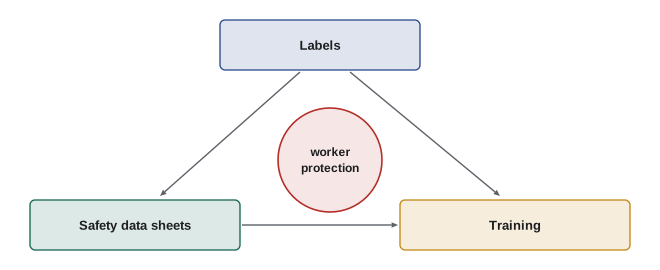
WHMIS rests on three main elements:
- Labels on containers of hazardous products, which alert you to the main hazards and the basic precautions.
- Safety data sheets (SDSs), which give detailed information about the product's hazards, safe handling, storage, emergency measures, properties and regulatory status.
- Worker education and training, which helps you understand the labels and SDSs and know the specific procedures for working safely with the products at your workplace.
These elements work together. A label gives a quick warning at the point of use; the SDS gives the full picture; training makes sure people can understand and act on the information. If any element is missing, hazard communication fails: a perfectly labelled drum is little use if workers do not know what the pictograms mean, and a complete SDS filed away where no one can find it protects no one.
Who is involved
WHMIS gives different groups different duties. Suppliers, meaning anyone who sells or imports hazardous products in Canada for use in workplaces, must classify their products, prepare supplier labels and SDSs that meet the Hazardous Products Regulations, and provide them to purchasers. Employers must make sure hazardous products in the workplace are properly labelled, that current SDSs are available to workers, that workers are educated and trained, and that products are handled, stored and controlled safely. Workers must take part in education and training, follow safe work procedures, use the controls and protective equipment provided, and report hazards such as damaged or missing labels. Lesson 12 discusses these duties in detail.
What hazard communication covers and does not cover
WHMIS applies to hazardous products, defined in the Hazardous Products Act as products, mixtures, materials and substances that meet the criteria for one or more hazard classes. Some products are covered by other laws and are excluded from WHMIS supplier label and SDS requirements, including explosives covered by the Explosives Act, cosmetics, drugs and foods regulated under the Food and Drugs Act, pest control products under the Pest Control Products Act, radioactive nuclear substances, consumer products sold at retail, wood and products made of wood, tobacco, manufactured articles and hazardous waste. Even when a product is excluded, employers still have general duties under occupational health and safety law to inform workers about its hazards and protect them. For example, a household cleaner bought at a store and used at work may not have a WHMIS label, but the employer must still make sure workers know how to use it safely.
Hazard communication and other safety rules
WHMIS is one of several systems for communicating chemical hazards. Transportation of dangerous goods (TDG) rules, under federal and provincial TDG legislation, govern the labels, placards and documents used when hazardous products are shipped by road, rail, air or water; TDG labels and placards look different from WHMIS labels and serve emergency responders during transport. Consumer chemical products sold in stores carry labels under the Consumer Chemicals and Containers Regulations, 2001. Pesticides carry labels approved by Health Canada's Pest Management Regulatory Agency. Workplace exposure limits, ventilation, respirator programs and confined space rules are set by occupational health and safety regulations. A product may carry several types of labels during its life: a TDG label on the shipping box, a WHMIS supplier label on the container, and a workplace label on a smaller container filled at work.
Why it matters: the cost of failure
Failures of hazard communication cause serious injuries and deaths every year. Common scenarios include workers mixing bleach with an ammonia-based or acidic cleaner, producing toxic gases; using a flammable solvent near an ignition source because the container had no label; entering a tank or pit without knowing that a previous product could release toxic vapour; transferring a chemical into an unlabelled drink bottle that someone later drinks from; and developing occupational asthma after months of exposure to a sensitizer that no one recognized as hazardous. Each of these could have been prevented by a clear label, an accessible SDS and training. Hazard communication violations are consistently among the most frequently cited workplace safety violations, showing how often the basics are missed.
Worked problem
A cleaning incident
A custodian cleaning a washroom pours a bleach-based cleaner into a toilet that had already been treated with an acidic bowl cleaner. Within seconds the custodian notices a sharp smell, starts coughing and feels a burning in the throat. What happened, and how could hazard communication have prevented it?
Show solution
- Mixing hypochlorite bleach with an acid releases chlorine gas, which irritates and damages the airways.
- The labels and SDSs of both products warn against mixing with other chemicals; the bleach SDS lists acids as incompatible materials in section 10.
- Training should have covered the products used in the job, the meaning of their labels, incompatibilities and what to do in an exposure.
- Immediate response: leave the area, get fresh air, report the incident, follow first aid measures from the SDS and seek medical attention if symptoms persist.
Answer: Chlorine gas formed when bleach met an acid; reading labels and SDSs and training on incompatible products would have prevented the exposure.
How this course is organized
Lesson 2 explains the GHS and the legal framework. Lessons 3 and 4 explain how physical and health hazards are classified. Lesson 5 covers pictograms, signal words and hazard and precautionary statements. Lessons 6 and 7 cover supplier and workplace labels. Lessons 8 and 9 cover safety data sheets and how to read them. Lesson 10 covers exposure, exposure limits and controls, Lesson 11 safe handling, storage, spills and emergencies, and Lesson 12 roles, training, programs and the capstone.
Key words to know from the start
A few terms recur throughout the course. A hazard is anything with the potential to cause harm; risk is the likelihood and severity of harm in a particular situation, which depends on exposure. Exposure means contact with a hazardous product, whether by breathing it, touching it, swallowing it or having it injected. Controls are measures that reduce exposure or the chance of an incident, from eliminating a product to wearing gloves. Keeping these ideas separate helps you understand why a highly hazardous product can sometimes be used safely, and why a seemingly mild one can cause harm when exposure is high.
Throughout the course, look for the products you actually use at work and compare their labels and SDSs with the examples. Applying each lesson to real products is the best way to turn awareness into safe habits.
Common mistakes
MistakeAssuming a product is safe because it looks or smells harmless.
InsteadCheck the label and safety data sheet before use.
MistakeTreating awareness training as enough.
InsteadComplete your employer's workplace-specific training too.
MistakeIgnoring products without supplier labels, such as retail products.
InsteadRemember that general duties to inform and protect still apply.
MistakeMixing cleaning products to make them stronger.
InsteadNever mix chemicals unless the procedure says to.
MistakeKeeping SDSs where no one can find them.
InsteadMake SDSs readily accessible to every worker.
Summary and key terms
- WHMIS is Canada's national hazard communication system.
- Hazardous products cause physical hazards and health hazards, some immediate and some delayed.
- Workers have a right to know about the hazards they work with.
- The GHS provides common classification, labelling and SDS rules adopted in both countries.
- Labels, safety data sheets and training work together.
- Suppliers, employers and workers each have duties.
- Other systems cover transport, consumer products and pesticides.
- Hazard communication
- Systems that inform workers about chemical hazards.
- WHMIS
- Workplace Hazardous Materials Information System (Canada).
- HazCom
- OSHA Hazard Communication Standard (United States).
- GHS
- Globally Harmonized System of Classification and Labelling of Chemicals.
- Physical hazard
- Hazard from a product's physical or chemical properties.
- Health hazard
- Hazard from a product's effects on the body.
- Safety data sheet
- Detailed document describing a product's hazards and safe use.
- Right to know
- Workers' right to information about workplace hazards.
- Sensitizer
- Substance that can cause allergic reactions after exposure.
- Awareness training
- General training that does not replace site-specific training.
Practice problems
Work each problem on paper first, then reveal the answer to check.
Name the two broad types of hazard.
Show answer
Physical hazards and health hazards.
Give an example of a delayed health effect.
Show answer
Cancer, occupational asthma, organ damage.
When did WHMIS first come into force?
Show answer
October 31, 1988.
What does GHS stand for?
Show answer
Globally Harmonized System of Classification and Labelling of Chemicals.
When was the GHS first published?
Show answer
2003.
Name the main elements of hazard communication.
Show answer
Labels, safety data sheets and training.
Why are labels alone not enough?
Show answer
Workers must understand them through training, and SDSs give full detail.
Name a product type covered by other laws.
Show answer
Pesticides, drugs, cosmetics, explosives, consumer products, hazardous waste.
What forms when bleach is mixed with acid?
Show answer
Chlorine gas.
Does this course replace workplace-specific training?
Show answer
No.
Lesson quiz · 5 questions
Score 60% or more to complete this lesson.
Create a free account to save your progress, take quizzes and earn a certificate.