
HSE-102 · Lesson 11 of 12 · 25 min
Safe handling, storage, spills and emergencies
Hazard information becomes protection only when it changes how products are handled, stored and responded to in emergencies. Many serious chemical incidents start with routine activities: transferring a flammable liquid without grounding, storing incompatible products together, overfilling a container, or responding to a spill without the right equipment. This lesson covers safe handling practices, transfer and dispensing, storage and segregation, flammable liquid storage, compressed gas cylinders, spill response, chemical emergencies and fire, first aid for chemical exposures, and waste and empty containers.
Safe handling practices
General safe handling practices apply to almost all hazardous products:
- Read the label and SDS before first use, and follow the safe work procedure.
- Use the smallest quantity needed for the task, and keep containers closed when not in use.
- Use the controls provided: ventilation, enclosures, tools and PPE.
- Never mix products unless a procedure says to; some combinations produce toxic gases or heat.
- Never smell, taste or touch products to identify them.
- Keep work areas clean and tidy, and clean up small drips promptly with appropriate materials.
- Wash hands after handling products and before eating, drinking or smoking, and never eat or drink in chemical areas.
- Report damaged containers, missing labels, leaks, odours and symptoms immediately.
Transferring and dispensing
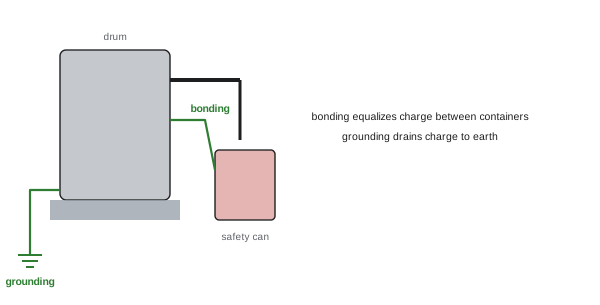
Transfers are high-risk moments. Use approved dispensing equipment such as drum pumps, self-closing faucets and safety cans rather than pouring from heavy containers. When transferring flammable liquids, bond and ground metal containers to prevent static sparks: bonding connects the containers to each other, and grounding connects them to earth, so that charge cannot build up and discharge as a spark that could ignite vapour. Transfer in well-ventilated areas away from ignition sources. Use funnels and drip trays, do not overfill, and label the receiving container immediately (Lesson 7). For corrosives, add acid to water rather than water to acid when diluting, because adding water to concentrated acid can cause violent boiling and splashing.
Storage and segregation
Good storage prevents leaks, fires and dangerous reactions. Principles include:
- Store products according to the SDS, section 7, at the right temperature, away from heat, sunlight and moisture where required.
- Segregate incompatible products, using section 10 of each SDS. Common incompatible groups include acids and bases; oxidizers and flammables or combustibles; water-reactive materials and water; cyanides or sulphides and acids; and bleach and ammonia or acids.
- Use secondary containment, such as trays or bunds, to catch leaks.
- Store heavy and large containers on low shelves, and corrosives below eye level.
- Keep storage areas ventilated, labelled, secure and free of clutter, with clear access to exits, eyewash stations and fire extinguishers.
- Keep inventory to a minimum, rotate stock, and dispose of products that are expired or no longer used.
| Group | Keep away from | Why |
|---|---|---|
| Acids | Bases, cyanides, sulphides, bleach, reactive metals | Heat, toxic gases, hydrogen |
| Bases (alkalis) | Acids, some metals such as aluminium | Heat, hydrogen gas |
| Oxidizers | Flammables, combustibles, organics, reducing agents | Fire, explosion |
| Flammable liquids | Oxidizers, ignition sources | Fire |
| Water-reactives | Water, humid areas, aqueous solutions | Flammable or toxic gas |
| Bleach (hypochlorite) | Acids, ammonia, amines | Chlorine and chloramine gases |
Storing flammable liquids
Fire codes, such as the National Fire Code of Canada and provincial fire codes, limit the quantities of flammable and combustible liquids that may be stored in work areas and specify requirements for storage cabinets, rooms and containers. Approved flammables storage cabinets, typically yellow with self-closing doors and labelled "Flammable — Keep fire away", protect contents from fire for a period and limit quantities in a work area. Safety cans with flame arrestors and self-closing lids reduce spills and ignition risk. Keep flammables away from ignition sources such as open flames, sparks, hot surfaces, electrical equipment that is not rated for hazardous locations, and static discharge.
Compressed gas cylinders
Cylinders must be secured upright with chains or straps to a wall, rack or cart, so they cannot fall and break their valves. Keep valve caps on when cylinders are not in use, move them on proper cylinder carts rather than by rolling or dragging, and never lift them by the cap. Store full and empty cylinders separately and clearly marked; separate oxidizing gases such as oxygen from flammable gases such as acetylene and propane, typically by at least 6 metres (20 feet) or a fire-resistant barrier, according to applicable codes. Use the correct regulator for each gas, never use oil or grease on oxygen fittings, and check for leaks with approved leak detection solution, not flames. Store cylinders in ventilated areas, away from heat, and indoors only in limited quantities.
Spill response
Every workplace that uses hazardous products should have a spill response plan that matches its products and quantities. For small spills that workers have been trained to handle, the general steps are:
- Assess: identify the product from the label or SDS and judge the size and hazard of the spill. If in doubt, treat it as a major spill.
- Alert and isolate: warn others, keep people away, and remove ignition sources for flammables if safe to do so.
- Protect yourself: put on the PPE listed in SDS section 6 or 8.
- Contain: stop the source if safe, and prevent spread to drains, using absorbent socks, pads or dykes.
- Clean up: use suitable absorbents or neutralizers from a spill kit; avoid sawdust or combustible absorbents for oxidizers.
- Dispose: place waste in labelled containers and dispose of it according to regulations.
- Report and review: report the spill and replace used spill kit materials.
For large spills, unknown products, highly toxic or flammable materials, or any spill beyond your training, evacuate the area, call the emergency number and let trained responders handle it. Many deaths in chemical incidents are of people who tried to help without proper protection.
Worked problem
Responding to a solvent spill
A 4-litre container of a Category 2 flammable solvent falls and spills on a workshop floor near a running electric motor. What should the worker who sees it do?
Show solution
- Warn others nearby and keep people away from the spill.
- If it can be done safely without approaching the vapour cloud, remove ignition sources, such as switching off the motor at a remote switch; otherwise evacuate.
- Ventilate the area if safe, for example by opening doors.
- If trained and equipped, put on gloves and eye protection and use a flammables spill kit to absorb the liquid, placing waste in a labelled, closed metal container.
- Report the spill, and if the spill is larger or vapour concentrations are high, evacuate and call emergency services.
Answer: Alert and isolate, control ignition sources only if safe, ventilate, clean up only if trained and equipped, and report; evacuate if in doubt.
Chemical emergencies and fire
Emergency plans should cover chemical releases, fires and exposures, including alarm and evacuation procedures, assembly points, shelter-in-place where appropriate, emergency contacts, and information for responders such as chemical inventories and SDSs. Fire extinguishers must suit the hazard: class B extinguishers for flammable liquids, class D for combustible metals, and never water on water-reactive materials or burning flammable liquids that float on water. Responders need to know what products are present, which is why chemical inventories, signage on storage rooms and NFPA 704 placards on buildings help. Only trained people should fight chemical fires, and only when the fire is small and an escape route is available.
First aid for chemical exposures
First aid for chemical exposures follows the SDS, section 4, but some principles apply widely:
- Eyes: flush immediately with clean, lukewarm water at an eyewash station for at least 15 minutes, or longer for corrosives, holding the eyelids open, and get medical attention.
- Skin: remove contaminated clothing, jewellery and shoes, and flush the skin with plenty of water for at least 15 to 20 minutes; use a safety shower for large exposures. Do not apply ointments unless directed.
- Inhalation: move the person to fresh air if it is safe to do so, keep them at rest, and get medical help; do not enter an area with toxic gas without proper protection.
- Ingestion: rinse the mouth, do not induce vomiting unless directed by a poison centre or doctor, and get medical help immediately.
Call 911 or the local emergency number for serious exposures, and contact a poison centre for advice; Canada has regional poison centres, reachable through a common toll-free number, 1-844-POISON-X (1-844-764-7669), in most provinces. Bring the SDS or the product label to medical care. First aid kits, eyewash stations and safety showers must meet the requirements of your jurisdiction, and certified first aid training is required for designated first aiders.
Waste and empty containers
Chemical waste can be as hazardous as the original products, or more so when different wastes are mixed. Collect waste in compatible, labelled, closed containers; never pour hazardous products down drains unless permitted; never mix different wastes unless a procedure allows it; and follow environmental regulations for storage, transport and disposal through licensed carriers and facilities. "Empty" containers often contain residues and vapours: a drum that held a flammable liquid can explode if cut or welded. Return, recycle or dispose of empty containers according to the supplier's instructions and regulations, and never reuse them for other purposes, especially food or drink.
Housekeeping and inspection of storage areas
Good housekeeping supports safe chemical storage. Keep floors, shelves and containment trays clean and dry; wipe up drips promptly; remove empty or damaged containers; keep aisles and exits clear; and keep combustible materials such as cardboard away from flammables and oxidizers. Inspect storage areas regularly for leaks, bulging or corroded containers, missing labels, expired products and overcrowding. Check that safety equipment, such as spill kits, eyewash stations, fire extinguishers and ventilation, is in place and working. Record inspection findings and correct problems promptly.
Emergency equipment
Emergency equipment must be suitable, accessible and maintained. Eyewash stations and safety showers should be within quick reach of areas where corrosives are used, on the same level, with an unobstructed path, and tested weekly by activation. Spill kits should match the products in the area, such as kits for acids, bases, solvents or general use, and be restocked after use. Fire extinguishers should be of the right type, inspected monthly and serviced annually. First aid kits should be stocked according to regulations, and designated first aiders should be trained. Workers should know where all emergency equipment is located before they need it.
Drills and preparedness
Emergency procedures work only if people have practised them. Chemical spill and release drills, evacuation drills and eyewash and shower tests help workers respond quickly and correctly. After a drill or a real incident, review what went well and what could be improved, update procedures and equipment, and share lessons learned. Preparedness also includes making sure that emergency contact numbers are posted, that first aiders are available on every shift, and that responders can quickly obtain the chemical inventory and SDSs.
Transporting products within the workplace
Moving hazardous products within a site also needs care. Use carts with raised edges or secondary containment for bottles and jugs, carry glass bottles in bottle carriers, keep lids closed, avoid carrying incompatible products together, and use elevators and corridors with care to avoid collisions. Never carry hazardous products in personal vehicles unless permitted and properly packaged, because transport of dangerous goods rules may apply even to small quantities in some situations.
Personal habits that prevent incidents
Small personal habits prevent many incidents: keeping your work area tidy, closing containers immediately after use, never leaving products unattended in public areas, checking labels each time rather than relying on memory, and reporting drips, leaks and damaged containers right away. These habits cost seconds and can prevent serious injuries.
Common mistakes
MistakePouring flammable liquids without bonding and grounding.
InsteadBond and ground metal containers during transfer.
MistakeStoring bleach next to acids.
InsteadSegregate incompatibles using SDS section 10.
MistakeLeaving cylinders unsecured.
InsteadChain or strap cylinders upright.
MistakeRushing in to help a collapsed worker in a toxic atmosphere.
InsteadCall for help; enter only with proper protection.
MistakeWelding on empty drums.
InsteadTreat empty containers as hazardous.
Summary and key terms
- Read labels and SDSs before use and follow safe handling practices.
- Use dispensing equipment, bond and ground flammables, and add acid to water.
- Segregate incompatible products and use secondary containment.
- Store flammables in approved cabinets and safety cans within code limits.
- Secure cylinders upright and separate oxidizing and flammable gases.
- Respond to small spills only if trained; evacuate for large or unknown spills.
- Follow SDS first aid, flush eyes and skin promptly, and manage waste and empty containers safely.
- Bonding
- Connecting containers to equalize static charge.
- Grounding
- Connecting to earth to drain static charge.
- Segregation
- Separating incompatible products.
- Secondary containment
- Trays or bunds that catch leaks.
- Flammables cabinet
- Approved fire-resistant cabinet for flammable liquids.
- Safety can
- Approved container with self-closing lid and flame arrestor.
- Spill kit
- Absorbents and equipment for spill cleanup.
- Shelter-in-place
- Staying indoors during an outdoor release.
- Eyewash station
- Equipment for flushing the eyes.
- Residue
- Product remaining in an empty container.
Practice problems
Work each problem on paper first, then reveal the answer to check.
Why bond and ground during transfers?
Show answer
To prevent static sparks igniting vapour.
Acid to water or water to acid?
Show answer
Acid to water.
Name two incompatible pairs.
Show answer
Acids and bases; oxidizers and flammables; bleach and ammonia.
Where should corrosives be stored?
Show answer
Below eye level with containment.
How should cylinders be stored?
Show answer
Upright, secured, caps on, oxidizers separated from flammables.
List the spill response steps.
Show answer
Assess, alert and isolate, protect, contain, clean up, dispose, report.
When should you evacuate rather than clean up?
Show answer
Large, unknown, highly hazardous spills or beyond your training.
How long should eyes be flushed?
Show answer
At least 15 minutes, longer for corrosives.
Should you induce vomiting after ingestion?
Show answer
Not unless directed by a poison centre or doctor.
Why are empty drums dangerous?
Show answer
Residues and vapours can ignite or explode.
Lesson quiz · 5 questions
Score 60% or more to complete this lesson.
Create a free account to save your progress, take quizzes and earn a certificate.