
HSE-101 · Lesson 5 of 12 · 21 min
Recognizing hazards
At the end of his first month, Jordan was invited to join a workplace inspection with Amara and the greenhouse lead, Marisol Vega. Once a month, two committee members walk through a part of the site with a checklist, looking for hazards. This month it was the greenhouses and the potting area.
Jordan thought he knew the greenhouses well by then. He walked through them a dozen times a day. But in forty minutes with Amara and Marisol, the three of them found eleven hazards he had walked past without noticing: a hose stretched across the main aisle, a cracked step on the potting bench platform, an extension cord running through a puddle, a sprayer of fungicide with no label, a bag of perlite open next to the fan, a wasp nest under the shade cloth, a heater vent blocked by stacked trays, a loose overhead hanging basket hook, an emergency exit partly blocked by a pallet of pots, a first aid kit with nothing left in it but tape, and a heavy watering wand hanging at head height by the door.
'You stop seeing things you see every day,' Amara said. 'That's normal. That's why we walk it on purpose, with fresh eyes, and why we ask new people to come along. You see stuff we don't anymore.'
This lesson explains how to recognize hazards: the kinds of hazards found at work, the ways to look for them, and how to judge which ones matter most. HSE-103 Hazard Recognition and Risk Assessment covers these skills in much more depth.
What makes something a hazard
Lesson 1 defined a hazard as anything that could cause harm. That definition is very broad on purpose. A hazard can be an object, like a blade. It can be a substance, like a chemical. It can be a form of energy, like electricity or a load held up in the air. It can be a condition, like a slippery floor or extreme heat. It can be a way of working, like a job that requires the same twisting motion hundreds of times a day. It can even be a person or a situation, like an angry customer or a shift with too few staff.
A useful habit is to ask, for any task, 'What could hurt me or someone else here, and how?' The 'how' matters. A gravel pile is not dangerous in itself, but a person climbing it can slip, a loader working it can hit someone, and its dust can get into lungs and eyes.
Six kinds of hazards
Safety professionals often sort hazards into categories. The exact names vary, but most use groups like these six. Sorting hazards this way helps you look for things you might otherwise miss.
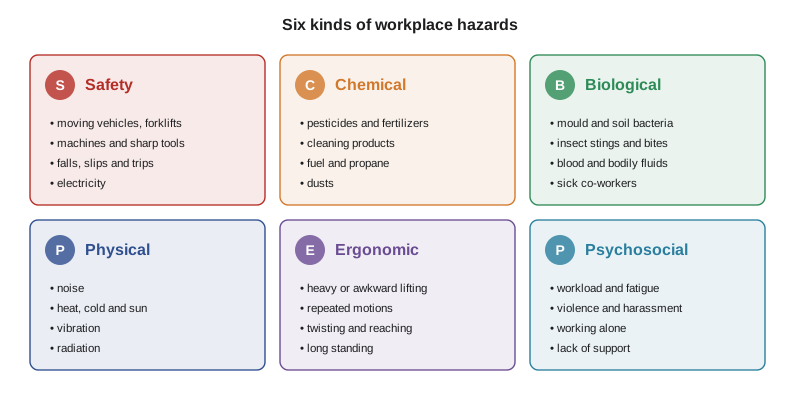
- Safety hazards can cause injury quickly, often in a moment: moving vehicles and equipment, machines with moving parts, sharp tools, working at height, slippery or cluttered floors, electricity, and falling objects. They cause most sudden injuries.
- Chemical hazards come from substances that can harm you if you breathe them, swallow them, or get them on your skin or in your eyes: pesticides, fertilizers, cleaning products, fuels, propane, solvents and dusts. Lesson 9 covers them.
- Biological hazards come from living things or their products: bacteria and fungi in soil and compost, mould, insect stings, animal bites, and blood or bodily fluids when giving first aid.
- Physical hazards are forms of energy in the environment: noise, heat, cold, sunlight, vibration and radiation.
- Ergonomic hazards come from the way the body is used: heavy or awkward lifting, repeated motions, twisting and reaching, long periods of standing or sitting, and poorly designed workstations. They are the most common cause of lost-time injuries in many workplaces.
- Psychosocial hazards come from the way work is organized and how people treat each other: high workload, long hours, fatigue, harassment, violence, working alone and lack of support. They can harm both mental and physical health. Lesson 11 covers them.
Some hazards fit in more than one group. Heat is a physical hazard, but working hard in heat is also an ergonomic issue, and the pressure to keep going on a busy day is psychosocial. That is fine. The categories are a tool for looking, not a filing system.
| Hazard from the greenhouse walk | Category | Possible harm |
|---|---|---|
| Hose across the main aisle | Safety | Trip and fall |
| Extension cord through a puddle | Safety | Electric shock |
| Unlabelled fungicide sprayer | Chemical | Skin, eye or lung harm; wrong product used |
| Open perlite bag next to a fan | Chemical | Dust in eyes and lungs |
| Wasp nest under shade cloth | Biological | Stings; severe allergic reaction |
| Watering wand at head height | Safety | Head or eye injury |
| Exit partly blocked by pots | Safety | Trapped in a fire or emergency |
| Empty first aid kit | Missing control | Delay in treating an injury |
Ways to find hazards
There are several ways to find hazards. A good workplace uses all of them.
Look around before you start
The simplest method is a quick check before every task. Stop for a moment and look at the area, the equipment, the materials and the people around you. Ask what has changed since last time. Is the floor wet? Is the weather different? Is there a new product, a new tool or someone new on the team? Many workplaces use a short written or spoken check for this, sometimes called a field-level hazard assessment or a pre-task plan. HSE-230 covers these.
Inspections
Planned inspections, like the one Jordan joined, look at an area in a set way, often with a checklist so nothing important is skipped. They should be done by people who know the work and include workers, not only managers. The point is to find and fix hazards, not to give a score. An inspection with eleven findings that all get fixed is far more useful than one with no findings because nobody looked closely.
Job hazard analysis
A job hazard analysis, sometimes called a job safety analysis, breaks a task into steps, lists the hazards at each step, and sets out how each hazard is controlled. It is usually written for tasks that are risky, done often, or new. Greenway has them for loading customer vehicles, operating the forklift, mixing and applying pesticides in the greenhouse, and using the cardboard baler. The analysis becomes the basis for the safe work procedure and for training.
Worked problem
Breaking down a task: loading a customer's trunk with soil bags
Show solution
- Step 1, pick up bags from the pallet: hazards are lifting from floor level and twisting. Control: use a pallet stand that raises the bags to waist height, and use a cart for more than four bags.
- Step 2, push the cart to the pickup lane: hazards are a vehicle in the lane and an uneven surface. Control: use the marked walkway and wait for vehicles to stop and switch off.
- Step 3, lift bags into the trunk: hazards are reaching forward over the bumper and lifting at arm's length. Control: stand close, keep the bag close to the body, and slide it rather than lift it where possible; get a second person for large orders.
- Step 4, close the trunk and return: hazards are pinch points at the trunk lid and the customer reversing. Control: let the customer close the trunk, and step back to the walkway before the car moves.
Answer: Breaking the job into steps found hazards that a quick look at 'loading bags' would miss, such as the customer reversing at the end.
Reports from workers
Workers find hazards all the time while doing their jobs. Hazard and near-miss reports, covered in Lesson 6, turn what they see into action. A workplace with many reports is not more dangerous. It is usually a place where people feel safe to speak up.
Learning from incidents
When something does go wrong, an investigation should look for the hazards and conditions behind it, and check whether the same hazards exist elsewhere. After Ethan climbed the forks, Priya checked whether any other area lacked the ladder or step stool it needed. She found two.
Other sources
Safety data sheets, equipment manuals, the regulator's guides, industry associations and injury records from similar businesses all point to hazards you might not think of. Before Greenway started selling propane cylinder exchanges, Tom read the supplier's manual and the fire code rules, and the committee looked at incidents at other retailers. That is how they knew to put the cage outside, away from doors and drains, with no-smoking signs.
Hazards that are easy to miss
Some hazards hide in plain sight. These are the ones new workers and experienced workers alike tend to overlook:
- Hazards that build up slowly, such as noise that damages hearing over years, or lifting that wears out a back over a career.
- Hazards that come and go, such as a floor that is only wet after watering, or a dock that is only icy in the morning.
- Hazards created by change, such as a new product, a rearranged store, a new staff member or a new piece of equipment.
- Hazards in tasks that are rarely done, such as clearing a jam in the baler or changing a propane tank on the forklift.
- Hazards from other people's work, such as a contractor working on the roof above the yard.
- Hazards that are 'normal', because everyone has always done it that way.
Judging the risk
Once you have found hazards, you need to decide which matter most, because you cannot fix everything at once. That is what risk assessment does. The idea is to think about two things for each hazard: how likely it is to cause harm, and how serious the harm would be.
A common tool is a risk matrix. Each hazard gets a score for likelihood, say from 1 for rare to 5 for almost certain, and a score for severity, from 1 for a minor injury needing first aid to 5 for a death or permanent disability. Multiplying the two gives a risk score. High scores are fixed first.
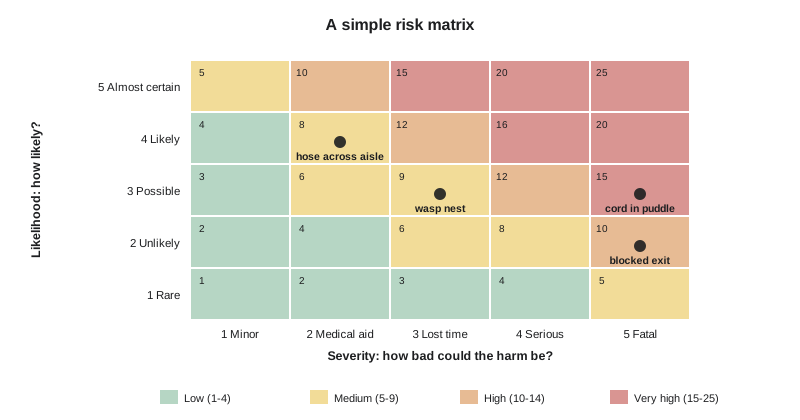
Amara ran the greenhouse findings through the committee's simple scoring sheet. The short program below does the same thing.
# Rank hazards from the greenhouse walk by risk = likelihood x severity (each 1 to 5)
hazards = [
    ("Extension cord through a puddle", 3, 5),
    ("Hose across the main aisle",      4, 2),
    ("Exit partly blocked by pots",     2, 5),
    ("Wasp nest under shade cloth",     3, 3),
    ("Unlabelled fungicide sprayer",    3, 3),
    ("Watering wand at head height",    3, 2),
]

def band(score):
    return "very high" if score >= 15 else "high" if score >= 10 else "medium" if score >= 5 else "low"

for name, likelihood, severity in sorted(hazards, key=lambda h: -h[1] * h[2]):
    score = likelihood * severity
print(f"{name:34} L={likelihood} S={severity} risk={score:>2} ({band(score)})")Extension cord through a puddle L=3 S=5 risk=15 (very high) Exit partly blocked by pots L=2 S=5 risk=10 (high) Wasp nest under shade cloth L=3 S=3 risk= 9 (medium) Unlabelled fungicide sprayer L=3 S=3 risk= 9 (medium) Hose across the main aisle L=4 S=2 risk= 8 (medium) Watering wand at head height L=3 S=2 risk= 6 (medium)
The cord in the puddle came out on top. It was unplugged and moved within five minutes of being found, and the committee asked for a covered outdoor outlet near the potting bench so a cord would not be needed at all. The blocked exit was cleared the same day. The hose got a hose reel. The wasp nest was removed by a pest control contractor that week.
Risk matrices are useful, but they are a guide, not a calculator. Two people can give the same hazard different scores. Any hazard that could kill someone deserves attention even if it seems unlikely, because 'unlikely' events happen eventually when a task is done thousands of times. The point of scoring is to have a conversation about priorities, not to prove that a hazard can be ignored.
Your part as a new worker
New workers are not expected to be experts at hazard recognition. But new workers have one big advantage: fresh eyes. You notice things that others stopped seeing long ago. If something looks odd, unsafe or confusing to you, say so. You might be the first person to notice a hazard that has been there for years.
Common mistakes
MistakeOnly looking for safety hazards like sharp edges and moving machines.
InsteadUse all six categories, including ergonomic and psychosocial hazards.
MistakeThinking an inspection with no findings means a safe workplace.
InsteadLook closely; a good inspection usually finds things to fix.
MistakeAssuming something is safe because 'we've always done it this way.'
InsteadTreat long-standing habits as worth a fresh look.
MistakeUsing a low risk score as a reason to ignore a possibly fatal hazard.
InsteadGive serious attention to any hazard that could kill, even if it seems unlikely.
MistakeKeeping quiet about a hazard because you are new.
InsteadUse your fresh eyes and report what you see.
Summary and key terms
- A hazard is anything that could cause harm, including objects, substances, energy, conditions, ways of working and situations.
- Six common categories are safety, chemical, biological, physical, ergonomic and psychosocial hazards.
- Hazards are found by checking before tasks, planned inspections, job hazard analysis, worker reports, incident investigations and outside information.
- Hazards that build slowly, come and go, come with change, or seem normal are easy to miss.
- Risk combines likelihood and severity; a risk matrix helps decide which hazards to fix first.
- New workers bring fresh eyes and should report anything that looks unsafe.
- Workplace inspection
- A planned walk through an area to find hazards, often using a checklist.
- Job hazard analysis
- A method of breaking a task into steps and identifying the hazards and controls for each step.
- Ergonomic hazard
- A hazard from how the body is used, such as heavy lifting, repetition or awkward postures.
- Psychosocial hazard
- A hazard from how work is organized and how people treat each other, such as stress or harassment.
- Risk matrix
- A grid that combines likelihood and severity to rank risks.
Practice problems
Work each problem on paper first, then reveal the answer to check.
Name the six categories of hazards.
Show answer
Safety, chemical, biological, physical, ergonomic and psychosocial.
Which category does a bag of fertilizer that is too heavy to lift safely belong to?
Show answer
Ergonomic, because the harm comes from how the body is used in lifting it; the fertilizer itself is also a chemical hazard.
A hazard has likelihood 2 and severity 5. What is its risk score, and why should it not be ignored?
Show answer
The score is 10, which is high; and any hazard that could cause death deserves attention even if unlikely.
Give two kinds of hazards that are easy to miss.
Show answer
Any two: hazards that build slowly, that come and go, that come with change, in rare tasks, from other people’s work, or that seem normal.
What did the job hazard analysis for loading a trunk find at the last step?
Show answer
The pinch point at the trunk lid and the risk of the customer reversing.
Lesson quiz · 5 questions
Score 60% or more to complete this lesson.
Create a free account to save your progress, take quizzes and earn a certificate.