
HSE-101 · Lesson 9 of 12 · 20 min
Hazardous products and WHMIS basics
Greenway's chemical room is a locked, ventilated room at the back of the warehouse. It holds the stock for the store: weed killers, insect sprays, fungicides, fertilizers, pool chemicals, lawn treatments, ice melt, lamp oil and cleaning products. The greenhouses have their own smaller cabinet of products used on the plants. And the yard has propane cylinders in a cage outside, plus fuel for the loader and the chipper.
Jordan was not allowed into the chemical room until he had done his WHMIS training. Marisol ran it for him and two seasonal workers on a Thursday afternoon. She started by holding up two bottles that looked almost the same, one a lawn fertilizer and one a concentrated weed killer. 'Which one of these could put you in hospital if it splashed in your eye?' she asked. Nobody was sure. 'That's why we have labels,' she said, 'and that's why you're going to learn to read them.'
This lesson covers the basics of working safely with hazardous products: how they can harm you, what the labels and pictograms mean, what a safety data sheet is, and what you must do to protect yourself. HSE-102 covers WHMIS in much more depth.
How chemicals can harm you
Chemicals can cause two broad kinds of harm. Physical hazards come from what the chemical does: it may catch fire, explode, react with other chemicals, or be stored under pressure. Health hazards come from what the chemical does to your body: it may burn your skin or eyes, irritate your lungs, poison you, cause an allergic reaction, or cause long-term illness such as cancer or lung disease.
To harm you, a chemical has to get into or onto your body. There are four main routes:
- Breathing it in as a gas, vapour, mist, spray or dust. This is the most common route at work.
- Skin and eye contact, from splashes, spills, contaminated gloves or touching your face.
- Swallowing it, usually by accident, from eating, drinking or smoking with contaminated hands.
- Injection through the skin, from a puncture by a contaminated sharp object or a high-pressure sprayer.
Knowing the routes tells you how to protect yourself. Ventilation and respirators protect against breathing in. Gloves, goggles and clothing protect skin and eyes. Washing your hands before you eat, drink or smoke protects against swallowing. Handling sharp objects carefully protects against injection.
What WHMIS is
WHMIS, the Workplace Hazardous Materials Information System, is Canada's system for giving workers information about hazardous products. It is based on the Globally Harmonized System of Classification and Labelling of Chemicals, the GHS, which the United Nations developed so that chemicals are classified and labelled the same way around the world. The current version is often called WHMIS 2015, and it was updated again in 2022.
WHMIS has two sides. Federal law, the Hazardous Products Act and the Hazardous Products Regulations, tells suppliers how to classify products and what their labels and safety data sheets must say. Provincial law, in Saskatchewan's case the OHS Regulations, tells employers what they must do in the workplace: keep labels and safety data sheets, make workplace labels when needed, and train workers.
WHMIS rests on three parts: labels, safety data sheets and worker education. Each one backs up the others.
Labels
A supplier label is put on a hazardous product by the company that makes or sells it. In Canada, it must be in English and French and include:
- the product identifier, the name of the product;
- the supplier identifier, the name and contact details of the supplier;
- hazard pictograms, the symbols inside a red diamond border;
- a signal word, either 'danger' for more severe hazards or 'warning' for less severe ones;
- hazard statements that describe the hazard, such as 'Causes serious eye damage'; and
- precautionary statements that say how to prevent harm and what to do if exposed, such as 'Wear eye protection' and 'If in eyes: rinse cautiously with water for several minutes'.
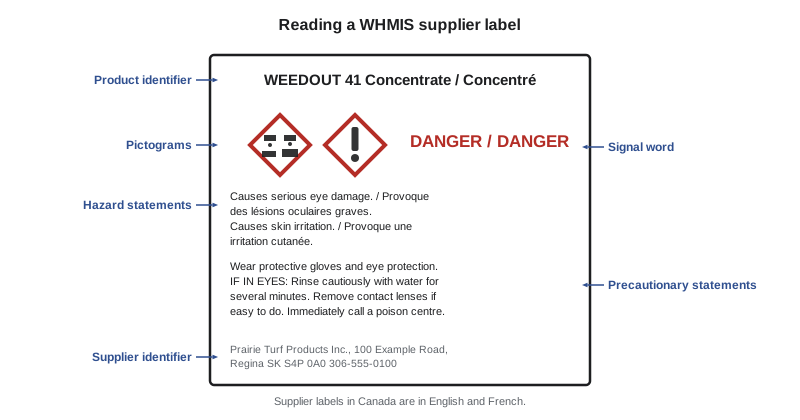
When a product is poured into another container, such as a spray bottle, or when the original label falls off or becomes unreadable, the new container needs a workplace label. At Greenway, workplace labels are printed from the tablet and show the product name, how to handle it safely, and where to find the safety data sheet.
The unlabelled fungicide sprayer that Jordan found in Lesson 5 broke this rule. Nobody knew for sure what was in it. It was emptied into the hazardous waste drum, and the greenhouse now has a box of pre-printed workplace labels next to the mixing bench.
Pictograms
Pictograms give a quick visual sign of the type of hazard. WHMIS uses the GHS pictograms, plus one of its own for biohazardous infectious materials.
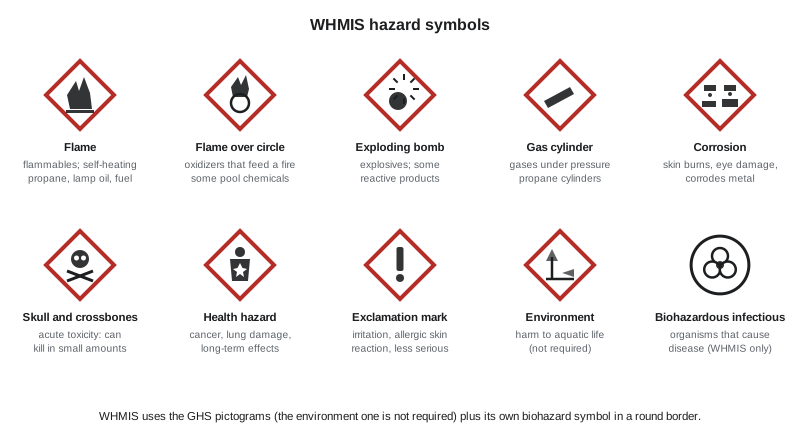
A few are easy to mix up. The flame means the product can burn. The flame over a circle means it is an oxidizer, which makes other things burn more fiercely; some pool chemicals are oxidizers. The exclamation mark means less serious health effects, such as skin irritation. The health hazard symbol, a person with a star-shaped burst on the chest, means serious or long-term effects, such as cancer, lung damage or harm to an unborn child. The corrosion symbol means the product can burn skin and damage eyes, or eat through metal.
A product can carry several pictograms. The weed killer concentrate Marisol held up carried the corrosion pictogram and the signal word 'danger', because it can cause serious eye damage. The lawn fertilizer carried only the exclamation mark and 'warning', for mild skin and eye irritation. They looked alike, but the labels told a very different story.
Safety data sheets
A safety data sheet, or SDS, is a document of several pages with detailed information about a product. Every hazardous product must have one from the supplier, and the employer must keep it where workers can get to it easily. At Greenway, the SDSs are in a binder in the chemical room and on the staff tablet, searchable by product name.
Every SDS has the same 16 sections in the same order, so once you know the layout, you can find information fast. The sections most useful to a worker are:
| Section | What it tells you |
|---|---|
| 1. Identification | Product name, supplier, recommended use, emergency phone number |
| 2. Hazard identification | The hazards, pictograms, signal word and statements (the same as the label) |
| 4. First-aid measures | What to do if someone breathes it in, gets it on skin or in eyes, or swallows it |
| 5. Fire-fighting measures | How to put out a fire involving the product, and what to avoid |
| 6. Accidental release measures | How to clean up a spill safely |
| 7. Handling and storage | How to use and store it safely, including what to keep it away from |
| 8. Exposure controls and personal protection | Ventilation and the PPE needed, including glove material |
| 10. Stability and reactivity | Chemicals it must not be mixed or stored with |
Section 4 is the one to find first in an emergency. The exact first aid for a chemical in the eyes, for example, can depend on the product. Section 8 tells you which gloves to use. Section 10 tells you what not to store it with; bleach and products containing ammonia, for example, can give off a toxic gas if they are mixed.
Suppliers must update an SDS when they learn significant new information about the product. Employers must make sure the SDSs they keep are current.
Products with other labels
Some products in a garden centre are covered by other laws instead of WHMIS supplier labelling. Pesticides are labelled under the federal Pest Control Products Act, and consumer products sold to the public have consumer labels. Workers still need to know their hazards and how to handle them safely, and Greenway's training covers them, but their labels look different. A pesticide label is a legal document: it says exactly how the product may be used, the PPE required, and how long people must stay out of a treated area.
Working safely with hazardous products
Marisol finished her training with a short list of rules that apply to every hazardous product at Greenway:
- Read the label before you use the product, every time, even if you think you know it.
- Use only what you have been trained to use. Ask before using anything new.
- Wear the PPE the label or SDS calls for, and check that glove material matches the product.
- Never mix products unless the label says to. Some combinations give off toxic gases or can catch fire.
- Keep products in their original containers, or in a container with a proper workplace label. Never put chemicals in food or drink containers.
- Store products as the SDS says, with incompatible products kept apart, and oxidizers such as pool chemicals away from fuels and flammables.
- Keep lids closed and containers upright.
- Wash your hands after handling chemicals and before eating, drinking or smoking.
- Know where the eyewash station, spill kit and SDSs are.
- Report spills, leaks, damaged containers, missing labels and any symptoms right away.
Worked problem
A broken bag in aisle 4
Show solution
- On a Sunday morning, a customer's cart tore a bag of granular lawn weed-and-feed in aisle 4. Granules and dust spread across the floor.
- Jordan blocked the aisle with cones and asked the customers to move to another aisle.
- He looked up the product's SDS on the tablet. Section 6 said to avoid making dust, sweep up gently or use a vacuum, and put the spill in a closed container. Section 8 said to wear gloves and eye protection.
- He put on nitrile gloves and safety glasses, swept the granules gently into a dustpan, and put them and the torn bag into a lidded pail from the spill kit, which he labelled.
- He told Priya, who logged the spill and checked the other bags on the pallet for damage.
Answer: Jordan used the SDS to choose the right PPE and cleanup method, and the spill was handled without spreading dust or exposing customers.
Propane, fuel and gases
Not every hazardous product sits on a shelf. Greenway's propane cylinder cage holds dozens of 9 kg (20 lb) barbecue cylinders, and the yard stores gasoline and diesel for the chipper and loader. Propane is a flammable gas stored under pressure, so its label carries the flame and gas cylinder pictograms. It is heavier than air, which means a leak can flow along the ground and collect in low spots, drains and basements, where a spark can ignite it.
The rules for these products are strict. Cylinders are stored upright in the outdoor cage, away from doors, drains and heat, and are never brought inside the store. Only trained staff exchange cylinders, and they check the valve is closed and the cap is on before moving one. Fuel is kept in approved, labelled safety cans, and refuelling is done outdoors with the engine off and cooled, with no smoking anywhere nearby. If anyone smells gas, the rule is to move people away, not to touch any switches, and to call a supervisor and, if needed, 911 from a safe distance.
Training
Under WHMIS, employers must train workers on the hazards of the products they work with, how to read labels and SDSs, and the procedures for safe use, storage, handling and emergencies. General WHMIS training is not enough on its own; it must be backed up by training on the actual products at the worker's workplace. Training should be reviewed at least once a year, and whenever conditions change.
Common mistakes
MistakeAssuming two products that look alike have the same hazards.
InsteadRead the label every time; similar packaging can hide very different hazards.
MistakePouring a product into an unlabelled spray bottle.
InsteadPut a workplace label on any container you fill.
MistakeMixing cleaning or pool products to make them stronger.
InsteadNever mix products unless the label says to; some combinations make toxic gas.
MistakeUsing any gloves for chemical work.
InsteadCheck section 8 of the SDS or the label for the right glove material.
MistakeLooking for the SDS only after an emergency starts.
InsteadKnow where the SDSs are before you need them, and find section 4 first in an emergency.
Summary and key terms
- Chemicals can cause physical hazards, such as fire and explosion, and health hazards, such as burns, poisoning and long-term illness.
- Chemicals enter the body by breathing, skin and eye contact, swallowing and injection.
- WHMIS is based on the GHS and rests on labels, safety data sheets and worker education.
- Labels show the product identifier, pictograms, a signal word, hazard and precautionary statements and the supplier; containers you fill need workplace labels.
- Every SDS has 16 sections; section 4 covers first aid, section 8 covers PPE and section 10 lists what not to mix or store together.
- Read the label, use the right PPE, never mix products, keep containers labelled and closed, wash your hands and report problems.
- GHS
- The Globally Harmonized System of Classification and Labelling of Chemicals, developed by the United Nations.
- Safety data sheet (SDS)
- A 16-section document with detailed information about a hazardous product, its hazards and how to use it safely.
- Pictogram
- A hazard symbol inside a red diamond border on a label.
- Signal word
- A word on a label showing how severe the hazard is: 'danger' for more severe or 'warning' for less severe.
- Workplace label
- A label made at the workplace for a container that has been filled or whose original label is missing.
Practice problems
Work each problem on paper first, then reveal the answer to check.
Name the four routes of entry for chemicals.
Show answer
Breathing in, skin and eye contact, swallowing and injection.
Which SDS section should you look at first in an emergency?
Show answer
Section 4, first-aid measures.
What does the flame over a circle pictogram mean?
Show answer
The product is an oxidizer, which can make other materials burn more fiercely.
You fill a spray bottle from a jug of concentrate. What must you do?
Show answer
Put a workplace label on the spray bottle with the product name, safe handling information and where to find the SDS.
What are the two signal words, and what do they mean?
Show answer
'Danger' for more severe hazards and 'warning' for less severe hazards.
Lesson quiz · 5 questions
Score 60% or more to complete this lesson.
Create a free account to save your progress, take quizzes and earn a certificate.