
HSE-101 · Lesson 4 of 12 · 21 min
Responsibilities of workers, supervisors and employers
One Saturday in May, the yard at Greenway was packed. Cars lined the pickup lane, the phones rang without stopping, and three customers were waiting for loads of mulch. Jordan saw a new seasonal worker, Ethan, climb onto the forks of a parked forklift to reach a box on a high shelf in the warehouse. Ethan was only 1 m (3 ft) off the ground, and he laughed when Jordan stared. 'It's faster than finding the ladder,' he said.
Jordan was not Ethan's supervisor, and he had only been at Greenway for three weeks himself. But he knew riding on forks was forbidden, and he knew why: a forklift is not built to lift people, and a fall or a sudden movement of the mast can crush or kill. He told Ethan to get down, then he told Priya. Priya talked to Ethan, then went to find out why the rolling ladder was not where it should have been. It had been taken into the store for a display and not brought back.
That small event shows three kinds of responsibility at once. Ethan had a duty to work safely and not to take shortcuts. Jordan, as a co-worker, had a duty to speak up. Priya, as a supervisor, had a duty to deal with the unsafe act and to fix the condition behind it. And Greenway, as the employer, had a duty to provide the right equipment and to make sure it was where people needed it. This lesson looks at each of those duties.
Why everyone has duties
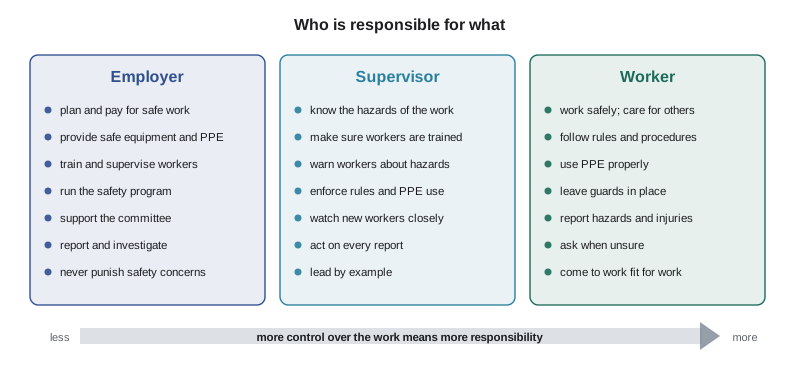
Lesson 2 explained the internal responsibility system: everyone in the workplace is responsible for health and safety within their own authority. The more control you have over the work, the more responsibility you have. Part III of The Saskatchewan Employment Act sets out general duties for employers, supervisors, workers and others, such as contractors, suppliers and owners. The regulations add more specific duties.
Responsibility in safety is not about blame. It is about who is in a position to do what. A worker cannot buy a new forklift, but they can check it before use and report a fault. An employer cannot watch every lift, but it can make sure the right equipment is there and people are trained to use it. When everyone does what is within their reach, hazards get caught early.
The employer's duties
The employer has the biggest share of responsibility, because it decides how the work is organized, what equipment is bought, who is hired and how they are trained. In plain terms, the employer must:
- Find and control hazards. Look at every job for hazards, decide how to control them, and keep checking. Lesson 5 covers how.
- Provide safe equipment and a safe place to work. That includes maintaining it, guarding machines, providing protective equipment and keeping floors, aisles and exits clear.
- Train and supervise workers. Make sure every worker knows the hazards of their job and how to do it safely before they start, and that a competent supervisor is in charge.
- Set up a safety program. Have written policies and procedures, plan for emergencies, provide first aid, and keep records.
- Involve workers. Support the committee or representative, consult workers about changes, and respond to concerns.
- Report and investigate. Report serious incidents to the regulator and workers' compensation, and investigate incidents to prevent them happening again.
- Never punish workers for raising safety issues.
In Saskatchewan, the employer's general duties are in Division 3 of Part III of the Act. One important duty is to make sure that supervisors are competent: that they have the knowledge, training and experience to do the job safely and to recognize the hazards of the work they direct.
At Greenway, Tom Bergeron, the general manager, holds the employer's responsibility on behalf of the owners. He signs the safety policy, sets the budget, and chairs a monthly safety review. But he cannot do it alone. He relies on his supervisors to make the program work every day.
The supervisor's duties
Supervisors are the link between the employer's plans and the work actually being done. A supervisor is anyone who directs the work of others, whether they are called a supervisor, a lead hand, a shift manager, a foreman or something else. For a new worker, the supervisor is the most important person for safety.
A supervisor must:
- Know the hazards of the work they direct and the controls for them.
- Make sure workers are trained before they start a task, and check they can actually do it.
- Tell workers about hazards and how to protect themselves.
- Make sure rules are followed, including the use of protective equipment, and act when they are not.
- Watch new and young workers more closely, until they can work safely on their own.
- Act on reports. When a worker reports a hazard or a near miss, the supervisor must look into it and fix it or pass it up.
- Lead by example. Workers notice when a supervisor skips the safety glasses or walks across the forklift lane.
The Act gives supervisors their own legal duties, separate from the employer's. A supervisor who knowingly lets a worker do something dangerous can be held responsible.
Priya takes this seriously. When she saw Ethan on the forks, she did not just tell him off. She asked why he had done it, found the missing ladder, and asked the store team to sign the ladder out and back in on a board. She also added a five-minute talk about working at height to the next morning's huddle. 'If I just yell at Ethan,' she said later, 'the ladder is still missing tomorrow, and someone else climbs the forks.'
The worker's duties
Workers have fewer duties than employers and supervisors, but the ones they have matter. Every worker must:
- Work safely, taking reasonable care to protect themselves and others.
- Follow the rules and procedures, including safe work procedures and the law.
- Use the equipment and protective gear they are given, and use it properly.
- Not remove or disable guards or safety devices.
- Report hazards, near misses and injuries to their supervisor right away.
- Not do work they are not trained for, and ask when they are unsure.
- Not harass or be violent toward others, and not take part in horseplay that puts people at risk.
- Not work while impaired by alcohol, drugs, including cannabis, or fatigue to the point where they cannot work safely.
- Cooperate with the supervisor, the committee and anyone else with safety duties.
These are worker duties under Division 3 of Part III of the Act. Workers who ignore them can be disciplined by the employer, and in serious cases can be charged under the Act.
Duties to co-workers
Jordan was not Ethan's boss, but he still had a part to play. Workers have a duty to take reasonable care for the safety of others, not only themselves. That does not mean policing your co-workers. It means not staying silent when you see someone about to get hurt, and telling your supervisor if it keeps happening.
Speaking up to a co-worker can feel awkward, especially when you are new and they have been there longer. Doug gave Jordan some advice: 'Don't make it about them. Make it about the hazard. Say "hey, those forks aren't rated for people, I don't want to see you fall," not "you're breaking the rules." Most people just need a second to think.'
Fit for work
One worker duty deserves a closer look: coming to work able to work safely. Impairment is not only about alcohol and drugs. A worker who has slept three hours, who is taking a new medication that causes drowsiness, or who is ill can be just as much of a danger on a forklift as one who has been drinking. Cannabis is legal for adults in Saskatchewan, but being legal does not make it safe at work, in the same way that alcohol is legal but not allowed on shift.
Greenway's fitness for work policy asks workers to tell their supervisor if anything might affect their ability to do their job safely that day. They do not have to explain medical details. The supervisor's job is to find them safer work for the shift, such as working the till instead of driving. Jordan once had to do this himself, after a night with almost no sleep when his younger brother was in hospital. Priya moved him from the yard to pricing plants in the greenhouse for the morning. 'Nobody's going to hold that against you,' she said. 'Telling me is the responsible thing.'
| Task: driving a forklift | Who | Duty |
|---|---|---|
| Buy a forklift that is safe and suited to the work | Employer | Provide safe equipment |
| Train and evaluate the operator | Employer and supervisor | Train and supervise |
| Check the forklift before each shift | Operator | Work safely and report faults |
| Take a faulty forklift out of service | Supervisor | Act on reports |
| Keep people on foot out of the forklift lane | Everyone | Follow rules and protect others |
Others with duties
Workplaces include more people than the employer's own staff. Many of them have safety duties too.
- Contractors who come to repair the coolers or maintain the trucks must work safely, follow the site's rules, and coordinate with the host employer about hazards they create or face.
- Suppliers of equipment and chemicals must provide equipment that is safe when used as intended, and chemicals with proper labels and safety data sheets.
- Owners of the building must keep the parts they control, such as the roof, the structure and the fire alarm, in safe condition.
- Temporary agencies and the businesses that use their workers share duties for those workers.
- Customers and visitors are not workers, but the employer must protect them, and can set rules for them, like Greenway's rule that customers stay with their vehicles in the yard.
Worked problem
Sorting out who does what
Show solution
- A pallet of 40 bags of fertilizer arrives with several bags torn open. Fertilizer dust is on the dock floor.
- Worker: Jordan, who is unloading, stops, puts on gloves and safety glasses as the safety data sheet says, sets out cones and tells Priya. He does not sweep the dust into the air with a dry broom.
- Supervisor: Priya checks the product's safety data sheet, has the spill cleaned up with the spill kit and a vacuum, and makes sure the damaged bags are set aside, not put on the store shelf.
- Employer: Greenway's receiving procedure is updated so that damaged deliveries are refused or set aside in a marked area, and the purchasing manager contacts the supplier.
- Supplier: The supplier must make sure its pallets are wrapped and loaded so bags arrive intact, with readable labels.
Answer: Each person acted within their own reach, and the hazard was fixed at the source, not just cleaned up once.
When duties are not met
Most of the time, people meet their duties without thinking about them. Things go wrong when duties are skipped, often because of time pressure, poor communication, or a belief that 'someone else will deal with it.' On busy Saturdays at Greenway, that belief was the biggest risk. Everyone was rushing, and everyone assumed the hazard they saw had already been reported.
The answer was not to tell people to try harder. Priya and the committee set up a short huddle at the start of each Saturday shift, where the lead named the jobs that would be most rushed and who would watch for what. They also put the near-miss form on a QR code in every work area, so reporting took less than a minute.
Common mistakes
MistakeThinking safety is only the employer's or the safety manager's job.
InsteadKnow that workers, supervisors and employers each have duties within their own control.
MistakeAssuming someone else has already reported the hazard.
InsteadReport it yourself; a duplicate report costs nothing.
MistakeSupervisors correcting the worker but not the condition.
InsteadAsk why the unsafe act happened and fix the cause, like the missing ladder.
MistakeStaying silent when a co-worker is about to get hurt.
InsteadSpeak up about the hazard in a respectful way, and tell your supervisor.
MistakeDoing a task you have not been trained for because you were asked to.
InsteadSay you have not been trained, and ask to be shown first.
Summary and key terms
- Everyone in a workplace has health and safety duties, and the more control a person has over the work, the more responsibility they carry.
- Employers must find and control hazards, provide safe equipment, train and supervise workers, run a safety program, involve workers and report incidents.
- Supervisors must know the hazards, make sure workers are trained, enforce rules, watch new workers closely, act on reports and lead by example.
- Workers must work safely, follow rules, use protective equipment, leave guards in place, report hazards and injuries, and not work impaired.
- Contractors, suppliers, owners and temporary agencies also have duties.
- Good supervisors fix the condition behind an unsafe act, not only the act itself.
- Employer
- The person or organization that hires workers and controls how work is organized, equipped and paid for.
- Supervisor
- Anyone who directs the work of others, whatever their job title.
- Competent
- Having the knowledge, training and experience to do a job safely and recognize its hazards.
- Safe work procedure
- Written steps for doing a task safely, including the hazards, controls and equipment needed.
- Impairment
- A reduced ability to work safely because of alcohol, drugs, fatigue or another cause.
Practice problems
Work each problem on paper first, then reveal the answer to check.
Name three duties of an employer.
Show answer
Any three: find and control hazards, provide safe equipment, train and supervise, run a safety program, involve workers, report and investigate incidents, not punish workers for raising safety issues.
Why did Priya look for the missing ladder after talking to Ethan?
Show answer
Because the unsafe act happened partly because the right equipment was not where it should have been; fixing that prevents a repeat.
Who counts as a supervisor?
Show answer
Anyone who directs the work of others, whatever they are called.
What should Jordan do if he sees a co-worker about to do something dangerous?
Show answer
Speak up about the hazard respectfully and tell the supervisor.
Name two groups other than employers, supervisors and workers who have safety duties.
Show answer
Any two: contractors, suppliers, owners, temporary agencies.
Lesson quiz · 5 questions
Score 60% or more to complete this lesson.
Create a free account to save your progress, take quizzes and earn a certificate.