
HSE-101 · Lesson 11 of 12 · 21 min
Workplace violence, harassment and psychological safety
It was the Saturday before a long weekend, and the line at the tills stretched past the seed racks. A customer at Amara's till found that the sale price on his lawn mower had ended the day before. He started shouting. He called Amara stupid, leaned over the counter, and slammed his hand down next to the card reader hard enough to knock it to the floor. Lily, at the next till, froze.
Amara did what she had been trained to do. She kept her voice low, stepped back out of reach, and said she would get a manager to help him. She pressed the call button under the counter, which sounded a tone on the floor lead's radio. Within thirty seconds, the floor lead and Priya were there. Priya stood beside Amara, calmly told the man she could not help him while he was shouting, and offered to talk to him at the service desk. He swore again, then left without the mower.
Afterwards, Priya took Amara and Lily into the office, made sure they were all right, and gave them a break before they went back to the tills. Amara filled in an incident report. At the next committee meeting, Lily's freeze came up. 'She's sixteen and nobody had ever shouted at her like that,' Amara said. 'We trained the full-timers. We forgot the part-timers.'
This lesson covers workplace violence, harassment and psychological safety: what they are, how to prevent them, and what to do when they happen. HSE-108 Workplace Violence and Harassment Prevention and HSE-109 Psychological Health and Safety go much deeper.
Workplace violence
Workplace violence includes physical attacks, attempts to use physical force, and threats or behaviour that a worker could reasonably see as a threat of physical harm. In Saskatchewan, since May 17, 2024, every provincially regulated employer must have a violence policy statement and a prevention plan. The plan must identify where violence could happen, set out how it will be prevented and how workers can get help, and say how incidents will be reported and investigated.
Violence at work can come from several directions:
- Customers, clients, patients or the public, which is the most common source in retail, health care, hospitality and transit.
- Criminals, such as robbers or shoplifters, who have no other link to the workplace.
- Co-workers or former co-workers, including bullying that turns physical.
- Partners or family members of a worker, when domestic violence follows someone to work.
Some kinds of work carry more risk: handling cash, working alone or in small numbers, working late at night or early in the morning, dealing with frustrated or upset people, enforcing rules, refusing service, and working with people who are ill, intoxicated or in distress.
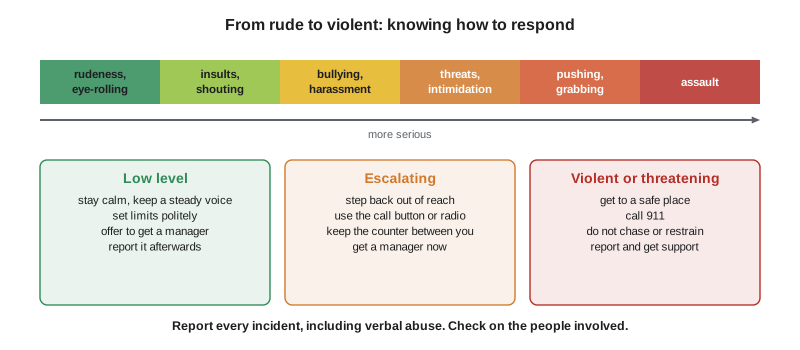
Preventing violence
Like any other hazard, violence is controlled best with several layers. At Greenway, the prevention plan includes:
- Design: counters deep enough to keep people out of arm's reach, clear sight lines from the service desk, good lighting in the parking lot, and a drop safe so little cash is kept in the tills.
- Equipment: call buttons at every till, radios for floor leads and yard staff, and cameras with signs.
- Staffing: never fewer than two people on the store floor or in the yard, and no one closing alone.
- Procedures: clear rules for refunds and price disputes so cashiers are not stuck making decisions that upset people, a procedure for refusing service, and a rule that staff never chase shoplifters.
- Training: all staff, including part-timers and seasonal workers, are trained to recognize warning signs, calm people down, and get away and get help.
- Reporting and support: every incident, including verbal abuse, is reported, and staff involved are checked on.
Responding to an angry or aggressive person
Most angry people can be calmed down. A few simple steps help:
- Stay calm and keep your voice low and steady. Anger is catching, and so is calm.
- Keep your distance. Stay out of arm's reach, keep the counter between you, and do not turn your back.
- Listen and acknowledge. 'I can see you're frustrated' often lowers the temperature.
- Do not argue or match their tone. You do not need to win.
- Offer options you are allowed to offer, such as getting a manager.
- Get help early. Use the call button or radio as soon as you feel uneasy, not when it is too late.
- Get away if the person becomes threatening. Your safety comes before any property or sale.
If a person becomes violent, or threatens violence, get to a safe place and call 911. Do not try to restrain them or fight back unless there is no other way to protect yourself. In a robbery, hand over what is asked for, do not argue, avoid sudden moves, and try to remember details to tell police afterwards.
Working alone or at night
Working alone raises the risk from violence and from any other emergency, because there is nobody to help or to call for help. A worker is alone when they cannot be seen or heard by anyone who could help them if they were hurt. At Greenway, this applies to the yard staff member who opens the gate at 6:30 a.m. and to delivery drivers out on the road.
Greenway's working alone procedure sets out a check-in system. The opener texts the floor lead when they arrive and again when the second person arrives; if the floor lead has not heard by 6:45, they call, and if there is no answer, they go or send someone. Drivers check in with the yard office after each delivery. Anyone working alone carries a phone or radio, avoids high-risk tasks such as using the chipper or the forklift until someone else is on site, and never handles cash alone after dark.
Harassment
Harassment is a pattern of unwelcome behaviour, or a single serious incident, that humiliates or intimidates a person. Saskatchewan was one of the first provinces to bring personal harassment into its health and safety law. Under The Saskatchewan Employment Act, harassment is inappropriate conduct, comment, display, action or gesture that either is based on a protected ground, such as race, religion, sex, sexual orientation, gender identity, disability, age or place of origin, or is a sexual solicitation or advance, or that harms a worker's psychological or physical well-being when the person knew or should have known it would humiliate or intimidate. It can be repeated behaviour or a single serious occurrence.
Harassment can look like:
- insults, name-calling, put-downs and mocking, including 'jokes';
- comments or jokes about someone's race, religion, gender, body, age, disability or accent;
- unwanted touching, sexual comments, sexual images or repeated requests for dates;
- spreading rumours, leaving someone out on purpose, or ganging up on them;
- shouting, swearing at or belittling someone in front of others;
- threats, intimidation or sabotaging someone's work;
- the same behaviour online, through texts, group chats and social media.
Harassment is not the same as ordinary management. A supervisor giving clear instructions, assigning work, giving fair feedback on performance or taking reasonable discipline is not harassing anyone, as long as it is done respectfully. Disagreements and the odd bad mood are not harassment either. The test is whether the behaviour is unwelcome and would humiliate or intimidate a reasonable person in that situation.
Employers in Saskatchewan must have a written harassment policy that explains what harassment is, how to report it, how complaints will be investigated, and that information will be kept confidential as far as possible. The employer must take reasonable steps to stop harassment, and workers must not harass others.
What to do if you are harassed
- Say no, if you feel safe to. Sometimes telling the person clearly that the behaviour is unwelcome is enough to stop it.
- Write it down: what happened, when, where, who was there, and what was said or done. Keep texts and messages.
- Report it to your supervisor, or to another manager or a committee member if the harasser is your supervisor. Greenway's policy names two people outside the chain of command for this.
- Get support from someone you trust, and from the employee assistance program if your workplace has one.
- Know you can go outside the workplace if needed, for example to an occupational health officer at the OHS Division, which deals with harassment under the Act, or to the Saskatchewan Human Rights Commission for harassment based on a protected ground.
If you see someone else being harassed, you can help too: check in with them, tell the harasser to stop if it is safe, back them up if they report it, and report it yourself.
Psychological health and safety
Health and safety is not only about bodies. Work can also harm mental health, through constant overload, long hours, unclear expectations, lack of control, poor support, conflict, harassment, or living through a violent or traumatic event. These are psychosocial hazards, which Lesson 5 introduced. They are hazards like any other: they can be found, assessed and controlled.
In Canada, a voluntary national standard, CSA Z1003, Psychological Health and Safety in the Workplace, sets out how employers can manage these hazards. It lists factors such as clear leadership and expectations, civility and respect, workload management, recognition, involvement and support.
Psychological safety
A related idea is psychological safety: a team climate where people feel safe to speak up, ask questions, admit mistakes and raise concerns without fear of being embarrassed or punished. Researcher Amy Edmondson at Harvard showed that teams with high psychological safety learn faster and report more problems. It matters for physical safety too. A worker who is afraid to ask 'is this safe?' or to report a near miss leaves hazards hidden.
Leaders build psychological safety by how they react. When Jordan admitted he had forgotten to chain the gate in the yard one evening, Priya thanked him for telling her and asked what would help him remember. The next week, a reminder was added to the closing checklist. If she had shouted at him, the next person would have kept quiet.
Looking after yourself and each other
Everyone has hard days. Some simple habits help: take your breaks, eat and drink, keep regular sleep where you can, and talk to someone if work stress is building up. Watch for co-workers who seem withdrawn, stressed or not themselves, and check in with them. If someone tells you they are thinking about harming themselves, take it seriously, stay with them, and get help, through a crisis line or emergency services if needed.
After the Saturday incident, Priya made sure Amara and Lily knew about Greenway's employee assistance program, which offers free, confidential counselling. Lily used it once. 'It helped to talk to someone who wasn't my mom,' she told Amara later.
Worked problem
Fixing the part-timer gap
Show solution
- The committee found that the violence prevention training had been given to full-time staff in the off-season, but most part-time and seasonal staff were hired in spring and never got it.
- Training was moved into every new worker's first week, before their first solo shift at a till or in the yard.
- Every new cashier now spends their first two shifts on a till next to an experienced cashier, who shows them the call button and the refund rules.
- The refund and price dispute rules were simplified so any cashier can say 'I'll get a manager to help you' straight away, without being expected to argue.
- Reports of verbal abuse went up for a few months as people learned they should report them, then levelled off. No staff were hurt by a customer that season.
Answer: Closing the training gap and making it easy to get help protected the workers most at risk.
Common mistakes
MistakeTreating verbal abuse from customers as part of the job.
InsteadReport all abuse and threats; they are hazards and should be controlled.
MistakeArguing with or trying to restrain an aggressive person.
InsteadStay calm, keep your distance, get help early and get away if needed.
MistakeCalling harassment 'just a joke'.
InsteadJudge behaviour by whether it is unwelcome and would humiliate or intimidate a reasonable person.
MistakeTreating fair feedback from a supervisor as harassment.
InsteadKnow that respectful instructions, feedback and reasonable discipline are normal management.
MistakePunishing people for admitting mistakes.
InsteadThank people for speaking up so others keep reporting problems.
Summary and key terms
- Workplace violence includes physical attacks, attempts and threats, from customers, criminals, co-workers or partners.
- Since May 2024, every provincially regulated Saskatchewan employer must have a violence policy statement and prevention plan.
- Violence is prevented with design, equipment, staffing, procedures, training and reporting; staff should calm, distance, get help early and get away.
- Saskatchewan's Act defines harassment broadly, including personal harassment, and employers must have a written harassment policy.
- Fair, respectful management is not harassment; unwelcome behaviour that humiliates or intimidates is.
- Psychosocial hazards can harm mental health and should be managed; psychological safety helps people speak up about all hazards.
- Workplace violence
- A physical attack, attempt or threat against a worker at work.
- Harassment
- Unwelcome conduct, repeated or a single serious incident, that humiliates or intimidates a person.
- De-escalation
- Calming an angry or upset person through a steady voice, distance, listening and offering options.
- Psychological safety
- A team climate where people feel safe to speak up, ask questions and admit mistakes.
- Employee assistance program (EAP)
- A confidential counselling and support service paid for by the employer.
Practice problems
Work each problem on paper first, then reveal the answer to check.
Name three sources of workplace violence.
Show answer
Any three: customers or the public, criminals, co-workers or former co-workers, partners or family members of workers.
What did Amara do when the customer became aggressive?
Show answer
She kept her voice low, stepped out of reach, offered to get a manager, and pressed the call button.
Is a supervisor telling a worker to redo a task that was done wrong harassment?
Show answer
No, not if it is done respectfully; it is normal management.
List three things to do if you are harassed.
Show answer
Any three: say no if safe, write it down, report it, get support, use outside agencies if needed.
How did Priya build psychological safety when Jordan admitted a mistake?
Show answer
She thanked him for telling her and asked what would help, rather than punishing him.
Lesson quiz · 5 questions
Score 60% or more to complete this lesson.
Create a free account to save your progress, take quizzes and earn a certificate.