
HSE-101 · Lesson 10 of 12 · 21 min
Emergencies: fire, evacuation and first aid
At 2:40 on a Wednesday afternoon in July, the fire alarm went off at Greenway. Jordan was in the warehouse stacking bags of mulch. For a second he just stood there, wondering if it was a drill, and whether he should finish the pallet first. Then Doug walked past him toward the side door and said, 'Out. Now. Don't stop for anything.'
Outside, at the muster point by the front of the parking lot, the store's floor lead checked off names on the shift list. Two people were missing: a seasonal worker who had been on break in his car, and Lily, the sixteen-year-old cashier, who had gone back in to get her phone from the staff room. Lily came out a minute later, and the seasonal worker was found in the lot. The alarm had been set off by smoke from a seized motor on the greenhouse exhaust fan, which the fire department found and dealt with. Nobody was hurt.
At the debrief that afternoon, Tom was blunt. 'We got lucky twice today. Going back in for a phone is how people die in fires. And if we'd had a real fire in the back, we wouldn't have known for sure where everyone was.' The next week, every shift practised the evacuation again.
Emergencies are rare, which is exactly why people are not ready for them. This lesson covers what every new worker needs to know: how emergency plans work, what to do in a fire, how evacuation works, and the basics of first aid. HSE-105 Fire Safety and Emergency Preparedness and HSE-110 and HSE-111 on first aid go into much more detail.
Emergency plans
Every workplace should have a plan for the emergencies it could face. In Saskatchewan, the OHS Regulations require employers to plan for emergencies and to make sure workers know what to do, and the fire code, adopted in the province from the National Fire Code of Canada, requires a fire safety plan in buildings like Greenway's.
A good emergency plan answers a few simple questions:
- What could happen here? At Greenway: fire, a propane leak, a chemical spill, a serious injury, severe weather, a medical emergency such as a heart attack, a violent person, and a power failure.
- How is the alarm raised? Fire alarm pull stations, the phone, the radio and calling 911.
- How do people get out? Exit routes from every area, and doors that are never locked from the inside or blocked.
- Where do people go? The muster point, and a backup in case the first is unsafe.
- How do we know everyone is out? Shift lists, sign-in sheets for visitors and contractors, and a person responsible for checking.
- Who does what? Who calls 911, who checks washrooms and the greenhouses, who meets the fire department, who gives first aid, and who shuts off gas if it is safe.
- What about customers? Staff guide customers to the exits.
- When do we practise? Drills at least once a year, and more often for a workplace like Greenway with many new staff each spring.
Your first-day checklist
On the first day at any new job, find out the following. Write them down if it helps.
- Where are the nearest two exits from where you work?
- Where is the muster point?
- What does the alarm sound like, and how do you raise it?
- Where are the fire extinguishers, and are you expected to use them?
- Where are the first aid kit, the eyewash station and the AED?
- Who are the first aiders on your shift?
- What is the address of the workplace, so you can tell 911?
- What should you do in the other emergencies the plan covers?
Jordan had been shown all of this on his first morning, but in the moment of the alarm, his first thought was to finish the pallet. That is normal. People tend to carry on with what they are doing, wait for more information, or look to others before acting. Drills train people to act at once.
Fire
A fire needs three things: fuel, heat and oxygen. Take any one away, and the fire goes out. Most workplace fire prevention is about keeping fuel and heat apart: storing flammables properly, keeping electrical equipment in good repair, not overloading power bars, keeping hot work and smoking away from anything that burns, and keeping the place tidy so there is less to burn.
Garden centres have plenty of fuel: dry mulch, peat moss, cardboard, wooden pallets, plastic pots, propane, fuel and oxidizing pool chemicals. Greenway's fire prevention includes keeping pallets and cardboard away from buildings, a no-smoking rule across the whole site, regular checks of the greenhouse fans and heaters, and the propane cage well away from the store.
If you discover a fire
Greenway uses a simple order that most workplaces follow:
- Raise the alarm. Pull the nearest alarm station and shout 'Fire!' to warn people nearby.
- Call 911, or make sure someone has, from a safe place.
- Get out, closing doors behind you to slow the fire, and help others, including customers, to get out.
- Fight the fire only if it is small, you have been trained, you have the right extinguisher, and you have a clear way out behind you.
Most workers are never expected to fight a fire. If you are not trained, or if any of the conditions above is not met, your job is to get out and get others out.
Using a fire extinguisher
At Greenway, staff are trained to use extinguishers during orientation and again each year. The method has four steps, remembered as PASS.
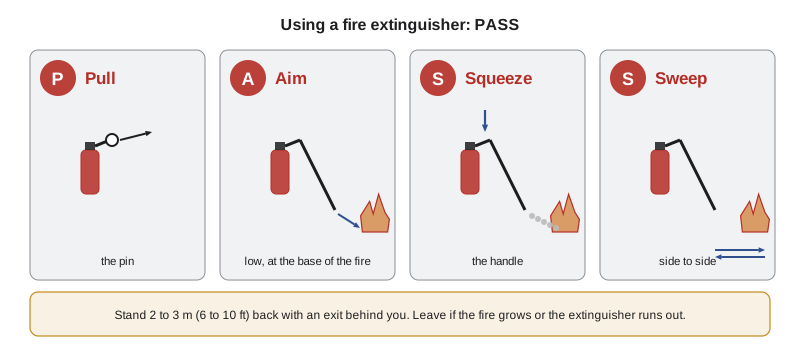
- Pull the pin.
- Aim the nozzle low, at the base of the fire, not at the flames.
- Squeeze the handle.
- Sweep from side to side across the base of the fire.
Most portable extinguishers run out in under 20 seconds. If the fire is not out by then, or if it grows, leave. The multi-purpose ABC dry chemical extinguishers used at Greenway work on ordinary materials, flammable liquids and electrical fires. Water must never be used on electrical or fuel fires.
Evacuation
When the alarm sounds, everyone leaves, every time, unless they have a specific emergency job. Treat every alarm as real.
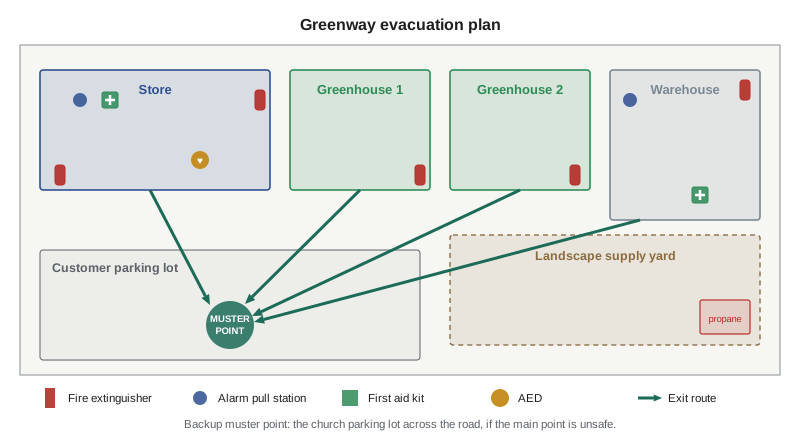
- Stop work at once. Switch off equipment only if it takes a moment and is safe.
- Leave by the nearest safe exit. If smoke is in the way, use another exit. Stay low if there is smoke, where the air is cleaner.
- Do not go back for belongings, phones, keys or anything else.
- Help customers and visitors to the exits and to the muster point.
- Go straight to the muster point and report to the person checking names. Do not leave the site without telling them, or rescuers may go looking for you.
- Stay there until someone in charge says it is safe to go back in.
The muster point is not just a place to stand. It is how the emergency team knows whether anyone is still inside. Firefighters risk their own lives searching for people who are reported missing. That is why Lily going back for her phone, and the seasonal worker staying in his car without telling anyone, mattered so much.
After the July alarm, Greenway made two changes. Every person on shift now signs in on the tablet when they arrive and out when they leave, including on breaks off site, so the shift list is always right. And the emergency plan now names a person on each shift to check the staff room, washrooms and greenhouses on the way out.
Other emergencies
Fire is not the only emergency. The plan covers others, and each has its own response. For a gas leak, move people away, do not operate switches or anything that could spark, and call 911 from a safe distance. For a chemical spill that is large or that you are not trained to clean, leave the area, keep others out, and tell your supervisor. For severe weather, such as a tornado or a severe thunderstorm with hail, the plan names an inside shelter area away from glass, which at Greenway is the warehouse's interior washrooms and office. For a violent person, Lesson 11 covers what to do.
Weather emergencies are a real part of life in Saskatchewan. Summer brings tornadoes, hail and lightning, and winter brings blizzards and extreme cold. Greenway's plan says outdoor work stops when thunder is heard, and does not restart until 30 minutes after the last thunder.
First aid basics
First aid is the help given to an injured or sick person until medical help arrives or the person recovers. It can save lives, prevent injuries from getting worse, and help people recover faster.
In Saskatchewan, the OHS Regulations require employers to provide first aid kits and trained first aiders, with the number and the size of the kits depending on how many workers are on each shift, the type of work and how far the workplace is from medical help. Greenway has at least one trained first aider on every shift, first aid kits in the store, warehouse and yard office, an eyewash station in the chemical room and greenhouse, and an AED, an automated external defibrillator, at the front counter.
If you are not a trained first aider, you still have a part to play. In an emergency:
- Check that the area is safe before you go near. Do not become a second casualty. If someone has collapsed in the chemical room, or is touching a live electrical cable, do not rush in.
- Call for help. Shout for the first aider, and call 911 or have someone call. Give the address and what has happened.
- Send someone for the AED if the person is not breathing normally. AEDs talk you through what to do.
- Stay with the person and reassure them until the first aider or paramedics arrive.
- Do not move someone with a possible head, neck or back injury unless they are in danger where they are.
First aid kits are for everyone, but the first aider knows how to use them properly. Wear gloves from the kit before touching blood or bodily fluids. Report every use of first aid, as Jordan learned in Lesson 6, so the injury is recorded and the kit gets restocked.
Cold and heat at Greenway
In winter, Saskatchewan's cold can cause frostbite and hypothermia. Frostbite often starts with numb, white or waxy skin on fingers, toes, ears or the face. Hypothermia, a dangerous drop in body temperature, shows as shivering, clumsiness, slurred speech and confusion. Anyone with signs of hypothermia must be moved somewhere warm, covered with dry layers, and given medical help. In summer, heat illness is a risk too, especially in the greenhouses, so the heat signs in HSE-110 apply here as well.
Worked problem
A collapse in the yard
Show solution
- On a hot afternoon in late May, a delivery driver collapsed beside his truck in the yard. Jordan was the nearest person.
- He checked for traffic, waved the forklift to stop, and went to the driver. The man was breathing but confused and did not answer questions properly.
- Jordan radioed for the first aider and asked Doug to call 911 with the address. Then he stayed with the driver and kept him still.
- The first aider arrived in under a minute, checked him, and found he had been unloading in the sun since dawn and had not had any water. They moved him to the shade and started cooling him.
- Paramedics took him to hospital with heat exhaustion. He recovered fully. Priya made sure the incident was reported, and the next week the receiving procedure was changed so drivers are offered water and shade on arrival.
Answer: Jordan made the scene safe, called for help, and stayed with the person, which is exactly what a worker without first aid training should do.
Common mistakes
MistakeTreating an alarm as a drill and finishing what you are doing.
InsteadTreat every alarm as real and leave at once.
MistakeGoing back inside for belongings.
InsteadLeave everything; nothing is worth your life.
MistakeLeaving the site without reporting at the meeting point.
InsteadReport to the person checking names, so nobody is searched for in vain.
MistakeFighting a fire without training or a clear exit behind you.
InsteadFight only small fires you are trained for, with the right extinguisher and a way out; otherwise get out.
MistakeRushing to help someone without checking the area is safe.
InsteadCheck for dangers first so you do not become a second casualty.
Summary and key terms
- Every workplace needs an emergency plan that covers raising the alarm, getting out, meeting up, accounting for everyone and who does what.
- On your first day, find the exits, the meeting point, the alarm, the extinguishers, the first aid kit, the AED and the first aid people.
- If you find a fire, raise the alarm, call 911, get out and help others; fight it only if it is small, you are trained and you have a way out.
- PASS stands for pull, aim, squeeze and sweep.
- During an evacuation, leave at once, never go back, go to the meeting point and stay until told it is safe.
- In a medical emergency, check the area is safe, call for help and the AED, and stay with the person until trained help arrives.
- Emergency plan
- A written plan that sets out how a workplace will respond to fires and other emergencies.
- Muster point
- The place outside where everyone gathers after an evacuation so they can be counted; also called an assembly point.
- PASS
- A way to remember how to use a fire extinguisher: pull, aim, squeeze, sweep.
- AED
- An automated external defibrillator, a device that can restart a heart in some kinds of cardiac arrest.
- First aid
- Help given to an injured or sick person until medical help arrives or the person recovers.
Practice problems
Work each problem on paper first, then reveal the answer to check.
What three things does a fire need?
Show answer
Fuel, heat and oxygen.
Name the four steps of PASS.
Show answer
Pull the pin, aim at the base of the fire, squeeze the handle, sweep side to side.
Why did Lily going back for her phone matter so much?
Show answer
She could have been trapped, and if she had been reported missing, firefighters would have risked their lives searching for her.
When should you not try to fight a fire?
Show answer
When it is not small, you are not trained, you do not have the right extinguisher, or you do not have a clear way out.
What should a worker without first aid training do when someone collapses?
Show answer
Check the area is safe, call for the first aid person and 911, send for the AED if needed, and stay with the person.
Lesson quiz · 5 questions
Score 60% or more to complete this lesson.
Create a free account to save your progress, take quizzes and earn a certificate.