
GEOM-499 · Lesson 12 of 12 · 21 min
Final presentation
The capstone ends with a public presentation. The audience in the lecture theatre at Oldman Valley University includes the two clients, the mentor firm, faculty examiners, other students and, this year, two homeowners from the crest of Coulee Ridge who saw the city's letter and asked to come. The team has 18 minutes to speak and 8 minutes for questions. In that time it must explain what it did and found to a mixed audience, show that the work is sound, answer hard questions honestly, and hand the project over. This lesson covers how the team plans, rehearses and delivers that talk, how it handles questions, how it closes the project, and what it learns.
One story, one main message
A good technical talk tells a story: here was a question that mattered, here is what we did to answer it, here is what we found, and here is what should happen next. Nadia insists that the team agree the main message before anyone makes a slide. They settle on one sentence: 'Most of the Coulee Ridge slope shows no detectable change, but a block above the canal moved about 2 cm last winter while the canal toe below it eroded, and both should be assessed before the next irrigation season.' Every slide must support that sentence or be cut.
The audience shapes the story. Faculty examiners want to see sound methods and quality evidence. The clients want findings and recommendations they can act on. The homeowners want to know whether their houses are at risk. The team cannot give each group a separate talk, so it orders the material from general to specific: the question and the answer first, in plain words, then the methods and evidence, then the details that specialists care about, and finally the recommendations. A listener who drifts off halfway still leaves with the main message.
Planning the time
Eighteen minutes is less than it sounds. At a comfortable speaking pace of about 130 words per minute, it is about 2,300 spoken words, a quarter of the written report. The team divides the time by section, gives the most time to results, and plans about one and a half slides per minute, so that no slide stays on screen so long the audience stops looking or so briefly that nobody can read it.
# Coulee Watch: final talk plan and project closeout
slides = [("problem and client", 2.0), ("site and requirements", 2.0), ("control and data", 3.0),
          ("processing and quality", 3.0), ("results: change and movement", 4.0),
          ("recommendations", 2.5), ("lessons learned", 1.5)]
talk = sum(t for _, t in slides)
words = 130 * talk
print(f"talk {talk:.1f} min, about {words:.0f} spoken words, then 8 min of questions")
for name, t in slides:
    print(f"  {name:28s} {t:3.1f} min  {round(t * 1.5)} slides")
BAC, AC_final, EV_final = 1200.0, 1268.0, 1200.0
print(f"final cost performance index {EV_final / AC_final:.3f} "
      f"({AC_final - BAC:+.0f} h, {AC_final / BAC - 1:+.1%})")
reqs_met = {"R1": True, "R2": True, "R3": True, "R4": True, "R5": True,
            "R6": True, "R7": True, "R8": True, "R9": True}
print(f"requirements met {sum(reqs_met.values())} of {len(reqs_met)}")talk 18.0 min, about 2340 spoken words, then 8 min of questions problem and client 2.0 min 3 slides site and requirements 2.0 min 3 slides control and data 3.0 min 4 slides processing and quality 3.0 min 4 slides results: change and movement 4.0 min 6 slides recommendations 2.5 min 4 slides lessons learned 1.5 min 2 slides final cost performance index 0.946 (+68 h, +5.7%) requirements met 9 of 9
Each member presents the part they led, which the advisor expects and which shows the team's division of work. The hand-overs between speakers are planned and rehearsed, so that each speaker introduces the next and the story continues rather than restarting four times.
Slides that work
Slides support the speaker; they are not the report. The team follows a few rules. Each slide has a headline that states its point as a sentence, not a topic: 'Two targets above the canal moved about 2 cm downslope' rather than 'Target results'. Each slide shows one idea, usually through a map, chart or photo, with as few words as possible. Text is large enough to read from the back of the room, which in practice means at least about 24 points. Colours follow the accessible palette from lesson 9. Numbers on slides are rounded to what matters: 2 cm, not 20.8 mm, with the precise values in the report for anyone who needs them.
The most important slide is the change map with the targets. Liam builds it in three steps on screen: first the slope and canal on the orthomosaic, then the change classes with the white 'below detection' class explained aloud, then the target arrows with their error ellipses. Building a complex graphic in steps lets the audience understand each layer before the next appears.
Showing uncertainty in a talk
Uncertainty is harder to convey in speech than in writing, and easy to drop. The team practises phrases that carry it without sounding evasive. 'We can detect changes larger than about 10 cm on open ground; smaller changes may exist but we cannot see them.' 'Two targets moved about 2 cm; with our measurement precision, anything over about 1.4 cm is real.' 'The radar shows slower movement than the targets; we explain three possible reasons and recommend a specialist look at both.' Stated plainly, uncertainty makes the team more credible, not less.
Worked problem
Choosing how to state a result
A homeowner asks during questions: 'Is my house going to slide into the coulee?' The house is on the crest, where no movement was detected. Which answer is best, and why?
Show solution
- Answer A: 'No, the slope is completely safe.'
- Answer B: 'We cannot comment on that.'
- Answer C: 'At the crest below the houses we detected no movement over the six months we measured, and our survey would have detected about 1.5 cm at the targets there. Whether the slope is stable over the long term is a geotechnical question, and we have recommended the city have a geotechnical engineer assess it.'
Answer: Answer C is best. It states what was measured and how well, avoids a safety claim the team is not qualified to make, and tells the homeowner what is being done. Answer A overstates the evidence; answer B is unhelpful and sounds evasive.
Rehearsal
The team rehearses four times. The first rehearsal runs 26 minutes, eight over. The results section has three slides on the radar processing that matter to the team but not to the audience; they move to backup slides. The second rehearsal, in front of Leah, runs 19 minutes, and her main comment is that the first two minutes explain the course rather than the problem. The opening is rewritten to start with a photograph of the eroded canal toe below the new houses and the clients' two questions. The third rehearsal is timed with a stopwatch section by section. The fourth is in the lecture theatre itself, to check the projector, the colours and the sound.
Rehearsal also prepares for questions. Each member writes down the five hardest questions they can imagine and how they would answer. The team prepares backup slides for the most likely: the adjustment statistics, the checkpoint distribution, the radar geometry, the cost of continuing the monitoring and the limitations. Backup slides are numbered so they can be found quickly.
Handling questions
The questions come from every direction. A faculty examiner asks why the team did not fly a lidar drone; Sofia explains the budget and the toe scans in thirty seconds. Marta asks how often she should repeat the survey; Nadia answers twice a year, in October and April, and explains why. A homeowner asks the question in the worked example above, and Jonas gives answer C, almost word for word, because the team rehearsed it. Claire asks whether the city should hold the next phase of building permits; the team says that is a decision for the city based on the geotechnical assessment, and that the data are available to support it.
Two habits help. Repeat or rephrase the question before answering, so that the whole room hears it and the speaker has a moment to think. And when you do not know, say so and offer to follow up: an examiner asks how the movement compares with published rates for similar coulee slopes in the region, and Liam says he has not compared them, will look, and will send the answer to the examiner and the clients. He does, two days later.
Closing the project
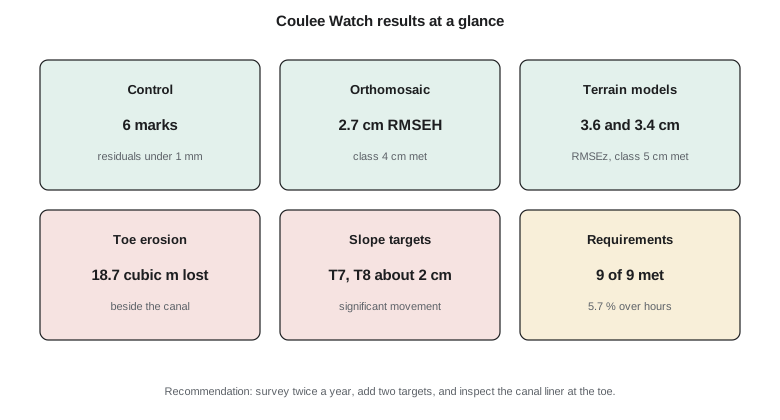
After the talk, the project is formally closed. The final earned value shows the team used 1,268 hours against a budget of 1,200, 5.7 percent over, with a final cost performance index of 0.946. The corrective actions taken at the week 12 review recovered about half of the overrun forecast then. All nine requirements are met, with the limitation on change detection in tall vegetation documented. The data, code and report are handed over with the manifest, and both clients confirm in writing that they have received and verified them.
| Closeout item | Status |
|---|---|
| Requirements R1 to R9 | All met; vegetated change detection limitation documented |
| Hours | 1,268 used against 1,200 budget (+5.7 %) |
| Data handover | Manifest verified by both clients |
| Control marks | Left in place, described and handed to the clients for future epochs |
| Slope targets | Left in place; locations and descriptions handed over |
| Equipment | Returned to the university and Coulee Geomatics, with a damage report for one tripod |
| Lessons learned | Recorded and given to next year's capstone teams |
Lessons learned
The team's last meeting is a lessons-learned review. It asks what went well, what went badly and what the team would do differently, and records the answers for future capstone teams. What went well: the requirements based on the level of detection, the decision to screen field logs before leaving the site, and the early memo to the clients in March. What went badly: the oblique flight lost to wind, which started the schedule slip; the underestimate of processing time for the dense matching; and the late discovery of the target-marking error in the bundle adjustment. What they would change: book three reserve field days instead of two, run a small pilot flight and full processing test in the first month, and have a second person check every control target marking before the final adjustment.
The review also looks at the team itself. The charter helped in February, when a member fell behind during exams; the agreed process, a conversation at the weekly meeting and a redistribution of two tasks, avoided resentment. The peer evaluations at the end, required by the course, are consistent with each other, which the advisor reads as a sign that the team worked well.
From capstone to practice
Six months later, Coulee Geomatics is hired to continue the monitoring. The October survey uses the team's control marks, targets, flight plan and code, and takes half the time because everything is documented. The geotechnical engineer's assessment, informed by the team's data, finds a shallow slide above the canal toe driven by seepage and erosion, recommends drainage and toe protection, and finds no evidence of deep movement that would affect the houses on the crest. The city releases the next phase of building permits with a condition for continued monitoring. Two of the four students, now engineers in training, work on the follow-up.
That outcome is the real test of a capstone: not the grade, but whether the work was good enough for others to rely on and build upon. Everything in this course, and in the program before it, has been aimed at producing engineers who can do that.
Common mistakes
MistakeMaking slides before agreeing the main message.
InsteadWrite the one-sentence message first; cut any slide that does not support it.
MistakePutting every number from the report on the slides.
InsteadRound to what matters on slides; keep precise values in the report and backup slides.
MistakeAnswering a safety question with reassurance the data cannot support.
InsteadState what was measured and how well, and refer the judgment to the right specialist.
MistakeTreating the talk as the end of the project.
InsteadClose out formally, hand over data and records, and capture lessons learned.
Summary and key terms
- A capstone talk tells one story with one main message, ordered from general to specific.
- About 130 words per minute and about one and a half slides per minute help plan the time.
- Slide headlines state the point; slides show one idea with large text and accessible colours.
- Uncertainty is stated plainly; it makes the team more credible.
- Rehearsal finds overruns and prepares answers and backup slides for hard questions.
- Formal closeout, data handover and a lessons-learned review complete the project.
- Main message
- The single sentence a presentation exists to convey.
- Headline
- A slide title written as a sentence stating the slide's point.
- Backup slide
- A prepared slide held in reserve for likely questions.
- Closeout
- The formal completion of a project: requirements, handover, records and accounts.
- Lessons learned
- A structured review of what went well and badly, recorded for future projects.
- Cost performance index at completion
- Earned value divided by actual cost at the end of the project.
Practice problems
Work each problem on paper first, then reveal the answer to check.
How many spoken words fit in a 15-minute talk at 130 words per minute?
Show answer
About 1,950.
Rewrite the slide title 'Checkpoint results' as a headline.
Show answer
For example: 'The terrain model meets the 5 cm vertical class with 3.6 cm RMSE.'
Why does the team build the change map slide in three steps?
Show answer
So the audience understands each layer before the next appears.
What should you do when you do not know the answer to a question?
Show answer
Say so, offer to follow up, and do it.
The final hours were 1,268 against 1,200 budgeted for the planned work. What is the final CPI?
Show answer
1,200 / 1,268 = 0.946.
Name one lesson learned the team recorded for future teams.
Show answer
Book three reserve days, run a pilot flight and processing test early, or have a second person check control target markings.
Lesson quiz · 5 questions
Score 60% or more to complete this lesson.
Create a free account to save your progress, take quizzes and earn a certificate.