
GEOM-499 · Lesson 1 of 12 · 25 min
Team formation and project planning
The capstone is the last course in the geomatics engineering program and the first time you run a project from start to finish with nobody handing you the next step. Everything from the earlier courses comes back: control surveys, satellite positioning, adjustment, photogrammetry, lidar, remote sensing, geographic information systems, cadastral law and construction surveying. What is new is that you have to choose which of those tools to use, plan how to use them in a fixed amount of time, deliver something a real client can rely on, and defend your choices in front of people who know more than you do. This course follows one team through that experience, lesson by lesson, so that each lesson can teach a part of the capstone process using a concrete example.
The team works at Oldman Valley University in Lethbridge, Alberta, a fictional school used throughout this course. Its four members are final-year geomatics engineering students. Nadia Hussain is the project manager and quality lead. Jonas Weber leads control and satellite positioning. Sofia Reyes leads drone photogrammetry. Liam Chen leads lidar, radar interferometry and the web map. Their faculty advisor is Dr. Elaine Marsh, and their industry mentor is Leah Tran of Coulee Geomatics, the firm that appears in the earlier courses of this program. Ruth Albrecht, the firm's principal and a licensed land surveyor, agrees to review anything that touches property boundaries, and Grant Okonkwo, the field crew chief, gives the team its field safety orientation.
The project
The project comes from two clients who share a problem. Coulee Ridge, the subdivision designed in the previous course, sits at the top of a coulee. Its first phase of houses is now being built along the crest, with a geotechnical setback of 15 m from the top of bank. At the foot of the same slope, the irrigation district's main canal runs for about 1.4 km. The radar interferometry program described in the remote sensing and spatial data science courses has shown slow movement on part of this slope, and the canal operator has seen seepage and a sagging liner near its foot. Claire Fontaine, the city's planner, wants to know whether the slope below the new houses is moving. Marta Kowalchuk, the water manager, wants to know whether the canal bank is eroding or being pushed by the slope.
Both clients agree to sponsor one capstone that sets up a monitoring baseline for the slope and the canal reach and repeats it once, so that real change can be measured. The team names the project Coulee Watch. Its deliverables include a control network, two epochs of drone imagery and terrain models, terrestrial laser scans of the steepest part of the slope, a set of survey targets on the slope measured by total station, a summary of the radar movement data, a change analysis, a web map, a final report and a public presentation. The area of interest covers about 31 ha: a strip of slope about 850 m long and up to 150 m wide, plus the canal reach and its banks.
Why the capstone is different
In earlier courses, the problem was defined, the data were provided and the answer could be checked against a solution. In the capstone none of that is true. The clients describe their concerns in everyday language, not in specifications. The data have to be collected by the team, in weather that does not cooperate, on a site with real hazards and real neighbours. Nobody knows in advance whether the slope is moving, so there is no answer to check against. And the result matters: the city may change its building permits and the canal operator may spend money on repairs because of what the team reports.
The capstone is also assessed differently. Accreditation bodies in both countries expect engineering programs to show that graduates can carry out design work that meets needs within realistic constraints, work in teams, communicate with technical and non-technical audiences, and act ethically and professionally. The Canadian Engineering Accreditation Board describes these as graduate attributes; a capstone is usually where a program shows that its graduates have them. That is why your capstone grade depends on the planning documents, the peer evaluations and the presentation as well as the technical result.
Forming the team
A team of four is large enough to share field work safely and small enough to coordinate without much overhead. Each member takes a lead role, which means being the person who knows that part of the project best and makes sure it gets done, not the person who does all of it. The Coulee Watch roles follow the main technical streams of the project, plus a project manager who also leads quality. Every member works in the field, and every member reviews at least one other member's processing.
The first meeting produces a team charter. The charter is a short agreement, one or two pages, that the team writes for itself and signs. It states the purpose of the project, the roles, how decisions will be made, how and when the team will meet, how work will be shared and tracked, what the team will do if someone misses deadlines, and how disagreements will be escalated, first within the team and then to the advisor. A charter seems like paperwork in September and becomes essential in February, when the processing takes longer than expected and everyone has other courses.
| Charter item | Coulee Watch decision |
|---|---|
| Purpose | Set up and test a monitoring baseline for the slope and canal reach for two clients |
| Roles | Nadia: manager and quality; Jonas: control; Sofia: drone; Liam: lidar, radar, web map |
| Meetings | Weekly team meeting, Monday; mentor call every second Thursday; advisor monthly |
| Decisions | Consensus first; if blocked, the lead for that stream decides and records why |
| Work tracking | Shared task board; hours logged daily against the work breakdown |
| Missed commitments | Raised at the next meeting; second miss goes to the advisor |
| Field rules | Never alone on the slope or in the canal; field plan sent to the mentor the day before |
From needs to scope
Scope is what the project will deliver and, just as important, what it will not. The team's first scope statement is too broad: it promises a full slope stability analysis, a groundwater study and a canal redesign. Leah points out that those are geotechnical and hydraulic engineering tasks that need other specialists and much more time. The revised scope keeps the project inside geomatics: measure the shape of the slope and canal precisely, measure how it changes, report the change with stated uncertainty, and give the data to the specialists in a form they can use. The report will recommend further work, but it will not claim to explain why the slope moves.
Writing out what is out of scope protects both the team and the clients. The Coulee Watch scope statement excludes boundary surveys, geotechnical interpretation, design of repairs, and any work on private lots without written permission. It also states the two epochs explicitly, so that nobody expects a full year of monitoring from a two-term course.
The work breakdown structure
A work breakdown structure divides the scope into pieces small enough to estimate, assign and track. The top level for Coulee Watch has nine work packages, from the charter and planning through to the web map, report and talk. Each package is broken into tasks of a few days to a few weeks. Each task has an owner, an estimate of hours, a start date and a deliverable that shows it is done. A good rule is that a task is too large if you cannot say what will exist when it is finished.
The estimates come from three sources: the mentor's experience on similar jobs, the team's own experience from field courses, and simple calculations. For example, Sofia estimates the drone flying time from the flight plan in lesson 4, then adds time for travel, setup, target placement, battery changes and weather delays. Each student has about 300 hours for the capstone over two terms, so the budget at completion is 1,200 hours. The team keeps about ten percent of that unassigned as a management reserve.
The schedule
The schedule is driven by the site, not by the academic calendar. The canal can only be surveyed when it is empty. The district shuts the water off after the irrigation season ends in early autumn and turns it back on in the spring, so the first survey epoch must happen in the first weeks of October and the second must be finished before the canal refills in late April. Between those dates, snow and frozen ground make field work impractical, so the winter is used for processing, the radar analysis and the first draft of the report. The figure shows the result.
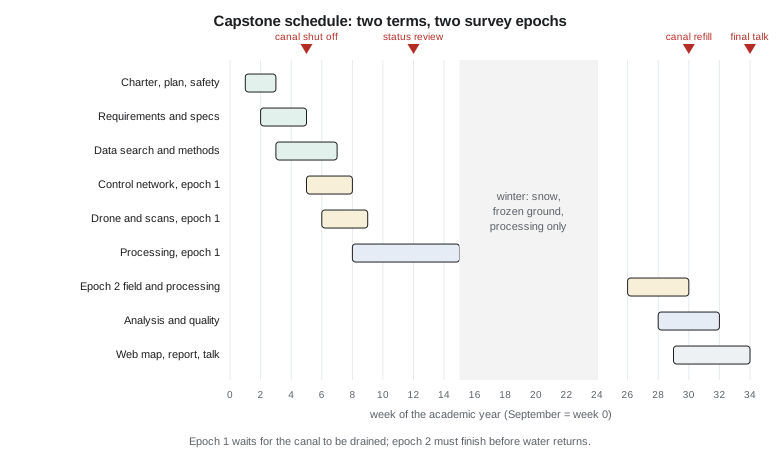
The critical path runs through the control network, the first drone survey, the processing of epoch 1, the second field epoch and the analysis. Any delay on that path delays the final talk, which cannot move. Tasks off the path, such as the data search or the web map design, have float and can absorb small delays. Nadia marks four milestones: the canal shut-off, a formal status review with the clients in week 12, the canal refill, and the final talk.
Earned value: are we on track?
Earned value management compares three numbers at a given date. Planned value is the budgeted cost of the work that should have been done by now. Earned value is the budgeted cost of the work that has actually been done. Actual cost is what has actually been spent. In a student project the currency is hours rather than dollars, but the method is the same. Two ratios follow: the cost performance index, earned value divided by actual cost, and the schedule performance index, earned value divided by planned value. Values below one mean the project is over budget or behind schedule.
At the week 12 status review Nadia runs the numbers from the team's hour log. The drone survey of epoch 1 is not quite complete because one flight was lost to wind, and processing has started late.
# Coulee Watch capstone: earned value at the end of week 12 (hours)
tasks = [  # name, budget hours, planned % done at week 12, actual % done, hours spent
    ("charter, plan and safety", 90, 100, 100, 104),
    ("requirements and specs", 70, 100, 100, 66),
    ("data search and methods", 110, 100, 90, 121),
    ("control network, epoch 1", 150, 100, 100, 172),
    ("drone and scan survey, epoch 1", 190, 100, 85, 176),
    ("processing, epoch 1", 160, 60, 35, 70),
    ("epoch 2 field and processing", 220, 0, 0, 0),
    ("analysis and quality", 110, 0, 0, 0),
    ("web map, report and talk", 100, 10, 5, 8),
]
BAC = sum(t[1] for t in tasks)
PV = sum(t[1] * t[2] / 100 for t in tasks)
EV = sum(t[1] * t[3] / 100 for t in tasks)
AC = sum(t[4] for t in tasks)
CPI, SPI = EV / AC, EV / PV
EAC = BAC / CPI
print(f"budget at completion BAC  {BAC:7.0f} h")
print(f"planned value PV          {PV:7.0f} h")
print(f"earned value EV           {EV:7.0f} h")
print(f"actual cost AC            {AC:7.0f} h")
print(f"cost variance CV = EV-AC  {EV - AC:7.0f} h")
print(f"schedule variance SV      {EV - PV:7.0f} h")
print(f"CPI {CPI:.3f}   SPI {SPI:.3f}")
print(f"estimate at completion    {EAC:7.0f} h  ({EAC / BAC - 1:+.1%} on budget)")
print(f"hours per student needed {EAC / 4:7.0f} h (plan {BAC / 4:.0f})")budget at completion BAC 1200 h planned value PV 716 h earned value EV 632 h actual cost AC 717 h cost variance CV = EV-AC -86 h schedule variance SV -84 h CPI 0.881 SPI 0.882 estimate at completion 1362 h (+13.5% on budget) hours per student needed 341 h (plan 300)
The team is about 12 percent behind both in cost and in schedule. If it keeps working at the same efficiency it will need about 1,362 hours, or about 341 hours each instead of 300. That is not a disaster in week 12, but it is a clear warning. The team decides on three corrective actions: Sofia and Liam swap the order of two processing tasks so that the terrain model needed for the analysis comes first, the mentor reviews the photogrammetry settings so that the processing does not have to be repeated, and the team uses part of its management reserve. It also agrees to drop one optional deliverable, an animation of the slope, unless time appears later.
Worked problem
An earned value check
A capstone has a budget at completion of 900 hours. At the mid-term review the planned value is 480 hours, the earned value is 420 hours and the actual cost is 400 hours. Find the cost and schedule performance indices and the estimate at completion.
Show solution
- \[\mathrm{CPI} = \frac{420}{400} = 1.05\]
- \[\mathrm{SPI} = \frac{420}{480} = 0.875\]
- \[\mathrm{EAC} = \frac{900}{1.05} = 857 \text{ h}\]
Answer: The team is efficient but behind schedule: work is costing fewer hours than planned, yet less of it is done than planned. The likely cause is a late start or a waiting task, not a productivity problem.
Risk register
A risk is an uncertain event that would affect the project if it happened. The team lists its risks in a register with a probability, an impact, a score and a response. At Coulee Watch the highest risks are weather on the field days, a drone or scanner breakdown, the canal being refilled early, a team member falling ill during an epoch, and a slope so dry and stable that no change is detected. That last one is not a failure: a well-measured result of no significant change is a valid answer, as long as the level of detection is reported.
| Risk | Probability | Impact | Response |
|---|---|---|---|
| Wind or rain on drone days | High | Medium | Two reserve days booked in each epoch |
| Canal refilled early | Low | High | Confirm the date with the water manager; canal reach surveyed first |
| Equipment failure | Medium | High | Backup GNSS receivers from the university; mentor firm as fallback |
| Illness during an epoch | Medium | Medium | Every task has a second person trained |
| Data loss | Low | High | Two copies daily, one off site; checksums on transfer |
| No detectable change | Medium | Low | Report level of detection; this is still a valid result |
Working with the mentor and the advisor
The mentor and the advisor have different jobs. The advisor is responsible for the academic assessment and for making sure the project is a fair test of the students. The mentor brings industry practice: what a client really expects, which shortcuts are safe, which are not. Neither of them does the work. The team prepares an agenda for every meeting, sends it a day ahead, records decisions and action items, and circulates the notes the same day. Meetings with a clear purpose and short notes save everyone's time and become part of the project record.
Common mistakes
MistakeStarting field work before the scope and the risks are written down.
InsteadWrite the charter, scope and risk register first; they take a week and save a month.
MistakePlanning around the academic calendar.
InsteadPlan around the site: the canal shut-off and refill set the field windows.
MistakeLetting each lead work alone in a separate stream.
InsteadHave every member review another member's work and take part in field work.
MistakeTreating a 'no change' result as failure.
InsteadA well-measured null result with a stated level of detection answers the client's question.
Summary and key terms
- The capstone asks you to choose methods, plan the work and deliver a result a client can rely on, with no answer key.
- A team charter sets roles, decisions, meetings and escalation before problems arise.
- Scope states what will and will not be delivered; keeping it inside geomatics keeps it achievable.
- The work breakdown structure, schedule and critical path turn scope into a plan; site constraints often set the schedule.
- Earned value compares planned value, earned value and actual cost to show whether the project is on track.
- A risk register names the threats in advance and plans a response to each.
- Team charter
- A short agreement on purpose, roles, decisions and conduct that a project team writes and signs.
- Scope
- The work and deliverables a project includes, and the items it explicitly excludes.
- Work breakdown structure
- A hierarchy that divides the scope into packages and tasks small enough to estimate and track.
- Critical path
- The longest chain of dependent tasks; a delay on it delays the project end.
- Earned value
- The budgeted cost of the work actually completed by a given date.
- Cost performance index
- Earned value divided by actual cost; below one means over budget.
- Schedule performance index
- Earned value divided by planned value; below one means behind schedule.
- Risk register
- A list of project risks with their probability, impact and planned response.
Practice problems
Work each problem on paper first, then reveal the answer to check.
Why does Coulee Watch need two survey epochs rather than one?
Show answer
Change can only be measured by comparing two surveys; one survey gives a baseline but no movement.
What sets the dates of the two field epochs?
Show answer
The canal shut-off in early autumn and the refill in spring, because the canal must be empty to survey it.
At week 20, PV = 800 h, EV = 760 h and AC = 840 h. Is the project over budget, behind schedule or both?
Show answer
Both: CPI = 0.905 and SPI = 0.95.
Name two items that are out of scope for Coulee Watch.
Show answer
Geotechnical interpretation of why the slope moves, and design of canal repairs (also boundary surveys).
Why should every task have a second trained person?
Show answer
So that an illness or absence during a short field window does not stop the work.
What is the difference between the mentor's role and the advisor's role?
Show answer
The advisor runs the academic assessment; the mentor brings industry practice. Neither does the work.
Lesson quiz · 5 questions
Score 60% or more to complete this lesson.
Create a free account to save your progress, take quizzes and earn a certificate.