
GCP-191 · Lesson 8 of 12 · 22 min
Commonly confused services and features
▶ Video coming soon A video version of this lesson is on the way.
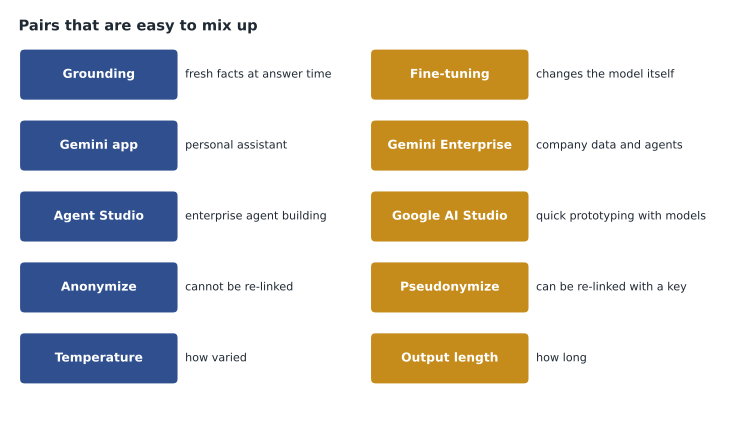
By the end of the section reviews, Jules's confusion list in the study log has grown to two pages. Few of the entries are about not knowing something. Most are about mixing up two things that sound alike or do related jobs: Agent Assist and Conversational Agents, prompt chaining and chain-of-thought, anonymization and pseudonymization. Ravi says that is normal and useful. "The exam writers know which pairs people confuse," he says, "and they put both into the options. If you can separate each pair in one sentence, a whole class of wrong answers disappears." This lesson collects the pairs that cost candidates the most marks, with a deciding difference for each and a signpost that tells you which one a question is about.
A method for separating pairs
For each confusing pair, write three things. First, one sentence that says what each one is for, using the audience or the job rather than the name. Second, the deciding difference: the single question that tells them apart, such as "does a person review it?" or "can it be reversed?" Third, a signpost phrase from a scenario that points to each. Keep the sentences short enough to say aloud in ten seconds. If you cannot, you do not yet understand the difference, and that is the pair to study next. Jules turns each pair into a card, with the deciding difference on the back.
Techniques that sound alike
Grounding and fine-tuning both improve output, but in different ways. Grounding gives the model reliable information at the moment it answers, so it is the fix for facts that are missing, private or changing. Fine-tuning changes the model's behaviour by training it on examples, so it is the fix for style, format or specialized behaviour. Deciding difference: is the problem what the model knows right now, or how it behaves? Signposts: "current", "our documents" and "cite sources" point to grounding; "consistent voice", "same structure every time" and "thousands of examples" point to fine-tuning.
Prompt engineering and prompt tuning differ in who does the work. Prompt engineering is a person writing better instructions, examples and context. Prompt tuning is a system learning a small set of values added to the input while the model stays fixed. Prompt chaining and chain-of-thought differ in structure. Prompt chaining is several prompts in a row, each using the previous output. Chain-of-thought is one prompt asking the model to reason in steps before answering. ReAct goes further, mixing reasoning with actions such as searches or tool calls and reading the results before continuing. Deciding difference: one prompt or several, and does it take actions?
Zero-shot, one-shot and few-shot differ only in the number of examples in the prompt: none, one or several. Role prompting is separate: it sets a persona, such as an experienced travel agent, and can be combined with any number of examples.
| Pair | Deciding difference | Signpost |
|---|---|---|
| Grounding / fine-tuning | What it knows now / how it behaves | "our documents" / "same structure every time" |
| Prompt engineering / prompt tuning | A person writes it / a system learns it | "rewrite the instructions" / "learned values, model fixed" |
| Prompt chaining / chain-of-thought | Several prompts / one prompt with steps | "output feeds the next step" / "show your reasoning" |
| Chain-of-thought / ReAct | Reasoning only / reasoning plus actions | "explain the steps" / "search, observe, continue" |
| Knowledge cutoff / hallucination | Missing recent facts / invented facts | "launched last month" / "confident but false" |
| Bias / fairness | A skew in data or output / whether outcomes are equitable | "under-represented in data" / "different approval rates" |
Offerings that sound alike
The Gemini app, Gemini for Google Workspace and Gemini Enterprise all put Gemini in front of people, but for different audiences. The Gemini app is a personal assistant. Gemini for Google Workspace works inside Gmail, Docs, Sheets, Slides and Meet. Gemini Enterprise connects to an organization's data across many systems, answers from it with access controls, and hosts agents. Deciding difference: one person, the Workspace tools, or the whole company's data? Signposts: "an individual", "in documents and email" and "across our internal systems".
The contact centre offerings are a frequent trap. Conversational Agents talk to customers directly, as virtual agents. Agent Assist helps human agents during live conversations with suggestions and summaries. Conversational Insights analyses many conversations afterwards to find trends and sentiment. Contact centre as a service is the platform for running the contact centre itself. Deciding difference: who is the user, the customer, the human agent or the manager, and is it live or afterwards?
Agent Search and grounding with Google Search both ground answers, but on different sources. Agent Search grounds on the organization's own content, such as product pages and help articles. Grounding with Google Search grounds on current public information. Prebuilt RAG through Agent Search and RAG APIs differ in how much you build: the prebuilt route handles indexing and retrieval for you, while the APIs let a technical team assemble its own pipeline. Model Garden and AutoML differ in what you start with: Model Garden is a catalogue of existing models to choose from, while AutoML trains a custom model on your own data with little code. Agent Studio and Google AI Studio differ in audience: governed enterprise agents versus quick prototyping by a developer.
| Pair | Deciding difference |
|---|---|
| Gemini app / Gemini Enterprise | One person's assistant / company data, access controls and agents |
| Gemini for Google Workspace / Gemini Enterprise | Inside the Workspace tools / across many company systems |
| Conversational Agents / Agent Assist | Talks to customers / helps human agents live |
| Agent Assist / Conversational Insights | During the conversation / analysis afterwards |
| Agent Search / grounding with Google Search | Own content / current public information |
| Prebuilt RAG / RAG APIs | Managed for you / assembled by your team |
| Model Garden / AutoML | Choose an existing model / train a custom one on your data |
| Agent Studio / Google AI Studio | Enterprise agents / quick prototyping |
| Gemini / Gemma | Google's multimodal models / lightweight open models |
| Imagen / Veo | Images / video |
| Document AI / Cloud Vision | Extracting data from documents / analysing images |
| Functions / extensions | Calling your own code / connecting to outside APIs |
Settings and privacy terms
Three settings are often mixed up. Temperature controls how varied the output is. Top-p also controls variety, by limiting the choice to the smallest group of likely next words whose combined chance reaches a threshold. Output length caps how many tokens the answer may use. Deciding difference: variety or length? A question about answers being cut off mid-sentence is about output length, not temperature. Safety settings are different again: they control how strictly the model blocks harmful content.
Anonymization and pseudonymization are the classic privacy pair. Anonymized data can no longer be linked to a person by anyone. Pseudonymized data replaces identifiers with codes that can be re-linked by whoever holds the key. Deciding difference: can it be reversed? Signposts: "must never be traceable" points to anonymization; "the fraud team needs to follow up on individual accounts" points to pseudonymization. SAIF and Security Command Center are another pair: SAIF is a conceptual framework for securing AI, while Security Command Center is a Google Cloud service for finding and managing security risks.
# A self-test drill: say the deciding difference before revealing it
cards = [
    ("Grounding vs fine-tuning", "facts at answer time vs a changed model"),
    ("Agent Assist vs Conversational Agents", "helps human agents vs talks to customers"),
    ("Anonymize vs pseudonymize", "cannot be re-linked vs re-linked with a key"),
    ("Temperature vs output length", "how varied vs how long"),
]
for front, back in cards:
    print("Q:", front)
    print("   A:", back)
print(len(cards), "cards reviewed")Q: Grounding vs fine-tuning A: facts at answer time vs a changed model Q: Agent Assist vs Conversational Agents A: helps human agents vs talks to customers Q: Anonymize vs pseudonymize A: cannot be re-linked vs re-linked with a key Q: Temperature vs output length A: how varied vs how long 4 cards reviewed
What this code does
A short list of flashcards pairs two easily confused ideas with the deciding difference between them. The program prints each question and its answer and then counts the cards. It is a simple self-test drill for the comparisons the exam likes to ask about.
Practice scenarios
Here are original scenarios that turn on a pair. First: a bank's virtual agent answers customers' questions about card limits in the bank's app, without a person involved. Conversational Agents or Agent Assist? Conversational Agents, because it talks to customers directly. Second: a news site's assistant must answer questions about this morning's events. Agent Search over its archive, or grounding with Google Search? Grounding with Google Search for current public events, possibly combined with the archive for older stories. Third: a team's answers are being cut off halfway through. Temperature or output length? Output length. Fourth: a data science team needs to try several open models from different providers before choosing one. Model Garden or AutoML? Model Garden. Fifth: a prompt sends a customer email to the model to extract the order number, then sends the order number and the email to a second prompt that drafts a reply. Chain-of-thought or prompt chaining? Prompt chaining.
More pairs from the guide
A few more pairs are worth a card each. Supervised and unsupervised learning differ in whether the data has labels. Structured and unstructured data differ in whether the data fits rows and columns. Bias and fairness are related but not identical: bias is a skew in data or output, and fairness is the question of whether outcomes are equitable across groups. Knowledge cutoff and hallucination both produce wrong answers, but the first is missing information and the second is invented information. Data stores and functions are both agent tools, but a data store lets the agent search content and a function lets it call code, such as checking stock levels.
Finally, first-party, third-party and world data are a trio rather than a pair: the organization's own data, data from partners and providers, and public information. A question about grounding answers in a supplier's specification sheets is about third-party data. A question about grounding in the company's own returns policy is first-party. A question about today's weather or news is world data, usually reached through grounding with Google Search.
Keep the deck small
A deck of pair cards works best when it stays small enough to review in ten minutes. Retire a card when you have answered it correctly from memory on three separate days, and add a new one whenever a practice question catches you with a pair you had not noticed. Jules's deck peaks at thirty cards in the final month and falls to twelve by the final week, which are the twelve still worth a glance on the morning of the exam.
Worked problem
Two right-sounding answers
A city council wants to study ten thousand recorded calls to its help line to learn which topics residents call about most and how satisfied they are. The options include Agent Assist and Conversational Insights. Which fits best?
Show solution
- The need is analysis across many past conversations: topics and satisfaction.
- Agent Assist helps human agents during a live call; it is not mainly an analysis tool.
- Conversational Insights analyses conversations at scale to find topics, trends and sentiment.
- The words "recorded" and "most" signal analysis afterwards, not live help.
Answer: Conversational Insights fits best. The deciding difference is live help versus analysis afterwards.
By the end of the week Jules can say every card's deciding difference aloud in under ten seconds, except two: Gemini for Google Workspace against Gemini Enterprise, and prebuilt RAG against RAG APIs. Those two go to the top of the deck.
Common mistakes
MistakeLearning pairs as two separate definitions.
InsteadLearn the single deciding difference between them.
MistakeConfusing live help with analysis afterwards.
InsteadAgent Assist is live; Conversational Insights analyses past conversations.
MistakeUsing temperature to fix truncated answers.
InsteadTruncation is about output length.
MistakeTreating pseudonymized data as anonymous.
InsteadPseudonymized data can be re-linked by whoever holds the key.
MistakeAssuming the newest-sounding offering is always right.
InsteadChoose by audience and job, not by name.
Summary and key terms
- Separate each confusing pair with one deciding difference and a signpost.
- Grounding fixes facts at answer time; fine-tuning changes behaviour.
- Prompt chaining uses several prompts; chain-of-thought asks for steps in one; ReAct adds actions.
- Gemini app, Gemini for Google Workspace and Gemini Enterprise differ by audience and data.
- Conversational Agents talk to customers; Agent Assist helps human agents; Conversational Insights analyses afterwards.
- Temperature and top-p control variety; output length controls length; anonymization cannot be reversed.
- Deciding difference
- The single question that tells two similar things apart.
- Top-p
- A setting that limits word choice to the most likely group reaching a threshold.
- Output length
- The maximum number of tokens a response may use.
- Conversational Insights
- Analysis of many conversations to find topics, trends and sentiment.
- AutoML
- Training a custom model on your own data with little code.
- Security Command Center
- A Google Cloud service for finding and managing security risks.
Practice problems
Work each problem on paper first, then reveal the answer to check.
What is the deciding difference between grounding and fine-tuning?
Show answer
Grounding supplies facts at answer time; fine-tuning changes how the model behaves.
Which offering talks to customers directly?
Show answer
Conversational Agents.
What setting fixes answers cut off mid-sentence?
Show answer
Output length.
What is the difference between Model Garden and AutoML?
Show answer
Model Garden is choosing an existing model; AutoML trains a custom one on your data.
Can pseudonymized data be re-linked?
Show answer
Yes, by whoever holds the key.
How does ReAct differ from chain-of-thought?
Show answer
ReAct adds actions such as tool calls between reasoning steps.
What is SAIF compared with Security Command Center?
Show answer
SAIF is a framework; Security Command Center is a service.
Lesson quiz · 5 questions
Score 60% or more to complete this lesson.
Create a free account to save your progress, take quizzes and earn a certificate.