
GCP-191 · Lesson 10 of 12 · 22 min
Finding and closing knowledge gaps
▶ Video coming soon A video version of this lesson is on the way.
Ravi likes to say that studying more is not the same as studying better. After the section reviews and the first practice set, Jules has a long list of things that feel shaky and very little time: the online shop's spring season starts in March, and the exam is planned for April. "You can't fix everything," Ravi says, "so we'll find out exactly which things are costing you marks and fix those first." This lesson describes a simple, repeatable way to find gaps, sort them by cause and close them: an objective checklist built from the exam guide, a diagnostic practice set, and a heat map of mistakes by section and reason. It also covers a gap that is special to this exam: keeping up with product names that change.
Start with the exam guide
The exam guide is your most reliable list of what can be tested. Copy every objective and sub-objective from the current guide into a checklist, one line each. Then rate yourself on each line with one of three marks: confident, unsure or unknown. Be honest; the point is to find gaps, not to feel good. Jules's checklist has about forty lines. Most of section 1 and section 4 are marked confident. Section 2 has a cluster of unsure marks around the contact centre offerings and the developer tools, and section 3 has two unknown marks: Feature Store, which Jules has never used, and the exact effect of top-p.
Ratings are a starting point, not a verdict. People are often overconfident about topics they use every day and underconfident about topics they have only read about. That is why the checklist is followed by a diagnostic set, which tests the ratings against real answers.
Run a diagnostic
A diagnostic is a practice set designed to cover every objective at least once, sat under timed conditions. It does not need to be full length; thirty to forty mixed questions in an hour is enough to show the pattern. Mark each answer with your confidence as you go: sure, fairly sure or guessing. Afterwards, record every question you got wrong and every question you got right by guessing. For each one, write down the section and the reason. Four reasons cover almost every mistake: you did not know the fact, you mixed up two similar things, you misread the question, or you ran out of time.
Read the heat map
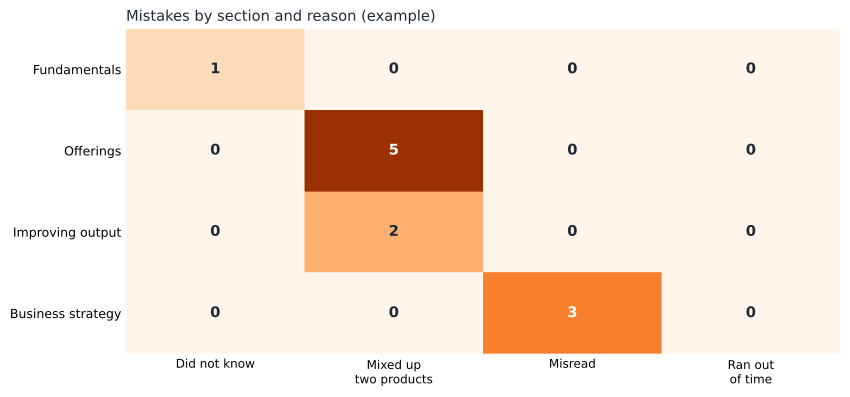
Once the mistakes are recorded, count them in a small grid: sections down the side, reasons across the top. The darkest cells tell you what to study next. In the example, the offerings section has five mistakes from mixing up two products, which points straight to the pairs in lesson 8. Business strategy has three misreads, which points not to more study of the content but to slower reading of the ask, the classic trap of answering from instinct. A section with many "did not know" mistakes needs content review. A section with time problems at the end of the set may not be a weak section at all; it may simply be where the clock ran out.
# Count mistakes by section and reason from a practice log
from collections import Counter
log = [
    ("Offerings", "mixed up"), ("Offerings", "mixed up"), ("Offerings", "did not know"),
    ("Offerings", "mixed up"), ("Strategy", "misread"), ("Output", "mixed up"),
    ("Strategy", "misread"), ("Offerings", "mixed up"), ("Fundamentals", "did not know"),
    ("Offerings", "mixed up"), ("Strategy", "misread"), ("Output", "misread"),
]
counts = Counter(log)
for (section, reason), n in counts.most_common(3):
print(f"{section:12} {reason:12} {n}")Offerings mixed up 5 Strategy misread 3 Offerings did not know 1
What this code does
Each mistake in a practice log is recorded with its exam section and the reason it happened. The program counts how often each section and reason pair appears and prints the three most common. Mixing up product offerings stands out as the main thing to review.
A fix for each reason
Each reason has a different fix, and applying the wrong fix wastes time. For "did not know", go back to the matching lesson in GCP-110, GCP-111 or GCP-112, reread the explanation, then answer three or four fresh questions on that objective without notes. For "mixed up", build or rebuild the pair cards from lesson 8 and drill the deciding difference aloud until it takes less than ten seconds. For "misread", slow down: practise underlining the ask and listing the constraints before reading the options, on a set of mixed questions, and check whether the misreads disappear. For "ran out of time", rehearse the pacing plan from lesson 9 and the two-minute cap on hard questions.
| Reason | Typical sign | Fix |
|---|---|---|
| Did not know | You could not have answered even with time to think | Reread the lesson; answer fresh questions without notes |
| Mixed up | You chose the sibling of the right answer | Pair cards with a deciding difference; drill aloud |
| Misread | You knew it but answered a different question | Underline the ask; list constraints before options |
| Ran out of time | Late questions rushed or blank | Rehearse checkpoints and the two-minute cap |
A gap special to this exam: changing names
Generative AI offerings change faster than most cloud products. Between the courses in this program being written and your exam, an offering may have been renamed, merged into a suite or moved to a different platform. The guide we read already mixed old and new names in places. That creates a particular kind of gap: you know what a tool does but not what it is called now, or you know an old name that no longer appears in the options. The fix is to tie every offering to its job and audience, as lesson 5 and lesson 8 suggested, and to check the current exam guide and Google Cloud product pages in the weeks before the exam. Note any renamed offering on its card with both names, the new one on top.
Be careful with blog posts and videos about the exam. They are often useful for motivation and study tips, but their product lists date quickly and they sometimes repeat claims, such as a passing score, that Google does not publish. Use Google's own pages as the source of truth, and treat everything else as a second opinion to check.
Closing gaps without losing strengths
Spend most of your remaining time on the darkest cells of the heat map, but not all of it. A section you are strong in still needs a short, spaced review so that it does not fade. A useful split is roughly two thirds of study time on the gaps and one third on mixed review of everything. After a week of targeted work, sit a short mixed set again and redraw the heat map. If the dark cells have faded, move on to the next ones. If they have not, change the fix: perhaps a "did not know" problem is really a "mixed up" problem, or a misreading problem is really fatigue from studying late at night.
Gaps in the business strategy section
The business strategy section creates a particular kind of gap for experienced leaders: answering from personal habit rather than from the frameworks the guide describes. A leader who has always launched products quickly may choose "launch and iterate" when the scenario's ask is about the first step, which the guide frames as defining the problem and success measures. A leader who has worked with strict compliance teams may choose "stop the project" when the scenario is asking for a safeguard that lets it continue safely. If your heat map shows misreads in this section, check whether they share a pattern like this, and write the pattern down as a rule to watch for.
Gaps in the offerings section
Offerings gaps are often gaps of exposure: you have not used the product, so its name does not call up a picture. One fix is to read the product's overview page and watch a short official demonstration, then explain in two sentences what it does and for whom. Another is to sort the offerings by audience, as in lesson 5, and rebuild the sort from memory. Jules has never worked in a contact centre, so the Customer Engagement Suite was the darkest patch on the map. Twenty minutes with the product overview pages and a sketch of a call, showing where each offering appears, did more than an hour of rereading notes.
Gaps in the fundamentals and output sections
In the fundamentals section, gaps are usually vocabulary: diffusion models, prompt tuning, the lifecycle stages, the data quality factors. Short definition drills work well here, especially when you explain each term in your own words and give an example from your own work. In the output section, gaps are usually about matching problems to techniques. A useful drill is to take each limitation in turn, knowledge cutoff, hallucination, bias, fairness, data dependency and edge cases, and say which practice addresses it and why. If you can do that for all six in two minutes, the section is in good shape.
Tracking progress
Keep the heat maps from each week side by side. Progress shows up as cells fading, and seeing it is motivating in a way a single score is not. It also shows when a fix is not working. If a cell stays dark for two weeks, change the approach: talk the topic through with someone, write questions about it, or find a different explanation. Sometimes the problem is simply tiredness, and the fix is to study that topic in the morning instead of the evening.
Gaps can also be about confidence rather than knowledge. Some candidates know the material but second-guess themselves, which shows up in the heat map as correct first answers changed to wrong ones in review. If your practice log shows that pattern, the fix is the rule from lesson 9: change an answer only when you can name what you missed. Track how many changes helped and how many hurt for a week; the numbers usually settle the habit quickly.
Worked problem
Choosing the next week's work
After the diagnostic, Jules's heat map shows: offerings, mixed up, 5; strategy, misread, 3; output, mixed up, 2; fundamentals, did not know, 1; and no time problems. Jules has six study hours next week. How should they be spent?
Show solution
- The biggest cell is offerings mixed up: about two and a half hours on the offering pair cards and fresh offerings questions.
- Next is strategy misread: about an hour of slow-reading practice on strategy scenarios, underlining the ask.
- Output mixed up: about an hour on the technique and settings pairs, such as top-p and output length.
- The remaining hour and a half goes to a short mixed set at the end of the week to redraw the map, plus a quick review of fundamentals.
- No time on pacing, since there were no time problems.
Answer: Spend most of the time on the darkest cells, keep a little for mixed review, and measure again at the end of the week.
Jules redraws the heat map after a week of this work. The offerings cell has dropped from five mistakes to one, and the strategy misreads have gone. Ravi is more pleased with the second change than the first. "Knowledge you can pick up in an evening," he says. "Reading habits take a week. You just changed one."
Common mistakes
MistakeStudying everything equally.
InsteadSpend most of the time on the darkest cells of the heat map.
MistakeRereading notes to fix a misreading problem.
InsteadFix misreading with slower reading practice, not more content.
MistakeTrusting self-ratings without a diagnostic.
InsteadTest the ratings against real answers.
MistakeLearning offerings only by their current name.
InsteadTie each offering to its job and audience; note renamed ones with both names.
MistakeIgnoring strong sections entirely.
InsteadKeep a short, spaced review of strengths so they do not fade.
Summary and key terms
- Turn the current exam guide into a checklist and rate each objective honestly.
- Run a timed diagnostic that covers every objective, marking confidence on each answer.
- Record each miss and each guess by section and reason, then build a heat map.
- Fix each reason differently: content for not knowing, pair cards for mix-ups, reading for misreads, pacing for time.
- Tie offerings to their jobs and check current names before the exam.
- Spend about two thirds of the time on gaps, one third on mixed review, and measure again.
- Diagnostic
- A practice set covering every objective, used to find gaps.
- Heat map
- A grid of mistake counts by section and reason, shaded by size.
- Objective checklist
- The exam guide's objectives copied as lines to rate and track.
- Confusion
- A mistake caused by mixing up two similar things.
- Misread
- A mistake made by answering a different question from the one asked.
- Spaced review
- Short reviews repeated after gaps of days.
Practice problems
Work each problem on paper first, then reveal the answer to check.
What is the most reliable list of what can be tested?
Show answer
The current exam guide.
Name the four reasons for mistakes.
Show answer
Did not know, mixed up, misread and ran out of time.
What fixes a "mixed up" mistake?
Show answer
Pair cards with a deciding difference, drilled aloud.
What fixes a misreading mistake?
Show answer
Slower reading practice: underline the ask and list constraints first.
Why is changing product names a special risk on this exam?
Show answer
Generative AI offerings are renamed or merged often, so old names may not appear.
How should study time be split between gaps and review?
Show answer
About two thirds on gaps and one third on mixed review.
When should you redraw the heat map?
Show answer
After a week of targeted work, using a short mixed set.
Lesson quiz · 5 questions
Score 60% or more to complete this lesson.
Create a free account to save your progress, take quizzes and earn a certificate.