
GCP-191 · Lesson 7 of 12 · 22 min
Review: Business strategies for generative AI
▶ Video coming soon A video version of this lesson is on the way.
For the fourth session Ravi invites two guests: Teresa Okonjo, Birchline's information security manager, and Dana Leclair, the chief financial officer. Both signed off on Jules's projects in the autumn, and both have opinions. "This is the section you will be tempted to answer from instinct," Ravi tells Jules, "because you have lived it. Don't. Answer from the frameworks." Section 4 of the guide we read covered roughly 15 out of every 100 questions, the smallest share. It asks you to describe the steps to implement a generative AI solution and measure its impact, to explain how to secure AI across its lifecycle, including Google's Secure AI Framework, and to explain responsible AI: transparency, privacy, bias and fairness, accountability and explainability. Although it is the smallest section, its questions are often the easiest marks on the exam for a well-prepared leader, and the easiest to lose for an overconfident one.
Choosing and implementing a solution
The guide names the solution types a leader chooses between: text generation, image generation, code generation and personalized user experiences. The choice depends on business requirements, such as the goal, the users and the value, and on technical constraints, such as data, skills, budget, integration and risk. A good choice starts from a business problem, not from a technology. Birchline did not start by asking where it could use Gemini; it started by noticing that copywriters spent two days on each seasonal batch of product descriptions and that customers asked the same sizing questions every day.
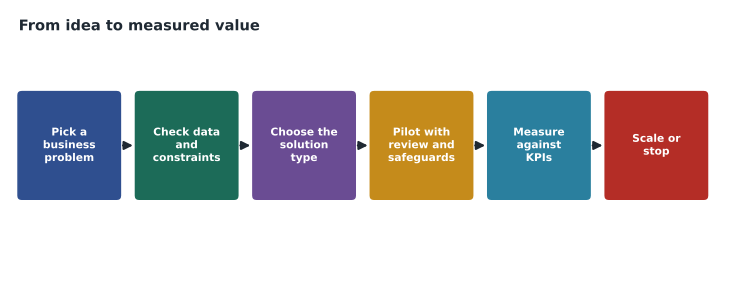
The steps to integrate generative AI into an organization follow a familiar pattern. Identify a valuable problem and the people it affects. Check that the data needed exists and is good enough, and that the constraints, including privacy and security, can be met. Choose the simplest solution type that fits. Run a pilot with a small group, human review and safeguards. Measure the results against agreed success measures. Then decide whether to scale, change or stop. Change management runs alongside every step: explaining the purpose, training people, gathering feedback and addressing concerns about jobs and quality. Questions often ask what to do first; the answer is usually to define the problem and the success measures, not to choose a model.
Measuring impact
Measuring impact means agreeing on key performance indicators before the pilot starts, so that success is not judged by enthusiasm. Useful measures fall into a few groups: efficiency, such as time saved per task; quality, such as error rates or customer satisfaction; adoption, such as how many staff use the tool regularly; financial, such as cost per task or revenue influenced; and risk, such as the number of incidents or escalations. Dana's rule is that every pilot at Birchline needs a baseline measured before it starts, a target and a date to decide.
# A simple value estimate for a pilot (illustrative numbers)
staff = 12                 # copywriters using the description writer
hours_saved_per_week = 3.5 # measured in the pilot
weeks = 46                 # working weeks a year
hourly_cost = 48           # loaded hourly cost, illustrative
annual_value = staff * hours_saved_per_week * weeks * hourly_cost
annual_cost = 21000        # licences, usage and support, illustrative
print("Estimated annual value:", round(annual_value))
print("Value to cost ratio:", round(annual_value / annual_cost, 1))Estimated annual value: 92736 Value to cost ratio: 4.4
What this code does
Using illustrative pilot figures, the program multiplies the number of copywriters by the hours each saved per week, the working weeks and an hourly cost to estimate the yearly value. It divides that by the yearly cost of the tool. The value is about 4.4 times the cost.
The numbers in the example are illustrative, but the shape of the calculation is what matters for the exam: value measured against cost, with a baseline. Exam questions may describe a pilot that "everyone liked" and ask what is missing. The answer is usually agreed, measurable success criteria.
Secure AI
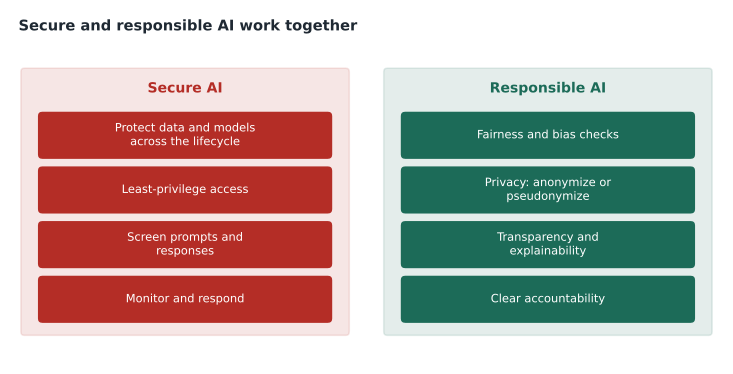
Security must cover the whole machine learning lifecycle: the data used for training and grounding, the models themselves, the prompts and responses flowing through them, the applications built on them and the people and systems with access. Generative AI adds new risks to familiar ones. Prompt injection hides instructions in content the model reads, trying to make it ignore its rules. Sensitive data can leak through prompts or responses. Models and data can be tampered with. Agents that take actions can be misused if their permissions are too broad.
Google's Secure AI Framework, known as SAIF, is Google's conceptual framework for securing AI systems. Its purpose is to give organizations a structured way to extend existing security practice to AI: building on strong security foundations, extending detection and response to AI systems, automating defences, applying consistent controls across platforms, adapting controls as threats change, and placing AI risks in the context of the business processes they affect. The exam asks about SAIF's purpose and benefits rather than its details: a common framework, a shared vocabulary for security and AI teams, and security built in from the start rather than added later.
The guide also names Google Cloud tools that support secure AI: secure-by-design infrastructure, Identity and Access Management to give each person and service only the access it needs, Security Command Center for finding and managing security risks across the organization's cloud, and workload monitoring tools. In GCP-110, Birchline's shopping assistant also screened prompts and responses with Model Armor, a Google Cloud service for detecting risks such as prompt injection and sensitive data in AI traffic. Least privilege applies to agents as much as to people: the shopping assistant can check stock but cannot issue refunds.
Responsible AI
Responsible AI is about using AI in ways that are fair, transparent, private and accountable. Google published its AI Principles in 2018 and has updated them since. The guide asks you to explain several ideas. Transparency means being open about where and how AI is used, so that people know when they are reading AI-generated content or dealing with an AI system. Privacy means protecting personal information throughout, which leads to two techniques the guide names. Anonymization removes or transforms personal information so that it can no longer be linked to a person by anyone. Pseudonymization replaces identifiers with codes or tokens, so that the data can be re-linked to the person only by someone who holds the key. Anonymized data carries less privacy risk; pseudonymized data keeps the ability to re-identify when there is a legitimate need.
Data quality, bias and fairness are linked: a model trained or grounded on unrepresentative data can produce outcomes that are unfair to some groups, so leaders test with diverse evaluation data and review results for different groups. Accountability means a named person or team is responsible for an AI system's outcomes, with a way to report and fix problems. Explainability means being able to explain, at an appropriate level, how a system reached an output, which matters most for decisions about people, such as credit, hiring or healthcare. At Birchline, Teresa signs off every AI project's privacy review, and each assistant has a named owner who reads the monthly evaluation results.
| Concern | What it asks | Example practice |
|---|---|---|
| Transparency | Do people know AI is involved? | Label AI-generated product summaries |
| Privacy | Is personal information protected? | Remove names before text reaches a model |
| Bias and fairness | Are outcomes fair across groups? | Test with diverse evaluation data |
| Accountability | Who is responsible? | A named owner for each AI system |
| Explainability | Can the output be explained? | Show the sources behind an answer |
The policy setting differs by country and changes quickly, so the exam tests principles rather than laws. For background: in Canada, the proposed Artificial Intelligence and Data Act lapsed in January 2025, and the federal government set out a national AI strategy in June 2026, while privacy law, including PIPEDA and Quebec's Law 25, already applies to personal information used with AI. Check current requirements with your own legal or privacy team.
Practice scenarios
Here are original scenarios with reasoning. First: a retailer's executives are excited about generative AI and ask the team to "use it everywhere". What should the team do first? Identify a specific, valuable business problem and define how success will be measured. Second: a pilot assistant was popular with staff, but nobody can say whether it saved time. What was missing? A baseline and agreed success measures. Third: a support team wants to analyse chat transcripts with AI, and the analytics team must later be able to link findings back to individual accounts for follow-up. Which privacy technique fits? Pseudonymization, because authorized re-linking is needed. Fourth: a company wants a shared framework so that its security and AI teams protect AI systems consistently. What does Google offer? The Secure AI Framework. Fifth: a lender uses AI to help assess loan applications. Which responsible AI concerns are most pressing? Fairness, explainability and accountability, because the decisions affect people's lives.
Change management and people
Technology alone rarely makes a generative AI initiative succeed. The guide's objective on integrating generative AI into an organization includes the people side: leaders who explain why the change matters, training so that staff can use the tools well, clear guidance on what is and is not allowed, and channels for feedback and concerns. Employees often worry about job security and about being blamed for AI mistakes. Good leaders address both openly: they describe how roles will change, they make clear that people remain accountable for decisions and that AI is a tool, and they celebrate improvements that come from staff using the tools well.
At Birchline, Jules ran short training sessions for the copywriters before the description writer launched, wrote a one-page guide on when to use it and when not to, and set up a channel where staff could report odd outputs. Reports from that channel caught the sleeping bag hallucination before any customer saw it. Questions that ask why a technically sound pilot failed to deliver value often point to missing training, unclear guidance or a lack of support from leaders.
Choosing between build and buy
Leaders are often asked whether to buy a prebuilt solution or build a custom one. Prebuilt offerings are faster, cheaper to start and need fewer skills, but offer less control. Custom builds take longer and need developers, but can be shaped to unusual needs and integrated deeply with company systems. A sensible pattern is to start with prebuilt tools for common needs, such as drafting and summarizing, and build custom solutions only where the business need is distinctive and the value justifies the effort. Exam questions usually make the right choice clear through the constraints.
Worked problem
Finding what is missing
A hotel chain plans to launch an AI assistant that answers guests' questions and can change bookings. The plan includes the model choice, a design for the chat window and a launch date. Teresa is asked to review it. What should she say is missing?
Show solution
- Security: the assistant can change bookings, so its permissions must be limited to what it needs, with checks before any change.
- Screening: prompts and responses should be screened for prompt injection and sensitive data.
- Responsible AI: guests should know they are talking to an AI, personal data should be protected, and there should be a named owner.
- Measurement: the plan has no success measures or baseline.
- Process: a pilot with human review should come before a full launch.
Answer: The plan has a model and a launch date but no security, responsible AI or measurement plan. Those come before launch.
Dana's last comment of the session is the one Jules writes down: "If you can't tell me what it will change and how we'll know, it isn't a project yet."
Common mistakes
MistakeStarting with the technology instead of the problem.
InsteadStart with a valuable business problem and success measures.
MistakeJudging a pilot by how much people liked it.
InsteadMeasure against a baseline and agreed indicators.
MistakeTreating pseudonymized data as anonymous.
InsteadPseudonymized data can be re-linked by whoever holds the key.
MistakeGiving an agent broad permissions for convenience.
InsteadApply least privilege to agents as well as people.
MistakeThinking SAIF is a product to install.
InsteadSAIF is a conceptual framework for securing AI systems.
Summary and key terms
- Start from a business problem; choose the simplest solution type that meets requirements and constraints.
- Integrate through a pilot with review and safeguards, then measure against agreed indicators.
- Secure AI covers data, models, prompts, applications and access across the lifecycle.
- SAIF is Google's conceptual framework for securing AI; IAM and Security Command Center support it.
- Responsible AI covers transparency, privacy, bias and fairness, accountability and explainability.
- Anonymization cannot be reversed; pseudonymization can be by whoever holds the key.
- KPI
- Key performance indicator, a measure agreed in advance to judge success.
- SAIF
- Google's Secure AI Framework, a conceptual framework for securing AI systems.
- Prompt injection
- Hidden instructions in content that try to make a model break its rules.
- Anonymization
- Transforming data so it can no longer be linked to a person.
- Pseudonymization
- Replacing identifiers with codes that can be re-linked using a key.
- Explainability
- The ability to explain how a system reached an output.
Practice problems
Work each problem on paper first, then reveal the answer to check.
What should a team do first before adopting generative AI?
Show answer
Identify a valuable business problem and define success measures.
Name three groups of measures for a pilot.
Show answer
Any three of efficiency, quality, adoption, financial and risk.
What is SAIF?
Show answer
Google's Secure AI Framework for securing AI systems.
Which Google Cloud tool finds and manages security risks across an organization's cloud?
Show answer
Security Command Center.
Which privacy technique allows authorized re-linking?
Show answer
Pseudonymization.
Why does explainability matter most for decisions about people?
Show answer
Because those decisions affect people's lives and must be justified.
What does least privilege mean for an agent?
Show answer
It has only the permissions it needs for its task.
Lesson quiz · 5 questions
Score 60% or more to complete this lesson.
Create a free account to save your progress, take quizzes and earn a certificate.