
GCP-191 · Lesson 11 of 12 · 22 min
The final week and exam day
▶ Video coming soon A video version of this lesson is on the way.
Ravi has a firm view about the last week before an exam: it is for consolidating, not cramming. "You will not learn a new section in the final week," he tells Jules, "but you can easily make yourself tired, anxious and slow." Jules's exam is planned for a Wednesday morning in mid-April 2027, online from home. This lesson lays out the plan for that week and for the morning itself, as Ravi and Jules have drawn it up. Everything here is a plan for a date still ahead as this course is written. The same approach works for any foundational Google Cloud exam, online or at a testing centre, and the testing centre differences are noted along the way.
Taper, do not cram
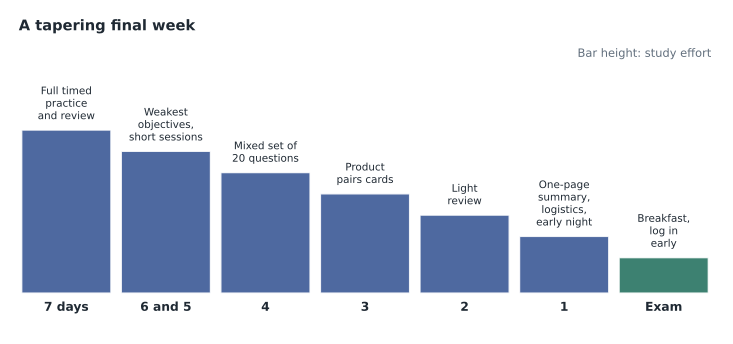
Athletes taper before a race: they keep training, but less, so that they arrive rested. Exam preparation works the same way. The heavy work of section reviews and gap closing belongs in the weeks before the final one. In the final week, study time drops day by day, sessions get shorter, and the focus moves from learning to recall and calm. A full timed practice session about a week out tells you where you stand; the days after it go to the weakest objectives in short sessions; the last two days are light; and the evening before is for logistics and sleep.
| Day | Plan | Why |
|---|---|---|
| 7 days out | Full timed practice set under online conditions, then review every miss and guess | A last measure of readiness |
| 6 and 5 | Short sessions on the two or three darkest heat map cells | Close the last gaps that matter |
| 4 | A mixed set of about 20 questions | Keep switching between sections |
| 3 | Pair cards and the signpost list | Sharpen the deciding differences |
| 2 | Light review of the one-page summary | Recall without fatigue |
| 1 | Logistics check, system test, early night | Remove avoidable risks |
| Exam day | Breakfast, short warm-up, log in early | Arrive calm and on time |
The one-page summary
Ravi asks Jules to write a one-page summary of the whole exam during the final week, by hand, from memory, and then check it against the guide and the course notes. The page holds the four sections with their key ideas; the offering cards' audiences and jobs; the limitations and the practice that fixes each; the prompting techniques; the sampling settings; and the responsible AI terms. Writing it is itself retrieval practice, and the gaps it reveals are the last things to review. On the last two days, the summary is the only thing Jules reads. It is not taken into the exam, of course; nothing is.
The day before
The day before is for removing risks, not for learning. For an online exam: run Pearson's system test again on the same computer, network and room, at the same time of day; install any updates and restart the computer so it does not decide to update in the morning; clear the desk and the room of everything except the computer; arrange for no one to come in, and tell the household; put the government-issued photo ID where you will find it; and check the booking confirmation for the time and time zone. For a testing centre: plan the route and leave a margin for traffic, check the centre's rules on what you may bring, and lay out the ID the night before. Then stop studying in the early evening, eat a normal meal and go to bed at your usual time.
Jules's list for the evening before the April exam has eight lines on it, and the last one reads: "Phone in the kitchen, notifications off, kettle filled for after." The kettle is not allowed in the room, but the tea afterwards is part of the plan.
The morning of the exam
Eat a normal breakfast, with nothing new. A short warm-up of five or ten easy questions or a glance at the one-page summary can help you get into the reading habit, but do not attempt anything hard. For an online exam, the launch window opens 10 minutes before the scheduled start and, as the help page described it in November 2026, closes 20 minutes after; aim to launch at the start of the window so that identity checks, photos of the room and any technical hiccups do not eat into your calm. For a testing centre, arrive early enough to check in without rushing; centres typically ask you to arrive well before the start time, so follow the instructions in your confirmation.
Check-in for an online exam usually involves showing your ID to the camera, taking photos of your face and workspace, and possibly a short conversation with the proctor. Keep your face in view, stay seated, and do not reach for anything off the desk. Once the exam starts, the rules from lesson 2 apply: silent reading, no breaks, no other people, nothing on the desk.
During the exam
The routines you practised now do their work. Read each question for context, need, constraints and ask. Look for the signposts, but read the whole question first. Choose the simplest option that fully meets the need. Cap your time on hard questions at about two minutes, mark them if the exam allows, and move on. Check your progress at the checkpoints you rehearsed, about a third of the way through and two thirds of the way through. Use the reserve at the end to revisit marked questions, changing an answer only if you can name what you missed. Make sure every question has an answer before the time runs out.
Nerves are normal and usually fade after the first few questions. If they rise during the exam, a few slow breaths help more than people expect. If a run of hard questions arrives, remember that difficulty is not evenly spread and that everyone meets questions they cannot answer. One hard question says nothing about the next.
If something goes wrong
Most exams go smoothly, but it helps to know what to do if one does not. If an online session drops, stay calm and follow the proctor's or Pearson's instructions; they will try to restart it. If you are ill on the morning, check the rescheduling rules: moving more than 24 hours ahead avoids a late fee, and a no-show forfeits the fee. If something happens during the exam that you think affected your result, such as a long technical interruption, note the time and details and contact Google's certification support afterwards. Do not photograph your screen, even to record a problem; photographing the exam or the result is a listed violation.
# Working back from an exam start to a morning plan (example times)
import datetime
start = datetime.datetime(2027, 4, 14, 9, 0)   # example only
plan = [("wake up", 120), ("breakfast", 90), ("warm-up questions", 40),
        ("final room check", 25), ("launch window opens", 10)]
for step, minutes_before in plan:
    t = start - datetime.timedelta(minutes=minutes_before)
    print(t.time().isoformat("minutes"), step)
print(start.time().isoformat("minutes"), "exam starts")07:00 wake up 07:30 breakfast 08:20 warm-up questions 08:35 final room check 08:50 launch window opens 09:00 exam starts
What this code does
Working back from an example exam start time, the program subtracts minutes to schedule each step of the morning, from waking up to the check-in window opening. It prints the clock time for each step and then the start time. Planning backwards leaves enough time for the online check-in.
Managing nerves
Some nervousness before an exam is normal and even useful, because it sharpens attention. Too much makes reading slow and memory patchy. A few simple habits help. Prepare the logistics early, so that the morning holds no surprises. Keep the routine of the morning ordinary: the same breakfast, the same coffee, the same walk if you usually take one. Remind yourself of the evidence: your practice results, the heat map that has faded, the cards you can answer. If anxiety is a serious problem for you in exams, it is worth speaking to a professional well before the date, and checking whether an accommodation would help.
During the exam, if you notice your mind racing, stop for a few seconds, take two slow breaths, reread the ask of the current question and carry on. The pacing plan has room for those seconds. Many candidates find that the first five questions feel hard simply because the brain is warming up, and that the exam feels easier after that.
A testing centre version of the plan
If you sit at a testing centre instead, the week looks almost the same, with three differences. The day before, plan the route, check the centre's opening details in your confirmation and decide when to leave, allowing generous margin for traffic, parking and finding the room. On the morning, take only what you need: the ID, keys and perhaps a water bottle to leave in the locker. And on arrival, expect to store your belongings, have your ID checked and possibly have a photo taken, then be shown to a computer in a supervised room. Centres follow their own rules on breaks and on what you may have at the desk; follow the staff's instructions.
After you submit
When the exam ends, take a moment before you leave the room or close the session. Follow any instructions on screen and from the proctor. Then step away and do something ordinary for a while. Jules's plan for the moment after the April exam is tea in the kitchen and a walk before reading any email, whatever the provisional result. Lesson 12 covers what comes next: the result, the badge, and the plan for either outcome.
One more item belongs in the final week: a short conversation with whoever shares your home or office. Tell them the date and time, explain that no one can come into the room during the exam, and ask them not to use video streaming or large downloads that morning if your connection is shared. Jules plans to put a small sign on the door as a reminder, not as a substitute for the conversation. It is a small step, but interruptions are one of the commonest reasons online sessions are stopped, and they are easy to prevent.
Worked problem
Spotting the risky final week
A colleague's final week looks like this: three long evenings learning the Customer Engagement Suite from scratch, a full practice set the night before the exam, the system test on the morning of the exam, and a coffee on the desk during the session. Which parts carry an avoidable risk, and what should change?
Show solution
- Learning a whole topic from scratch in the final week is cramming; that work belonged in the weeks before. Use the final week for the weakest objectives in short sessions.
- A full practice set the night before is tiring and can shake confidence. Move it to about a week out.
- Running the system test on the morning leaves no time to fix problems. Run it the day before and earlier.
- Food and drink are not allowed in an online workspace. Leave the coffee in the kitchen.
Answer: All four parts carry avoidable risk. Taper the study, test early and keep the desk clear.
Ravi's last message before the exam, planned for the evening before, will be short: "You know this. Read the ask. Simplest option that fits. See you for tea." He has already written it in his calendar.
Common mistakes
MistakeCramming new topics in the final week.
InsteadTaper: short sessions on the weakest objectives, then light review.
MistakeSitting a full practice set the night before.
InsteadSit the last full set about a week out.
MistakeRunning the system test on the morning.
InsteadRun it the day before, on the same computer, network and room.
MistakeLaunching at the end of the window.
InsteadLaunch at the start so checks do not eat into your calm.
MistakePhotographing the screen to record a problem.
InsteadNote the details and contact support afterwards.
Summary and key terms
- Taper the final week: a full practice set about a week out, then shorter, lighter sessions.
- Write a one-page summary from memory and use it for the last two days.
- The day before: system test, updates, cleared room, ID ready, early night.
- On the morning: normal breakfast, light warm-up, launch at the start of the window or arrive early.
- During the exam: read the ask, choose the simplest fit, cap hard questions, use checkpoints and the reserve.
- If something goes wrong, follow the instructions and contact support; never photograph the screen.
- Taper
- Reducing study gradually before an exam so you arrive rested.
- One-page summary
- A handwritten summary of the exam from memory, checked against the guide.
- Launch window
- The period in which an online exam can be started.
- Check-in
- The identity and workspace checks before an exam begins.
- Warm-up
- A few easy questions before the exam to start the reading habit.
- Reserve
- Time kept at the end of the exam for reviewing marked questions.
Practice problems
Work each problem on paper first, then reveal the answer to check.
When should the last full practice set be sat?
Show answer
About a week before the exam.
What is the one-page summary for?
Show answer
Retrieval practice and a light review for the last two days.
When should the online system test be run last?
Show answer
The day before, on the same computer, network and room.
When does the online launch window open?
Show answer
10 minutes before the scheduled start.
Why launch at the start of the window?
Show answer
So identity and room checks do not eat into your calm.
Is coffee allowed on the desk during an online exam?
Show answer
No; food and drink are not allowed.
What should you do if an interruption affected your exam?
Show answer
Note the details and contact Google's certification support afterwards.
Lesson quiz · 5 questions
Score 60% or more to complete this lesson.
Create a free account to save your progress, take quizzes and earn a certificate.