
GCP-191 · Lesson 3 of 12 · 22 min
Reading scenario questions carefully
▶ Video coming soon A video version of this lesson is on the way.
Jules's first practice set goes badly in an instructive way. Of ten original scenario questions Ravi has written, Jules gets six right, and on three of the four misses Jules knew the material perfectly well. One question asked for the option that needed no developers, and Jules chose a custom agent because Birchline had built one. Another asked how to keep customer names out of a model provider's logs, and Jules chose human review, which is good practice but does not answer the question. A third asked which offering would help call centre staff during live calls, and Jules chose a search tool for the website. "You don't have a knowledge problem on those three," Ravi says. "You have a reading problem. That is good news, because reading is the fastest thing to fix." This lesson is about that fix.
The four parts of a scenario
Almost every scenario question on a foundational Google Cloud exam can be split into four parts. The context tells you who the organization is: its size, its industry and what it already has. The need tells you what it wants to achieve. The constraints tell you what limits the choice: no developers, a short deadline, strict privacy rules, a small budget, a need for consistency or a need for variety. And the ask tells you exactly what the question wants: the best option, the first step, the most cost-effective approach, the main risk, or which two statements are true. Reading for those four parts, in that order, is the habit that turns knowledge into marks.
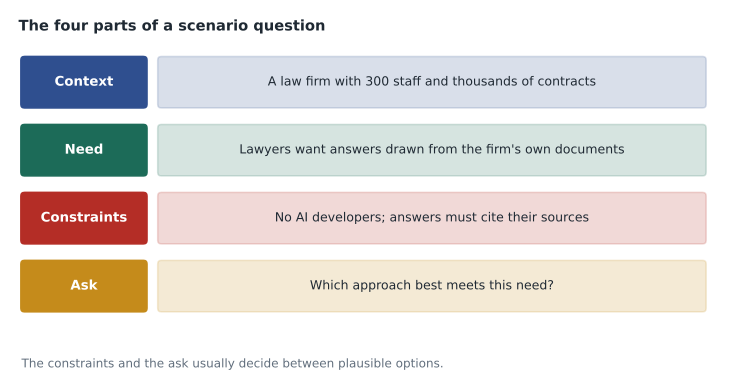
The context and the need usually narrow the field to two or three plausible options. The constraints and the ask then pick the winner. In the law firm example in the figure, several options might sound reasonable: fine-tuning a model on the contracts, writing better prompts, a general chat assistant, or an enterprise search and grounding offering that answers from the firm's documents with citations. The constraint of no AI developers rules out building something custom from scratch. The need for citations points to grounding over fine-tuning, because grounding retrieves the source passage and can show it, while fine-tuning changes the model's behaviour without giving the answer a source. The best answer is the managed grounding option.
Signposts in generative AI questions
Signposts are phrases that point strongly toward one kind of answer. They are not tricks, and they are not a substitute for understanding, but recognizing them quickly saves time and catches misreadings. Ravi asks Jules to start a list in the study log and add to it every time a practice question turns on a phrase. After two weeks the list looks like the table below. Yours will differ, and building it yourself is more useful than memorizing ours.
| Signpost phrase | Usually points toward |
|---|---|
| Using the organization's own documents or data | Grounding and retrieval-augmented generation |
| Recent events or information after the model was trained | Grounding with current sources, such as search |
| A consistent style or format across thousands of outputs | Fine-tuning or strong examples in the prompt |
| No developers, or results needed quickly | A prebuilt offering rather than a custom build |
| Employees in documents, email and meetings | Gemini for Google Workspace |
| Live customer calls or chats | Contact centre and conversational tools |
| Creative, varied ideas | A higher temperature setting |
| The same careful answer every time | A lower temperature setting |
| Must not be traceable to a person | Anonymization |
| Needs to be re-linked later by an authorized team | Pseudonymization |
| High-stakes decision about a person | Human in the loop and clear accountability |
Signposts work best as a second check, not a first reflex. Read the whole question, decide what you think the answer is, then look for the signpost to confirm it. If the signpost points somewhere else, slow down and reread. Sometimes a question contains two signposts that pull in different directions, such as "the company's own documents" and "a consistent brand voice", and the ask tells you which one matters for this question.
Best fit, not merely works
The hardest questions on the exam are those where more than one option would work. A foundational exam asks for the best fit: the option that meets the need and respects every constraint with the least effort, cost and risk. A custom agent built on the developer platform can do almost anything, so it would work for most scenarios. That does not make it the best answer when a prebuilt tool does the same job for a team with no developers. Fine-tuning can improve almost any output, but it is rarely the best first step when better prompts or grounding would solve the problem faster and more cheaply.
Ravi gives Jules a rule of thumb for these questions: prefer the simplest option that fully meets the need. Simpler usually means prebuilt over custom, prompting over grounding when no outside data is needed, grounding over fine-tuning when facts are the problem, and managed over self-built. When two options seem equally simple, the constraints decide. The rule is not absolute; sometimes the need genuinely requires the more complex option. But it catches the most common mistake: choosing the most powerful answer when the question asked for the most suitable one.
Watch the ask
The ask is the part candidates most often skim, and it is the part that most often decides the answer. "What should the organization do first?" is a different question from "What is the best long-term approach?" A first step is usually about understanding the problem, the data or the risk: defining the business goal, checking data quality, or running a small pilot. A long-term approach may be a full rollout with monitoring. "Which is the main risk?" asks you to rank, not list. "Which statement is not true?" reverses the usual logic, and a candidate who reads quickly will choose a true statement.
Jules's fourth miss in the first set was exactly this. The question asked what a retailer should do first before launching a customer-facing assistant, and Jules chose "deploy it with monitoring dashboards", which is a good later step. The best first step in the options was to define success measures and test the assistant on a set of real customer questions. Jules now underlines the ask in every practice question, in the study log, before reading the options.
# A reading checklist applied to one practice question
question = {
    "context": "online bookshop, 15 staff, no developers",
    "need": "answer customer questions about orders and returns",
    "constraints": ["no developers", "answers must follow the returns policy"],
    "ask": "best option",
}
for part in ("context", "need", "constraints", "ask"):
    print(part.upper() + ":", question[part])
print("Prefer a prebuilt, grounded option that uses the returns policy as its source.")CONTEXT: online bookshop, 15 staff, no developers NEED: answer customer questions about orders and returns CONSTRAINTS: ['no developers', 'answers must follow the returns policy'] ASK: best option Prefer a prebuilt, grounded option that uses the returns policy as its source.
What this code does
A practice question is broken into four parts (context, need, constraints and what is being asked) and each part is printed on its own line. Reading it this way makes the key constraint, a small team with no developers whose answers must follow the returns policy, stand out. The final line states the conclusion: choose a prebuilt option grounded in the returns policy.
Eliminating options
When the best answer is not obvious, eliminate. Most questions have one or two options that are clearly wrong: an offering from the wrong audience, a technique that solves a different problem, or a statement that is simply false. Remove those first. Then compare the remaining options against the constraints one at a time. An option that breaks a constraint is out, however attractive it sounds. If two options are still left, ask which one needs less building, less data, less cost or less risk, and choose it unless the need clearly calls for the other.
Be careful with options that are true but irrelevant. "Human review improves quality" is true, but if the question asks how to keep names out of logs, it does not answer it. "Gemini models are multimodal" is true, but if the question asks which offering lets employees draft documents in tools they already use, a fact about the models misses the point. True statements that do not answer the ask are among the most effective distractors on the exam.
Words that change the meaning
Small words matter. "Only", "always" and "never" make a statement easier to falsify, so be wary of options built on them. "Most", "best" and "first" ask you to rank. "Not" and "except" reverse the question. "Prebuilt", "custom", "managed" and "low-code" describe how much building is involved and often line up with the constraints. In generative AI questions, also watch for "factual", "creative", "consistent", "current" and "private", because each points to a different technique. Reading slowly enough to notice these words costs a few seconds per question and saves many marks.
More practice scenarios
Here are three more original scenarios to read with the four parts. First: a regional newspaper wants an assistant that answers readers' questions about local events from this week, and its newsroom has one developer. The context is a small newsroom; the need is answers about current events; the constraint is a single developer; the ask is the best option. A prebuilt offering grounded on current sources fits, because the problem is recency and the team is small. Second: a pharmaceutical company wants to summarize clinical study reports, and a mistake could mislead doctors. The ask is the most important safeguard. Human review by qualified staff is the answer, even though grounding also helps. Third: a game studio wants many unusual names for fantasy creatures. The ask is which setting to change, and the answer is a higher temperature.
Look at how often the ask decides between two good practices. Grounding and human review are both good, but only one is the most important safeguard where errors could mislead doctors. Prebuilt and custom offerings both work, but only one fits a newsroom with one developer. Train yourself to finish each scenario by saying the ask in your own words before you look at the options.
Worked problem
Applying the four parts
A regional insurer wants its claims staff to summarize long accident reports quickly. Reports contain names, addresses and licence plate numbers. The insurer's privacy officer says no personal details may leave the company's control, and the IT team has two developers. The question asks for the best way to reduce privacy risk while still getting useful summaries. Read it with the four parts.
Show solution
- Context: an insurer with claims staff and a small IT team.
- Need: quick, useful summaries of long reports.
- Constraints: personal details must stay under the company's control; limited developers.
- Ask: the best way to reduce privacy risk while keeping summaries useful.
- Eliminate: options about creativity settings or model size do not address privacy. An option to stop using AI entirely meets the constraint but fails the need.
- Choose: remove or replace the personal details before the text reaches the model, using anonymization or pseudonymization as the situation requires, together with a service configured so the company's data stays under its control.
Answer: Splitting the question shows that the privacy constraint, not the summary itself, is what the ask is about.
By the end of the week, Jules has reworked the four missed questions and written a fifth of Jules's own for each of them, using the same trap. Writing a question with a deliberate trap is one of the fastest ways to learn to spot one.
Common mistakes
MistakeReading the options before the ask.
InsteadUnderline the ask first, then read the options.
MistakeChoosing the most powerful option by habit.
InsteadChoose the simplest option that fully meets the need and constraints.
MistakeTreating a true statement as a correct answer.
InsteadCheck that the option actually answers the ask.
MistakeIgnoring "first" or "not" in the question.
InsteadWords that rank or reverse the question change the answer.
MistakeRelying on signposts without reading the whole question.
InsteadUse signposts to confirm an answer, not to replace reading.
Summary and key terms
- Split each scenario into context, need, constraints and ask.
- The constraints and the ask usually decide between plausible options.
- Choose the best fit: the simplest option that fully meets the need and respects every constraint.
- Signposts such as "own documents" or "no developers" confirm an answer; they do not replace reading.
- Eliminate options that break a constraint or answer a different question.
- Watch small words: only, always, first, best, not, except.
- Context
- The part of a scenario that describes the organization and its situation.
- Need
- What the organization wants to achieve.
- Constraint
- A limit on the choice, such as budget, skills, privacy or time.
- Ask
- The exact question being posed, such as best, first or not true.
- Distractor
- A wrong option designed to look plausible.
- Best fit
- The option that meets the need and every constraint with the least effort and risk.
Practice problems
Work each problem on paper first, then reveal the answer to check.
What are the four parts of a scenario question?
Show answer
Context, need, constraints and ask.
Which two parts usually decide between plausible options?
Show answer
The constraints and the ask.
What does "using the company's own documents" usually point to?
Show answer
Grounding and retrieval-augmented generation.
What does a request for varied creative ideas suggest about temperature?
Show answer
A higher temperature.
Why is a true statement not always a correct answer?
Show answer
Because it may not answer the ask.
What is Ravi's rule of thumb for best-fit questions?
Show answer
Prefer the simplest option that fully meets the need.
What should you do when a signpost points away from your answer?
Show answer
Slow down and reread the question.
Lesson quiz · 5 questions
Score 60% or more to complete this lesson.
Create a free account to save your progress, take quizzes and earn a certificate.