
GCP-191 · Lesson 1 of 12 · 23 min
How the Generative AI Leader exam works
▶ Video coming soon A video version of this lesson is on the way.
On the second Thursday of November 2026, Ravi Menon, the data and analytics lead at Birchline Outfitters in Toronto, books a small meeting room and writes four short phrases on the whiteboard: fundamentals, offerings, better output, business strategy. Across the table sits Jules Baptiste, the product manager for Birchline's online shop. Over the autumn, Jules has led the company's first generative AI projects: a shopping assistant grounded in the product catalogue, a product description writer, a review summarizer and an internal policy assistant. Leadership now wants someone who can speak for those projects with authority, and Jules has decided to earn Google Cloud's Generative AI Leader certification. "Before we review anything," Ravi says, "you need a map of the exam itself. If you know what it measures and how it is built, you will study the right things and stop worrying about the wrong ones." This course is that map, plus the practical preparation that turns what you know into a pass on exam day.
GCP-191 is the final course of the Generative AI Leader program on this site. GCP-110 covered the fundamentals: how machine learning becomes generative AI, foundation models, tokens and context windows, prompting, grounding, agents, evaluation and responsible AI. GCP-111 toured Google Cloud's generative AI products and platforms, from the Gemini app and Gemini for Google Workspace to the platform that developers use to build agents. GCP-112 took the leader's view: choosing use cases, building the business case, managing risk, governing AI and leading change. This course does three jobs. It explains how the exam works and how to book and sit it. It reviews each section of the current exam guide with original practice scenarios. And it helps you plan your final weeks so that you arrive on exam day ready and calm.
What the certification is for
Google Cloud groups its certifications into three levels. Foundational certifications check broad knowledge of what the cloud and its services can do for an organization. Associate certifications check that you can deploy and operate solutions. Professional certifications check deep design and implementation skill in one area. Generative AI Leader sits at the foundational level, alongside Cloud Digital Leader. Google's certification page describes it as being for anyone in any job role, with or without hands-on technical experience. It does not ask you to write code, configure a model or tune a prompt in a console. It asks whether you can explain what generative AI is and is not, which Google Cloud offering fits a described business need, how the quality of model output can be improved, and how an organization should adopt generative AI securely and responsibly.
That focus matters for how you study. Jules has spent the autumn inside real projects and knows the vocabulary, but tends to answer from Birchline's experience rather than from the general principles the exam tests. Owen Mitchell from the IT team, who is preparing for Cloud Digital Leader at the same time, has offered to join some sessions and tends to reach for the most technical answer. Ravi tells them both the same thing: the exam lives in the middle. You need to recognize Google's generative AI offerings by name and purpose, understand the concepts well enough to explain them to a colleague, and judge which option best fits a described need and its constraints.
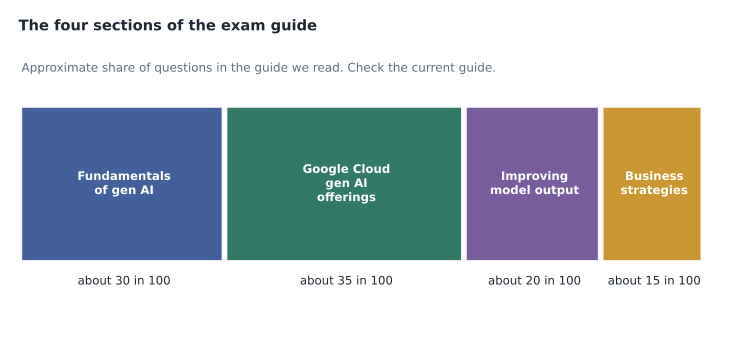
The four sections of the exam guide
Google publishes an exam guide for every certification, and the guide is the single most important document for your preparation. The Generative AI Leader guide we read for this course in November 2026 divides the exam into four sections. Section 1 is the fundamentals of generative AI: core terms such as machine learning, natural language processing, foundation models, multimodal and diffusion models; the types of machine learning; the machine learning lifecycle; the kinds of data that models use; the layers of the generative AI landscape; and Google's own foundation models. Section 2 is Google Cloud's generative AI offerings: Google Cloud's strengths, the prebuilt tools for everyday work, the offerings that improve customer experience, the platform for developers and the tools that agents use. Section 3 is techniques to improve model output: the limits of foundation models and how to overcome them, prompt engineering, grounding and the settings that shape a response. Section 4 is business strategy: how to implement a generative AI solution, how to secure it, and how to use it responsibly.
The guide we read gave approximate weights for each section: roughly 30 out of every 100 questions on the fundamentals, roughly 35 on Google Cloud's offerings, roughly 20 on improving output and roughly 15 on business strategy. Google revises its guides from time to time, and the guide we read mixed older and newer product names in places, so check the guide on Google's site before you plan your study time. The weights still give a useful rule of thumb. The offerings section is the largest single block, and it is the one where product names change most often, so it deserves the most careful and most current study. The business strategy section is the smallest, but it is the one where leaders often drop easy marks by answering from instinct rather than from the frameworks the guide names.
| Section | Main ideas | Covered in | Review lesson |
|---|---|---|---|
| 1. Fundamentals of gen AI | Core terms; machine learning types; data; layers; Google's models | GCP-110 | Lesson 4 |
| 2. Google Cloud gen AI offerings | Strengths; tools for work; customer experience; building agents | GCP-111 | Lesson 5 |
| 3. Improving model output | Limitations; prompting; grounding; sampling settings | GCP-110, GCP-112 | Lesson 6 |
| 4. Business strategies | Implementation steps; secure AI; responsible AI | GCP-112 | Lesson 7 |
The exam at a glance
Google's certification page, checked for this course in November 2026, describes the standard Generative AI Leader exam as 90 minutes long with 50 to 60 multiple choice questions. The registration fee is 99 US dollars, plus tax where it applies. The exam is offered in English, Japanese, Spanish and Portuguese. You can take it online with a remote proctor or in person at a testing centre, and the page points to Pearson VUE as the testing centre network. There are no prerequisites. A pass is valid for three years, and the page describes a way to renew through a learning path in the final year. Google does not publish a passing score, so be wary of any website that claims to know one.
Some of those facts differ from the Cloud Digital Leader exam, and that trips people up when they prepare for both. Cloud Digital Leader listed French among its languages in November 2026; Generative AI Leader did not. Cloud Digital Leader described its questions as multiple choice and multiple select; the Generative AI Leader page said multiple choice. Treat each exam's own page as the authority, and when a fact matters to you, such as the language, check it again just before you book. Throughout this course, when we give a fact about the exam we say when we checked it.
| Item | What Google's page said in November 2026 |
|---|---|
| Length | 90 minutes |
| Questions | 50 to 60, multiple choice |
| Fee | 99 US dollars plus tax where applicable |
| Languages | English, Japanese, Spanish, Portuguese |
| Delivery | Online proctored, or onsite at a Pearson VUE testing centre |
| Prerequisites | None |
| Validity | Three years |
| Passing score | Not published |
What the questions look like
Most questions are short business scenarios. An organization wants to do something with generative AI, has a constraint, and needs the best option. A call centre wants agents to see suggested answers during live calls. A law firm wants lawyers to ask questions of its own contracts and see the source of every answer. A bank worries that customer names will end up in prompts. A marketing team wants many varied slogan ideas, while a support team wants the same careful answer every time. The options are usually all real Google Cloud offerings or real techniques, so you cannot pass by spotting made-up names. You pass by understanding which option fits the need best, which is why lesson 3 spends a whole lesson on reading scenarios carefully.
Because the questions are about fit, many of them hinge on a single phrase. "Using the company's own documents" points toward grounding and retrieval rather than fine-tuning. "No developers" points toward a prebuilt offering rather than building a custom agent. "During live customer calls" points toward contact centre tools. "Must not be able to identify the person" points toward anonymization rather than pseudonymization. Ravi calls these phrases signposts, and part of this course is building your own list of them. Lesson 8 collects the pairs of products, features and techniques that candidates most often confuse.
# Average time per question for the range Google publishes
minutes = 90
for questions in (50, 55, 60):
    seconds = minutes * 60 / questions
print(questions, "questions:", round(seconds), "seconds each on average")50 questions: 108 seconds each on average 55 questions: 98 seconds each on average 60 questions: 90 seconds each on average
What this code does
The 90-minute exam time is converted to seconds and divided by each possible number of questions in the published range. This gives the average time available per question. With 60 questions that is 90 seconds each, and with 50 it is 108 seconds.
The numbers above are a first look at pacing. Even at the top of the published range, you have about a minute and a half for each question. That is generous for a foundational exam, but scenario questions take longer to read than simple recall questions, and nerves eat time. Lesson 9 turns this into a practical timing plan with checkpoints.
Who the candidate is
Jules Baptiste is the main candidate in this course. Jules has managed Birchline's online shop for several years and has never worked in IT, but has spent the autumn steering four generative AI projects with Ravi's help, sitting in on privacy reviews with Teresa Okonjo, the information security manager, and presenting budgets to Dana Leclair, the chief financial officer. Jules plans to sit the Cloud Digital Leader exam online in late January 2027, then turn to Generative AI Leader. The plan is to take the Generative AI Leader exam online from home on a Wednesday morning in April 2027, after a spring of review sessions with Ravi. Owen Mitchell, who is aiming at the associate level later, joins a few sessions to test his own knowledge of the AI material.
Jules has real strengths for this exam. Jules thinks naturally in terms of customers, value and risk, which is exactly what the business strategy section asks about, and has seen grounding, evaluation and human review work in practice. The risks are just as real. Jules sometimes answers from Birchline's particular choices rather than the general principle, and has not used every offering in the guide, especially the contact centre tools and the developer platform. Lessons 9 and 10 build a study plan around those strengths and gaps, and you can borrow whichever parts suit you.
Worked problem
Reading a section name as a study task
Jules reads the section name "Techniques to improve gen AI model output" and asks what to study. Ravi asks Jules to turn the section's three objectives into concrete questions. What might those questions be?
Show solution
- The first objective is about the limits of foundation models. Concrete questions: What is a knowledge cutoff? Why do models hallucinate? Which practice fixes which limitation, and when is human review needed?
- The second objective is about prompt engineering. Concrete questions: What is the difference between zero-shot, one-shot and few-shot prompting? When does role prompting help? What is prompt chaining, and what do chain-of-thought and ReAct add?
- The third objective is about grounding and settings. Concrete questions: What are first-party, third-party and world data? How does retrieval-augmented generation change an answer? What do temperature, top-p and output length control?
- Turning each objective into three or four plain questions gives a checklist Jules can answer out loud, which is a better test of readiness than rereading notes.
Answer: A good study task is a question you can answer in your own words. Turn every objective in the exam guide into a few such questions.
Ravi finishes the meeting by drawing a circle around the four phrases on the whiteboard. "Everything on the exam comes from one of these," he says. "Learn what each section means, learn the offerings that live in it, and practise choosing between them. The rest of this course is about getting you from here to exam day without surprises." Jules takes a photo of the whiteboard. It becomes the first page of a new study log.
Common mistakes
MistakeStudying model architecture in depth for a foundational exam.
InsteadFocus on what offerings and techniques do, why they are chosen and the value they create.
MistakeTreating third-party passing scores as official.
InsteadGoogle does not publish a passing score; prepare to know the material well.
MistakeAssuming the facts match Cloud Digital Leader.
InsteadCheck this exam's own page; languages and question types differ.
MistakeAnswering from your own company's choices.
InsteadAnswer from the general principle the guide describes.
MistakeSkipping business strategy because it is the smallest section.
InsteadEvery section is tested, and leaders often lose easy marks there.
Summary and key terms
- Generative AI Leader is Google Cloud's foundational certification on generative AI for any role.
- The exam guide has four sections: fundamentals, Google Cloud offerings, improving output and business strategy.
- In November 2026 Google listed the exam at 90 minutes, 50 to 60 multiple choice questions, 99 US dollars plus tax, valid three years.
- The languages listed were English, Japanese, Spanish and Portuguese.
- Google does not publish a passing score.
- Check the certification page and the current exam guide before you plan or book.
- Generative AI Leader
- Google Cloud's foundational certification on generative AI concepts, offerings and strategy.
- Exam guide
- Google's published document listing the sections and objectives an exam can cover.
- Foundational level
- The entry level of Google Cloud certification, below associate and professional.
- Section weight
- The approximate share of questions a guide section receives.
- Signpost
- A phrase in a scenario that points toward a particular kind of answer.
- Proctor
- The person who supervises an exam, in person or remotely.
Practice problems
Work each problem on paper first, then reveal the answer to check.
How many sections does the exam guide we read have?
Show answer
Four.
Which section did the guide we read weight most heavily?
Show answer
Google Cloud's generative AI offerings, at about 35 in 100.
How long did Google list the standard exam in November 2026?
Show answer
90 minutes.
Does Google publish a passing score?
Show answer
No.
How long is a pass valid?
Show answer
Three years.
Which language listed for Cloud Digital Leader was not listed for Generative AI Leader?
Show answer
French.
Why does Ravi warn Jules about answering from Birchline's experience?
Show answer
Because the exam tests the general principle, and one company's choices may not be the best fit for every scenario.
Lesson quiz · 5 questions
Score 60% or more to complete this lesson.
Create a free account to save your progress, take quizzes and earn a certificate.