
GAS-330 · Lesson 6 of 12 · 25 min
Gas meters and measuring gas use
▶ Video coming soon A video version of this lesson is on the way.
On Wednesday, September 30, Maureen took Ayesha to Iron Kettle Brewing on Wilson Street, a small brewery that had installed a new direct-fired brew kettle in August. The brewer, Nadia Okafor, was worried. Her first few batches had scorched on the bottom of the kettle, the stainless steel around the burner was discoloured, and the boil was far more violent than the kettle's maker had promised. The supplier's start-up technician had set the burner in August by clocking the brewery's gas meter, and his notes said the burner was firing at exactly its rating of 293 kW. "His arithmetic is fine," Maureen said, reading the notes in the truck. "It's what he didn't do to the reading that worries me. This brewery is on 14 kPa."
This lesson describes the kinds of gas meters, how they measure, why the volume a meter records at elevated pressure must be corrected to standard conditions, and how a technician uses a meter to measure an appliance's actual input by clocking it. It ends with the utility's rules for where meters go and how they are protected.
What a meter measures
A gas meter measures the volume of gas passing through it at the pressure and temperature inside the meter. But gas is compressible, and the same volume at higher pressure, or at lower temperature, contains more gas. The utility bills, and appliances burn, the amount of gas, so the volume must be related to a standard condition. In Canada the standard conditions for gas measurement, set under Measurement Canada's rules, are 101.325 kPa absolute and 15 °C. A cubic metre or cubic foot at those conditions is a standard unit of gas, and heating values, such as about 37.5 MJ per standard cubic metre for natural gas, refer to it.
On a house at 1.74 kPa, the gas in the meter is so close to atmospheric pressure that the correction is small, under 1 in 100, and it is usually ignored for clocking. At elevated pressure it is not small: gas at 14 kPa is about 12 in 100 denser than at the base pressure, and at 35 kPa about a third denser. A technician who clocks an elevated-pressure meter without correcting the reading will believe the appliance is burning less gas than it really is.
Kinds of meters
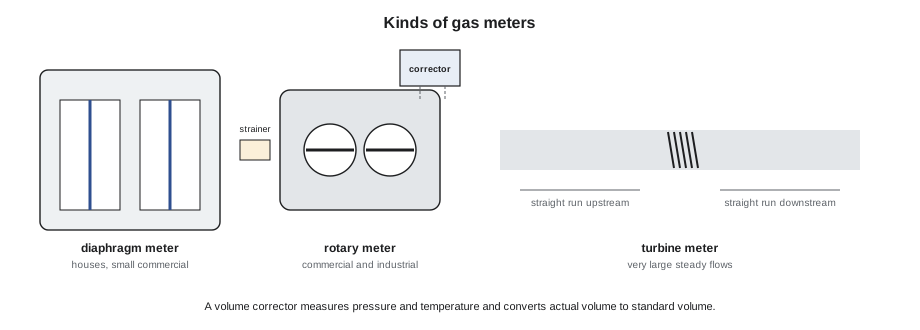
- Diaphragm meters are positive-displacement meters: leather or synthetic diaphragms fill and empty measuring chambers, and a linkage counts the cycles. They are accurate over a wide range of flows, cheap and robust, and they serve almost every house and many small commercial buildings. Many are temperature compensated, with a mechanism that adjusts the count to the base temperature.
- Rotary meters are also positive-displacement meters: two figure-eight lobed impellers turn inside a precisely machined case, each revolution trapping and passing a fixed volume. They are compact, handle much larger flows than diaphragm meters, work well at elevated pressures, and are used on most commercial and industrial services. Their close clearances make them sensitive to debris, so they are installed with strainers, and the utility checks them by a differential pressure test.
- Turbine meters measure velocity: the gas spins a rotor whose speed is proportional to flow. They suit very large, steady flows at higher pressures, and they need straight pipe upstream and downstream to give an even velocity profile.
- Ultrasonic meters, which time sound pulses across the gas stream, are used for large flows and, increasingly, as smart residential meters.
Large services often have an electronic volume corrector on the meter: a small computer with pressure and temperature sensors that converts the meter's actual volume to standard volume continuously and records it for billing. Many meters now also have automated meter reading modules that send readings by radio. None of this changes the technician's job when clocking, but a corrector's display, if the utility allows it to be read, gives both the corrected volume and the conditions in the meter.
Correcting for pressure and temperature
The correction uses absolute pressure and absolute temperature, because gas volume is proportional to absolute temperature and inversely proportional to absolute pressure. The pressure factor is the absolute pressure in the meter divided by the base pressure; the temperature factor is the base absolute temperature divided by the absolute temperature of the gas. Multiplying the meter's actual volume by both gives the standard volume. For the small elevated pressures in buildings, the effects of gas compressibility beyond this are negligible.
The atmospheric pressure used is the local one, not sea level. In Hamilton, about 100 kPa is a reasonable figure for clocking; the utility uses a set value for each area in billing. Temperatures are converted to absolute: degrees Celsius plus 273.15 gives kelvins.
Worked problem
Pressure and temperature factors
Iron Kettle's rotary meter runs at 14 kPa gauge. Atmospheric pressure is 100.0 kPa and the gas in the meter is at 10 °C. Find the pressure factor, the temperature factor and the combined factor.
Show solution
- Pressure factor:
- \[\frac{100.0 + 14}{101.325} = 1.1251\]
- Temperature factor:
- \[\frac{273.15 + 15}{273.15 + 10} = \frac{288.15}{283.15} = 1.0177\]
- Combined:
- \[1.1251 \times 1.0177 = 1.1450\]
Answer: Every cubic metre the meter records holds about 1.145 standard cubic metres of gas. A clocking that ignores this underestimates the input by about 13 in 100 of the real input.
Clocking an appliance
Clocking the meter means timing how fast the meter's test dial turns while only the appliance being checked is firing, then calculating the input. Every meter has a test dial, the fastest-moving pointer or a digital equivalent, marked with the volume one revolution represents, such as 0.1 or 1 m³. The procedure is the same on any meter:
- Shut off, or make sure are off, every other appliance on the meter, including pilots if they are significant.
- Fire the appliance at the rate to be checked, usually high fire, and let it settle.
- Time several full revolutions of the test dial with a stopwatch, and divide to get the time for one.
- Calculate the actual flow: the dial volume divided by the time, converted to an hourly rate.
- On an elevated-pressure meter, multiply by the pressure and temperature factors to get standard flow.
- Multiply by the heating value from the utility to get the input, and compare it with the rating plate.
Worked problem
Checking the brewery's arithmetic
The start-up technician set the kettle burner so that the meter's 0.1 m³ test dial turned once every 12.8 s, and calculated the input as 0.1 ÷ 12.8 × 3,600 × 37.5 ÷ 3.6 without any correction. Find his figure, then the real input using the combined factor of 1.1450.
Show solution
- Actual flow:
- \[\frac{0.1}{12.8} \times 3{,}600 = 28.13 \text{ m}^3/\text{h}\]
- Uncorrected input:
- \[28.13 \times \frac{37.5}{3.6} = 293 \text{ kW}\]
- Standard flow:
- \[28.13 \times 1.1450 = 32.21 \text{ m}^3/\text{h}\]
- Real input:
- \[32.21 \times \frac{37.5}{3.6} = 335.5 \text{ kW}\]
Answer: The burner had been set about 14.5 in 100 above its rating. The technician's figure matched the plate because he had treated the meter as if it were at atmospheric pressure.
To set the burner to its real rating, the target actual flow is the rated standard flow divided by the combined factor, and the target time per revolution follows from it.
Worked problem
The correct dial time
What time per revolution of the 0.1 m³ dial gives the kettle's rated 293 kW?
Show solution
- Rated standard flow:
- \[293 \times \frac{3.6}{37.5} = 28.13 \text{ m}^3/\text{h}\]
- Actual flow at the meter:
- \[\frac{28.13}{1.1450} = 24.57 \text{ m}^3/\text{h}\]
- Time per revolution:
- \[\frac{0.1}{24.57} \times 3{,}600 = 14.7 \text{ s}\]
Answer: The dial must turn more slowly than the technician's setting, because each revolution at elevated pressure carries more gas than its marked volume.
| Delivery pressure | Approximate pressure factor | Ignore for clocking? |
|---|---|---|
| 1.74 kPa | 1.004 (at 100 kPa atmosphere) | Usually yes |
| 14 kPa | 1.125 | No |
| 35 kPa | 1.33 | No |
What Maureen and Ayesha did at Iron Kettle
Maureen asked Nadia to shut down the glycol chiller's gas-fired backup heater and the building's two unit heaters, leaving only the kettle on the meter. Ayesha read 13.9 kPa on the gauge at the meter outlet test port and a gas temperature of about 10 °C from the probe on the piping beside the meter. With the kettle at high fire she timed ten revolutions of the test dial: 128 s, confirming the start-up technician's setting. The corrected calculation put the burner about 14.5 in 100 over its rating, which matched the scorching and the violent boil, and the combustion analyzer read carbon monoxide rising from 35 ppm at a lower firing rate to 140 ppm air-free at that setting.
Maureen reduced the burner's train regulator a little at a time, re-timing the dial after each change, until ten revolutions took 147 s. The flame shortened and lifted off the kettle bottom, the carbon monoxide fell to 38 ppm air-free, and the manifold pressure ended slightly below the figure the maker's manual suggested, which Maureen noted on the start-up sheet with an explanation. She sent the kettle supplier a copy of the calculation, politely, and Nadia's next batch boiled the way the maker had promised.
Meter location and protection
The utility decides where its meter set goes, and its rules are written into its conditions of service. They generally require that the meter be outdoors or in a ventilated, accessible space; that it be readily reachable for reading, service and replacement; that it be clear of driveways and parking unless protected by bollards; that it be away from building openings, air intakes and sources of ignition by set distances, especially around the regulator vent; that it not be under stairs, decks or fire escapes; that the customer's piping support itself so that no strain is put on the meter; and that a shutoff valve be on the inlet. Enbridge also restricts what may be built around a meter after it is set. A technician planning piping lays out the building's connection to suit the utility's meter location, not the other way round.
Two more rules apply to buildings with several meters. Piping from different meters must not be connected together downstream of the meters, because each customer's gas must go through its own meter and a valve closed on one system must not leave it fed from another; and each system must be permanently labelled to show which meter and which part of the building it serves. A customer may also install check meters or sub-meters to track gas use by department or process. These are the customer's, not the utility's, and they are installed and clocked like any other meter.
Volume correctors and electronic meters
An electronic volume corrector shows several numbers, and a technician who has the utility's permission to read it should know which is which. It usually displays the uncorrected volume, matching the meter's own index; the corrected volume, at standard conditions, which is what the customer is billed for; the pressure and temperature it is measuring in the meter; and the correction factor it is applying. Its corrected flow rate, if it shows one, gives a quick check on a clocked input. A corrector is the utility's billing equipment: a technician reads it but never opens, resets or adjusts it, and reports to the utility anything that looks wrong, such as a pressure reading that does not match the delivery pressure on the gauge.
Many newer meters have no mechanical test dial at all, only a digital display. Some show a rate of flow directly; others show a volume register that advances in small steps, and the maker or utility gives the volume per step or a test mode that makes the register easier to time. The principle of clocking is the same: measure a known volume over a measured time with only the appliance being checked firing, then correct for pressure and temperature where the meter is at elevated pressure. Where a display can only be read to a coarse step, timing a longer period improves the accuracy.
Large sites sometimes have more than one utility meter, or a utility meter and several customer-owned check meters on different departments. Before clocking, the technician confirms which meter actually feeds the appliance, by drawing and by watching the dial respond as the appliance starts, because a wrong meter gives a convincingly wrong answer.
Common mistakes
MistakeClocking an elevated-pressure meter without correcting for pressure.
InsteadMultiply the actual flow by the pressure and temperature factors.
MistakeUsing sea-level atmospheric pressure everywhere.
InsteadUse the local atmospheric pressure for the correction.
MistakeClocking with other appliances or large pilots still on the meter.
InsteadIsolate the appliance being checked.
MistakeTiming a single revolution of the test dial.
InsteadTime several revolutions and divide, for accuracy.
MistakeSetting a burner by manifold pressure alone on a large appliance.
InsteadConfirm the input by clocking, corrected for pressure and temperature.
MistakeConnecting piping from two meters together downstream.
InsteadKeep each meter's system separate and labelled.
Summary and key terms
- A meter measures volume at the pressure and temperature inside it, so at elevated pressure its reading must be corrected to standard conditions of 101.325 kPa absolute and 15 °C.
- The correction multiplies by the pressure factor, absolute meter pressure over base pressure, and the temperature factor, base absolute temperature over gas absolute temperature; it is small at 1.74 kPa but about 12 in 100 at 14 kPa and a third at 35 kPa.
- Diaphragm meters serve small loads, rotary meters most commercial and industrial loads at elevated pressure, and turbine and ultrasonic meters very large flows; electronic volume correctors make the correction continuously.
- Clocking times the test dial with only one appliance firing, then converts to actual flow, standard flow and input.
- The utility sets meter locations and protection, and separate meters' systems are never interconnected.
- Standard conditions
- The base pressure and temperature to which gas volumes are corrected for billing and heating value.
- Pressure factor
- Absolute pressure in the meter divided by the base pressure.
- Temperature factor
- Base absolute temperature divided by the absolute temperature of the gas.
- Rotary meter
- A positive-displacement meter with lobed impellers, used for commercial and industrial loads.
- Electronic volume corrector
- A device on a meter that converts actual volume to standard volume using measured pressure and temperature.
- Test dial
- A meter's fastest pointer or digit, marked with the volume one revolution represents.
- Clocking
- Measuring an appliance's input by timing the meter's test dial.
Practice problems
Work each problem on paper first, then reveal the answer to check.
Why must an elevated-pressure meter reading be corrected?
Show answer
Gas at higher pressure is denser, so each measured volume holds more gas than at standard conditions.
Find the pressure factor at 35 kPa gauge with an atmosphere of 100 kPa.
Show answer
(100 + 35) ÷ 101.325 = 1.332.
Which kind of meter is most common on commercial elevated-pressure services?
Show answer
The rotary meter.
Why time several revolutions of the test dial?
Show answer
To reduce the error from starting and stopping the stopwatch.
What had the brewery's start-up technician done wrong?
Show answer
He calculated the input without correcting the meter reading for the 14 kPa pressure, so the burner was overfired.
Lesson quiz · 5 questions
Score 60% or more to complete this lesson.
Create a free account to save your progress, take quizzes and earn a certificate.