
GAS-330 · Lesson 1 of 12 · 23 min
Delivery pressures and pressure classes
▶ Video coming soon A video version of this lesson is on the way.
On Tuesday, September 15, Maureen Fitch took Grant Whitlock and Ayesha Rahman to an empty warehouse on Arvin Avenue in Stoney Creek. Keystone Coatings, a powder-coating company, had leased it and wanted to be painting steel shelving and railings by December. The plant manager, Teresa Lindqvist, walked them past the bare concrete where a cure oven, a burn-off oven, a five-stage parts washer and two new rooftop units would go. The building's old gas service, a small meter at 1.74 kPa feeding four unit heaters, was nowhere near big enough. Enbridge Gas had already asked the question that would shape the whole job: what pressure did Keystone want delivered? "Everyone wants the answer to be 'more'," Maureen said, "but the answer decides your pipe size, your regulators, your overpressure protection, how you test and how you purge. So before we answer it, you two need to be fluent in pressure."
This lesson sets out how gas pressure is measured and expressed, the pressures at which utilities deliver gas, the usual pressure levels inside buildings, the limits the codes place on pressure indoors, and why commercial and industrial customers so often choose an elevated delivery pressure. The rest of the course builds on it: regulators, meters, sizing, piping methods, testing and purging all change once the pressure rises above what a house uses.
Measuring pressure
Gas pressure is force per unit area. In Canada the official unit is the kilopascal (kPa), and you will meet pascals (Pa) for very small pressures such as draft, but the trade still uses pounds per square inch (psi) and inches of water column (in. w.c.) every day, and many gauges and nameplates show them. One inch of water column is the pressure that holds up a column of water one inch high in a U-tube manometer, a very small pressure: about 0.249 kPa.
Two reference points matter. Gauge pressure is pressure measured above the surrounding atmosphere, and it is what almost every gauge and manometer reads; it is written psig or simply kPa when the context is clear. Absolute pressure is gauge pressure plus atmospheric pressure, written psia or kPa absolute. Atmospheric pressure is about 101.3 kPa at sea level and less at higher elevations; in Hamilton it is typically about 100 kPa. Absolute pressure matters whenever gas is compressed or expanded, because a cubic metre or cubic foot of gas at elevated pressure contains more gas than the same volume at low pressure. Lesson 6 uses absolute pressure to correct meter readings, and lesson 10 uses it to explain why a pressure test drops when the pipe cools.
| Pressure | kPa | psi | in. w.c. |
|---|---|---|---|
| Typical natural gas appliance manifold | 0.87 | 0.13 | 3.5 |
| Standard delivery and house piping | 1.74 | 0.25 | 7 |
| Common appliance maximum inlet | 3.5 | 0.5 | 14 |
| Elevated pressure, "2 psi" system | 14 | 2 | 55 |
| Elevated pressure, "5 psi" system | 35 | 5 | 138 |
| A commercial or industrial delivery | 70 to 140 | 10 to 20 | 277 to 554 |
Conversions come up constantly, and they are worth memorizing: 1 psi equals 6.895 kPa and 27.7 in. w.c.; 1 kPa equals 4.02 in. w.c.; 1 in. w.c. equals 0.249 kPa. A gauge that reads 14 kPa is reading about 55 in. w.c., far beyond any U-tube manometer used for appliance work, so a technician moving up to elevated-pressure systems carries both a manometer and a set of pressure gauges, and checks that each gauge's range suits the pressure being read.
Worked problem
Converting between units
A rooftop unit's plate gives a maximum inlet pressure of 3.5 kPa. The building's line regulator is set to 7 in. w.c., and the utility delivers 2 psig. Express all three in kPa and in in. w.c., and check that the rooftop unit is protected.
Show solution
- Plate maximum:
- \[3.5 \text{ kPa} \times 4.02 = 14.1 \text{ in. w.c.}\]
- Line regulator:
- \[7 \text{ in. w.c.} \times 0.249 = 1.74 \text{ kPa}\]
- Delivery:
- \[2 \text{ psi} \times 6.895 = 13.8 \text{ kPa}, \quad 2 \times 27.7 = 55.4 \text{ in. w.c.}\]
Answer: The line regulator holds the unit at about half its plate maximum, but the delivery pressure is about four times that maximum. If the line regulator failed open, the unit would see 13.8 kPa, which is why lesson 5's overpressure protection is required on any system like this.
How gas reaches a building
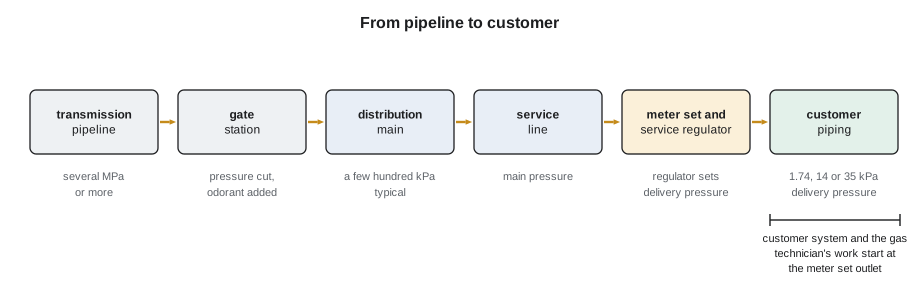
Natural gas travels across the continent in transmission pipelines at very high pressures, often several thousand kilopascals, hundreds of pounds per square inch or more. At a gate station the utility reduces the pressure and adds the odorant, and its distribution mains carry the gas under the streets at pressures that vary from system to system: older low-pressure mains in some downtown areas, and intermediate-pressure mains, often a few hundred kilopascals, in most suburbs and industrial parks. A service line runs from the main to the customer, and at the meter set the utility's service regulator drops the pressure to the delivery pressure agreed with the customer.
The delivery pressure is the pressure at the outlet of the utility's meter set, and it is where the customer's piping, and the gas technician's responsibility, begins. Enbridge delivers to most houses at 1.74 kPa (7 in. w.c.). For larger customers it offers higher delivery pressures, commonly 14 kPa or 35 kPa (2 or 5 psig) and higher for industrial loads, when the customer's equipment and piping are designed for them and the utility agrees. The utility decides what its main and service can supply; the customer's designer decides what the building needs; and the two must agree before the meter is ordered. At Keystone the main on Arvin Avenue could easily supply 35 kPa (5 psig).
Pressure levels inside buildings
Inside a building, gas piping is described by the pressure it is designed to carry. At the low end is the standard system that most houses and many small commercial buildings have: delivery at 1.74 kPa, piping sized for a small pressure drop, and appliances whose own regulators reduce the pressure to their manifold settings. Above it are elevated-pressure systems, typically 14 kPa or 35 kPa (2 or 5 psig), in which the main piping carries gas at the higher pressure and line pressure regulators reduce it near the appliances. Some large commercial and industrial buildings carry still higher pressures to process equipment, boilers and ovens whose gas trains are built for them.
The codes limit how high the pressure may go inside a building, because a leak at higher pressure releases more gas and a failure is harder to contain. CSA B149.1 sets maximum pressures for piping inside buildings by occupancy and gas, allowing higher pressures in industrial buildings and in mechanical rooms and other locations that meet its conditions. In Ontario, natural gas piping designed above 450 kPa indoors or 860 kPa outdoors is high-pressure piping whose design must be registered with TSSA before it is built. At Keystone, an industrial building, 35 kPa throughout the main was well within these limits.
| System | Typical use | What changes for the technician |
|---|---|---|
| 1.74 kPa standard | Houses, small shops | Low-pressure pipe sizing; appliance regulators only |
| 14 kPa elevated | Larger houses, restaurants, offices | Line regulators with overpressure protection; outdoor purging |
| 35 kPa elevated | Commercial and light industrial | As above, with larger loads and longer runs |
| Higher pressures | Industrial process, large boiler plants | Gas trains built for the pressure; welding; TSSA registration above the high-pressure thresholds |
Why choose an elevated pressure?
The main reason is pipe size. Gas flow through a pipe depends on the pressure available to push it; a standard system may lose only a small fraction of its delivery pressure along the pipe, because the appliances need most of it, so long runs and large loads demand large pipe. At elevated pressure the designer can allow a much larger pressure drop, since a line regulator near each appliance will bring the pressure down anyway, and the same load travels through a much smaller pipe. Smaller pipe is cheaper to buy, easier to hang, and fits in crowded ceilings and racks.
Worked problem
The same load at two pressures
Keystone's connected load is 1,963 kW, about 188 m³/h of natural gas, and the farthest appliance is 120 m of pipe from the meter. Using SAMPLE capacities made for this course from a pipe-flow formula, compare a standard system (1.74 kPa with a 0.12 kPa drop) with an elevated system (35 kPa with a drop to about 10 kPa).
Show solution
- SAMPLE capacity at 120 m, standard system: NPS 5 carries about 162 m³/h, NPS 6 about 262 m³/h.
- So the standard system needs NPS 6, 150 mm steel.
- SAMPLE capacity at 120 m, 35 kPa system: NPS 1-1/2 carries about 156 m³/h, NPS 2 about 300 m³/h.
- So the elevated system needs NPS 2, 50 mm steel.
Answer: The elevated system uses pipe one-third the diameter and about one-ninth the cross-sectional area. Even after paying for line regulators and overpressure protection, that is a large saving on a 120 m (400 ft) run, and it is why nearly every new commercial and industrial building is supplied at elevated pressure.
A second reason is equipment. Large burners, process ovens and boilers often need more inlet pressure than a standard system can provide, because their gas trains, with their safety shutoff valves, regulators and strainers, lose pressure of their own. A large burner whose train needs 7 kPa (1 psig) at the inlet simply cannot run from 1.74 kPa delivery.
Elevated pressure has costs as well as benefits. Every appliance needs a regulator that can take the higher pressure; overpressure protection is required wherever a regulator failure could expose low-pressure appliances to the full delivery pressure; testing and purging rules become stricter; and gas escapes faster from any leak. These are the subjects of the rest of the course.
Utility requirements
The utility's own rules sit beside the code. Enbridge publishes requirements for meter locations, clearances around the meter set and its regulator vent, the protection of meters from vehicles, and the information it needs to approve a load: a list of every appliance with its input and required pressure, the building's location on the property, and the date gas is needed. Its approval sets the meter type and size, the service regulator and the delivery pressure. Bayline's part of an application is usually that load list, prepared by the technician who will install the piping, and its accuracy matters: a meter set sized for half the real load will starve the plant on its first cold morning.
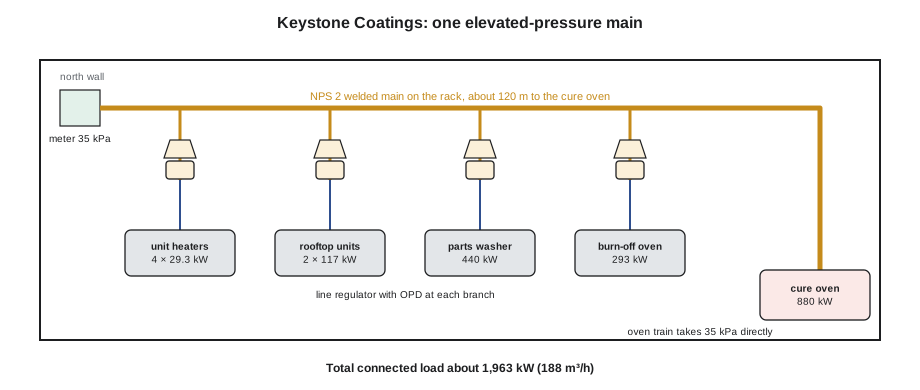
Maureen's load list for Keystone went to the utility that Friday, September 18. It listed every appliance, its input in kW and its required inlet pressure range, and noted that the cure oven would run continuously on two shifts while the rooftop units would cycle. Enbridge approved 35 kPa (5 psig) delivery through a rotary meter, with the meter set on the north wall away from the truck dock.
| Appliance | Input | Inlet pressure needed |
|---|---|---|
| Cure oven | 880 kW | 14 to 35 kPa (train built for the delivery pressure) |
| Burn-off oven | 293 kW | 1.7 to 3.5 kPa |
| Parts washer heater | 440 kW | 2.5 to 3.5 kPa |
| Two rooftop units | 2 × 117 kW | 1.2 to 3.5 kPa |
| Four unit heaters | 4 × 29.3 kW | 1.2 to 3.5 kPa |
| Total | 1,963 kW |
Grant asked why Keystone did not simply ask for a higher pressure still. "Because nothing here needs it," Maureen said. "The oven's train is built for 35 kPa. Above that, every regulator gets bigger and every rule gets tighter, and we'd gain nothing. You pick the lowest pressure that gives you sensible pipe sizes and satisfies the biggest burner. That's the whole art of it."
Reading pressures on plates, tags and drawings
Pressures turn up on every document a gas technician reads, in whatever units the writer preferred. An appliance plate may say 'Max. inlet 3.5 kPa (14 in. w.c.)' and a regulator tag 'Inlet max 35 kPa, outlet 1.2 to 3.2 kPa'; an imported burner's manual may give millibars, and one millibar is 0.1 kPa, about 0.4 in. w.c. Drawings note the design pressure of each part of the system, and a good drawing writes the unit beside every number. Bayline's rule is simple: every pressure written on a start-up sheet, test record or tag carries its unit, and where a document mixes units, the technician converts and writes both. Most of the expensive mistakes with elevated pressure begin with someone reading 14 on a gauge and assuming the wrong unit.
Common mistakes
MistakeReading a gauge in psi and recording it as kPa without converting.
InsteadConvert every reading and write the unit beside it.
MistakeAssuming every appliance can take the building's delivery pressure.
InsteadCheck each appliance's maximum inlet pressure on its plate and regulate down where needed.
MistakeUsing a U-tube manometer on an elevated-pressure line.
InsteadUse a gauge whose range suits the pressure; keep the manometer for low pressures.
MistakeConfusing gauge and absolute pressure in a calculation.
InsteadAdd atmospheric pressure whenever gas volume or expansion is involved.
MistakeOrdering a meter set before the load list is complete.
InsteadGive the utility every appliance, its input and its pressure before the meter is sized.
Summary and key terms
- Gas pressure is measured as gauge pressure, above atmosphere; absolute pressure adds atmospheric pressure, about 100 kPa in Hamilton, and is used for any calculation involving gas volume. 1 psi = 6.895 kPa = 27.7 in. w.c., and 1 in. w.c. = 0.249 kPa.
- The utility's service regulator sets the delivery pressure at the meter outlet, where the customer's system begins: 1.74 kPa for most houses, and 14 or 35 kPa (2 or 5 psig) or more for larger customers by agreement with the utility.
- The codes limit pressures inside buildings, with higher pressures allowed in industrial and other locations that meet their conditions; in Ontario, natural gas piping above 450 kPa indoors or 860 kPa outdoors needs TSSA design registration.
- Elevated pressure allows much smaller pipe and supplies large gas trains, at the cost of line regulators, overpressure protection and stricter testing and purging.
- Gauge pressure
- Pressure above the surrounding atmosphere, as most gauges read it.
- Absolute pressure
- Gauge pressure plus atmospheric pressure.
- Delivery pressure
- The pressure at the outlet of the utility meter set, agreed between utility and customer.
- Service regulator
- The utility's regulator at the meter set that reduces main pressure to the delivery pressure.
- Elevated pressure system
- A building piping system operating above the standard delivery pressure, typically 14 or 35 kPa.
- Line pressure regulator
- A regulator in the building piping that reduces elevated pressure to what appliances need.
- Load list
- A list of every appliance with its input and required pressure, used to size the meter and service.
Practice problems
Work each problem on paper first, then reveal the answer to check.
What is 5 psi in kPa and in in. w.c.?
Show answer
5 × 6.895 = 34.5 kPa, and 5 × 27.7 = 138.5 in. w.c.
What is the difference between gauge and absolute pressure?
Show answer
Absolute pressure is gauge pressure plus atmospheric pressure.
Where does the customer's piping system begin?
Show answer
At the outlet of the utility's meter set.
Give the main reason commercial buildings use elevated pressure.
Show answer
It lets the same load travel through much smaller pipe.
What must the utility receive before it sizes a meter set?
Show answer
A complete load list with every appliance's input and required pressure.
Lesson quiz · 5 questions
Score 60% or more to complete this lesson.
Create a free account to save your progress, take quizzes and earn a certificate.