
GAS-330 · Lesson 4 of 12 · 22 min
Regulator venting and vent limiters
▶ Video coming soon A video version of this lesson is on the way.
On Thursday, September 24, the volunteer manager of a community hall on Hughson Street North called about the hall's kitchen and boiler. The burners on the big kitchen range pulsed, growing and shrinking every few seconds, and the boiler in the basement had been rumbling on start-up. The hall had been converted to an elevated-pressure system the previous year, when a second boiler and a commercial range were added, and the work had passed inspection. Since then, the manager said, a volunteer crew had repainted the basement. Grant and Ayesha found the line regulator for the kitchen in the basement mechanical room, its vent line running up into the ceiling space and stopping there, open, above the new drop ceiling. The second regulator, for the boilers, had no vent line at all, just a vent limiter in its vent opening. Someone had painted over the limiter.
This lesson explains why regulators have vents, what happens when a vent is blocked or misused, how vent lines are run and terminated outdoors, and when a listed vent-limiting device may take the place of a vent line. It also covers the vents on the utility's service regulator and on overpressure protection devices, which lesson 5 covers in more detail.
Why a regulator needs a vent
The space above a regulator's diaphragm, where the spring sits, must stay at atmospheric pressure. As the diaphragm moves up and down, that space changes volume, and air must flow in and out through the vent so that the diaphragm can move freely. The vent is the regulator's breathing hole. It has a second job as well: if the diaphragm tears, gas from the outlet side passes into the spring case and out through the vent, and on regulators with internal relief, the relief valve discharges gas through the same vent when the outlet pressure climbs too high. So a regulator's vent may carry air in normal service and gas in a failure, and it must be treated as a possible gas outlet.
A blocked or restricted vent changes how the regulator behaves. If the vent is completely blocked, air is trapped above the diaphragm and acts like an extra spring that stiffens as the diaphragm moves; the regulator cannot open properly at high flow, and outlet pressures can rise above set point when the trapped air is warmed or the diaphragm cannot settle. If the vent is partly blocked, air moves in and out slowly, the diaphragm lags behind the changes in flow, and the regulator overshoots and undershoots: the outlet pressure hunts, rising and falling, and burners downstream pulse with it. A partly blocked vent is one of the most common causes of pulsing flames on an elevated-pressure system.
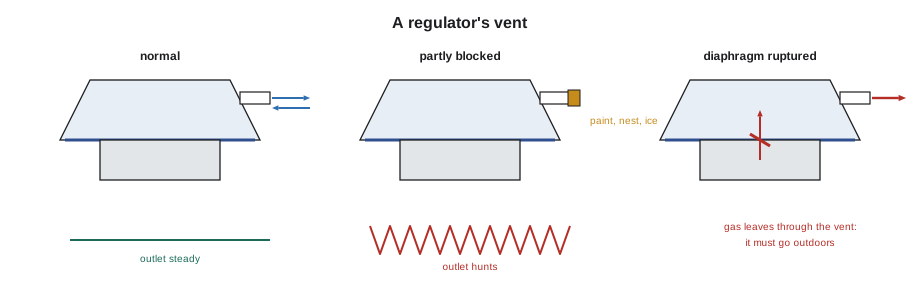
Bayline met another blocked vent a month after this call. At Kingsview Manor in October, a mud dauber nest in a boiler's train regulator vent caused low gas pressure trips until the regulator was replaced and an insect-proof vent cap fitted, as GAS-310 described. Insects, paint, ice, snow, dirt and spider webs block vents, and the vent opening is one of the first things to look at whenever a regulator misbehaves.
Vent lines
Where a regulator is indoors and the code or the regulator's certification requires it, its vent is piped to the outdoors. The rules for vent lines are similar in both codes and in every maker's instructions:
- Size. The vent line must be no smaller than the regulator's vent connection, and the maker's table sets the larger size needed for long runs. A long, small vent line restricts breathing just as a blockage does.
- Length and fittings. The maker states a maximum length for each vent size, usually counting elbows as equivalent lengths of pipe.
- Independence. Each regulator's vent normally runs on its own. Vent lines are not tied into one another unless the regulator maker and the code allow a manifold, and vents from relief valves and overpressure devices run independently of everything else, so that one device's discharge cannot back up into another's spring case.
- Termination. The vent ends outdoors, turned down or fitted with a vent cap, with an insect screen, where it cannot be blocked by snow, ice, water or debris. In flood-prone or deep-snow locations an anti-flood fitting is used.
- Clearances. The end of the vent must be clear of building openings, mechanical air intakes and sources of ignition by the distances the code sets, because it may discharge gas. CSA B149.1 sets these clearances for regulator vents, and the utility sets its own for the service regulator.
- Never into a building space. A vent line may not end inside the building, in a ceiling or wall cavity, in a combustion chamber, in a flue or chimney, or in a duct.
The hall's kitchen regulator broke the last rule. Its vent line ran up through the old open ceiling and had once ended at a fitting through the wall. During the painting, a volunteer had taken down a length of the vent line to paint behind it and put back only the lower part, so the vent now ended in the space above the new drop ceiling. In normal service that meant only air moving in and out. If the diaphragm failed or the regulator's internal relief opened, gas would fill the ceiling space over the kitchen.
Worked problem
Is the vent line big enough?
A line regulator's maker allows a vent line of NPS 1/2 up to 9 m of equivalent length, and NPS 3/4 up to 30 m. Each elbow counts as 0.6 m of pipe (SAMPLE values for this lesson). The hall's kitchen regulator needs 7.5 m of pipe and 4 elbows to reach the outdoor wall. Which size is needed?
Show solution
- Equivalent length:
- \[7.5 + 4 \times 0.6 = 9.9 \text{ m}\]
- This is more than the 9 m allowed for NPS 1/2, so the vent line must be NPS 3/4.
Answer: The regulator's vent connection was NPS 1/2, but the run is long enough that the line must be one size larger. Real limits come from the maker's instructions for the exact model.
Vent limiters
A vent-limiting device, or vent limiter, is a small fitting screwed into a regulator's vent opening in place of a vent line. In normal service it lets air pass freely in and out, so the diaphragm can breathe. If the diaphragm ruptures and gas rushes into the spring case, a ball or valve in the limiter is pushed onto a seat with a tiny orifice, so that only a very small flow of gas, a rate set by the regulator standard, can escape into the room. That small leak is easily diluted by normal ventilation, and it also makes the failure noticeable by its smell.
Vent limiters are allowed only on regulators certified to be used with them, and only in the way the regulator's certification and the code allow. The conditions differ between the codes and between regulator models; they may cover the regulator's inlet pressure, its location, the ventilation of the space and whether a limiter can be used on regulators with an internal relief or OPD. A vent limiter is part of a certified assembly: it must be the maker's limiter for that regulator, fitted in the position the maker shows, and kept clean and unpainted. Painting a limiter, blocking it with tape during work, or replacing it with a plug turns it into a blocked vent. The boiler regulator at the hall had exactly that problem: the volunteers had painted the regulator and the limiter together, sealing the limiter's breathing passages, and the regulator had started to hunt.
| Situation | Vent arrangement |
|---|---|
| Line regulator indoors, certified for a vent limiter, in a location the code allows | Maker's vent limiter, clean and unpainted |
| Line regulator indoors, not certified for a limiter, or not allowed by the code | Vent line to outdoors, sized for its length |
| Regulator with internal relief or OPD discharging through its vent | As the maker and code require; usually a vent line outdoors |
| Regulator outdoors | Vent turned down or capped, screened, clear of snow and openings |
| Utility service regulator | The utility's vent arrangement; keep it clear |
Service regulator vents
The utility's service regulator vent is usually a short fitting turned down beside the meter set, with a screen. Its relief discharge can be large if the regulator fails, so the utility keeps it clear of windows, doors, air intakes, and sources of ignition, and anything that could trap gas. The commonest problems are made by people: a deck built around the meter, a window added near it, a shed against the wall, a dryer vent beside it, snow shovelled over it, or a downspout spilling ice onto it. A blocked service regulator vent can cause the same hunting and overpressure as a blocked line regulator vent, at the very point where all the building's gas enters. When a gas technician sees a service regulator vent in trouble, the right call is to the utility.
Checking vents on a service call
Whenever a regulator is suspected, its vent is checked before its adjustment is touched. The technician looks at the vent opening or limiter for paint, insects, webs, ice and dirt; follows any vent line to its end, checking its size, length, supports and termination; and confirms that no two vents have been tied together and that nothing has been built near the end. If the outlet pressure hunts, a quick test is to watch the manometer while the vent cap or limiter is removed for a moment, with the space ventilated and no ignition sources nearby: if the hunting stops, the vent is the problem. Where a regulator has been flooded or iced, its spring case may hold water or rust, and the regulator is replaced rather than dried out.
What Grant and Ayesha did at the hall
With the kitchen range firing, Ayesha's manometer on the kitchen regulator's outlet swung between 1.4 and 2.1 kPa every few seconds. Grant traced the vent line into the ceiling space and found its open end. With the boilers firing, the boiler regulator's outlet also swung, more slowly, and the limiter was coated in the same paint as the regulator body. They shut off the kitchen line at its valve, ventilated the space, and checked the ceiling cavity with a combustible gas indicator: it read zero, because the kitchen regulator's diaphragm was still intact.
They replaced the painted vent limiter with a new one of the maker's part number, after confirming from the regulator's tag and installation sheet that it was certified for a limiter in that location. The boiler regulator's outlet steadied at 3.2 kPa within a minute, and the boiler's start-up rumble stopped. For the kitchen regulator, which was not certified for a limiter, they replaced the missing length of vent line in NPS 3/4 pipe, as the equivalent-length check required, and extended it through the original wall fitting, with a turned-down screened cap clear of the kitchen exhaust and the hall's side door. With the vent restored, the kitchen regulator held 1.74 kPa with the range on high and the pulsing stopped.
Before leaving, Grant hung a tag on each regulator that read DO NOT PAINT OR COVER VENT and wrote a note for the hall's volunteer manager. "Nobody did anything wrong on purpose," he said to Ayesha in the van. "They just didn't know that a little brass fitting was breathing for the whole system."
Vents in winter
In Hamilton's winters, freezing rain, drifting snow and ice falling from roofs are the commonest causes of blocked vents outdoors. Water can enter a vent that faces up or sideways, freeze inside it and stop the diaphragm breathing; snow piled against a wall can bury a low vent; and an icicle dripping onto a vent cap can seal it overnight. Outdoor vents are turned down, kept above the expected snow line where possible, fitted with caps or anti-icing fittings where the maker offers them, and kept out from under eaves and downspouts. A regulator that has frozen should be thawed gently, checked for water in the spring case and, if water got in, replaced. Each fall, a maintenance visit to an elevated-pressure building includes a walk around the outside to look at every regulator vent and OPD vent before winter.
Common mistakes
MistakePainting or taping over a regulator vent or vent limiter.
InsteadKeep vents and limiters clean and uncovered; mask them during painting.
MistakeEnding a vent line in a ceiling, wall or duct.
InsteadRun every required vent line to the outdoors and terminate it properly.
MistakeRunning a long vent line at the size of the vent connection.
InsteadCheck the maker's length table and upsize long runs.
MistakeTying several regulator or relief vents together.
InsteadRun each vent independently unless the maker and code allow a manifold.
MistakeFitting any vent limiter that threads in.
InsteadUse only the maker's limiter on a regulator certified for it, where the code allows.
MistakeDrying out a flooded or iced regulator and putting it back in service.
InsteadReplace it; water and rust in the spring case affect control.
Summary and key terms
- A regulator's vent lets the space above its diaphragm breathe at atmospheric pressure, and it becomes a gas outlet if the diaphragm tears or an internal relief opens.
- A blocked vent stiffens the diaphragm; a partly blocked vent makes the outlet pressure hunt and burners pulse.
- Required vent lines run to the outdoors, no smaller than the vent connection and sized for their equivalent length, each on its own unless the maker and code allow otherwise, with a turned-down, screened end clear of openings, intakes and ignition sources by the code's distances as CSA B149.1 sets, and never inside the building, a flue or a duct.
- A vent limiter, used only on regulators certified for it where the code allows, breathes freely but limits gas escape to a tiny flow if the diaphragm fails; it must be kept clean and unpainted.
- Service regulator vents belong to the utility and must be kept clear.
- Regulator vent
- The opening that lets the space above a regulator's diaphragm breathe to atmosphere.
- Vent line
- Piping that carries a regulator's vent to the outdoors.
- Vent-limiting device
- A fitting that lets a regulator breathe but limits gas escape to a tiny flow if the diaphragm fails.
- Hunting
- A regulator outlet pressure swinging above and below set point.
- Anti-flood fitting
- A vent termination that keeps water or snow from entering a vent.
- Equivalent length
- The length of straight pipe that has the same resistance as a run including its fittings.
Practice problems
Work each problem on paper first, then reveal the answer to check.
What two jobs does a regulator vent do?
Show answer
It lets the spring case breathe to atmosphere, and it carries gas outdoors if the diaphragm fails or the relief opens.
What symptom does a partly blocked vent usually cause?
Show answer
Hunting outlet pressure and pulsing burner flames.
Name three places a vent line must never end.
Show answer
Inside the building or a cavity, in a combustion chamber or flue, and in a duct.
When may a vent limiter replace a vent line?
Show answer
Only on a regulator certified for that limiter, in a location and way the code allows.
What was wrong with the hall's boiler regulator?
Show answer
Its vent limiter had been painted over, so the regulator hunted.
Lesson quiz · 5 questions
Score 60% or more to complete this lesson.
Create a free account to save your progress, take quizzes and earn a certificate.