
GAS-330 · Lesson 11 of 12 · 21 min
Purging larger systems safely
▶ Video coming soon A video version of this lesson is on the way.
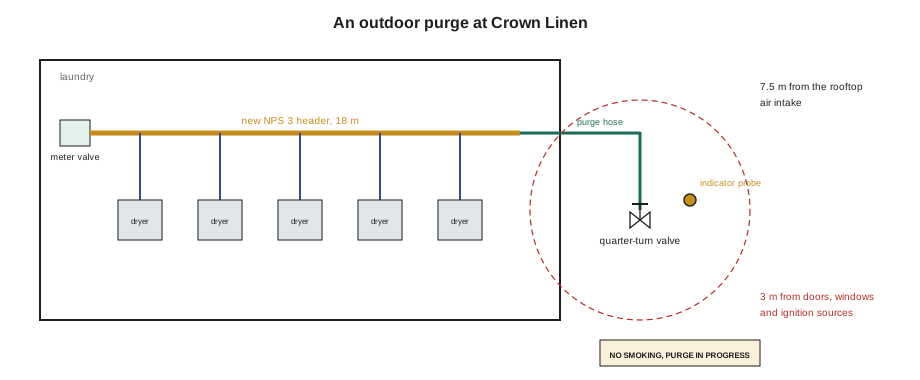
By one o'clock on Sunday, October 4, Crown Linen's new header had passed its pressure test and was full of nitrogen at a low pressure. Before the dryers could run on Monday morning, the nitrogen had to be pushed out and replaced by natural gas, from the meter valve to every dryer and the boiler, without letting a flammable mixture form anywhere inside the building. On a house, a technician often bleeds a new line through an appliance burner and is done in a minute. Crown Linen's header was NPS 3 and 18 m long, and at that size and length, and at 35 kPa, both codes require the purge to discharge outdoors. Grant ran a purge hose out through the back wall's sleeve to the yard, and Ayesha zeroed the combustible gas indicator in the fresh air. "Slow and attended," Grant said. "The whole job is about knowing exactly where the gas is."
This lesson explains purging: replacing air or inert gas with fuel gas when piping goes into service, and replacing fuel gas with inert gas when it comes out of service. It covers why the flammable range matters, when the codes require purging to the outdoors, how an outdoor purge is set up and controlled, when indoor purging through an appliance is allowed, the use of inert gas, and the special care needed on large industrial systems.
Why purging is dangerous
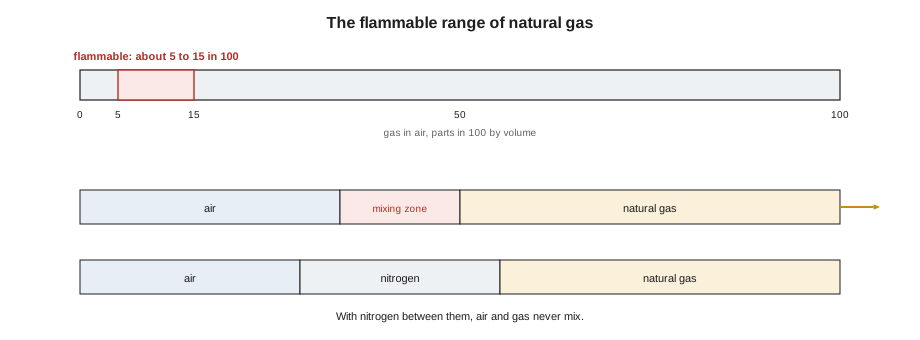
Natural gas burns only when it is mixed with air in a narrow range: roughly 5 to 15 parts of gas in 100 of the mixture by volume, between the lower explosive limit, LEL, and the upper explosive limit, UEL. Below the LEL the mixture is too lean to burn; above the UEL it is too rich. A pipe full of air is safe, and a pipe full of gas is safe, but while one is replacing the other there is always a zone, at the boundary between them, where the mixture passes through the flammable range. If that zone, or the mixture leaving the pipe, meets an ignition source, it can ignite. Inside a pipe, an ignition can accelerate into a detonation that ruptures the pipe; outside it, a cloud of gas and air drifting into a building can explode. Many serious gas explosions have happened during purging of new commercial and industrial piping, which is why the codes were tightened in the years after them.
Purging is made safe by three things: controlling where the discharge goes, so that any flammable mixture is released outdoors in open air away from people and ignition; knowing what is coming out, by measuring with an instrument rather than guessing; and, on larger systems, keeping air and gas apart altogether by putting an inert gas between them.
When the purge must go outdoors
Both codes require piping to be purged to the outdoors when it is large or long enough, or at high enough pressure, that a purge into the building could release a dangerous amount of gas. CSA B149.1 requires outdoor purging when the system operates above 14 kPa (2 psig), or when it contains a section of pipe longer than the code's limit for its size, a limit that starts at the NPS 2-1/2 size and gets shorter as the pipe gets larger. The tables in the code give the exact limits. Crown Linen's header met both conditions: it ran at 35 kPa, and its NPS 3 header was well past the length the code allows to be purged indoors at that size.
Smaller, lower-pressure systems that fall below those limits may be purged indoors, in ways the code describes: typically by burning the gas off at an appliance rated up to 120 kW (400,000 Btu/h) that has a readily accessible burner outside its combustion chamber and a continuous source of ignition, or by the methods in the code's annex for appliances without a continuous pilot. Even an indoor purge is attended and monitored.
Setting up an outdoor purge
The outdoor purge rules in the two codes are similar in substance. In practice, a purge point is set up like this:
- A purge line to the outdoors, from a fitting at the far end of the section being purged, no smaller than NPS 1/2 and sized so that the purge is controllable, running through a wall sleeve, window or door to open air.
- A quarter-turn shutoff valve with a handle, close to the open end, within 1.5 m (5 ft), so that the person attending can stop the flow instantly.
- A safe discharge location, clear of building openings, sources of ignition and mechanical air intakes by the distances the code sets, at least 3 m (10 ft) from openings and ignition sources and 7.5 m (25 ft) from mechanical air intakes, pointed away from people, and not under eaves or into an enclosed yard where gas could collect.
- Exclusion of people and ignition sources from the area around the discharge, with no smoking, vehicles or running engines nearby, and bystanders kept well back.
- Continuous attendance by a qualified person at the discharge, for the whole purge.
- A combustible gas indicator, zeroed in fresh air, monitoring the discharge, so that the end point is measured, not guessed.
Knowing the end point
When purging into service, the purge continues until the combustible gas indicator shows a steady reading of fuel gas at the discharge, meaning that the air or nitrogen has been displaced. Smell is never the test. New steel piping can absorb the odorant from the first gas that passes through it, a problem called odorant fade, so that gas arriving at the end of a new main may smell weak or not at all. Gas with no smell is still gas. On large new systems, utilities may also condition new piping, or the designer may call for odorant monitoring, so that gas reaching appliances is properly odorized.
When purging out of service, before work on the piping, the order is reversed: the gas is displaced with nitrogen, the discharge is monitored, and the purge continues until the indicator shows no combustible gas at the discharge and at the point where the work will be done. Then the work area itself is checked before hot work, as lesson 8 described.
Worked problem
How much gas will the purge release?
Crown Linen's header is 18 m of NPS 3 Schedule 40 (inside diameter 77.9 mm), and its ten dryer branches and boiler branch add about 22 m of NPS 1 (inside diameter 26.6 mm). Find the volume to be purged. If the purge is continued until about twice that volume has been discharged, at about 20 m³/h through the purge line, how long does it take?
Show solution
- Header volume:
- \[\frac{\pi \times 0.0779^2}{4} \times 18 = 0.0858 \text{ m}^3\]
- Branch volume:
- \[\frac{\pi \times 0.0266^2}{4} \times 22 = 0.0122 \text{ m}^3\]
- Total about 0.098 m³; twice that is about 0.20 m³.
- Time:
- \[\frac{0.20}{20} \times 3{,}600 = 36 \text{ s}\]
Answer: The purge itself takes well under a minute, which is exactly why it must be controlled by someone holding a valve and watching an instrument. At a higher flow, the end point would pass in seconds, and an unattended open pipe at elevated pressure releases gas very quickly.
Inert gas purging
On larger systems, the safest way to put piping into service is to put an inert gas, usually nitrogen, between the air and the fuel gas. The air is first purged out with nitrogen, until an oxygen meter at the discharge shows the oxygen has fallen to a low level, and then the nitrogen is purged out with gas. Because air and gas never meet, the mixture inside the pipe never enters the flammable range. Taking a system out of service is the same in reverse: gas purged out with nitrogen before any air is let in. Crown Linen's header was already full of nitrogen from its pressure test, so the purge into service was simply nitrogen to gas.
Large industrial and power plant gas systems, with big pipe, high pressures and long runs, are purged to detailed written procedures, often following NFPA 56, the standard for fire and explosion prevention during cleaning and purging of flammable gas piping, which many engineers specify for such work even where the code does not require it. These procedures name a purge supervisor, set out each step, the instruments and the acceptance readings, and require a written record. A gas technician working on such a system follows the procedure; it is not improvised on the day.
Purging appliances after the main
Once the main and its branches are full of gas, each appliance is put into service in turn: its manual valve opened, its train or connector purged of the small amount of air or nitrogen in it, usually through its own burner and pilot system following the maker's start-up instructions, and its operation checked. Appliances with continuous pilots or proven ignition systems will usually light after a few trials as the last of the inert gas clears; an appliance that locks out repeatedly may still have nitrogen in its train, and the maker's instructions say how to clear it. The leak test at operating pressure from lesson 10 is done on every new connection as it is put into service.
| Stage | What happens | Check |
|---|---|---|
| Before | Permit or plan; outdoor discharge set up; people and ignition kept clear | Indicator zeroed in fresh air |
| Air to nitrogen (if used) | Nitrogen displaces air | Oxygen meter shows low oxygen at discharge |
| Nitrogen or air to gas | Gas from the meter valve displaces the contents | Indicator shows steady fuel gas at discharge |
| Close and remove purge line | Valve closed, purge fitting capped | Leak test the cap |
| Appliances | Each appliance purged through its own burner per the maker | Leak test connections; light and check operation |
| Record | Who, when, where discharged, readings | Job file and permit |
What Grant and Ayesha did on Sunday afternoon
With the purge line out to the yard, the area marked off and a sign on the yard gate, Ayesha stood at the quarter-turn valve with the indicator. Grant reconnected the inlet spool at the meter, leak-tested its flanges with solution at low pressure, and opened the meter outlet valve slowly while talking to Ayesha by radio. She cracked the purge valve. The first discharge read zero combustible gas, then the reading rose quickly through the LEL to a steady fuel gas reading in a little under a minute. She closed the valve, and Grant capped the purge fitting and leak-tested the cap.
Then they went dryer by dryer. Each dryer's manual valve was opened, its burner purged through its normal ignition sequence, and each new socket-welded branch connection was leak-tested with solution at operating pressure. Two dryers locked out on their first trial and lit on the second as the last nitrogen cleared their trains. The boiler, with its own train and burner management system, was put into service last, with Grant checking its gas pressure switch settings against its start-up sheet. At five o'clock all eleven appliances were running, and Ayesha's purge record listed the time, the discharge location, the indicator readings and both their names. On Monday morning the laundry opened on time.
Purging out of service for alterations
When part of an existing elevated-pressure system must be opened, for a tie-in, a repair or a removal, the section is isolated and its gas is purged out with nitrogen to the outdoors through the same kind of attended, monitored purge line, until the indicator shows no combustible gas at the discharge. The section is then kept isolated with a blind or removed spool while the work is done, as lesson 8 described, and purged back into service afterward.
Common mistakes
MistakePurging a large or elevated-pressure system into the building.
InsteadPurge to the outdoors when the code requires it, through a controlled purge line.
MistakeLeaving a purge discharge unattended, even for a moment.
InsteadKeep a qualified person at the quarter-turn valve throughout.
MistakeJudging the end of a purge by smell.
InsteadUse a combustible gas indicator; new pipe can absorb odorant.
MistakeDischarging near doors, windows, air intakes or ignition sources.
InsteadChoose a location clear by the code's distances, in open air.
MistakeLetting air into a gas-filled large main before work.
InsteadPurge it out of service with nitrogen first.
MistakeImprovising the purge of a large industrial system.
InsteadFollow a written procedure, often to NFPA 56, with a named supervisor.
Summary and key terms
- Natural gas is flammable between about 5 and 15 in 100 in air, so whenever air and gas replace each other in a pipe a flammable mixture passes through it.
- Purging is made safe by discharging to the outdoors, measuring with a combustible gas indicator, and, on larger systems, placing nitrogen between air and gas.
- Both codes require outdoor purging above 14 kPa (2 psig) and for pipe sections longer than the code's limit for their size, from NPS 2-1/2 up.
- An outdoor purge uses a purge line of at least NPS 1/2 to open air, a quarter-turn valve near the end, continuous attendance, an indicator at the discharge and a location clear of openings, intakes and ignition sources by the code's distances.
- Smaller systems may be purged indoors as the code allows, typically through an appliance with continuous ignition.
- Purges into service end at a steady fuel gas reading, never judged by smell because of odorant fade; purges out of service end at no combustible gas.
- Large industrial systems follow written procedures, often to NFPA 56.
- Appliances are then put into service one at a time, with their connections leak-tested.
- Purging
- Replacing the contents of a pipe, air or inert gas with fuel gas, or fuel gas with inert gas.
- Lower explosive limit
- The lowest concentration of gas in air that will burn, about 5 in 100 for natural gas.
- Upper explosive limit
- The highest concentration of gas in air that will burn, about 15 in 100 for natural gas.
- Combustible gas indicator
- An instrument that measures combustible gas in air, used to monitor a purge.
- Odorant fade
- Loss of odorant from gas absorbed by new piping, so that gas may smell weak or not at all.
- Inert gas purging
- Placing nitrogen or another inert gas between air and fuel gas so that they never mix.
Practice problems
Work each problem on paper first, then reveal the answer to check.
Why does every purge pass through a flammable mixture unless inert gas is used?
Show answer
As gas replaces air, the boundary between them passes through the 5 to 15 in 100 range.
When must a purge go to the outdoors?
Show answer
When the system operates above 14 kPa or has a pipe section longer than the code's limit for its size.
Name four requirements for an outdoor purge.
Show answer
A purge line to open air, a quarter-turn valve near the end, continuous attendance and an indicator at the discharge; also a location clear of openings, intakes and ignition.
Why is smell never used to end a purge?
Show answer
New piping can absorb the odorant, so gas may not smell.
Why did two of Crown Linen's dryers lock out on their first try?
Show answer
The last of the nitrogen from the test was still clearing from their trains.
Lesson quiz · 5 questions
Score 60% or more to complete this lesson.
Create a free account to save your progress, take quizzes and earn a certificate.