
GAS-310 · Lesson 8 of 12 · 26 min
Modulating and staged firing
▶ Video coming soon A video version of this lesson is on the way.
The Westmount branch library on Hamilton Mountain had replaced its old boiler two winters earlier with three condensing boilers of 300 kW (1,000,000 Btu/h) each, piped in parallel and run by a cascade controller. The facilities manager called because on mild days the boilers seemed to start and stop constantly, and the gas bills were higher than the engineer had promised. On Thursday, October 29, a mild, grey afternoon of 12 °C, Maureen and Luis stood watching the lead boiler's display: it lit, ran for ninety seconds, stopped, waited three minutes and lit again. "That," said Maureen, "is a boiler that can't turn down far enough for the load, run by a controller that's been told to use one boiler at a time."
This lesson explains how commercial burners vary their output to follow the load: on-off, high-low, multi-stage and fully modulating firing; how the fuel and air are kept in the right ratio as the rate changes, by mechanical linkage or by servo motors; how firing-rate controllers work; and how several boilers are staged together. Lesson 9 covers tuning the fuel-air ratio at each firing rate.
Why firing rate matters
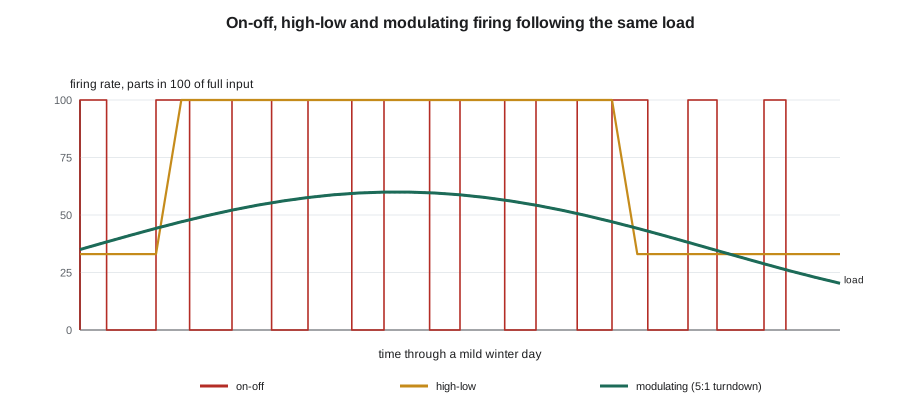
A boiler is sized for the coldest day, but most of the season the load is a fraction of that. A burner that can only run at full input meets a small load by running briefly and stopping, over and over. Each cycle wastes energy in the purge, which blows warm air out of the boiler, and in heating up the boiler's metal and water. Each cycle also wears the ignition system, the valves and the refractory, and on condensing boilers short cycles keep the heat exchanger from settling into efficient condensing operation. A burner that can reduce its firing rate to match the load runs longer, more steadily and more efficiently.
Firing modes
An on-off burner fires at a single rate whenever the operating control calls. It is simple and suits small loads or boilers in a large staged group. A high-low or two-stage burner lights at low fire and moves to high fire when the load needs it, returning to low fire, rather than shutting off, as the load falls. A multi-stage burner has several fixed steps. A modulating burner varies its firing rate smoothly anywhere between its minimum and maximum, following a signal from a firing-rate controller. The range is given by the turndown ratio of lesson 1: a 5:1 burner can fire from full input down to one-fifth of it, a 10:1 burner to one-tenth. Below its minimum rate, even a modulating burner must cycle on and off.
Worked problem
Can the lead boiler follow the mild-day load?
Each Westmount boiler is rated 300 kW with a 5:1 turndown. On a 12 °C afternoon, the library's heating load is about 45 kW. What is a boiler's minimum firing rate, and what would its minimum rate be with a 10:1 turndown?
Show solution
- Minimum rate at 5:1:
- \[\frac{300}{5} = 60 \text{ kW}\]
- Minimum rate at 10:1:
- \[\frac{300}{10} = 30 \text{ kW}\]
- The load of 45 kW is below the 5:1 minimum but above the 10:1 minimum.
Answer: At 5:1, even at its lowest rate a boiler produces more heat than the building can use on a mild day, so it must cycle. The boilers' data sheet showed that they were in fact capable of 10:1, but the installer had left the minimum firing rate parameter at the factory's 5:1 setting.
Keeping the fuel-air ratio as the rate changes
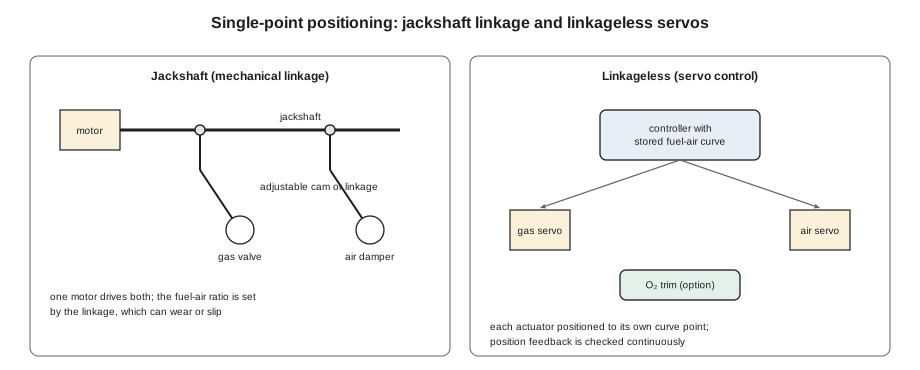
Whatever the firing rate, the air must change with the gas so that excess air stays in the right range. On packaged commercial burners, the traditional method is single-point positioning with a jackshaft: one modulating motor turns a shaft connected by arms, rods and linkages to both the gas butterfly valve and the air damper. The shape of the linkage, often adjusted with a characterizing cam, a strip of adjustable screws that the follower rides on, sets how the gas opening relates to the air opening at each position. Jackshaft systems are robust and familiar, but their linkages wear, their set screws can slip, and they can only follow one fixed curve; a slipped damper arm silently changes the excess air at every firing rate.
Linkageless control, also called parallel positioning, replaces the jackshaft with separate servo motors on the gas valve, the air damper and sometimes the fan speed drive and a flue gas recirculation damper. A controller stores a fuel-air curve of matched positions at ten or more points across the firing range, set during tuning, and drives each servo to its point. Each servo reports its actual position, and the controller shuts the burner down if any servo is not where it should be. Linkageless systems hold the ratio more precisely, avoid linkage wear and allow oxygen trim, in which an oxygen sensor in the flue fine-tunes the air to hold a target oxygen reading as conditions change. Premix condensing boilers achieve the same goal differently, by varying the fan speed and letting the zero-governor gas valve of lesson 2 deliver gas in proportion to the air.
| Method | How the ratio is held | Advantages | Watch for |
|---|---|---|---|
| Jackshaft with cam | One motor, mechanical linkage to gas and air | Simple, robust, well known | Wear, slipped arms, one fixed curve |
| Linkageless servos | Separate servos to a stored curve, position feedback | Precise, many curve points, supports oxygen trim | Needs careful setup and trained technicians |
| Premix with fan speed control | Fan speed sets air; zero-governor follows with gas | Simple modulation, wide turndown | Venturi and gas valve offset settings; sensitive to vent restriction |
| Oxygen trim (add-on) | Sensor fine-tunes air to target oxygen | Holds efficiency as air density and gas change | Sensor calibration and failure mode |
Firing-rate controllers
The firing-rate controller decides how hard the burner should fire. It compares a measured value, such as boiler supply water temperature or steam pressure, with a set point and sends a signal to the burner's modulating motor or controller, commonly 4 to 20 milliamps or 0 to 10 volts. Most use PID control. The proportional part changes the firing rate in proportion to how far the measurement is from the set point; a narrow proportional band makes the burner react strongly to small errors and can make it hunt up and down, while a wide band makes it sluggish. The integral part slowly adds or removes firing rate as long as an error persists, eliminating the steady offset that proportional control alone leaves. The derivative part reacts to how fast the measurement is changing; it is often left off on boilers. Controllers also provide a low-fire hold after light-off, so the burner stays at low fire while a cold boiler warms up gently, avoiding thermal shock, and a release to modulation once the boiler is warm.
Many hot water systems also use outdoor reset, which lowers the boiler water set point as the outdoor temperature rises, since the building needs less heat. A lower water temperature on mild days reduces cycling and, on condensing boilers, lowers the return water temperature so that more of the water vapour in the flue gas condenses and gives up its heat.
Worked problem
The outdoor reset set point
Westmount's reset curve is set to supply 80 °C water at the design outdoor temperature of −18 °C and 30 °C water at 18 °C outdoors, varying in a straight line between. What supply set point does it give at 12 °C outdoors?
Show solution
- Fraction of the way from the warm end to the design end:
- \[\frac{18 - 12}{18 - (-18)} = \frac{6}{36} = 0.167\]
- Set point:
- \[30 + 0.167 \times (80 - 30) = 30 + 8.3 = 38.3 \text{ °C}\]
Answer: On a 12 °C day the boilers need to supply only about 38 °C water. The facilities manager had overridden the reset to a fixed 70 °C after a complaint the previous winter, which made the boilers reach their set point and shut off even faster and kept the return water too warm to condense.
Staging several boilers
Where a building has several boilers, a sequencing or cascade controller decides how many run and at what rates. It names a lead boiler that starts first and lag boilers that start as the load grows, and it rotates the lead role so that the boilers wear evenly. There are two broad strategies. Series staging runs the lead boiler up to high fire before starting the next, which keeps the fewest boilers running and suits non-condensing boilers, whose efficiency changes little with rate. Parallel staging starts more boilers sooner and runs them together at lower rates, which suits condensing boilers, because a heat exchanger running at part load has more surface per unit of heat and makes a cooler flue gas, condensing more. Where boilers have isolation valves or pumps, the controller must also open the valve or start the pump of each boiler it fires.
Worked problem
Two boilers or three?
On a colder day Westmount's load is 400 kW. With series staging, how many boilers run and at what fraction of their capacity? With parallel staging using all three, what fraction does each run at?
Show solution
- Series: the lead boiler runs at full 300 kW, and the second makes up the rest:
- \[400 - 300 = 100 \text{ kW} \;\to\; \frac{100}{300} = 0.33\]
- Parallel, three boilers sharing equally:
- \[\frac{400}{3} = 133 \text{ kW each} \;\to\; \frac{133}{300} = 0.44\]
Answer: Series staging runs one boiler flat out and one at about a third; parallel staging runs all three at under half. For these condensing boilers, the maker's efficiency curve favours the parallel arrangement, as long as each boiler stays comfortably above its minimum rate.
Fixing Westmount
With the facilities manager's agreement and the boiler maker's installation manual open, Luis changed the minimum firing rate parameter on each boiler to the 10:1 the maker allowed for that model, and Maureen confirmed with the analyzer that each boiler burned cleanly at its new minimum, with oxygen and carbon monoxide within the maker's range and a steady flame signal. She restored the outdoor reset curve, with a slightly higher warm-end temperature to answer the old complaint from a cold reading room, and changed the cascade from series to parallel staging, with a minimum run time so that a boiler, once started, would run for at least ten minutes. By the end of the afternoon the lead boiler was running continuously at about 15 parts in 100 of its input. Maureen asked the manager to send her the next two months' gas readings, and set a reminder to check the boilers' cycle counts in December.
Steam boilers: pressure as the controlled value
On a steam boiler the firing-rate controller follows steam pressure instead of water temperature. A low-pressure heating boiler might hold around 35 to 70 kPa; a process boiler like Brightwater's in lesson 6 runs much higher. The control arrangement has three layers. The modulating pressure control varies the firing rate to hold the set point. The operating pressure control stops the burner if the pressure rises to its cut-out setting and restarts it when the pressure falls back by its differential, so that a lightly loaded boiler cycles rather than overshooting. The high pressure limit, set above the operating control and below the safety valve, is a manual-reset safety that locks the burner out if the other controls fail. The safety valve on the boiler is the final protection, set by the pressure-vessel rules, and the burner controls must be set so that the safety valve never has to lift in normal operation.
Hot water boilers have the same layers in temperature: the modulating control, the operating control and the manual-reset high limit. On both kinds, the settings must step up in order, with enough gap between them that a normal swing at the modulating control does not reach the operating control, and a normal cut-out never reaches the limit. A limit set too close to the operating control causes nuisance lockouts; a limit set above the safety valve or the maker's maximum is no limit at all.
| Control | Typical role | Reset |
|---|---|---|
| Modulating control | Varies the firing rate to hold the set point | Automatic |
| Operating control | Stops the burner at cut-out; restarts after the differential | Automatic |
| High limit | Locks out if pressure or temperature exceeds the limit | Manual |
| Safety valve (pressure-vessel side) | Relieves pressure if every control fails | Reseats when pressure falls |
Checking how a modulating burner responds
After any change to a firing-rate controller, a technician watches the burner respond to a load change before leaving. A simple field test is to open more zones or a bypass, so the load steps up, and watch the firing rate and the water temperature for several minutes. A well-tuned loop raises the firing rate promptly, overshoots the set point only slightly, and settles. A loop that swings the burner up and down repeatedly needs a wider proportional band or less integral action; one that creeps up slowly and leaves the temperature low for a long time needs the opposite. At Westmount, Luis watched the lead boiler through three load steps before Maureen was satisfied that the new staging and reset settings worked together.
Common mistakes
MistakeLeaving a boiler's minimum firing rate at the factory setting when the model allows lower.
InsteadSet the turndown the maker allows, then confirm clean combustion at the new minimum.
MistakeOverriding outdoor reset to a fixed high temperature.
InsteadUse reset, and adjust the curve rather than defeating it.
MistakeTightening the proportional band until the burner hunts.
InsteadTune the controller so the burner settles without hunting.
MistakeIgnoring a slipped linkage arm because the burner still lights.
InsteadA slipped arm changes the fuel-air ratio at every rate; re-tune after any linkage repair.
MistakeStaging condensing boilers like non-condensing ones without checking.
InsteadUse the staging the maker recommends for the boiler type.
Summary and key terms
- Burners fire on-off, high-low, in stages or with full modulation, and a modulating burner follows the load down to the minimum set by its turndown ratio.
- The fuel-air ratio is held across the range by a jackshaft linkage with a cam, by linkageless servos following a stored curve with position feedback and often oxygen trim, or, on premix boilers, by fan speed with a gas valve that follows the air.
- A PID firing-rate controller compares temperature or pressure with a set point, with low-fire hold for warm-up, and outdoor reset lowers hot water set points in mild weather.
- Cascade controllers stage several boilers in series or in parallel and rotate the lead.
- Modulating burner
- A burner that varies its firing rate smoothly between its minimum and maximum.
- Jackshaft
- A shaft driven by one motor and linked to both the gas valve and the air damper.
- Characterizing cam
- An adjustable cam that shapes the relation between gas and air openings on a jackshaft.
- Linkageless control
- Fuel-air ratio control using separate servos positioned to a stored curve.
- Oxygen trim
- Fine adjustment of combustion air to hold a target flue gas oxygen reading.
- Proportional band
- The range of error over which a proportional controller moves its output from minimum to maximum.
- Outdoor reset
- Control that lowers the hot water set point as the outdoor temperature rises.
- Low-fire hold
- Holding a burner at low fire after light-off until the boiler warms up.
Practice problems
Work each problem on paper first, then reveal the answer to check.
What is the minimum firing rate of a 600 kW burner with a 4:1 turndown?
Show answer
150 kW.
What is one disadvantage of a jackshaft linkage?
Show answer
Linkages wear and arms can slip, changing the fuel-air ratio, and it follows only one fixed curve.
What does the integral part of a PID controller do?
Show answer
It removes the steady offset by adjusting output as long as an error persists.
Why does parallel staging often suit condensing boilers?
Show answer
Part-load operation gives cooler flue gas and more condensing, so efficiency is higher.
What did the Westmount installer leave at the factory setting?
Show answer
The minimum firing rate parameter, at 5:1 instead of the 10:1 the boilers allowed.
Lesson quiz · 5 questions
Score 60% or more to complete this lesson.
Create a free account to save your progress, take quizzes and earn a certificate.