
GAS-310 · Lesson 12 of 12 · 26 min
Case study: a boiler that will not light
▶ Video coming soon A video version of this lesson is on the way.
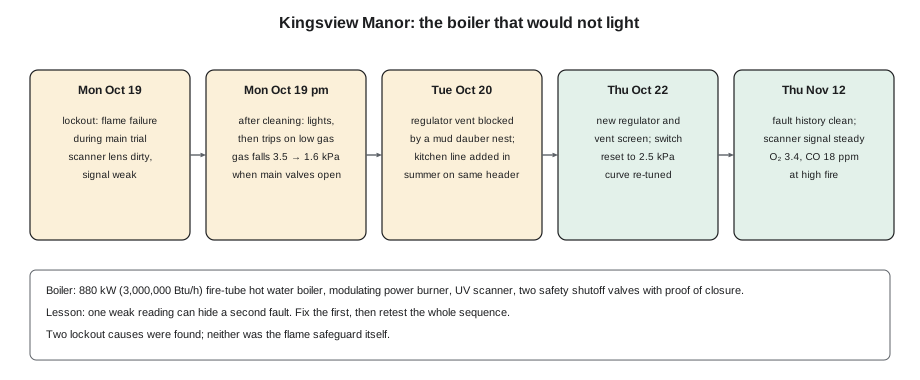
At 6:40 on the morning of Monday, October 19, the night supervisor at Kingsview Manor, a seniors' residence on Mohawk Road East in Hamilton, called Bayline's emergency line. The main heating boiler had locked out, she said, for the third time since Saturday, and resetting it had worked the first two times but not this time. The smaller second boiler was running flat out, the hallways were cooling, and the overnight low had been −2 °C. Maureen picked up Luis on the way. "Three lockouts in three days and a reset that stopped working," she said as they drove. "That's a boiler that's been trying to tell somebody something for a while."
This case study follows the whole call, from the first lockout to the follow-up visit three weeks later. It brings together the ideas of this course: reading a burner management system's history, flame signals and flame detectors, gas train pressures and pressure switches, regulators and their vents, the sequence of light-off, combustion readings, and the discipline of fixing one fault and then testing the whole system again.
The equipment
Kingsview's main boiler is a fire-tube hot water boiler rated 880 kW (3,000,000 Btu/h), installed in 2014, with a modulating power burner on linkageless servos, a self-checking UV scanner, and a gas train with a manual valve, strainer, regulator, low gas pressure switch, two safety shutoff valves with proof of closure, a high gas pressure switch and a butterfly firing-rate valve. Gas reaches the boiler room at 14 kPa from a header that also feeds the building's kitchen. The second boiler, rated 440 kW (1,500,000 Btu/h), normally runs only in the coldest weather. Bayline had taken over the service contract in the summer from another company, and the boiler room binder held the 2014 start-up report and the previous company's spring service report.
Reading the history before touching anything
Maureen did not press reset. She opened the burner management system's lockout history and read it aloud while Luis wrote. The three lockouts since Saturday were all the same: flame failure during the main trial for ignition. Before that, for about two weeks, the history showed a string of warnings: low flame signal at low fire, each lasting a few seconds, never long enough to shut the burner down. The control's flame signal display showed the last good run: pilot 1.6 V, main flame at low fire wandering between 1.1 and 1.4 V, on a scale where the maker's minimum holding signal was 1.25 V. The previous company's spring report had recorded the pilot at 2.8 V and the main flame at 3.5 V. "There's our first suspect," Maureen said. "The flame hasn't changed. What the scanner sees has."
Worked problem
How far had the signal fallen?
In the spring, the main flame signal at low fire was 3.5 V. On October 19 it wandered between 1.1 and 1.4 V. The minimum holding signal is 1.25 V. Express the October range as fractions of the spring value, and explain why the burner sometimes held and sometimes failed.
Show solution
- Low end as a fraction of the spring value:
- \[\frac{1.1}{3.5} = 0.31\]
- High end as a fraction of the spring value:
- \[\frac{1.4}{3.5} = 0.40\]
- The minimum, 1.25 V, falls inside the range 1.1 to 1.4 V.
Answer: The signal had fallen to about a third of its spring value, and it now straddled the minimum. When it happened to be above 1.25 V during the main trial, the burner held; when it dipped below, the control saw no flame and locked out. The night staff's resets had worked until, on a colder morning, the signal stayed low.
The first fault: the scanner
With the boiler locked out and tagged, the gas train isolated and the power off, Luis removed the UV scanner from its sight tube. The quartz lens was coated with a grey film of dust and a brownish, slightly sticky deposit. The sight tube's cooling air line, a small hose from the burner fan housing that keeps a flow of clean air across the lens, had cracked through at a fitting, so for weeks the lens had had no purge air and had been collecting what drifted into the sight tube. Luis cleaned the lens with the cleaner the scanner maker specifies, replaced the hose and its fittings, and checked the sight tube for alignment. Then they restored power and gas and let the burner run its sequence. The pilot signal read 2.7 V, and, as the main flame lit at low fire, 3.6 V. The burner proved the main flame and released to modulation.
Eleven seconds later, it locked out again. This time the history read low gas pressure.
The second fault: gas pressure that collapses
"Good," Maureen said, to Luis's surprise. "Now we're seeing the next problem instead of the flame relay hiding it." A weak flame signal had been failing the burner during the main trial, so the burner had never run long enough at the moment of main-valve opening and release to show a second weakness. Luis connected a digital manometer to the test point at the low gas pressure switch and set it to record. Maureen reset the control and they watched a start. With the valves closed, the pressure was 3.5 kPa, the regulator's lock-up. When the main valves opened, the reading plunged to 1.6 kPa and then crept back up over about twenty seconds. The low gas switch opened on the way down and the burner locked out. The switch's dial read 3.0 kPa.
Worked problem
How badly was the regulator lagging?
Lock-up at the switch was 3.5 kPa. When the main valves opened, the pressure fell to 1.6 kPa. The 2014 start-up report recorded the dip on main-valve opening as falling only to 3.2 kPa. Express each low point as a fraction of lock-up.
Show solution
- October:
- \[\frac{1.6}{3.5} = 0.46\]
- At start-up in 2014:
- \[\frac{3.2}{3.5} = 0.91\]
Answer: When new, the regulator held about nine-tenths of its lock-up pressure as the main valves opened. Now it fell to under half, and took twenty seconds to recover. Something was stopping the regulator from opening quickly when the flow suddenly increased.
The burner was not safe to run in that condition, and the day was warming up, so Maureen left boiler A locked out and tagged, confirmed with the residence's manager that the second boiler could carry the building through the mild afternoon and the forecast night, and arranged to come back first thing.
Ruling out the supply
On Tuesday, October 20, the first question was whether the problem was the supply or the regulator. The manager mentioned that the kitchen had been renovated in the summer, with a new range and a tilting kettle fed from the same header as the boilers. A larger load on the header could lower the pressure reaching the boiler's regulator, especially when the kitchen was cooking. Luis connected a second gauge upstream of the boiler's regulator and asked the kitchen to turn on everything it had. The inlet pressure barely moved, from 13.8 to 13.6 kPa, whether the kitchen was cooking or not. The header was delivering; the trouble was downstream of the inlet gauge, in the regulator.
The vent
A spring-loaded regulator's diaphragm can move only as fast as air can enter and leave its spring chamber through the vent, as GAS-240 explained. When the main valves open and the flow jumps, the diaphragm must move down quickly to open the seat, which needs air to flow into the spring chamber. If the vent is blocked, the chamber is sealed, the diaphragm moves sluggishly against the trapped air, and the outlet pressure sags until the diaphragm catches up. Maureen sent Luis outside to find where the regulator's vent line ended. It ran up the wall to a downturned elbow under the eaves, fitted with a screen. Behind the screen, packed into the elbow, was the clay nest of a mud dauber wasp, long abandoned, completely blocking the opening. The screen's mesh had been coarse enough to let the wasp through.
With the nest cleared, they tested again. The dip on main-valve opening was much smaller, falling to 2.9 kPa and recovering in about four seconds. Better, but not the 3.2 kPa of the 2014 report, and still below the switch's dial setting of 3.0 kPa. The regulator had been fighting a sealed spring chamber for who knew how long; its diaphragm might be stretched, and it was twelve years old. Maureen decided to replace it rather than trust it, and ordered a new regulator of the same model and a vent cap with an insect screen fine enough to stop wasps.
Why was the switch set so high?
That left the low gas switch. The 2014 start-up report listed its setting as 2.5 kPa, the burner maker's start-up value. The previous company's spring report listed 3.0 kPa, with no note of a change. Maureen could only guess why: perhaps someone had raised it to try to cure a nuisance problem, or had set it from memory. Either way, a switch set at 3.0 kPa on a train that normally ran at about 3.3 kPa with flow left almost no room for the normal dip on light-off, even with a healthy regulator. "A switch that close to running pressure will trip on a good day," she said. "And the next technician jumpers it, and then you've got nothing. We'll set it to the maker's value and test it with real pressure." She did not change it on Tuesday, because she wanted to set it with the new regulator in place, and boiler A stayed off for one more mild day.
Repair day
On Thursday, October 22, with the gas train isolated, Luis installed the new regulator and its vent cap, leak tested the joints and set the regulator's outlet to the burner maker's value. He reset the low gas switch to 2.5 kPa and tested it with real pressure by slowly closing the train's inlet valve: it opened at 2.46 kPa. He tested the high gas switch by raising the regulator setting temporarily: it opened within its tolerance of its setting. With the new regulator, the dip on main-valve opening fell only to 3.2 kPa and recovered within two seconds, matching the 2014 report.
Because the new regulator's outlet and response could change the gas flow at each firing rate, Maureen had Luis check the fuel-air curve with the analyzer at every stored point and re-tune the three that had moved. He bubble tested both safety shutoff valves, both within the maker's allowance, timed the sequence, ran the flame failure test and recorded the flame signals: pilot 2.7 V, low fire 3.6 V, high fire 4.0 V. They then ran three cold starts, letting the boiler cool between them, and the burner lit cleanly each time. Maureen removed the tag and returned the boiler to service.
| Reading | Oct 19 as found | Oct 22 as left |
|---|---|---|
| Pilot flame signal | 1.6 V | 2.7 V |
| Main flame signal, low fire | 1.1 to 1.4 V | 3.6 V |
| Gas at low gas switch, lock-up | 3.5 kPa | 3.5 kPa |
| Gas at low gas switch, main valves opening | 1.6 kPa | 3.2 kPa |
| Low gas switch trip | set at 3.0 kPa | trips at 2.46 kPa |
| Oxygen at high fire (parts in 100) | — | 3.4 |
The follow-up
On Thursday, November 12, after three weeks that included the first real cold snap of the season, Maureen and Luis returned to check the boiler. The lockout history showed no faults since October 22 and no low flame signal warnings. The flame signals matched the as-left readings. At high fire the analyzer read 3.4 parts in 100 oxygen and 15 ppm carbon monoxide as measured.
Worked problem
Final combustion check
Convert the November 12 high-fire carbon monoxide reading of 15 ppm as measured at 3.4 parts in 100 oxygen to air-free.
Show solution
- \[15 \times \frac{20.9}{20.9 - 3.4} = 15 \times \frac{20.9}{17.5} = 15 \times 1.194 = 17.9 \text{ ppm}\]
Answer: About 18 ppm air-free, a clean result well within the burner maker's limit.
Maureen left two recommendations in writing for the residence: add the scanner's cooling air line and the regulator's vent termination to Bayline's checklist for every service, and keep a printed copy of the burner's start-up settings in the boiler room binder, so that any change could be compared with the original. She also explained to the night supervisor why the resets had become dangerous: each reset after a flame failure meant another main trial with gas flowing and a flame the control could barely see. "If it locks out twice, stop and call," she said. "Every time."
What the case teaches
| Principle | At Kingsview |
|---|---|
| Read the history before resetting | Two weeks of low flame signal warnings pointed straight at the scanner |
| Compare with earlier records | The spring report and the 2014 start-up report showed how far readings had moved |
| Fix one fault, then retest the whole sequence | Curing the flame signal revealed the gas pressure fault behind it |
| Measure, don't guess | A recording manometer caught a dip that lasted only seconds |
| Rule out causes in order | An upstream gauge with the kitchen running cleared the supply |
| Look at the whole system, including outside the boiler room | The cause was in a vent elbow under the eaves |
| Restore safety settings to the maker's values and test them | The low gas switch was reset and tested with real pressure |
| Re-tune after changing a component that affects gas flow | Three curve points moved with the new regulator |
Common mistakes
MistakeResetting a lockout repeatedly without reading the history.
InsteadRead and record the history first; repeated resets after flame failure are dangerous.
MistakeStopping at the first fault found.
InsteadAfter each repair, run the whole sequence again and watch for the next problem.
MistakeBlaming the newest change in the building without testing.
InsteadMeasure: an upstream gauge showed the kitchen line was not the cause.
MistakeIgnoring regulator vent terminations.
InsteadInspect vent ends and fit screens fine enough to keep insects out.
MistakeLeaving a pressure switch where someone else set it.
InsteadCompare with the maker's value, reset it if needed and test it with real pressure.
Summary and key terms
- Kingsview Manor's boiler locked out on flame failure because a cracked cooling air hose let the UV scanner's lens foul, dropping the flame signal to around the minimum.
- Cleaning the lens and replacing the hose restored the signal and revealed a second fault: the gas pressure collapsed when the main valves opened, tripping a low gas switch set too close to running pressure.
- With the kitchen line ruled out by measurement, the cause was a regulator vent blocked by a mud dauber nest, which made the regulator sluggish.
- Bayline replaced the regulator, fitted an insect-proof vent cap, reset the low gas switch to the maker's value and tested it with real pressure, re-tuned the curve, tested the valves and sequence, and confirmed clean operation three weeks later.
- Read the history, compare with records, fix one fault and retest the whole system.
- Lockout history
- The record a burner management system keeps of its faults, with the step and conditions.
- Cooling air line
- A small air supply that keeps a flame scanner's lens cool and clean.
- Recording manometer
- A gauge that records pressure over time to catch brief changes.
- Mud dauber
- A wasp that builds clay nests, often in vent openings and pipe ends.
- As-found and as-left readings
- Readings recorded before and after service, for comparison.
Practice problems
Work each problem on paper first, then reveal the answer to check.
What were the two causes of the Kingsview lockouts?
Show answer
A fouled scanner lens from a cracked cooling air hose, and a regulator made sluggish by a blocked vent.
How did Maureen rule out the kitchen line?
Show answer
With a gauge upstream of the boiler's regulator while the kitchen ran everything; the inlet pressure barely changed.
Why does a blocked regulator vent make the pressure sag when flow increases?
Show answer
The diaphragm can't move quickly because air can't enter the sealed spring chamber.
Why was the low gas switch setting a problem?
Show answer
It was set too close to the running pressure, so even a normal dip could trip it.
Why did Luis re-tune the curve after replacing the regulator?
Show answer
A new regulator can change the gas flow at each firing rate.
Lesson quiz · 5 questions
Score 60% or more to complete this lesson.
Create a free account to save your progress, take quizzes and earn a certificate.