
GAS-310 · Lesson 2 of 12 · 22 min
Atmospheric and power burners
▶ Video coming soon A video version of this lesson is on the way.
On Wednesday, September 23, Maureen took Jonah and Luis to Glenview Public School for its fall start-up. The boiler room told the story of fifty years of heating. Against one wall stood a 1987 cast-iron sectional boiler with a row of atmospheric burners under it and a draft hood on top, rated 530 kW (1,800,000 Btu/h). Beside it was a gap in the floor where its twin had been, and in the gap's place a fire-tube boiler installed in 2010 with a power burner bolted to its front, the same rating, with a fan housing, an air damper and a gas train of red and yellow valves. The school board had approved replacing the old atmospheric boiler too, with the new one to be commissioned in November. "Look at both while you can," Maureen said. "In ten years you'll hardly see that kind in a school."
This lesson explains the two main families of gas burner in commercial work, atmospheric and power burners, how each gets its air, what each needs from the boiler, the venting and the controls, and how to recognize the common types. Lesson 3 looks at the air and fuel ratios in more detail.
Atmospheric burners
An atmospheric burner, also called a natural-draft burner, uses the energy of the gas jet to draw in air. Gas at a few hundred pascals leaves a small orifice at high speed and enters the throat of a venturi tube, where it pulls in primary air through an adjustable shutter. The gas and primary air mix in the tube and leave through ports or slots along the burner, where they burn. The primary air is only part of what the flame needs, typically somewhere around half, so the flame draws secondary air from around the burner ports as it burns. The hot flue gases then rise through the heat exchanger by their own buoyancy and leave through a draft hood into a chimney or vent, which carries them away by natural draft, as GAS-230 described.
Atmospheric burners are simple and quiet. They have no fan, no air-proving switch and few parts to wear. A commercial atmospheric boiler is usually a set of identical burners on a common manifold, each burning a share of the input, so a large boiler might have twenty or thirty burner tubes. But atmospheric burners have serious limits. Because the air supply depends on the gas jet and the draft, the burner cannot control excess air closely, and it always runs with plenty of it, often 40 to 100 parts in 100 of excess air or more, which carries heat up the chimney. The draft varies with the weather and the chimney temperature. The heat exchanger must be open and large enough for natural draft, so the boiler is big for its output. And firing rate is usually on and off, or two stages at best.
Power burners
A power burner, also called a forced-draft burner, uses a fan to supply all of the combustion air. Air from the fan passes an air damper that sets how much air enters, then flows through an air tube to the combustion head, where a diffuser or swirl plate spins and shapes it. Gas from the gas train enters the head through a ring of ports or spuds and mixes with the air at the face of the head, where it is lit and burns as a compact, stable flame projected into the combustion chamber. Because the fan provides a steady, measured air flow, the burner can run with low excess air, typically 10 to 25 parts in 100 at high fire, and it can vary both gas and air together to change the firing rate.
Most commercial power burners are packaged burners, factory-built assemblies with the fan, motor, air damper, head, ignition system, flame detector and often the gas train and control panel, bolted to the front plate of a boiler. A boiler sold with its burner as a matched, certified unit is a packaged boiler. Larger industrial burners are often built separately from the boiler or furnace and connected to a separate fan, gas train and burner management panel.
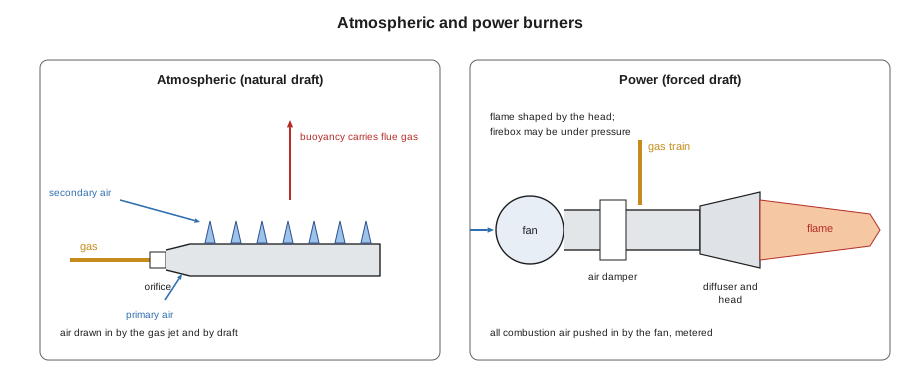
Comparing the two
| Feature | Atmospheric burner | Power burner |
|---|---|---|
| Air supply | Drawn in by the gas jet and natural draft | Supplied by a fan and metered by a damper |
| Typical excess air | High, often 40 to 100 parts in 100 or more | Low, typically 10 to 25 parts in 100 at high fire |
| Firing rate | On-off, or two stages | On-off, high-low or modulating |
| Combustion chamber | Under slight negative pressure; needs draft | Often under slight positive pressure |
| Venting | Draft hood and natural-draft chimney | Sealed breeching and vent suited to the pressure and temperature, as the maker requires |
| Safety devices | Pilot or ignition safety, limits | Air-proving switch, gas pressure switches, two safety shutoff valves, flame safeguard |
| Noise and parts | Quiet, few parts | Fan noise, more parts to maintain |
Worked problem
The cost of excess air
Glenview's old atmospheric boiler burns 530 kW and runs with about 50 parts in 100 of excess air; the power-burner boiler beside it, at the same input, runs with about 15. Natural gas needs about 9.57 m³ of air per cubic metre of gas, and has a heating value of about 37.5 MJ/m³. If the extra air is heated from 20 °C to a stack temperature of 200 °C, about how much heat does the atmospheric boiler's extra air carry away? Use 1.2 kg/m³ for the density of air and 1.005 kJ/(kg·K) for its specific heat.
Show solution
- Gas flow:
- \[\frac{530 \times 3.6}{37.5} = 50.9 \text{ m}^3/\text{h}\]
- Air needed in theory:
- \[9.57 \times 50.9 = 487 \text{ m}^3/\text{h}\]
- Extra air at 50 instead of 15 parts in 100:
- \[0.35 \times 487 = 170 \text{ m}^3/\text{h}\]
- Heat carried away:
- \[170 \times 1.2 \times 1.005 \times (200 - 20) = 36{,}900 \text{ kJ/h} \;\to\; \frac{36{,}900}{3600} = 10.3 \text{ kW}\]
- As a fraction of input:
- \[\frac{10.3}{530} = 0.019\]
Answer: The extra air alone carries away about 10 kW, roughly 2 parts in 100 of the input, before counting the draft hood's dilution air that cools and leaves through the chimney all the time. Over a heating season that is a lot of gas, which is part of why atmospheric commercial boilers are being replaced.
Types of power burner
Power burners come in several designs. In a nozzle-mix burner, the most common kind on commercial boilers, gas and air travel separately to the head and mix only at the flame, so there is no explosive mixture inside the burner. In a premix burner, a fan draws in air and gas together, mixes them, and pushes the mixture through a burner surface of woven metal fibre, perforated steel or ceramic, where it burns as a flat, even, low-temperature flame. Premix burners are used on most modern condensing boilers and water heaters, and they produce low levels of nitrogen oxides because the flame is cooler and the mixture is even. Their gas is metered by a zero-governor or negative-pressure regulator that delivers gas in proportion to the air flow drawn through a venturi, so the gas-air ratio holds as the fan speed changes. GAS-220 introduced these on residential condensing appliances; the commercial versions are the same idea on a larger scale.
Other designs you will meet include low-NOx burners that stage the air or the gas, or recirculate flue gas into the flame, to reduce flame temperature where air quality rules require it; dual-fuel burners that can fire gas or oil, common where the gas supply is interruptible; line burners and duct burners that burn in a moving air stream, such as in direct-fired makeup air units; radiant tube and infrared burners in industrial heating; and induced-draft arrangements, in which a fan at the outlet pulls air through an atmospheric-style burner, used on some water heaters and unit heaters.
| Burner type | How air and gas meet | Where you see it |
|---|---|---|
| Nozzle-mix power burner | Separately until the head | Packaged commercial boilers, process heaters |
| Premix (surface) burner | Mixed before the fan or burner surface | Condensing boilers and water heaters |
| Low-NOx staged burner | Air or gas added in stages; may recirculate flue gas | Boilers in areas with emission limits |
| Dual-fuel burner | Gas or oil through the same head | Interruptible gas service, hospitals |
| Line or duct burner | Burns in the air stream itself | Direct-fired makeup air, dryers |
| Atmospheric burner with induced-draft fan | Air pulled through by an outlet fan | Some water heaters and unit heaters |
What a power burner needs from the boiler
A power burner and the boiler it fires must match. The burner's flame must fit the combustion chamber: too long a flame hits the back wall or the tubes, causing carbon monoxide and damage; too short or too wide, and it may impinge on the sides. The burner must be able to overcome the firebox pressure of the boiler at full input, which the boiler maker states, usually in pascals or millimetres of water column; a burner chosen for a low-resistance boiler may not reach full input on one with a high resistance. The breeching and vent must suit a burner that pressurizes the firebox, which usually means sealed joints and a vent type the boiler maker lists, sometimes with a draft control or a barometric damper in the breeching to hold the outlet draft steady when the stack produces strong draft on cold days. And the boiler room must supply enough air for the fan, as lesson 3 shows.
Luis asked why the atmospheric boiler had a draft hood and the power-burner boiler didn't. Maureen pointed to the power burner's breeching, a sealed stainless steel connector with a barometric damper and a test port. "The fan sets the air, not the chimney," she said. "A draft hood would let the chimney pull whatever it liked through the boiler and wreck the tuning. What we want here is a steady outlet draft, a little negative, the same every day, and the barometric damper gives us that." She showed them the boiler maker's sheet: the firebox would run at a slight positive pressure at high fire, and the outlet draft was to be held within a narrow negative range.
Start-up checks on both kinds
The fall start-up at Glenview followed Bayline's commercial checklist. On the atmospheric boiler, they checked the burner tubes for rust scale and spiders, the pilot and its thermocouple, the draft hood for spillage with the boiler running, the chimney base for debris, the gas pressure at the manifold, and the operation of the high limit and the low-water cutoff. On the power-burner boiler, they checked everything a power burner adds: the fan wheel and motor, the air damper linkage for wear and slippage, the combustion head and ignition electrode, the flame scanner lens, the gas train valves, the gas pressure switches, the air-proving switch, and the light-off sequence itself. Then, on both boilers, they took combustion readings with the analyzer, as GAS-230 taught and lesson 9 will extend.
| Reading at high fire | Atmospheric boiler | Power-burner boiler |
|---|---|---|
| Oxygen in flue gas (parts in 100) | 9.1 | 3.8 |
| Carbon monoxide, air-free (ppm) | 42 | 24 |
| Stack temperature | 205 °C | 188 °C |
| Outlet draft | −5 Pa at the draft hood outlet | −10 Pa after the barometric damper |
Noise, vibration and refractory
Power burners bring three practical concerns that atmospheric burners rarely do. The fan and the flame make noise, often enough that hearing protection is needed near a large burner at high fire, and the noise can carry through ducts and walls into occupied rooms; a change in a burner's sound is also a useful early sign of trouble. A burner and boiler can set up combustion-driven vibration, a low rumble or pulsing at certain firing rates, when the flame and the gas column in the boiler and vent resonate; it is usually cured by adjusting the air, the gas, the head setting or the flame shape, not by ignoring it. And many power-burner boilers have refractory, heat-resisting brick or castable material, around the burner opening and in the combustion chamber. Refractory protects the boiler's steel and helps keep a stable flame, but it cracks with age and with rapid heating and cooling, and pieces can fall into the flame path. The start-up checklist at Glenview included a look at the burner's refractory throat with a flashlight before the first fire of the season.
Common mistakes
MistakeFitting a power burner to a boiler without checking firebox pressure and chamber size.
InsteadMatch the burner's capacity curve and flame length to the boiler maker's data.
MistakeVenting a positive-pressure boiler with a draft hood or unsealed connector.
InsteadUse the sealed vent type the boiler maker lists, with draft control as required.
MistakeExpecting an atmospheric burner to run at low excess air.
InsteadAtmospheric burners need generous excess air; tune them only as the maker allows.
MistakeSkipping the air damper linkage on a start-up.
InsteadCheck linkages for wear and slippage, since they set the fuel-air ratio.
Summary and key terms
- Atmospheric burners use the gas jet to draw in primary air through a venturi and take secondary air from around the flame; flue gases rise by buoyancy through a draft hood.
- They are simple and quiet but run with high excess air and limited firing-rate control.
- Power burners use a fan and air damper to supply all the air, mix it with gas at a combustion head, and can run with low excess air and modulate.
- Nozzle-mix burners mix gas and air at the head; premix burners mix them first and burn on a surface, with gas metered in proportion to air.
- A power burner must suit the boiler's combustion chamber and firebox pressure, and its vent must suit a pressurized firebox, often with a barometric damper to steady the draft.
- Atmospheric burner
- A burner that draws its air by the energy of the gas jet and natural draft.
- Primary air
- Air mixed with the gas before it reaches the burner ports.
- Secondary air
- Air the flame draws from around the burner ports as it burns.
- Combustion head
- The end of a power burner where gas and air meet and the flame is shaped.
- Nozzle-mix burner
- A power burner in which gas and air mix only at the head.
- Premix burner
- A burner in which gas and air are mixed before reaching the burner surface.
- Barometric damper
- A weighted damper in a breeching that admits room air to hold the draft steady.
- Packaged boiler
- A boiler sold with its matched burner and controls as a certified unit.
Practice problems
Work each problem on paper first, then reveal the answer to check.
Where does an atmospheric burner get its secondary air?
Show answer
From around the burner ports as the flame burns.
Give two advantages of a power burner over an atmospheric burner.
Show answer
Lower excess air and the ability to modulate the firing rate; also a compact firebox.
Why does a power-burner boiler not use a draft hood?
Show answer
The fan sets the air flow; a draft hood would let varying chimney draft disturb it. The vent is sealed, with draft control if needed.
What does a zero-governor do on a premix burner?
Show answer
It delivers gas in proportion to the air flow so the gas-air ratio holds as the fan speed changes.
Name two things a power burner must match on the boiler.
Show answer
The combustion chamber size and shape, and the firebox pressure at full input.
Lesson quiz · 5 questions
Score 60% or more to complete this lesson.
Create a free account to save your progress, take quizzes and earn a certificate.