
GAS-220 · Lesson 8 of 12 · 23 min
Limit and rollout switches
▶ Video coming soon A video version of this lesson is on the way.
Before Priya handed Jonah his own meters on Friday, November 13, Rosa took him on one more morning call together. The tenants of a townhouse on Lawrence Road near Gage Park said their furnace ran "in little bursts": it would light, blow warm air for three or four minutes, shut its burners off while the blower kept running, then light again a few minutes later. The house was never quite warm. The board's fault history showed the same code over and over, "limit circuit open", more than forty times in the last week. "This one's a gift," Rosa said. "The limit is telling us the heat exchanger is getting too hot. The question is why. It's almost always air."
The pressure switch in lesson 7 proves that flue gas can get out. The controls in this lesson watch for heat in the wrong place: too much of it in the heat exchanger or the water, or any of it escaping from the burner area. They are the high limit, the auxiliary limit, the flame rollout switch, the spill switch on natural-draft appliances, and the temperature cutoffs on water heaters and boilers. This lesson explains what each one watches, whether it resets itself or must be reset by hand, how to test it, and why a technician never resets one and leaves without knowing why it opened.
The high limit
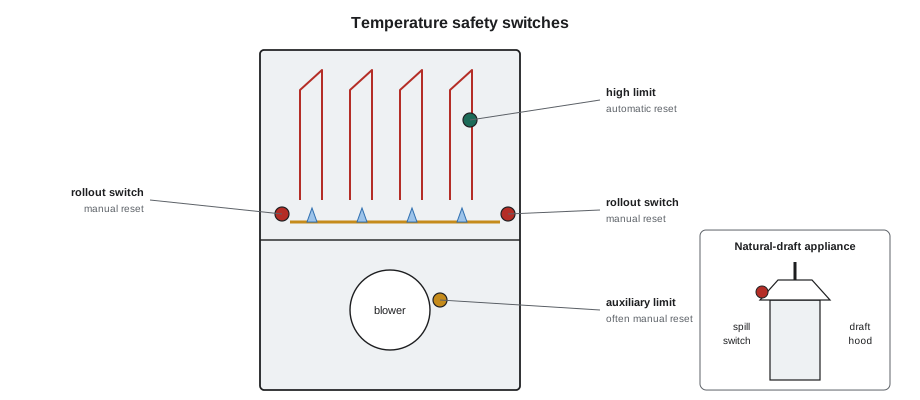
The high limit, often just called the limit, is a temperature switch mounted where it can feel the heat exchanger or the air leaving it, usually on the front of the heat exchanger compartment with its sensing disc in the airstream on the supply side. Most modern limits are snap-disc switches: a small bimetallic disc that snaps from one shape to another at a set temperature, opening its contacts. The disc's rating is stamped on it, often as an opening temperature, and on furnaces it is commonly somewhere in a wide band between about 65 and 120 °C, chosen by the maker for that model and position. Older furnaces used a fan and limit control with a bimetal helix in the plenum, a dial and adjustable pointers; on those, the limit pointer is never set higher than the maker's setting.
On a furnace the high limit is normally an automatic-reset switch. When it opens, the board shuts the gas valve at once, keeps the inducer running to clear the flue gas, and runs the blower to carry heat away from the heat exchanger. When the limit cools and closes again, the board restarts the sequence. That is exactly the short-cycling the townhouse tenants saw. Many boards count limit trips during one call for heat and, after a set number, lock out for a period, commonly an hour, and flash a code that says so. The number and the period are in the board's literature.
Downflow and horizontal furnaces, and many others, also have an auxiliary limit or secondary limit, often near the blower. It catches the heat that rises back through the blower compartment if the blower stops while the burner is firing, for example when a blower motor fails. Auxiliary limits are often manual-reset, with a button, because the conditions they catch are serious.
Why limits trip
A limit trips because heat is not being carried away from the heat exchanger as fast as the burner is producing it. On a furnace that almost always means too little airflow across the heat exchanger, and the temperature rise from lesson 4 of GAS-210 is the measure of it: if the rise is above the plate's range, the airflow is too low for the input. The common causes are a dirty or overly restrictive filter, closed or blocked supply registers or return grilles, undersized or crushed ductwork, a dirty blower wheel, a blower set to the wrong speed for heating, a failing blower motor or run capacitor, a dirty evaporator coil above the furnace, and, less often, overfiring from a manifold pressure set too high or wrong orifices. A limit can also fail: a weak disc can open below its rated temperature, and a disc that has opened thousands of times can drift.
Worked problem
Airflow and the limit
The townhouse furnace delivers 20.8 kW of heat to the air when it fires, and its plate gives a temperature rise range of 25 to 42 °C. Using 1.21 kJ per cubic metre per degree Celsius for air, what rise would it have at an airflow of 330 L/s? At what airflow does the rise reach the top of the range?
Show solution
- Rise at 330 L/s:
- \[\Delta T = \frac{20.8}{1.21 \times 0.330} = \frac{20.8}{0.399} \approx 52 \ ^\circ\text{C}\]
- Airflow for a 42 °C rise:
- \[\dot V = \frac{20.8}{1.21 \times 42} = \frac{20.8}{50.8} \approx 0.409 \text{ m}^3\text{/s} \approx 410 \text{ L/s}\]
Answer: At 330 L/s the rise would be about 52 °C, far above the plate's 42 °C maximum, and the limit would trip. The furnace needs at least about 410 L/s to stay within its range, and more to sit comfortably in the middle of it.
At the townhouse, Rosa had Jonah measure the temperature rise during one of the short runs before the limit opened. It was 51 °C, well above the plate's range. The filter was a new 25 mm pleated filter, clean. The supply registers in two bedrooms and the basement were closed, because a previous tenant had liked the bedrooms cold, and the blower's heating speed had been moved to the lowest tap, the one the maker's chart reserves for continuous fan, probably by someone trying to make the furnace quieter. Rosa had Jonah move the heating tap back to the speed the chart and the furnace's start-up sheet showed for this model and input, and open the registers. The rise came down to 34 °C, and the furnace ran a full twenty-minute cycle without a trip. Rosa cleared the fault history and showed the tenants which registers to leave open.
The flame rollout switch
A flame rollout switch is a snap-disc switch mounted on the burner box, above or beside the burner openings, where it would be heated by flame or hot flue gas escaping out of the front of the burner area instead of travelling into the heat exchanger. Furnaces commonly have one or two, often one on each side. Rollout switches are almost always manual-reset: when one opens it stays open, and a technician must press its reset button after finding the cause. Some appliances use a thermal fuse or fusible link instead, which melts once and must be replaced.
Flame rolls out of a burner box for a few reasons, all of them serious. The heat exchanger or the flue collector may be blocked, with soot, scale, rust or debris, as on Wentworth Street in lesson 1, so flue gas cannot get through and backs out of the front. The heat exchanger may be cracked, letting the blower push air into the combustion side and blow the flames out of the burner openings, as on Sanford Avenue in GAS-130. The vent may be blocked or disconnected. The appliance may be overfiring, or have the wrong orifices for its gas. A delayed ignition can push flame out of the burner box in a puff, as the Corktown furnace in lesson 5 was doing. And on natural-draft appliances, too little combustion air or a depressurized room can starve the flame and push it out.
A rollout switch that has opened is evidence of one of those causes, and resetting it without finding the cause is never acceptable. Bayline's rule is that a technician who finds a tripped rollout switch inspects the burners, the flue passages and the heat exchanger, checks the vent, the manifold pressure and the orifices, and watches several ignitions with the burner door in place before resetting it. If the cause cannot be found and fixed on that visit, the appliance is shut off and tagged.
Spill switches and blocked vent switches
Natural-draft appliances, those with a draft hood or draft diverter and no fan in the flue, use a spill switch, also called a blocked vent switch or blocked vent shut-off. It is a heat-sensing disc mounted at the edge of the draft hood, where hot flue gas would pour out if the vent were blocked or the room depressurized. It is usually manual-reset, and on a standing-pilot appliance it is often wired into the thermocouple circuit, as lesson 2 mentioned, so that tripping it puts the pilot out. A water heater or boiler that shuts down with a tripped spill switch needs the same investigation GAS-110 and GAS-210 described for spillage: a chimney check, a worst-case depressurization test and a look at what else in the house has changed, such as a new range hood or a removed furnace.
Water heater and boiler cutoffs
Gas water heaters have an energy cut-off, or ECO, a temperature switch in the thermostat or gas control that shuts the gas off if the water becomes dangerously hot, far above any normal setting. On many standing-pilot water heaters the ECO is a one-time device that requires replacing the gas control when it trips; on others it can be reset. FVIR water heaters also have the thermal cutoff on the flame arrestor that GAS-210 described, which trips if lint or dust has blocked the arrestor. Boilers have a high limit on the water temperature, often with a manual-reset limit beside the automatic operating control, and further protections such as low-water cutoffs and pressure relief valves, which later courses cover. In every case, a cutoff that has tripped is reporting a condition that needs a cause.
| Switch | Where it is | What it watches | Reset |
|---|---|---|---|
| High limit | Heat exchanger compartment, supply side | Heat exchanger and supply air temperature | Automatic (furnaces) |
| Auxiliary limit | Blower compartment | Heat rising back through the blower | Often manual |
| Flame rollout switch | Burner box, at the burner openings | Flame or hot gas escaping from the burner area | Manual, or one-time fuse |
| Spill or blocked vent switch | Draft hood of a natural-draft appliance | Flue gas spilling from the hood | Usually manual |
| Energy cut-off (ECO) | Water heater thermostat or gas control | Dangerously hot water | Manual or one-time |
| Boiler high limit | Boiler supply water | Water temperature above the limit | Automatic or manual, by type |
Testing temperature switches
Temperature safety switches are tested with the meter the way GAS-130 taught for any switch. In the circuit with the power on, the meter on AC volts is placed across the switch's two terminals: about 24 volts across a switch means it is open, and close to zero means it is closed and passing current. Out of the circuit with the power off and the wires removed, a closed switch reads close to zero ohms and an open one reads OL. A switch that reads open at room temperature, after it has had time to cool, is faulty or has been tripped and must be reset or replaced.
Testing that a switch is closed is not the same as testing that it opens at the right temperature, and in the field a technician rarely needs to test its opening point. What matters is the condition that made it open. The temperature rise, the external static pressure, the blower current and the condition of the filter and coil tell whether a limit was right to trip. A switch is replaced only with the exact part the maker specifies, with the same rating, the same reset type and in the same position. A limit is never replaced with a higher-rated one, never moved, and never shielded or insulated to stop it tripping.
Worked problem
Reading a limit rating
A replacement limit in the parts room is stamped L170, meaning it opens at 170 °F. The furnace's own limit is stamped L77C in degrees Celsius. Is the part on the shelf the same rating?
Show solution
- Convert 170 °F to degrees Celsius:
- \[\frac{(170 - 32) \times 5}{9} = \frac{138 \times 5}{9} \approx 76.7 \ ^\circ\text{C}\]
Answer: The two ratings are the same temperature, rounded. Even so, the rating is only one of the things that must match: the replacement must also be the maker's part number, or a listed equivalent, with the same reset type, mounting and disc length, so it sits in the airstream exactly where the original did.
Common mistakes
MistakeResetting a rollout switch and leaving because the furnace now runs.
InsteadFind the cause: blocked or cracked heat exchanger, blocked vent, overfiring or delayed ignition.
MistakeReplacing a limit that keeps tripping with a higher-rated one.
InsteadMeasure the temperature rise and fix the airflow problem.
MistakeAssuming a new filter means the airflow is fine.
InsteadCheck registers, blower speed, wheel, motor, coil and ducts as well.
MistakeMoving a limit or shielding it to stop nuisance trips.
InsteadLeave it where the maker put it; it is protecting the heat exchanger.
MistakeResetting a spill switch without a spillage test.
InsteadCheck the chimney and depressurization as GAS-110 and GAS-210 describe.
Summary and key terms
- The high limit, a snap-disc switch on the heat exchanger compartment, opens when the heat exchanger or supply air gets too hot; on furnaces it resets itself, and many boards lock out after repeated trips.
- Limits trip because airflow is too low, shown by a temperature rise above the plate range, or occasionally because of overfiring.
- Auxiliary limits near the blower catch heat rising back through it.
- The flame rollout switch at the burner openings, usually manual-reset, opens when flame or hot gas escapes the burner area, from a blocked or cracked heat exchanger, a blocked vent, overfiring or delayed ignition.
- Spill switches on draft hoods catch spillage.
- Water heaters have energy cut-offs and flame arrestor cutoffs, and boilers have water high limits.
- Test switches by voltage across them or resistance out of circuit, find the cause of every trip, and replace switches only with the maker's exact part in the same position.
- High limit
- A temperature switch that shuts the burner off when the heat exchanger or supply air is too hot.
- Snap-disc
- A bimetallic disc that snaps open or closed at a set temperature.
- Auxiliary limit
- A second limit, often near the blower, that catches heat rising back through the blower compartment.
- Flame rollout switch
- A manual-reset switch at the burner openings that opens if flame escapes the burner area.
- Manual reset
- A switch that stays open after tripping until someone presses its reset button.
- Energy cut-off (ECO)
- A water heater safety that shuts off the gas if the water is dangerously hot.
- Overfiring
- Burning more gas than the appliance's rated input.
Practice problems
Work each problem on paper first, then reveal the answer to check.
What does a furnace board usually do when the high limit opens?
Show answer
Shuts the gas valve, runs the inducer and blower, and restarts when the limit closes.
What measurement shows whether a limit was right to trip?
Show answer
The temperature rise compared with the plate range, with static pressure and blower checks.
Name three causes of flame rollout.
Show answer
A blocked heat exchanger, a cracked heat exchanger and a blocked vent; also overfiring or delayed ignition.
How do you tell in-circuit that a switch is open?
Show answer
About 24 volts measured across its terminals.
Why is a rollout switch manual-reset?
Show answer
Because rollout is a serious hazard that must be investigated before the appliance runs again.
Lesson quiz · 5 questions
Score 60% or more to complete this lesson.
Create a free account to save your progress, take quizzes and earn a certificate.