
GAS-220 · Lesson 7 of 12 · 23 min
Pressure switches and draft inducers
▶ Video coming soon A video version of this lesson is on the way.
On Saturday, October 31, Jonah was on call with Luis when a family in a 2013 house in Mount Hope, just south of Hamilton, phoned with no heat. Their condensing furnace started, its inducer ran for about a minute, and then it stopped and started again, three times, before going quiet with a flashing light. The board's code chart read "pressure switch did not close". The homeowner had already bought a new pressure switch at a hardware store and was holding it when they arrived. Luis smiled and asked him to put it down. "The pressure switch is the messenger," he said. "Nine times out of ten it's fine, and it's telling you the truth: the inducer isn't pulling hard enough at that switch. Let's find out why before we spend your money."
Every induced-draft furnace, and every power-vented water heater, boiler or other appliance with a fan in its flue path, depends on that fan to move combustion air and flue gas. A pressure switch proves that the fan is doing its job before the board will light the burner, and keeps proving it while the burner runs. This lesson explains what the draft inducer does, how a pressure switch senses it, what the board checks, how to measure the pressure with a manometer, and the causes of the faults technicians see most.
The draft inducer
A draft inducer, also called a combustion blower or inducer motor, is a small fan mounted on the furnace's flue collector box or at the outlet of the heat exchanger. On a mid-efficiency furnace it pulls flue gas through the heat exchanger and pushes it into a Category I vent that rises to the chimney or a B-vent; on a condensing furnace it pulls the gas through both heat exchangers and pushes it out through a sealed Category IV vent, often to a wall termination. Because the inducer pulls on the heat exchanger, the burner side of the appliance is kept slightly below the pressure of the room, so any leak draws air in rather than letting flue gas out.
Most inducers are single-speed motors with a capacitor, as GAS-130 described; two-stage furnaces have two-speed inducers, with a separate pressure switch or a dual switch for each speed; and many current furnaces and boilers use variable-speed inducers with electronically commutated motors that the board drives to a set speed or a set pressure. A power-vented water heater has a similar blower on top of its flue. In each case the inducer runs before the burner lights, for the pre-purge, and after it shuts off, for the post-purge.
How a pressure switch works
A pressure switch is a diaphragm switch. A flexible diaphragm separates two chambers, one connected by a small hose to a pressure tap on the inducer housing or the collector box, the other open to the room or connected to the burner box. When the inducer runs, it pulls a slight vacuum at the tap. The difference in pressure across the diaphragm moves it, and when the difference passes the switch's set point, the diaphragm closes a set of normally open contacts. When the difference falls back, past a slightly lower point, the contacts open again. The set point is stamped or printed on the switch, often as a negative pressure such as −162 Pa, and the maker chooses it so the switch closes only if the inducer, the vent and the heat exchanger passages are all clear enough for safe combustion.
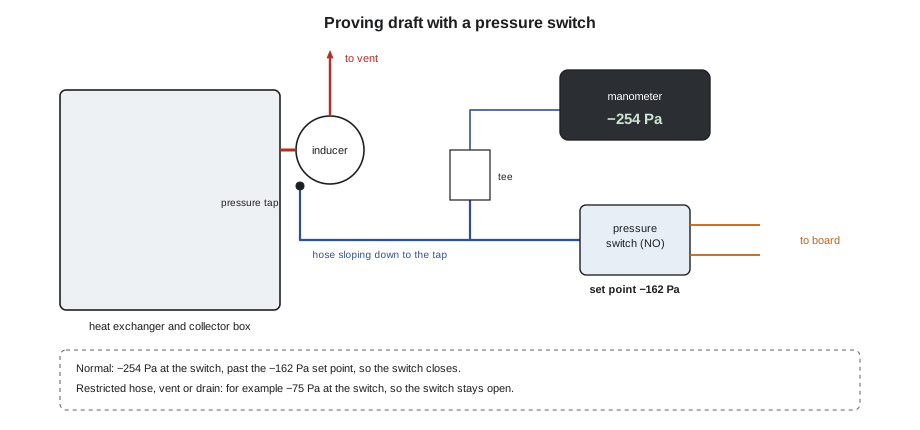
A pressure switch proves more than the inducer's motor. If the vent is blocked by ice, a nest or a collapsed pipe, the inducer pulls a stronger vacuum on some designs and a weaker one at the tap on others, depending on where the tap sits; the maker places the tap and chooses the set point so that dangerous restrictions are caught. On a condensing furnace, the switch also catches condensate that is not draining: if the trap or drain is blocked, water backs up into the collector box, the inducer's suction at the tap falls, and the switch opens. Many condensing furnaces have a second switch at the collector box for exactly this. Some appliances use a differential switch that compares two taps rather than one tap and the room.
What the board checks
The board uses the pressure switch at three points in the sequence, and each produces a different fault code. Before starting the inducer, the board checks that the switch is open. A switch that is already closed, with no draft, means its contacts are welded, its hose is connected wrongly, or it is otherwise faulty, and the board will not start; its code is usually something like "pressure switch stuck closed". After starting the inducer, the board waits a set time for the switch to close. If it does not, the board keeps the inducer running, sometimes retries, and then flashes "pressure switch did not close" or "open". During the run, the switch must stay closed. If it opens, the board shuts the gas valve at once, runs the inducer for a post-purge and usually tries again, recording "pressure switch opened during cycle".
| Board check | What it means if it fails | Common causes |
|---|---|---|
| Switch open before inducer starts | Switch closed with no draft | Welded contacts, wrong hose connection, water in switch, faulty switch |
| Switch closes after inducer starts | Not enough draft at the switch | Weak or failed inducer, blocked or long vent, blocked tap or hose, condensate backup, faulty switch |
| Switch stays closed during run | Draft lost while firing | Wind at the termination, condensate backing up, vent sag holding water, inducer slowing as it heats |
Measuring at the switch
The pressure switch is tested with a manometer, not by guesswork, and the measurement is taken where the switch feels it. With the power off, the hose is removed from the switch, a tee is fitted with short pieces of hose, and the manometer is connected to the tee's third leg so that the switch and the manometer see the same pressure. The furnace is started and the reading is taken with the inducer running, compared with the set point on the switch. The two possible results point in opposite directions.
If the manometer shows a vacuum well past the set point and the switch is still open, the switch is faulty. The technician can confirm this electrically: with the inducer running and the vacuum present, about 24 volts measured across the switch's two terminals means its contacts are open. If the vacuum is weaker than the set point, the switch is telling the truth, and replacing it would be at best a waste of money and at worst a hazard. The cause is somewhere between the inducer and the switch, or in the vent and heat exchanger the inducer is pulling through. A switch is never replaced with one of a different set point, and is never adjusted, jumpered or left disconnected.
When the reading at the switch is low, the next step is to move the manometer closer to the source. A reading taken directly at the inducer's tap, with the hose off, shows whether the inducer itself is producing enough vacuum. If the tap reads well and the switch end of the hose reads poorly, the hose or the tap's passage is blocked, cracked or full of water. If the tap also reads poorly, the inducer is weak or the flue path is restricted.
Worked problem
Following the vacuum back to its source
At the Mount Hope furnace, the switch's set point is −162 Pa. With the manometer teed in at the switch and the inducer running, Luis reads −75 Pa. He moves the manometer to the inducer's pressure tap, with the hose removed, and reads −262 Pa. Where is the fault?
Show solution
- At the switch, the vacuum is weaker than the set point:
- \[75 \text{ Pa} < 162 \text{ Pa}\]
- At the tap, the inducer is producing plenty of vacuum:
- \[262 \text{ Pa} > 162 \text{ Pa}\]
- Between the two, the vacuum has fallen by:
- \[262 - 75 = 187 \text{ Pa}\]
Answer: The inducer and the flue path are fine. The vacuum is being lost in the hose between the tap and the switch, so the hose is blocked, cracked or holding water. Replacing the switch would not have helped.
Luis pulled the hose. It had sagged into a loop below the switch, and the low point held a slug of water that had condensed in it, enough to block the small passage. A fine crack near the tap end let room air in as well. The hose had been replaced at some point with one that was too long and routed differently from the maker's diagram. Luis fitted a new hose of the maker's specification, cut to length and routed with a steady slope from the switch down to the tap so any condensate drains back into the inducer. With the manometer teed in again, the switch now saw −254 Pa, and the furnace lit on its first try.
Worked problem
How much margin is enough?
After the repair, the switch sees −254 Pa against a set point of −162 Pa. What is the margin, in pascals and as a ratio of the set point?
Show solution
- Margin:
- \[254 - 162 = 92 \text{ Pa}\]
- Ratio:
- \[\frac{254}{162} \approx 1.57\]
Answer: The switch sees about 1.6 times its set point, a healthy margin. A reading only a few pascals past the set point would close the switch on a calm day but let it open on a windy one, or once the inducer is hot. Luis recorded the reading on the service report.
Common causes of pressure switch faults
When the switch is telling the truth, the cause is usually one of these. The inducer may be weak: worn bearings that slow it, a failed run capacitor, a wheel that has come loose on its shaft or cracked, or a failing variable-speed motor; its current and its sound tell a lot, and GAS-130 showed how to test its capacitor. The vent may be restricted: an intake or exhaust termination blocked by ice, snow, leaves or a nest, a vent longer or with more elbows than the instructions allow, a sagging pipe holding condensate, or a joint that has come apart. The heat exchanger passages may be restricted with scale or debris, especially in a secondary heat exchanger. The condensate may not be draining: a blocked trap, a trap that was never primed after installation, a frozen drain line or a failed condensate pump. The hose or tap may be blocked, cracked, kinked, too long or full of water. And wind blowing directly at a wall termination can upset the pressures on a gusty day, which is one reason termination clearances and positions in the instructions matter.
A pressure switch that opens only some of the time is one of the most frustrating calls in the trade, because everything tests fine when the technician arrives. The board's fault history, which records how often each code has appeared, is the key, and lesson 12 follows one such case from first call to fix.
Pressure switches on other appliances
Power-vented water heaters, as GAS-130 showed on the Barton Street duplex, use the same idea: a blower on the flue and a pressure switch that must close before the burner can light. Boilers and other appliances with fans in the flue path have them too. Natural-draft appliances with draft hoods have no fan to prove, so they use a different control: a blocked vent switch or spill switch, a small heat-sensing switch at the draft hood that opens if hot flue gas spills out of the hood instead of rising up the vent. It is usually a manual-reset switch, because a spilling vent is a hazard that must be investigated, and lesson 8 describes it with the other temperature-sensing safety switches.
Common mistakes
MistakeReplacing a pressure switch because the code says pressure switch.
InsteadMeasure the vacuum at the switch first; usually the switch is telling the truth.
MistakeReplacing a switch with one of a different set point.
InsteadUse the exact switch the maker specifies.
MistakeRouting the switch hose in a loop below the switch.
InsteadRoute it as the maker shows, sloping so condensate drains back to the tap.
MistakeMeasuring only at the switch when the reading is low.
InsteadMove the manometer to the tap to tell a hose problem from an inducer or vent problem.
MistakeJumpering a pressure switch to see if the furnace will light.
InsteadNever; the switch proves that flue gas can leave the appliance.
Summary and key terms
- The draft inducer moves flue gas through the heat exchanger and vent and keeps the burner side below room pressure.
- A pressure switch, a diaphragm switch connected by a hose to a tap on the inducer or collector box, closes when the vacuum passes its stamped set point, proving the inducer, vent, heat exchanger passages and, on condensing furnaces, condensate drainage.
- The board checks the switch is open before the inducer starts, closes after it starts and stays closed during the run, with a different code for each failure.
- Test with a manometer teed in at the switch: a vacuum past the set point with the switch open means a faulty switch; a weak vacuum means a problem upstream.
- Measure at the tap to separate a hose fault from an inducer or vent fault.
- Common causes are a weak inducer, a restricted vent or termination, condensate backup and a blocked or badly routed hose.
- Natural-draft appliances use a blocked vent or spill switch instead.
- Draft inducer
- A fan that pulls flue gas through an appliance's heat exchanger and pushes it into the vent.
- Pressure switch
- A diaphragm switch that closes when the inducer creates enough vacuum at its tap.
- Set point
- The pressure difference at which a pressure switch closes, stamped on the switch.
- Pressure tap
- A small port on the inducer or collector box where the pressure switch hose connects.
- Differential switch
- A pressure switch that compares the pressures at two taps.
- Collector box
- The chamber on a furnace that gathers flue gas, and on a condensing furnace condensate, before the inducer.
- Spill switch
- A heat-sensing switch at a draft hood that opens if flue gas spills.
Practice problems
Work each problem on paper first, then reveal the answer to check.
What does the board check about the pressure switch before the inducer starts?
Show answer
That it is open.
The manometer shows a vacuum well past the set point but the switch is open. What is faulty?
Show answer
The switch.
How do you tell a blocked hose from a weak inducer?
Show answer
Measure at the inducer's tap: a good reading there and a poor one at the switch means the hose.
Why can a blocked condensate trap make a pressure switch open?
Show answer
Water backs up into the collector box and reduces the vacuum at the tap.
How should a pressure switch hose be routed?
Show answer
As the maker shows, with a slope so condensate drains back to the tap.
Lesson quiz · 5 questions
Score 60% or more to complete this lesson.
Create a free account to save your progress, take quizzes and earn a certificate.