
GAS-220 · Lesson 12 of 12 · 30 min
Case study: chasing an intermittent lockout
▶ Video coming soon A video version of this lesson is on the way.
Joan and Pete Kowalczyk had been cold on and off for two winters. Their house, a 1970s semi-detached house on East 25th Street on the Hamilton Mountain, had a two-stage condensing furnace installed in 2011, and every so often, usually on a cold morning, they came downstairs to a cool house and a furnace with a blinking light. Switching it off and on at the disconnect always brought it back. Two other companies had been out in the past year. One had cleaned the flame sensor twice; the other had replaced the pressure switch the winter before. Neither had stopped it. In early October the Kowalczyks called Bayline, and Hank gave the call to Rosa and Jonah. "Intermittent," he said, handing over the work order. "Take your time on this one. Nobody's found it yet because nobody has watched it fail."
This lesson follows the case through three visits and a follow-up, from the first fault history to the repair. It brings together most of this course: the safety chain and the sequence of operation, the pressure switch and inducer, the flame signal, the control board's fault history, and the troubleshooting method from lesson 11, together with the condensing furnace venting that GAS-210 described.
The furnace
The furnace was a two-stage condensing model with a variable-speed blower, rated at 20.5 kW input on high fire and 14.4 kW on low, with hot surface ignition and a flame sensor at the far end of its burner row. It had two pressure switches on its collector box, one for each inducer speed. Their set points were stamped on them: −125 Pa for low fire and −224 Pa for high fire. It was vented with two pipes, a combustion air intake and an exhaust, which left the basement through the rim joist into the attached garage, ran about 6.0 m across the unheated garage's ceiling and left the house through the garage's side wall. The thermostat was programmable, set back to 17 °C at night and up to 21 °C at 6:00 in the morning.
Visit 1: Monday, October 19
Rosa had Jonah follow the method. First he talked to the owners. The furnace failed perhaps once or twice a week, they said, almost always early in the morning, and more often when the weather was cold. It had never failed in the afternoon that they could remember. They had not noticed any connection with the dryer, the range hood or the bathroom fans. Next he read the board's fault history before touching anything. It held eight codes: six of them "pressure switch opened during the cycle" and two "lockout after repeated failures". Rosa pointed out what that already said. The furnace was not failing to light; it was losing its proof of draft while it was running, and the lockouts followed repeated losses. The two flame sensor cleanings had been aimed at the wrong step.
Jonah checked the basics: power, gas, filter, thermostat, doors, and both terminations outside, which were clear and correctly spaced. Then he ran the sequence and timed it. It was normal: inducer, pressure switch, pre-purge, igniter, ignition at high fire, flame proved, drop to low fire, blower on its delay. He measured the flame signal at 3.9 microamps, healthy. With a manometer teed in at the high-fire pressure switch, he forced the furnace to high fire through the thermostat and read −274 Pa, comfortably past the −224 Pa set point.
The condensate trap was the one thing that was clearly wrong. It was partly blocked with a grey sludge, and its drain was slow. A slow trap lets condensate back up into the collector box, which reduces the vacuum at the switch, so it was a reasonable cause. Jonah cleaned and refilled the trap and flushed the drain line, and ran a fifteen-minute high-fire cycle: the switch held at about −262 Pa the whole time. It was a mild morning, 9 °C. Rosa was not convinced the trap was the whole story. "A partly blocked trap doesn't care what time of day it is," she said. She asked the Kowalczyks to write down the time and the outdoor temperature whenever the furnace failed, and not to reset it if they could stand to wait an hour for a call back.
Between visits
Over the next nine days the furnace failed three more times. The Kowalczyks' notes showed the same pattern each time: between 6:30 and 7:30 in the morning, on the coldest mornings of the week, after the thermostat had raised the setting at 6:00. On the morning of Wednesday, October 28, after a night that went down to −4 °C, the furnace was in lockout at 6:40 when Pete came downstairs, and he called Bayline instead of resetting it.
Worked problem
What the notes said about the run
The thermostat rises from 17 °C to 21 °C at 6:00. When it raises the setting by more than about 2 °C, the two-stage control goes straight to high fire and stays there until the house is nearly up to temperature. On a cold morning that recovery takes about 40 minutes. The failures were all logged between 6:30 and 7:30. What does that suggest about the run when the furnace fails?
Show solution
- Size of the morning step:
- \[21 - 17 = 4 \ ^\circ\text{C} > 2 \ ^\circ\text{C}\]
- So each cold morning begins with a long high-fire run. The earliest failure came at least:
- \[6{:}30 - 6{:}00 = 30 \text{ min}\]
- after the run began.
Answer: The furnace fails only during long, continuous high-fire runs in cold weather, never in the first few minutes and never on short cycles. Whatever is wrong develops during a run. Fifteen minutes on a mild morning, as on the first visit, had not been long enough or cold enough to show it.
Visit 2: Wednesday, October 28
This time Rosa and Jonah arrived to a furnace that had just failed. The history now had three new "pressure switch opened" codes and one new lockout. Rosa had Jonah set up to watch the failure happen. He teed his manometer in at the high-fire pressure switch, reset the furnace with the thermostat calling for a large rise so that it would stay on high fire, and wrote down the reading every minute, with the outdoor temperature at −3 °C.
| Minutes on high fire | Vacuum at high-fire switch (Pa) | Note |
|---|---|---|
| 1 | −269 | Normal |
| 4 | −264 | |
| 8 | −244 | Falling |
| 10 | −234 | |
| 12 | −222 | Below set point |
| 13 | −219 | Switch opened; board shut gas valve |
The vacuum was falling steadily, and the switch opened about thirteen minutes into the run, just below its set point, as switches do. The board shut the valve, ran its post-purge and tried again; the second run failed sooner. Jonah moved the manometer straight to the inducer's pressure tap for the next run, with the hose off, and saw the same slow fall. So the hose was not the problem. He measured the inducer's current, which stayed steady at its normal value, so the inducer was not slowing. The trap was draining freely; he could see water flowing. Something in the flue path itself was becoming more restrictive the longer the furnace ran.
Worked problem
How fast the vacuum fell
Between minute 1 and minute 12, the vacuum at the switch fell from −269 Pa to −222 Pa. What was the average rate of fall, and how long would it take to fall from the first visit's −262 Pa to the switch's opening point of about −219 Pa at that rate?
Show solution
- Rate of fall:
- \[\frac{269 - 222}{12 - 1} = \frac{47}{11} \approx 4.3 \text{ Pa per minute}\]
- Time from −262 Pa to −219 Pa:
- \[\frac{262 - 219}{4.3} = \frac{43}{4.3} = 10 \text{ min}\]
Answer: At the cold-morning rate, the furnace would have tripped about ten minutes after the reading taken on the first visit. On that mild morning the vacuum had held steady for fifteen minutes, so the restriction builds much faster in cold weather. That pointed at the one part of the flue path that is outdoors in all but name: the pipe across the unheated garage.
Jonah followed the exhaust pipe into the garage with a flashlight and a level. The pipe was hung from the ceiling joists on strap hangers about 3.0 m apart, and between two of them it sagged visibly. With the level he found that the run fell only about 20 mm toward the furnace over its whole length, and that in the middle it had a low spot, a belly, about 35 mm below a straight line between the hangers. The pipe was bare, with no insulation, in a garage that was little warmer than outdoors.
Rosa pulled out the furnace's installation instructions, which Bayline had downloaded for the model. They required the exhaust pipe to slope back toward the furnace so that condensate drains back to the trap, at a minimum of 21 mm per metre; they gave a maximum spacing for pipe supports of 1.5 m for this pipe; and they required exhaust pipe running through an unheated space to be insulated with a closed-cell insulation of a stated thickness. The garage run met none of the three.
Worked problem
How much water the furnace makes
Burning one cubic metre of natural gas produces about 1.6 kg of water vapour. On high fire the furnace burns 20.5 kW at 37.5 MJ per cubic metre. How much water vapour does it produce in an hour, and what is the required fall of the 6.0 m garage run at 21 mm per metre?
Show solution
- Gas burned per hour:
- \[20.5 \text{ kW} \times 3.6 = 73.8 \text{ MJ/h} \qquad \frac{73.8}{37.5} \approx 1.97 \text{ m}^3\text{/h}\]
- Water vapour per hour:
- \[1.97 \times 1.6 \approx 3.2 \text{ kg} \approx 3.2 \text{ L}\]
- Required fall:
- \[6.0 \text{ m} \times 21 \text{ mm/m} = 126 \text{ mm}\]
Answer: The furnace makes about 3.2 litres of water vapour an hour on high fire. Most of it condenses in the secondary heat exchanger and drains through the trap, but in a cold, uninsulated pipe more condenses in the vent. With only 20 mm of fall instead of 126 mm, and a 35 mm belly, that water could not run back. It collected in the low spot during every long run, narrowing the pipe, until the inducer could no longer hold the vacuum the switch needed.
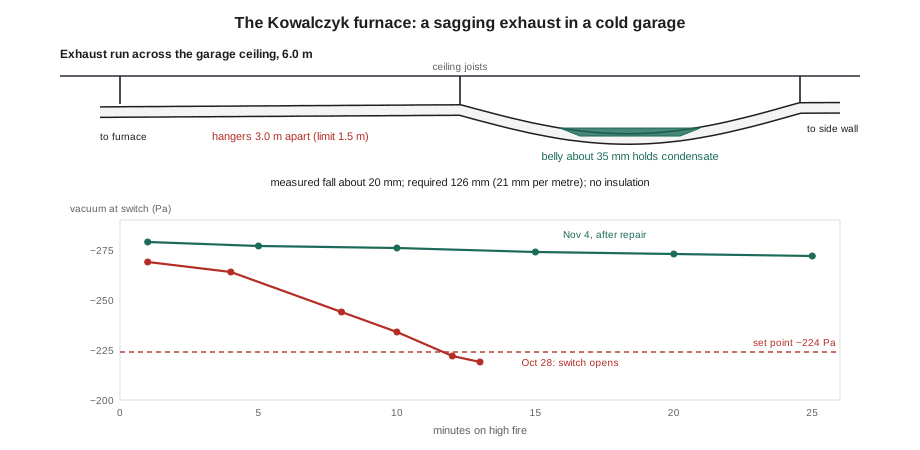
Rosa explained the finding to the Kowalczyks in the garage, with the level on the pipe so they could see the bubble. The furnace was not dangerous: the pressure switch had been doing exactly what it was there to do, stopping the burner when the flue gas could not leave freely. But the vent was not installed as the furnace's instructions required, and it would keep failing every cold morning until it was. Hank priced the repair that afternoon, and the owners booked it for the following Wednesday.
Visit 3: Wednesday, November 4
Rosa and Jonah re-hung the exhaust pipe on new hangers about 1.2 m apart, within the instructions' limit. To get the slope, they lowered the pipe at the furnace end by rerouting its last section below the joists, which gave the run a steady fall of about 130 mm toward the furnace, a little more than the minimum. They checked it with the level at every hanger. They insulated the whole garage run with closed-cell pipe insulation of the thickness the instructions gave, sealing its joints. They checked the intake pipe too, which had the same hanger spacing but carries only outdoor air and no condensate; they re-hung it on the new hangers for good measure. Jonah then replaced the pressure switch hose, which was the right one but had hardened with age, cleaned the trap again, and checked that every vent joint was sound.
The proof was a long run. With the thermostat calling for a large rise, the furnace ran on high fire for twenty-five minutes with Jonah's manometer teed in at the high-fire switch. The reading started at −279 Pa and was still −272 Pa at the end, flat to within the meter's flicker. He measured the flame signal at 3.9 microamps, the temperature rise at 36 °C, within the plate range, and the flue gas with the analyzer, with air-free carbon monoxide of 18 ppm. Then he cleared the fault history, so that any recurrence would stand out.
| Reading | Visit 1 (Oct 19) | Visit 2 (Oct 28) | Visit 3 (Nov 4) |
|---|---|---|---|
| Outdoor temperature | 9 °C | −3 °C | 2 °C |
| High-fire switch set point | −224 Pa | −224 Pa | −224 Pa |
| Vacuum at start of high fire | −274 Pa | −269 Pa | −279 Pa |
| Vacuum after long high fire | −262 Pa at 15 min | −219 Pa at 13 min, switch open | −272 Pa at 25 min |
| Flame signal | 3.9 µA | Not needed | 3.9 µA |
| Exhaust run fall | Not checked | About 20 mm, 35 mm belly | About 130 mm, no belly |
Worked problem
Margin after the repair
After the repair the high-fire switch saw −272 Pa at the end of a 25-minute high-fire run, against its set point of −224 Pa. What is the margin, and how does it compare with the margin at the start of the run on October 28?
Show solution
- Margin after the repair, at the end of the run:
- \[272 - 224 = 48 \text{ Pa}\]
- Margin at the start of the run on October 28:
- \[269 - 224 = 45 \text{ Pa}\]
Answer: After the repair, the switch has the same margin at the end of a long cold run that it used to have only at the very start. The margin no longer shrinks as the furnace runs, which is what fixing the restriction should do.
Follow-up
Rosa phoned the Kowalczyks on Friday, November 13. The furnace had run through nine mornings since the repair, including the coldest of the season so far on the morning of November 10, and the board's light had shown normal every time they looked. Hank put a short visit on the schedule for early December, to read the fault history after a month of colder weather, and the first annual service is planned for next autumn. If the history is still clean in December, the case will be closed.
What the case teaches
Three companies had worked on this furnace, and each had fixed something real. The flame sensor had probably needed cleaning; the old pressure switch may have been worn; the trap was certainly partly blocked. But none of those was the cause of the lockouts, and the furnace kept failing because nobody had matched the fault to its conditions. The fault history said which step was failing: the proof of draft during the run, not ignition. The owners' notes said when: during long high-fire runs on cold mornings. The minute-by-minute readings said how: the restriction grew as the furnace ran. And the inspection, checked against the maker's instructions, said why.
Jonah wrote the lessons on the inside cover of his notebook that evening, in the order he had learned them on the job. Read the fault history before you touch anything. Ask when it fails, not just what fails. Watch it fail if you can, and write down the numbers as it does. Measure where the control feels it, then move back toward the source. Check the installation against the maker's instructions, not against what looks reasonable. And prove the repair under the conditions that caused the fault, which here meant a long high-fire run, not a five-minute test on a mild afternoon.
Rosa read it over his shoulder in the truck and added one line at the bottom: the safety control was right every time.
Common mistakes
MistakeTreating an intermittent lockout by replacing the part named in the code.
InsteadRead the history and match the fault to the conditions it happens in.
MistakeTesting an intermittent fault for a few minutes on a mild day.
InsteadRecreate the failing conditions, here a long high-fire run in cold weather.
MistakeTaking one manometer reading and calling the pressure switch good.
InsteadLog the reading over time to see whether it changes during the run.
MistakeJudging a vent by eye.
InsteadCheck slope, supports and insulation with a level against the maker's instructions.
MistakeClosing the call as soon as the furnace runs.
InsteadClear the history, follow up, and check the history again after colder weather.
Summary and key terms
- A two-stage condensing furnace locked out on cold mornings, and two earlier companies had cleaned its flame sensor and replaced its pressure switch without success.
- Its fault history showed the pressure switch opening during the run, and the owners' notes tied the failures to long high-fire recovery runs on cold mornings.
- Minute-by-minute manometer readings showed the vacuum at the switch falling steadily during a long run until the switch opened; readings at the inducer tap and the inducer's current ruled out the hose and the inducer.
- The exhaust pipe across the unheated garage had too little slope, a belly, supports too far apart and no insulation, contrary to the furnace's instructions, so condensate collected in it during long runs.
- Re-hanging it with the required slope and support spacing and insulating it fixed the fault: the vacuum held steady through a 25-minute high-fire run.
- The lessons are to read the history, match the fault to its conditions, log readings over time, check against the instructions, and prove the repair under the conditions that caused the fault.
- Intermittent lockout
- A lockout that happens only some of the time, often under particular conditions.
- Setback recovery
- The long run a furnace makes when a programmable thermostat raises the setting after a setback.
- Belly
- A low spot in a vent pipe where condensate can collect.
- Slope back to the furnace
- The required fall of a condensing furnace's exhaust pipe so condensate drains back to the trap.
- Data logging
- Recording readings at regular intervals to see how a condition changes over time.
Practice problems
Work each problem on paper first, then reveal the answer to check.
Why did the flame sensor cleanings not fix the furnace?
Show answer
The fault was loss of draft proof during the run, not ignition or flame sensing.
What did the owners' notes show?
Show answer
Failures only during long high-fire runs on cold mornings after setback.
How did Jonah rule out the pressure switch hose?
Show answer
The same slow fall in vacuum appeared at the inducer's tap with the hose off.
Name the three ways the exhaust run failed the instructions.
Show answer
Too little slope back to the furnace, supports too far apart and no insulation in the unheated space.
How was the repair proved?
Show answer
A 25-minute high-fire run with the vacuum logged, holding steady well past the set point.
Lesson quiz · 5 questions
Score 60% or more to complete this lesson.
Create a free account to save your progress, take quizzes and earn a certificate.