
GAS-130 · Lesson 3 of 12 · 22 min
Alternating current and household power
▶ Video coming soon A video version of this lesson is on the way.
In the second week of November, Bayline replaced a 30-year-old furnace in a split-level house in Westdale. The new furnace arrived with a wiring sheet that called for a 15-amp circuit, a service switch and a separate receptacle for the condensate pump. Jonah followed Rosa to the electrical panel and watched her read the breaker directory, then trace the old furnace cable through the basement ceiling to a switch at the top of the stairs. "Before we touch anything," she said, "you need to know where this power comes from, what the numbers on the panel mean, and which part of this job is ours and which part belongs to a licensed electrical contractor".
This lesson explains alternating current (AC), how power reaches a house from the utility, how the service panel divides it into branch circuits, and what the electrical code expects of the circuit that feeds a gas appliance. It also sets out where a gas technician's electrical work stops in Ontario.
Direct and alternating current
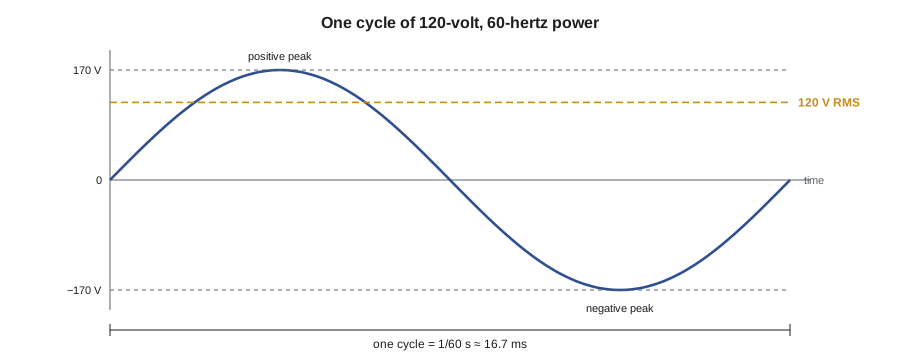
A battery or a thermocouple produces direct current: its voltage has one polarity, positive and negative, and current flows one way. Utility power is alternating current: the voltage rises from zero to a peak in one direction, falls back through zero, rises to a peak in the other direction and returns, over and over. One complete swing is a cycle, and the number of cycles each second is the frequency, measured in hertz (Hz). In both Canada and the United States, utility power runs at 60 Hz, so the voltage reverses direction 120 times a second.
Alternating current is used for utility power because its voltage is easy to change with a transformer. The utility can generate at one voltage, step it up to hundreds of thousands of volts to send it long distances with little loss, step it down in stages near town, and finally step it down to the voltage a house uses. Lesson 5 explains how a transformer does this, and the 24-volt control transformer inside a furnace works on exactly the same principle.
Peak and RMS values
Because AC voltage changes all the time, a single number is needed to describe it. The number used is the RMS value, short for root mean square. An AC voltage of 120 volts RMS delivers the same heating power to a resistance as 120 volts of steady DC. Household voltages, nameplate ratings and the readings of ordinary meters are all RMS values unless stated otherwise. For a smooth sine wave, the peak voltage is about 1.414 times the RMS voltage.
Worked problem
Peak voltage of household power
A receptacle measures 120 V AC on a meter. What is the peak voltage, and how large is the swing from the positive peak to the negative peak?
Show solution
- Multiply the RMS value by 1.414:
- \[V_{\text{peak}} = 1.414 \times 120 \approx 170 \text{ V}\]
- The peak-to-peak swing is twice the peak:
- \[V_{\text{p-p}} = 2 \times 170 = 340 \text{ V}\]
Answer: The insulation on a 120-volt circuit must withstand peaks of about 170 volts many times a second. This is one reason meter and tool ratings are higher than the circuit's nominal voltage.
Utility voltage is not exact. The nominal 120 volts can normally read anywhere from about 112 to 125 volts at a receptacle depending on the load in the neighbourhood and the length of the wiring, and the equipment is designed to tolerate that range. A reading far outside it, such as 100 volts or 135 volts, points to a supply problem, often a loose neutral, and is a matter for the utility or an electrician, not for adjusting the appliance.
From the utility to the panel
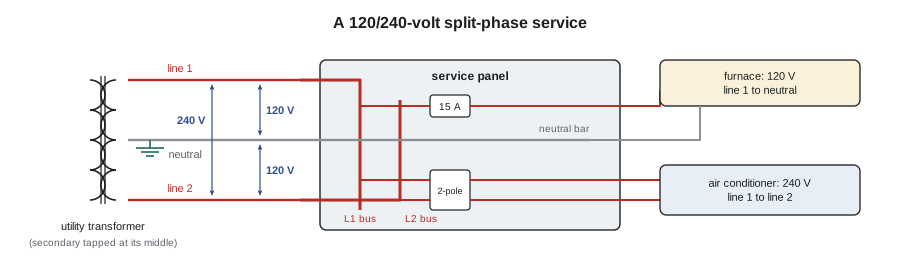
Most houses in Hamilton are fed by a split-phase service. The utility, Alectra Utilities in Hamilton, brings power to a transformer on a pole or a ground-level pad. The transformer's secondary winding has a connection at its centre, called the centre tap, which is grounded and becomes the neutral. The two ends of the winding become two hot conductors, often called line 1 and line 2. Between either hot conductor and the neutral there are 120 volts. Between the two hot conductors there are 240 volts, because the two halves of the winding add. Three conductors, two hots and a neutral, run to the house through the utility's meter to the service panel.
In the panel, the main breaker or main switch can disconnect the whole house. The two hot conductors feed two bus bars, and individual circuit breakers clip onto the bars. A single-pole breaker takes one hot and feeds a 120-volt circuit. A double-pole breaker takes both hots and feeds a 240-volt circuit, such as an air conditioner, a heat pump or an electric range. The neutral conductors of all circuits return to the neutral bar, and the grounding conductors to the ground bar. At the main service, and only there, the neutral and ground are connected together and to the grounding electrode, a link that lesson 10 explains.
Branch circuits, breakers and wire
Each breaker protects a branch circuit: the wiring from the panel to the receptacles, lights or equipment it feeds. The breaker is sized to protect the wire, not the appliance. If current rises above the wire's safe limit, because of an overload or a short, the breaker trips and opens the circuit before the wire overheats. In ordinary house wiring, 14 AWG copper is protected at 15 amps and 12 AWG copper at 20 amps. A furnace normally runs on a 15-amp circuit, and its installation instructions give the maximum overcurrent protection it may have. Fitting a bigger breaker because a circuit keeps tripping removes the protection for the wire and can start a fire; a breaker that trips is telling you something is wrong.
Conductors are identified by colour on both sides of the border. Hot conductors are black or red, sometimes blue or another colour. The neutral is white or grey. The grounding conductor is green, green with a yellow stripe, or bare copper. In older houses, and in cables used for 240-volt circuits, a white conductor is sometimes used as a hot and should be re-marked with black or red tape. Never assume a conductor's job from its colour alone; measure.
Electrical power for an AC load is complicated by motors and transformers, whose current does not rise and fall exactly in step with the voltage. For those loads, volts times amps gives the apparent power, measured in volt-amperes (VA), which is a little more than the real power in watts. The ratio of the two is the power factor. For a heating element they are the same; for a motor they can differ by a fifth or more. That is why transformers are rated in VA, not watts, as lesson 5 explains.
Worked problem
Checking a furnace circuit against its breaker
The new furnace's nameplate lists a total of 9.8 A at 115 V, and the installation sheet says the maximum overcurrent protection is 15 A. The condensate pump plugged into a receptacle on the same circuit draws 1.2 A. What is the total load, and how much of the breaker's rating does it use?
Show solution
- Add the currents on the circuit:
- \[I_T = 9.8 + 1.2 = 11.0 \text{ A}\]
- Express it as a fraction of the breaker rating:
- \[\frac{11.0}{15} \approx 0.73\]
Answer: The load uses about 73 in every 100 parts of the breaker's rating. That is acceptable for a furnace circuit, but there is not much room left. Rosa noted it on the work order so that nobody later adds an electronic air cleaner and a humidifier to the same circuit without checking.
What the electrical code asks of a furnace circuit
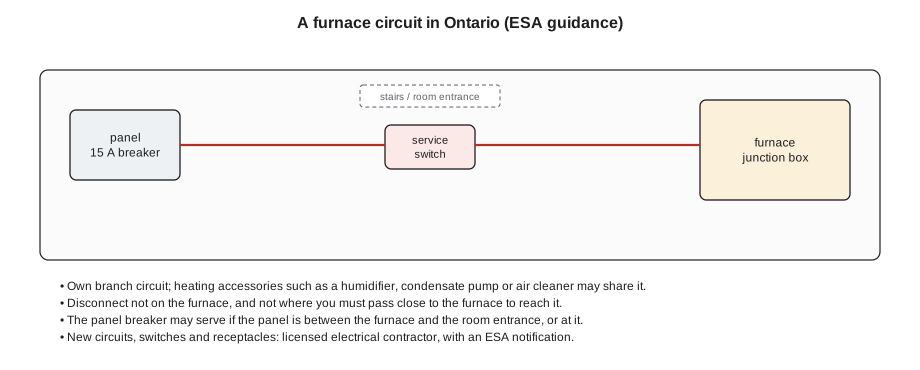
In Ontario, electrical installations are governed by the Ontario Electrical Safety Code, enforced by the Electrical Safety Authority (ESA). The current edition is the 29th, which is the Canadian Electrical Code, Part I (CSA C22.1-24) with Ontario amendments, in force since May 1, 2025. For fuel-fired central heating equipment, the code expects a supply from its own branch circuit, with auxiliary equipment that is part of the heating system, such as a humidifier, condensate pump or electronic air cleaner, allowed on the same circuit. ESA's guideline on residential HVAC installations explains the disconnecting means required under Rule 26-806: the furnace circuit needs a suitable disconnect, the panel breaker can serve if the panel is between the furnace and the entrance to the room or at that entrance, and the switch must not be mounted on the furnace or where a person would have to pass close to the furnace to reach it. That is why so many Ontario basements have a furnace switch, often with a red plate, at the bottom or top of the stairs.
Where the gas technician stops
Electrical work in Ontario is licensed under the Electricity Act, and O. Reg. 570/05 requires electrical contractors to be licensed. The regulation does not apply to work done on the electrical components of appliances by a person authorized to do that work under O. Reg. 215/01, the regulation that issues gas technician certificates. In plain terms, a certified gas technician may work on the wiring and controls that are part of the appliance. ESA's guidance draws the line at the branch circuit: a fuel industry certificate holder may replace a furnace on an existing circuit but may not install, extend, alter or repair the branch circuit that feeds it, which is work for a licensed electrical contractor, with a notification of work filed with ESA. New installations need a notification regardless of who does the work. On the Westdale job, the existing circuit and switch were suitable, so Rosa connected the new furnace to them. The condensate pump receptacle was new wiring, so Bayline's electrical partner, a licensed contractor, added it and filed the notification.
The principle is the same on both sides of the border. The gas technician owns the appliance, its internal wiring, its controls and its connection to a suitable supply. The electrician owns the supply: the panel, the breaker, the branch circuit and the disconnect. When a job needs both, the work is planned so each trade does its own part, with the right permit or notification, and nobody quietly runs a new circuit because it is quicker.
Back at the split-level
Before disconnecting the old furnace, Rosa had Jonah switch off the furnace switch, test the meter on a known live receptacle, confirm zero volts at the old furnace's junction box between every pair of conductors, and test the meter again on the receptacle. Then they locked the switch off with a padlock and tagged it. When the new furnace was set and its supply connected, Jonah measured 121 volts hot to neutral, 0.2 volts neutral to ground and 121 volts hot to ground at the furnace junction box before the first start, and wrote all three readings on the start-up sheet. Lesson 4 explains why those three readings, and that live-dead-live test, matter.
Common mistakes
MistakeFitting a larger breaker because a furnace circuit trips.
InsteadThe breaker protects the wire; find out why it trips.
MistakeAssuming a white wire is always a neutral.
InsteadWhite conductors are sometimes re-marked hots on 240-volt circuits; measure before you touch.
MistakeRunning a new branch circuit because it is "just a furnace job".
InsteadNew circuits, switches and receptacles belong to the electrical trade with the right permit or notification.
MistakeMounting the furnace disconnect where it cannot be reached safely.
InsteadFollow the adopted code and local guidance on where the disconnect goes.
MistakeTreating 120 V as an exact number.
InsteadA reading from about 112 to 125 V is normal; far outside that is a supply problem.
Summary and key terms
- Alternating current reverses direction; utility power in Canada and the US runs at 60 Hz.
- Meters show RMS values; the peak of 120 V AC is about 170 V.
- A split-phase service gives 120 V from either hot to neutral and 240 V between the hots.
- Breakers protect the wire, and a furnace normally has a 15-amp circuit with the maximum overcurrent protection listed in its instructions.
- Hot conductors are black or red, neutrals white or grey, grounds green or bare, but always measure.
- The Ontario Electrical Safety Code, enforced by ESA, expects a furnace on its own branch circuit with a suitable disconnect located as Rule 26-806 sets out.
- The gas technician works on the appliance; new branch circuits belong to the electrical trade.
- Alternating current
- Current that reverses direction many times a second; 60 cycles a second in North America.
- Hertz
- The unit of frequency, one cycle per second.
- RMS value
- The effective value of an AC voltage or current, equal in heating effect to the same DC value.
- Split-phase service
- A 120/240-volt supply from a centre-tapped transformer, with two hots and a neutral.
- Branch circuit
- The wiring from the final overcurrent device to the outlets or equipment it serves.
- Volt-ampere
- The unit of apparent power, volts times amps, used to rate transformers.
- Disconnecting means
- A switch or breaker that can disconnect the appliance from its supply.
Practice problems
Work each problem on paper first, then reveal the answer to check.
What is the frequency of utility power in Canada and the US?
Show answer
60 Hz.
What voltage is between the two hot conductors of a split-phase service?
Show answer
240 V.
What does a breaker protect?
Show answer
The branch circuit wiring, against overload and short circuit.
What is the peak of a 120-V RMS sine wave?
Show answer
About 170 V.
Who installs a new branch circuit for a furnace?
Show answer
A licensed electrical contractor, with the required ESA notification.
Lesson quiz · 5 questions
Score 60% or more to complete this lesson.
Create a free account to save your progress, take quizzes and earn a certificate.