
GAS-130 · Lesson 1 of 12 · 26 min
Voltage, current, resistance and Ohm's law
▶ Video coming soon A video version of this lesson is on the way.
The first hard frost of the season arrived on the first Monday of November 2026, and by eight in the morning Bayline's phones were ringing with no-heat calls. Priya Nair sent Rosa Delgado and Jonah Clarke to a two-storey house on Locke Street where the furnace had run the night before and then gone quiet. Rosa opened the burner compartment, watched the inducer start, and then watched the hot surface igniter stay dark. She handed Jonah a digital multimeter still in its case. "Most of what goes wrong on a modern furnace is electrical," she said. "The gas side tells you something is wrong. The electrical side usually tells you why. Before you can read this meter, you need three words and one law."
This lesson introduces those three words, voltage, current and resistance, and the law that links them, Ohm's law, together with electrical power. Every later lesson in this course builds on them: series and parallel circuits, household power, meters, transformers, relays, motors, thermostats and troubleshooting. Earlier training on trade math covered the arithmetic; here the numbers are attached to real parts of gas appliances.
What electricity is
All matter is made of atoms, and atoms contain negatively charged electrons. In metals such as copper and aluminum, some electrons are only loosely held and can drift from atom to atom. An electric current is an organized drift of those electrons through a conductor, pushed by a difference in electrical pressure between two points. Materials that let electrons move easily are conductors: copper, aluminum, steel, brass, and also water with dissolved salts in it, and the human body. Materials that resist that movement strongly are insulators: plastics, rubber, glass, ceramics, dry wood and dry air. Wire is a conductor wrapped in an insulator, so that current goes where it is wanted and nowhere else.
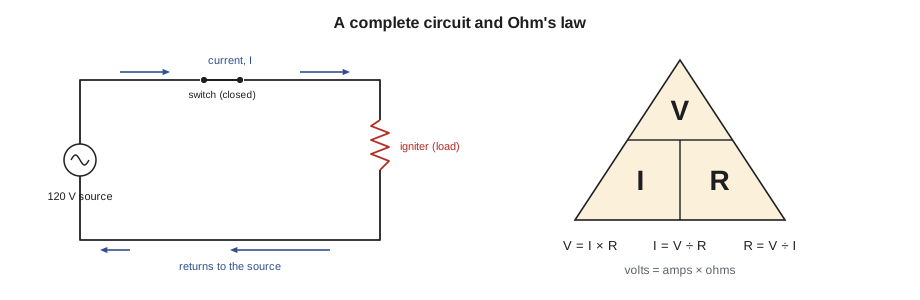
Electricity needs a complete path, called a circuit. Current leaves a source, flows through wires to a load that does useful work, such as a motor, an igniter or a gas valve coil, and returns to the source. If the path is broken anywhere, by an open switch, a burnt-out igniter or a loose wire nut, current stops everywhere in that path. If the path is completed somewhere it should not be, such as a bare wire touching a metal cabinet, current takes the unintended route. Nearly every electrical fault a gas technician meets is one of those two things: an open where there should be a path, or a short or ground fault where there should not be one.
Voltage: the push
Voltage is the difference in electrical pressure between two points, the push that drives current through a circuit. It is measured in volts (V) and given the symbol V or E in formulas. A useful comparison is the gas piping you already know. Gas flows from the meter to an appliance because the pressure at the meter outlet is higher than the pressure at the burner. Voltage plays the same part in a circuit. No pressure difference, no flow; no voltage difference, no current.
Voltage is always measured between two points. A wire does not have a voltage on its own; it has a voltage compared with something else, usually the neutral, ground or the other side of a circuit. That is why a meter has two leads. When Rosa says the furnace has 120 volts at the junction box, she means 120 volts between the hot conductor and the neutral. When she says the thermostat has 24 volts, she means 24 volts between the R terminal and the C terminal. Gas technicians meet a small number of voltages again and again: 120 volts for furnace and boiler power and receptacles, 240 volts for air conditioners, heat pumps and some commercial equipment, 24 volts for control circuits, and very small direct-current voltages from thermocouples and thermopiles on standing-pilot appliances.
Current: the flow
Current is the rate at which electric charge flows past a point. It is measured in amperes, shortened to amps (A), and given the symbol I in formulas. Again the gas comparison helps: current is like the flow rate of gas through a pipe, measured in cubic metres per hour. A large inducer motor might draw one or two amps, a blower motor several amps, a gas valve coil a few tenths of an amp, and a flame sensor signal only a few millionths of an amp, called microamps (µA). Small currents are also written in milliamps (mA), where 1,000 mA equals 1 A.
Current is what heats wires, trips breakers and injures people. A wire carries current safely only up to the limit of its size and insulation. Push more current through it and it heats, its insulation softens, and it can start a fire. That is why every circuit is protected by a fuse or circuit breaker sized for its wire. The amount of current that passes through the body, not the voltage on its own, sets how badly a shock injures someone, as the meters lesson explains.
There are two kinds of current. Direct current (DC) flows in one direction only, as from a battery, a thermocouple or a thermopile. Alternating current (AC) reverses direction many times a second, as in household power and the 24-volt control circuit of a furnace. Ohm's law works for both. A later lesson looks at alternating current in detail.
Resistance: the opposition
Resistance is the opposition a material or component offers to the flow of current. It is measured in ohms, written with the Greek letter omega (Ω), and given the symbol R in formulas. A long, thin wire has more resistance than a short, thick one, in the same way that a long run of small pipe causes more pressure drop than a short run of large pipe. Some components are made to have resistance: the heating element of a hot surface igniter, the coil of a gas valve and the windings of a motor all have resistances that suit their jobs.
Four things set the resistance of a conductor: the material (copper is better than aluminum, which is better than steel), the length (double the length, double the resistance), the cross-sectional area (double the area, half the resistance) and the temperature (most metals have more resistance when hot). Wire size follows the American Wire Gauge (AWG) system on both sides of the border, and in this system a larger gauge number means a thinner wire. Furnace power is commonly wired with 14 AWG copper, while thermostat cable is commonly 18 AWG.
Temperature matters for igniters in particular. The resistance of a silicon carbide igniter falls as it heats up, while that of a silicon nitride igniter rises. A cold reading on the meter is therefore not the same as the igniter's resistance when glowing, and the right check is to compare the cold reading with the range the manufacturer gives for that part. A reading of infinite resistance, shown on most digital meters as OL for over limit, means the path is open: the igniter is cracked or burnt through.
Ohm's law
In 1827 the German physicist Georg Ohm showed that, for a conductor at a steady temperature, the current through it is proportional to the voltage across it. Double the push, double the flow. The law is usually written as
where V is in volts, I in amps and R in ohms. Rearranged, it gives the other two forms: I = V ÷ R and R = V ÷ I. If you know any two of the three quantities, you can find the third. The triangle in the figure is a memory aid: cover the letter you want, and the two that remain show whether to multiply or divide.
Ohm's law tells you what to expect, and troubleshooting is mostly comparing what you measure with what you expect. If a 24-volt gas valve coil has a resistance in the range its manufacturer gives, it should draw a predictable current when energized. If the current is far lower, the coil or its wiring has too much resistance. If it is far higher, the coil may be shorted. The same reasoning applies to every load on the appliance.
Worked problem
Current through a gas valve coil
Jonah measures the resistance of a gas valve coil with the wires disconnected and the power off. Suppose it reads 48 Ω. With the furnace calling for heat, the coil will have 24 volts across it. What current should it draw?
Show solution
- Write Ohm's law for current:
- \[I = \frac{V}{R}\]
- Substitute the values:
- \[I = \frac{24 \text{ V}}{48\ \Omega} = 0.5 \text{ A}\]
Answer: The coil should draw about 0.5 amp. A clamp meter reading close to that tells Jonah the coil and its circuit are behaving as they should.
Worked problem
Finding the hot resistance of an igniter
On a different furnace, suppose a 120-volt igniter draws 3.0 A once it is glowing. What is its resistance when hot?
Show solution
- Write Ohm's law for resistance:
- \[R = \frac{V}{I}\]
- Substitute the values:
- \[R = \frac{120 \text{ V}}{3.0 \text{ A}} = 40\ \Omega\]
Answer: The igniter has about 40 Ω when hot. Its cold reading will be different, which is why the manufacturer's cold-resistance range, not this figure, is used to check a new or suspect igniter.
Electrical power
Power is the rate at which electrical energy is converted into heat, light or motion. It is measured in watts (W), with 1,000 W equal to one kilowatt (kW), and given the symbol P. For a resistive load such as an igniter or a heating element, power equals voltage times current:
Combining this with Ohm's law gives two more forms that are often handy: P = I² × R and P = V² ÷ R. The first shows why a loose, high-resistance connection gets hot: the current through it is the full load current, and the heat produced rises with the square of that current. The second shows why an igniter rated for 120 volts must never be fed from 240 volts: doubling the voltage on the same resistance makes four times the power, and the element fails in seconds.
Electrical energy is power multiplied by time, and the utility bills it in kilowatt-hours (kWh). A blower motor that uses 400 W for 10 hours uses 4 kWh. Gas technicians are sometimes asked by customers why a new furnace with a variable-speed blower costs less to run, and this arithmetic is the answer: a blower that runs slower, drawing less power, for the same number of hours uses less energy.
Worked problem
Power and heat in a loose connection
A blower motor draws 6 A. A loose connection at its terminal block has developed a resistance of 0.5 Ω. How much power is being turned into heat at that one connection?
Show solution
- Use the form that needs only current and resistance:
- \[P = I^2 \times R\]
- Substitute the values:
- \[P = (6 \text{ A})^2 \times 0.5\ \Omega = 36 \times 0.5 = 18 \text{ W}\]
Answer: About 18 W is being released inside a small terminal, roughly the heat of a small soldering iron, all day while the blower runs. Over weeks that heat chars the insulation and can melt the terminal block, which is why discoloured or brittle wiring at a terminal always calls for a closer look.
| Quantity | Symbol | Unit | Unit symbol | Gas piping comparison |
|---|---|---|---|---|
| Voltage | V or E | volt | V | Pressure difference |
| Current | I | ampere (amp) | A | Flow rate |
| Resistance | R | ohm | Ω | Friction or restriction |
| Power | P | watt | W | Rate of energy delivered |
| Energy | E or W | kilowatt-hour | kWh | Total energy delivered over time |
Prefixes and reading the numbers
Electrical values range over huge spans, so meters and diagrams use metric prefixes on both sides of the border. Kilo (k) means a thousand: 2.2 kΩ is 2,200 Ω. Mega (M) means a million: an insulation reading of 20 MΩ is 20,000,000 Ω. Milli (m) means a thousandth: 250 mA is 0.25 A. Micro (µ) means a millionth: a flame signal of 4 µA is 0.000004 A. A common mistake is to read a meter showing 1.5 on its kilohm range as 1.5 Ω, which is a thousand times wrong. Always read the unit symbol on the display as well as the number.
Most digital meters are autoranging, choosing the scale themselves and showing the prefix on the display. Some older meters and many clamp meters still need the range set by hand. The habit to build now is to say the reading out loud with its unit: "forty-eight ohms", "point five amps", "one hundred and twenty-two volts AC". Rosa makes Jonah do this on every call, and on the Locke Street job it paid off at once.
Back at the furnace
With the power to the furnace switched off and verified off, Jonah disconnected the igniter plug and measured across the two igniter wires. The meter read OL. He measured again, holding the probes firmly on the terminals, and it still read OL. Rosa had him look closely at the element with a flashlight, and there was a hairline crack near its base. An open element has infinite resistance, so by Ohm's law no current can flow through it, whatever the voltage. The control board had been doing its job, sending 120 volts to the igniter at the right moment, and seeing no flame, locking out after its trials.
Before fitting the new igniter, Rosa had Jonah measure it cold and compare the reading with the range printed in the installation sheet. It was within range. They fitted it without touching the element, since skin oil creates hot spots that shorten its life, restored power, and watched the full sequence: inducer, pressure switch, igniter glow, gas valve, flame, blower. "Three words and one law," Rosa said as they packed up. "You used all of them on that call."
Common mistakes
MistakeThinking a wire "has" a voltage on its own.
InsteadVoltage is always measured between two points; say what you measured it against.
MistakeMeasuring resistance with the circuit powered.
InsteadSwitch off, verify the power is off, and isolate the part before measuring ohms.
MistakeReading OL as zero.
InsteadOL means over limit, an open circuit with infinite resistance, the opposite of zero.
MistakeIgnoring the prefix on the display.
InsteadRead kΩ, MΩ, mA and µA carefully; the prefix changes the value by a thousand or a million.
MistakeFeeding a 120-volt part from 240 volts "to test it".
InsteadDoubling the voltage on the same resistance makes four times the power and destroys the part.
Summary and key terms
- Electric current is a flow of electrons through a complete circuit, and it stops anywhere the path is open.
- Voltage, in volts, is the push between two points; current, in amps, is the flow; resistance, in ohms, is the opposition.
- Ohm's law links them: V = I × R.
- Power in watts equals voltage times current, and also I² × R and V² ÷ R.
- Resistance depends on material, length, area and temperature, and a cold igniter reading is compared with the manufacturer's range.
- OL on a meter means an open circuit.
- Read prefixes such as kilo, milli and micro carefully.
- Voltage
- The difference in electrical pressure between two points, measured in volts.
- Current
- The rate of flow of electric charge, measured in amperes.
- Resistance
- Opposition to the flow of current, measured in ohms.
- Ohm's law
- The relationship V = I × R between voltage, current and resistance.
- Power
- The rate at which electrical energy is converted, measured in watts.
- Open circuit
- A break in the current path, showing infinite resistance on a meter.
- Short circuit
- An unintended low-resistance path that lets excessive current flow.
- Microamp
- One millionth of an amp, the scale of a flame sensing signal.
Practice problems
Work each problem on paper first, then reveal the answer to check.
What three quantities does Ohm's law connect?
Show answer
Voltage, current and resistance: V = I × R.
A 24-volt coil draws 0.4 A. What is its resistance?
Show answer
R = 24 ÷ 0.4 = 60 Ω.
What does OL mean on a resistance reading?
Show answer
Over limit: an open circuit with infinite resistance.
Why does a loose connection get hot?
Show answer
Its resistance carries the full load current, and heat rises with I² × R.
How many milliamps are in 0.25 A?
Show answer
250 mA.
Lesson quiz · 5 questions
Score 60% or more to complete this lesson.
Create a free account to save your progress, take quizzes and earn a certificate.