
GAS-110 · Lesson 6 of 12 · 23 min
Complete and incomplete combustion
▶ Video coming soon A video version of this lesson is on the way.
In early October, Bayline got a call from Marigold Kitchen, the restaurant in the Eastgate plaza. The cooks complained of headaches by mid-afternoon, and a ring of soot had appeared on the wall above one of the range burners. Luis brought Jonah along. The first thing Luis did was look at the flames on the six-burner range: four were crisp and blue, two were tall, soft and tipped with yellow. Then he took out the combustion analyzer. "The flames tell you something is wrong," he said. "The analyzer tells you how wrong, and whether you fixed it."
The previous lesson described the ideal: fuel and oxygen combining completely into carbon dioxide and water. This lesson describes what happens when combustion is not complete, what causes it, how to recognize it and how a gasfitter measures it.
Complete combustion
Combustion is complete when every carbon atom in the fuel ends up in carbon dioxide and every hydrogen atom ends up in water. For that to happen, three conditions must be met at the flame:
- Enough oxygen. At least the theoretical amount, and in practice some excess air.
- Good mixing. The gas and air must be mixed well enough that each fuel molecule meets its oxygen.
- Enough temperature and time. The mixture must stay hot enough, long enough, for the reaction to finish. Gas chemists sometimes summarize the last two as "time, temperature and turbulence".
When all three are met, the flame on a typical atmospheric burner has a sharp, light blue outer cone, a well-defined inner cone, and sits steadily on the burner ports without lifting off or floating. The flue gas holds carbon dioxide, water vapour, nitrogen and some oxygen, and only a trace of carbon monoxide.
Incomplete combustion
Combustion is incomplete when some carbon does not reach carbon dioxide. Instead it leaves as carbon monoxide (CO), a molecule with one oxygen atom instead of two, or as soot, which is nearly pure carbon. Other partly burned compounds, such as aldehydes, may form and give a sharp, eye-stinging smell. Incomplete combustion wastes fuel, fouls heat exchangers and vents, and, most importantly, produces carbon monoxide, which can kill.
In simple form, when methane burns with too little oxygen, part of it follows a reaction like this:
Real flames produce a mix of carbon dioxide and carbon monoxide, with the share of CO rising as conditions get worse.
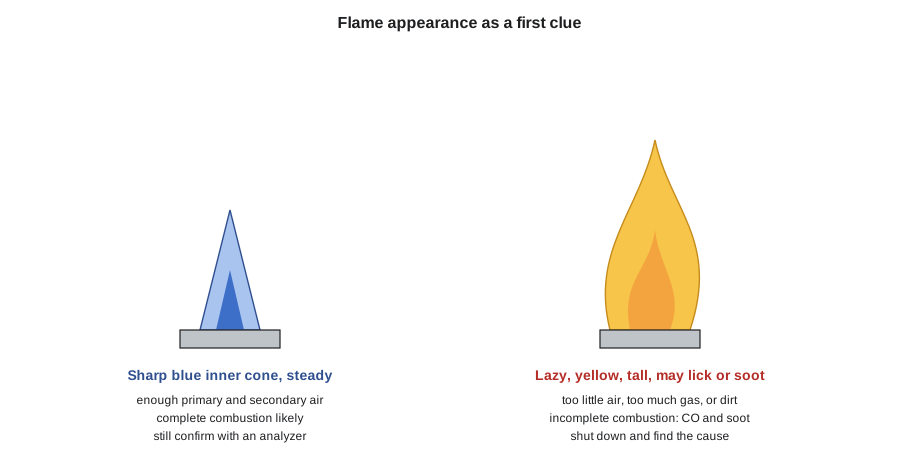
Flame appearance is a useful clue but not a test. Some appliances are designed with yellow-tipped flames, such as decorative log sets, and some flames that look fine produce high CO because of what happens after the flame, for example when a flame touches a cool surface. Always measure.
What causes incomplete combustion
Most causes fall into a few groups. Each one breaks one of the three conditions above.
| Cause | How it starves or cools the flame | Typical signs |
|---|---|---|
| Blocked primary air openings | Lint, dust, cobwebs or a closed shutter reduce air mixed with the gas | Lazy yellow flames, soot on burners |
| Not enough combustion air in the room | Tight room or closet; closed or blocked air openings | Flames lengthen when the door is closed; high CO |
| Over-firing | Orifice too large, manifold pressure too high or wrong gas | Large flames, flame rollout, overheated parts |
| Flame impingement | Flame touches a cool surface and is quenched before burning out | Soot where flames touch, high CO with normal oxygen |
| Blocked or poor venting | Flue gases spill back and the burner breathes its own exhaust | Spillage at draft hood, condensation, scorch marks |
| House depressurization | Exhaust fans, range hoods or dryers pull air from the appliance room and reverse the vent | Spillage when fans run, CO alarms |
| Dirty or damaged burners and heat exchangers | Distorted flame pattern; poor mixing | Uneven flames, noise, soot |
Several of these can combine. At Marigold Kitchen, Luis found that the two bad burners had grease-clogged air shutters, and that a new exhaust hood fan, installed without enough make-up air, was pulling the kitchen into negative pressure. That pulled air away from the range burners and, when the fan ran on high, spilled flue gas from the water heater in the back room. Fixing the shutters solved the soot; fixing the make-up air solved the headaches.
A burner that breathes its own exhaust is in especially serious trouble. Flue gases contain little oxygen. If they spill back into the room and are drawn into the burner, the flame gets less oxygen, makes more CO, which spills back, and so on. This feedback can raise CO levels in a room quickly.
Excess air and efficiency
Because incomplete combustion is so dangerous, burners are set with excess air. But excess air has a cost. Every extra cubic metre of air is heated in the combustion chamber and carried up the vent, taking heat that should have gone into the building. The goal is enough excess air for clean combustion and not much more.
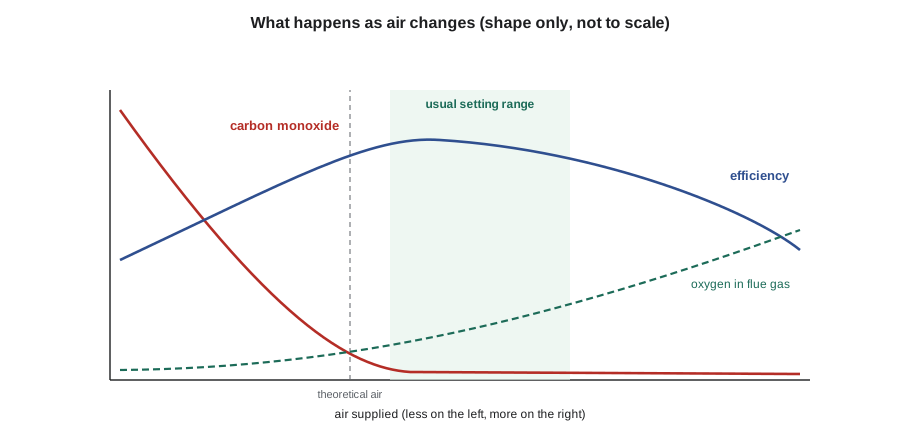
The graph shows the trade-off in shape. Near theoretical air, a small loss of air sends CO sharply upward. A little to the right, CO is low and efficiency near its peak. Far to the right, efficiency falls as heat leaves with the extra air. Manufacturers specify the oxygen or carbon dioxide range their appliance should run in, and the technician sets the burner within it.
Measuring combustion with an analyzer
A combustion analyzer draws a sample of flue gas through a probe and measures it with electrochemical sensors. Most measure oxygen (O2) and carbon monoxide (CO) directly and the flue gas temperature with a thermocouple. From those readings and the fuel type, the analyzer calculates carbon dioxide (CO2), excess air and combustion efficiency. Many also measure draft.
Sampling must be done at the point the manufacturer specifies: in the flue before any draft hood on a natural-draft appliance, so that dilution air does not water down the sample, or at the test port on a sealed-combustion appliance. The appliance should run for several minutes until readings stabilize. The analyzer must be zeroed in fresh outdoor air and its sensors calibrated on schedule.
Two calculated values are especially useful.
- Excess air can be found from the oxygen reading. If the flue gas holds O2 parts in 100 of oxygen on a dry basis, excess air in parts in 100 is about O2 divided by (20.9 minus O2), times 100.
- Air-free CO corrects the CO reading for dilution by excess air, so that readings from different appliances can be compared. It is the measured CO multiplied by 20.9 and divided by (20.9 minus the measured O2).
Worked problem
Reading an analyzer
At Marigold Kitchen's water heater, after the make-up air was fixed, Luis's analyzer read 9.0 parts in 100 oxygen and 60 ppm CO in the flue sample. What are the excess air and the air-free CO?
Show solution
- Excess air:
- \[\frac{9.0}{20.9 - 9.0} \times 100 = \frac{9.0}{11.9} \times 100 \approx 76 \text{ in 100}\]
- Air-free CO:
- \[60 \times \frac{20.9}{20.9 - 9.0} = 60 \times \frac{20.9}{11.9} \approx 105 \text{ ppm}\]
Answer: The water heater runs at about 76 in 100 excess air, normal for an atmospheric water heater, and about 105 ppm air-free CO. Luis compares that with the manufacturer's limit and with Bayline's own action level. He notes it on the service record and recommends cleaning the burner at the next visit, then checks the room with an ambient CO meter while the hood fan runs on high.
What counts as acceptable CO depends on the appliance. The standards that appliances are certified to set laboratory limits on air-free CO, and manufacturers give field values in their instructions. Many service companies and energy programs use their own action levels, often well below the certification limits, and require further investigation or shutdown above them. The rule for a technician is simple: know the manufacturer's value, never leave an appliance running that produces more, and treat any rising CO reading as a fault to find.
Draft and spillage
A natural-draft appliance relies on hot flue gases rising up the vent to pull fresh air through the burner. If the vent is blocked, too cold, poorly sized or overwhelmed by depressurization, the flue gas spills out of the draft hood into the room. Technicians check this with a spillage test: with the appliance running and, where required, the house's exhaust fans on, they hold a smoke source, mirror or temperature probe at the draft hood rim and watch whether gases are drawn in or pushed out. A draft gauge in the vent connector gives a numerical reading. Persistent spillage is a serious hazard and the appliance must not be left operating until it is corrected. Venting is covered in detail in later courses.
| Analyzer reading | Likely meaning | Action |
|---|---|---|
| Low O2, high CO | Not enough air or over-firing | Check air openings, manifold pressure, orifices, venting |
| Normal O2, high CO | Flame impingement, poor mixing or damaged burner | Inspect flame pattern, burner, heat exchanger |
| Very high O2, low CO | Too much excess air; low efficiency | Check for air leaks, over-sized air openings, under-firing |
| CO rises over several minutes | Spillage or vent problem; burner breathing exhaust | Spillage test; shut down if confirmed |
Setting up a burner
Adjusting a burner for clean combustion follows the same general steps on most appliances, always within the manufacturer's instructions:
- Confirm the appliance matches the gas supplied and that the orifices are correct for that gas and the altitude.
- Check inlet pressure with the appliance off and running, and confirm it is within the manufacturer's range.
- Set manifold pressure to the rating plate value with the burner at full input.
- Clock the meter or confirm input by orifice and pressure; correct over- or under-firing.
- Check the flame: stable, seated, correct colour, no impingement.
- Sample the flue gas after readings stabilize; compare oxygen or carbon dioxide and CO with the manufacturer's values.
- Check draft or spillage under worst-case conditions on natural-draft appliances.
- Record all readings on the job file and leave the test ports sealed and leak tested.
Many analyzers show carbon dioxide calculated from oxygen. For natural gas, the relationship is roughly CO2 = CO2max × (20.9 − O2) ÷ 20.9, where CO2max is about 11.7 parts in 100.
Worked problem
Carbon dioxide from an oxygen reading
An analyzer reads 6.0 parts in 100 oxygen in the flue of a natural gas furnace. Using a maximum carbon dioxide of 11.7, estimate the carbon dioxide in the flue gas.
Show solution
- Apply the relationship:
- \[11.7 \times \frac{20.9 - 6.0}{20.9} = 11.7 \times \frac{14.9}{20.9} \approx 8.3 \text{ in 100}\]
Answer: The flue gas holds about 8.3 parts in 100 carbon dioxide. As oxygen rises with more excess air, carbon dioxide falls; both describe the same thing, how much air passed through the burner.
Soot and its effects
Soot is not only a sign of incomplete combustion; it causes more of it. A thin layer of soot on a heat exchanger insulates it, so less heat passes into the building and more goes up the vent. Heavier soot narrows the flue passages, restricting flow and starving the burner of air, which makes more soot. Soot can fall and block the burner ports or the base of a vent. An appliance that has sooted must be cleaned and the cause corrected before it goes back into service; cleaning alone just resets the clock.
Caring for the analyzer
A combustion analyzer is only as good as its care. Electrochemical sensors wear out, usually over two to five years, and drift between calibrations, so most manufacturers call for annual calibration against certified test gases. Water condensing in the probe and hose can reach the sensors and ruin them, which is why analyzers have water traps and filters that must be emptied and changed. The CO sensor can be damaged by very high concentrations, so technicians watch the reading and pull the probe if it climbs off scale. Always start the analyzer in clean outdoor air so it zeroes correctly, never inside a room that may already contain CO. A technician who cannot trust the instrument cannot trust the readings, and readings are what decide whether an appliance is safe to leave running.
Common mistakes
MistakeJudging combustion only by how the flame looks.
InsteadConfirm with a combustion analyzer at the manufacturer's test point.
MistakeSampling above a draft hood, where dilution air lowers the readings.
InsteadSample in the flue before the draft hood or at the specified test port.
MistakeTesting spillage with all the house's exhaust fans off.
InsteadTest under the worst realistic conditions, with exhaust appliances running as the procedure requires.
MistakeAdding excess air without limit to keep CO down.
InsteadSet excess air within the manufacturer's range; too much wastes heat and can cause condensation.
Summary and key terms
- Complete combustion turns all carbon into carbon dioxide and all hydrogen into water; it needs enough oxygen, good mixing, and enough temperature and time.
- Incomplete combustion produces carbon monoxide, soot and aldehydes.
- Common causes are blocked air openings, too little combustion air, over-firing, flame impingement, poor venting and house depressurization.
- Burners run with excess air; too little sends CO up sharply, too much wastes heat.
- A combustion analyzer measures oxygen, CO and flue temperature and calculates CO2, excess air, efficiency and air-free CO.
- Spillage tests check that a natural-draft vent is carrying flue gas away.
- Complete combustion
- Combustion in which all the carbon forms carbon dioxide and all the hydrogen forms water.
- Incomplete combustion
- Combustion in which some carbon forms carbon monoxide or soot.
- Flame impingement
- A flame touching a surface that cools it before combustion is complete.
- Combustion analyzer
- An instrument that samples flue gas and measures oxygen, carbon monoxide and temperature.
- Air-free CO
- A CO reading corrected for dilution by excess air.
- Spillage
- Flue gas escaping into the room from a draft hood or vent instead of going outdoors.
Practice problems
Work each problem on paper first, then reveal the answer to check.
Name the three conditions for complete combustion.
Show answer
Enough oxygen, good mixing of gas and air, and enough temperature and time.
Why can a flame that touches a cool surface produce CO even with plenty of air?
Show answer
The surface cools the flame and stops the reaction before carbon reaches carbon dioxide.
Where should a flue gas sample be taken on a natural-draft appliance?
Show answer
In the flue before the draft hood, or where the manufacturer specifies.
What does air-free CO correct for?
Show answer
Dilution of the sample by excess air.
How can a range hood cause CO problems from a water heater?
Show answer
It depressurizes the space, reversing the water heater's vent so flue gas spills into the room.
Lesson quiz · 5 questions
Score 60% or more to complete this lesson.
Create a free account to save your progress, take quizzes and earn a certificate.