
GAS-110 · Lesson 5 of 12 · 26 min
The chemistry of combustion
▶ Video coming soon A video version of this lesson is on the way.
Jonah had always thought of a gas flame as fire, and fire as something that simply happens. Rosa wanted him to see it as a chemical reaction with ingredients and products that can be counted. On a quiet afternoon at the shop she drew a methane molecule on the whiteboard, one carbon atom with four hydrogen atoms around it, and two oxygen molecules beside it. "Every gas appliance you will ever work on is a machine for doing this one reaction safely," she said. "Get the ingredients right and you get heat, carbon dioxide and water. Get them wrong and you get soot and carbon monoxide."
This lesson explains what combustion is, where the oxygen comes from, how to balance the combustion reactions for methane and propane, and how much air a burner needs. The next two lessons build on it to explain incomplete combustion and carbon monoxide.
What combustion is
Combustion is a rapid chemical reaction between a fuel and oxygen that releases heat and light. Chemists call it oxidation: the carbon and hydrogen atoms in the fuel combine with oxygen atoms to form new molecules. The reaction is exothermic, meaning it gives off energy. The chemical bonds in carbon dioxide and water hold their atoms more tightly than the bonds in the fuel and oxygen did, and the difference is released as heat.
For combustion to start and keep going, three things must be present together: fuel, oxygen and enough heat to start the reaction. This is often drawn as the fire triangle. Remove any side and the fire goes out. Many safety texts add a fourth element, the chain reaction that keeps the flame going once it starts, and call the model a fire tetrahedron.
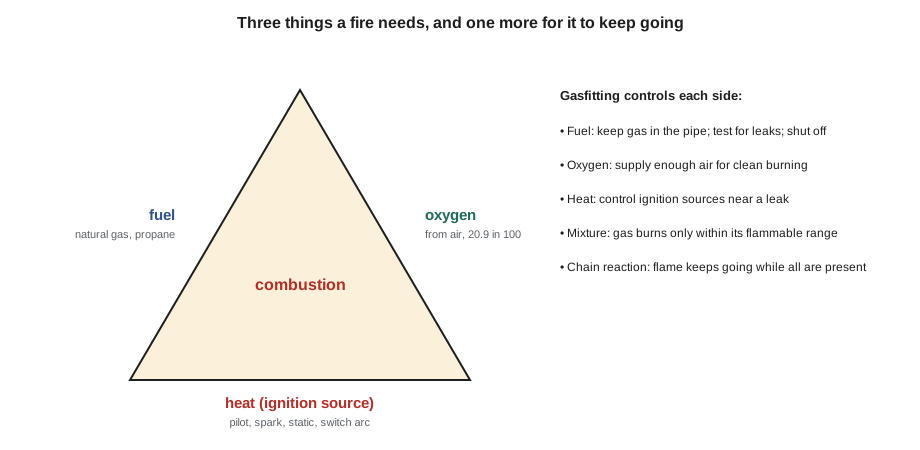
In gas work, all three sides matter. Keeping fuel in the pipe is the purpose of leak testing. Supplying the right amount of oxygen is the purpose of combustion air and venting rules. Controlling heat is why we avoid sparks and flames near a leak. And the mixture must be within the flammable range from Lesson 3.
Where the oxygen comes from
Burners take their oxygen from air. Dry air at sea level is about:
| Gas in dry air | Parts in 100 by volume |
|---|---|
| Nitrogen | about 78.1 |
| Oxygen | about 20.9 |
| Argon | about 0.9 |
| Carbon dioxide and others | about 0.04 and trace amounts |
Only the oxygen takes part in combustion. The nitrogen, nearly four times as much by volume, passes through the flame and leaves in the flue gas, carrying heat with it. A small amount of nitrogen reacts at high flame temperatures to form nitrogen oxides, which is why low-NOx burners exist, but for the purposes of air calculations nitrogen is treated as inert.
Because air is only about one fifth oxygen, a burner must move about five volumes of air for every volume of oxygen it needs. That is the reason combustion air openings and vents are as large as they are.
Balancing the reaction for methane
A chemical equation shows the molecules going into a reaction on the left and the molecules coming out on the right. Atoms are never created or destroyed, so the number of each kind of atom must be the same on both sides. Balancing the equation tells us exactly how much oxygen the fuel needs.
One methane molecule has one carbon atom and four hydrogen atoms. The carbon ends up in one molecule of carbon dioxide, which needs two oxygen atoms. The four hydrogen atoms end up in two molecules of water, which need two more oxygen atoms. That is four oxygen atoms, or two oxygen molecules:
Count the atoms to check: on the left, one carbon, four hydrogen and four oxygen; on the right, one carbon in the carbon dioxide, four hydrogen in the two water molecules, and two plus two oxygen. The equation balances.
For gases at the same temperature and pressure, equal volumes contain equal numbers of molecules. So the equation also reads in volumes: one volume of methane needs two volumes of oxygen and produces one volume of carbon dioxide and two volumes of water vapour.
Balancing the reaction for propane
Propane has three carbon atoms and eight hydrogen atoms. The three carbons become three carbon dioxide molecules, needing six oxygen atoms. The eight hydrogens become four water molecules, needing four more. Ten oxygen atoms make five oxygen molecules:
One volume of propane needs five volumes of oxygen, two and a half times as much as methane. That matches its heating value, about two and a half times that of natural gas: the heat released depends closely on how much oxygen the fuel combines with.
How much air
The amount of air that supplies exactly enough oxygen for complete combustion, with none left over, is the theoretical air or stoichiometric air. Since air is about 20.9 parts in 100 oxygen, divide the oxygen needed by 0.209.
Worked problem
Theoretical air for methane and propane
How many volumes of air supply the oxygen for one volume of methane and one volume of propane?
Show solution
- Methane needs 2 volumes of oxygen:
- \[\frac{2}{0.209} \approx 9.57 \text{ volumes of air}\]
- Propane needs 5 volumes of oxygen:
- \[\frac{5}{0.209} \approx 23.9 \text{ volumes of air}\]
Answer: One volume of methane needs about 9.5 to 9.6 volumes of air, and one volume of propane about 24. Trade references often round these to 10 and 24. Pipeline natural gas, with its small amounts of heavier gases, needs slightly more than pure methane, about 9.6 to 10 volumes per volume depending on the supply.
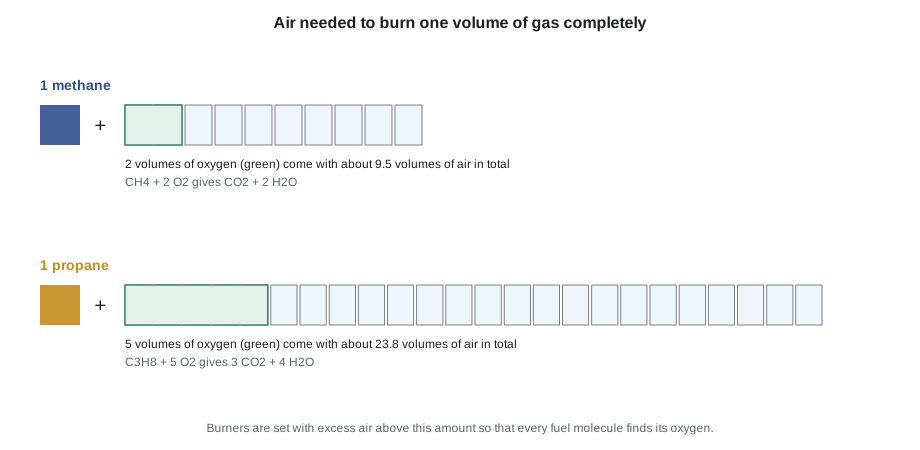
Real burners never run at exactly theoretical air. Gas and air do not mix perfectly, so some fuel molecules would never meet their oxygen. Burners are designed and adjusted to supply excess air, more than theoretical, so that every fuel molecule finds oxygen. Too much excess air, though, carries heat up the vent and lowers efficiency. Typical atmospheric burners run with roughly 40 to 60 parts in 100 excess air or more; modern sealed-combustion and power burners run with much less. Lesson 6 explains how excess air is measured with a combustion analyzer.
Primary, secondary and dilution air
An appliance uses air in several ways, and a gasfitter needs to know each one.
- Primary air is mixed with the gas before it reaches the flame. In an atmospheric burner, gas leaving the orifice at speed draws air in through an adjustable shutter or fixed opening, by the same effect that pulls air into a spray bottle.
- Secondary air reaches the flame from around it, supplying the rest of the oxygen as the flame burns.
- Excess air is the air beyond the theoretical amount that passes through the combustion zone.
- Dilution air enters a natural-draft vent through a draft hood or draft diverter. It does not take part in combustion; it mixes with the flue gases, cools them and steadies the draft.
Together, these are why the codes require that an appliance room have enough combustion air and ventilation air, whether from inside the building or from outdoors through openings or ducts. A furnace in a tight closet with no air supply will starve its own flame. The sizing rules for air supply are in the adopted CSA B149.1 edition and are covered in later courses.
Worked problem
Air for a furnace
The furnace from Lesson 4 burns 2.5 m³ of natural gas per hour. Using 9.57 volumes of air per volume of gas, how much theoretical air does it need each hour? If it runs at 50 parts in 100 excess air, how much air passes through it?
Show solution
- Theoretical air:
- \[2.5 \times 9.57 \approx 23.9 \text{ m}^3\text{/h}\]
- With 50 in 100 excess air, multiply by 1.5:
- \[23.9 \times 1.5 \approx 35.9 \text{ m}^3\text{/h}\]
Answer: The furnace moves about 36 cubic metres of air through its burners every hour at full fire, more than the volume of a small room, and that air must be replaced from somewhere. If it cannot get it, combustion suffers.
The products of combustion
When natural gas burns completely, the flue gas contains carbon dioxide, water vapour, nitrogen and the oxygen left over from excess air. Each of these matters to the gasfitter.
- Carbon dioxide is not poisonous at low levels, but it displaces oxygen in an enclosed space. Its concentration in the flue gas, measured by an analyzer, shows how close the burner is to theoretical air. The highest possible value for natural gas, at exactly theoretical air, is about 11.7 to 12 parts in 100 on a dry basis; for propane it is about 13.7.
- Water vapour is produced in large amounts: two volumes for every volume of methane. Burning about one cubic metre of natural gas makes roughly 1.5 litres of water. If flue gases cool below their dew point, about 55 °C for natural gas, the water condenses. Condensing appliances are built for that; conventional appliances and their vents are not, and condensation in the wrong place corrodes heat exchangers and vents.
- Nitrogen makes up most of the flue gas volume and simply carries heat away.
- Excess oxygen shows how much extra air passed through. Too little points toward incomplete combustion; too much means wasted heat.
If combustion is incomplete, carbon monoxide, soot and other unburned products also appear. That is the subject of the next two lessons.
Worked problem
Water from a day of heating
On a cold day the furnace uses 30 m³ of natural gas. Using about 1.5 litres of water per cubic metre burned, about how much water does it produce?
Show solution
- Multiply the gas used by the water per unit:
- \[30 \times 1.5 = 45 \text{ litres}\]
Answer: About 45 litres of water leave as vapour in one day. A condensing furnace turns much of it into liquid condensate that must be drained; a conventional furnace sends it up the vent, which must stay warm enough to keep it from condensing inside.
Where the heat goes
Combustion releases heat, but not all of it ends up in the building. Some leaves with the flue gases as sensible heat, the warmth of the hot gas, and some as latent heat, the energy held in water vapour that has not condensed. The rest passes through the heat exchanger into the air or water being heated. The fraction delivered is the appliance's efficiency. A conventional furnace with a natural-draft vent may deliver around 60 to 80 parts in 100 of its input; a condensing furnace, which cools its flue gases enough to condense much of the water vapour, can deliver over 95. Seasonal ratings such as AFUE (annual fuel utilization efficiency) average performance over a heating season.
Worked problem
Input and output
The furnace from Lesson 4 has an input of 26 kW and an efficiency of 95 in 100. How much heat does it deliver to the house at full fire?
Show solution
- Multiply input by efficiency:
- \[26 \times 0.95 \approx 24.7 \text{ kW}\]
Answer: The furnace delivers about 24.7 kW. The rest, about 1.3 kW, leaves in the flue gases and through the cabinet.
Combustion also produces small amounts of nitrogen oxides (NOx), formed when nitrogen and oxygen combine at high flame temperatures. They contribute to smog, so some regions limit NOx from appliances, and manufacturers use low-NOx burners that spread the flame or recirculate cooled flue gas to keep peak temperatures down. And every unit of natural gas burned releases carbon dioxide, about 1.9 kg per cubic metre of gas. That is the reason behind the efficiency standards, heat pump incentives and hydrogen research that are changing the trade.
Common mistakes
MistakeThinking a burner needs only enough air to supply the oxygen in the equation.
InsteadBurners need excess air beyond theoretical so every fuel molecule finds oxygen.
MistakeTreating the nitrogen in air as part of the reaction.
InsteadNitrogen mostly passes through; only the oxygen, about 20.9 in 100 of air, reacts.
MistakeForgetting that clean combustion still produces large amounts of water vapour.
InsteadExpect water vapour in every flue; keep conventional vents warm and drain condensing appliances.
MistakeAssuming dilution air at a draft hood helps the flame burn.
InsteadDilution air mixes with flue gases after the flame; combustion air must reach the burner itself.
Summary and key terms
- Combustion is the rapid, heat-releasing reaction of a fuel with oxygen; it needs fuel, oxygen and heat together.
- Air is about 78 in 100 nitrogen and 20.9 in 100 oxygen; only the oxygen reacts.
- Methane burns as CH4 + 2 O2 → CO2 + 2 H2O, and propane as C3H8 + 5 O2 → 3 CO2 + 4 H2O.
- Theoretical air is about 9.57 volumes per volume of methane and 23.9 per volume of propane.
- Burners use primary, secondary and excess air; draft hoods add dilution air.
- Complete combustion produces carbon dioxide, water vapour and nitrogen, with leftover oxygen from excess air.
- Combustion
- A rapid reaction of fuel with oxygen that releases heat and light.
- Theoretical air
- The amount of air that supplies exactly the oxygen needed for complete combustion; also called stoichiometric air.
- Excess air
- Air supplied beyond the theoretical amount.
- Primary air
- Air mixed with gas before it reaches the flame.
- Secondary air
- Air that reaches the flame from around it.
- Dew point
- The temperature at which water vapour in flue gas begins to condense.
Practice problems
Work each problem on paper first, then reveal the answer to check.
What three things does a fire need?
Show answer
Fuel, oxygen and heat (an ignition source).
Write the balanced equation for the complete combustion of methane.
Show answer
CH4 + 2 O2 → CO2 + 2 H2O.
Why does a burner need about five volumes of air for each volume of oxygen?
Show answer
Air is only about one fifth oxygen.
What is the difference between primary and secondary air?
Show answer
Primary air mixes with gas before the flame; secondary air reaches the flame from around it.
Why can conventional vents corrode?
Show answer
If flue gases cool below their dew point, water condenses inside them.
Lesson quiz · 5 questions
Score 60% or more to complete this lesson.
Create a free account to save your progress, take quizzes and earn a certificate.