
GAS-110 · Lesson 10 of 12 · 21 min
Working in confined spaces and around energized equipment
▶ Video coming soon A video version of this lesson is on the way.
In November, Luis's crew was called to a farm near Ancaster where a propane line ran through an old concrete pit that once held a water pump. The farmer had smelled gas near the pit lid. Jonah wanted to climb down and look. Luis stopped him at the edge. "That pit is deeper than you are tall, it has one way in and out, and propane is heavier than air," he said. "If there's gas down there, it's sitting at the bottom, pushing out the oxygen. People die in places like that trying to rescue the first person who went in." Luis lowered the probe of his four-gas meter on its hose before anyone moved. The flammable reading at the bottom was well into alarm, and the oxygen was low. Nobody went in. The crew shut off the line at the tank, ventilated the pit with a blower from the surface, and called Priya to set up a proper entry.
This lesson covers two hazards that have killed many tradespeople: confined spaces and energized equipment. Both are controlled by careful procedure: assessing the hazard, isolating energy or atmosphere, testing, and having a plan before anyone is exposed.
What a confined space is
A confined space, in general terms, is a space that is not designed for continuous human occupancy, is large enough for a person to enter, has limited or restricted ways in and out, and may contain a hazardous atmosphere or other serious hazards. The legal definitions differ between jurisdictions, and whether a space is a confined space under the law can depend on the hazards in it, so the exact wording must be checked in the regulation that applies.
Gasfitters meet confined or near-confined spaces more often than they expect:
- pits, vaults and trenches around meters, regulators and underground piping;
- crawl spaces and attics where piping and appliances run;
- the inside of large boilers, furnaces, ducts and tanks during repair;
- mechanical rooms and tunnels in large buildings; and
- propane tank enclosures, pump pits and underground tank domes.
Not every crawl space is a confined space by law, but every one deserves the same thinking: what could be in the air, how would I get out, and who would know if something went wrong?
Hazards in confined spaces
The most dangerous confined space hazards are atmospheric, because they cannot be seen and can overcome a person in seconds.
- Oxygen deficiency. Normal air has about 20.9 parts in 100 oxygen. Gas that leaks into a space, nitrogen used to purge piping, rust forming on steel, and decaying organic matter can all lower it. Below about 19.5 parts in 100, judgment and coordination begin to suffer; at much lower levels, a person can collapse after one or two breaths with no warning.
- Oxygen enrichment. Too much oxygen, for example from a leaking oxygen hose, makes materials ignite easily and burn fiercely.
- Flammable atmospheres. Natural gas or propane leaking into a space, solvent vapours from vent cements, and gasoline vapours can reach the flammable range. Propane in a pit is the classic gas-trade example.
- Toxic atmospheres. Carbon monoxide from engines or burners, hydrogen sulphide from sewers or manure, and vapours from cleaning products.
Other hazards include engulfment by grain, water or soil, moving parts such as blowers and augers, extreme heat or cold, poor lighting, noise and slippery surfaces.
Testing the atmosphere
The atmosphere in a confined space must be tested before entry, by a competent person with a calibrated multi-gas meter, and monitored while people are inside. Most gasfitters use a four-gas meter that reads oxygen, flammable gas (as parts in 100 of the LFL), carbon monoxide and hydrogen sulphide.
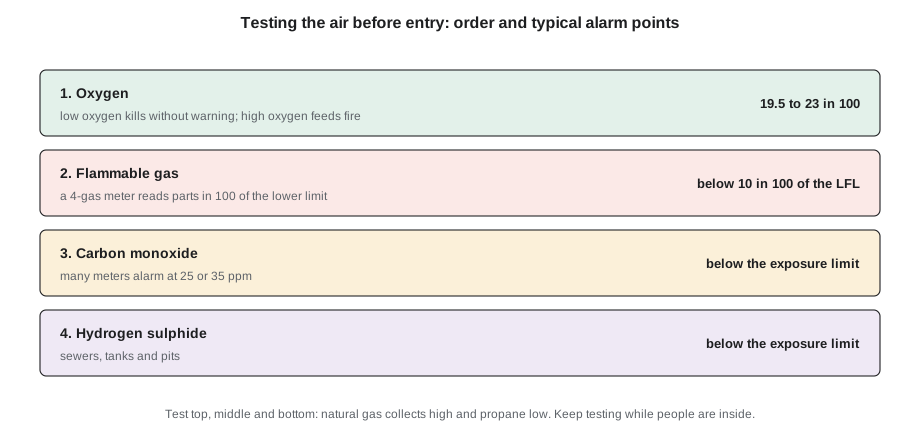
The order matters. Oxygen is tested first because many flammable gas sensors need normal oxygen to read correctly; in an oxygen-poor atmosphere, a catalytic sensor can show a falsely low flammable reading. The space is tested at the top, middle and bottom from outside, by lowering the probe or a sampling hose, because gases layer according to their specific gravity. The meter must be bump tested before use to confirm that its sensors respond.
In Ontario, confined spaces are governed by O. Reg. 632/05 under the Occupational Health and Safety Act. The employer must have a written program, a hazard assessment by a competent person, a plan for each space, and an entry permit for each entry. The regulation requires that, before and during entry, the oxygen level be at least 19.5 and no more than 23 parts in 100 by volume, and that flammable gases be kept below a set fraction of the lower explosive limit: 10 in 100 of the LEL for most work, and a stricter 5 in 100 where hot work will be done. An attendant must be stationed outside, and an on-site rescue plan with trained rescuers and equipment must be in place before anyone enters.
Controlling the hazards
When testing shows a problem, or the work itself could create one, the hazards are controlled before entry:
- Isolate the space from sources of gas, liquids and energy: close and lock valves, blank or disconnect lines, lock out blowers and pumps.
- Purge and ventilate with a blower that pushes fresh air in, placed so that it does not draw in engine exhaust or recirculate the contaminated air. Ventilation continues during entry.
- Test again after ventilating, and keep monitoring with the meter worn by the entrant.
- Plan rescue. Most deaths in confined spaces include would-be rescuers. Nobody enters to rescue without the training and equipment the plan specifies; the attendant calls for help and uses retrieval equipment from outside.
Worked problem
How long to ventilate?
The pit at the farm holds about 50 m³ of air. Luis's blower delivers about 20 m³ per minute. Bayline's procedure calls for at least seven complete air changes before retesting. How long should the blower run?
Show solution
- Time for one air change:
- \[\frac{50}{20} = 2.5 \text{ minutes}\]
- Time for seven air changes:
- \[7 \times 2.5 = 17.5 \text{ minutes}\]
Answer: The blower should run for at least 17.5 minutes before the space is retested, and it keeps running during entry. Real blowers deliver less air through long or bent ducts than their rating, so Luis rounds up to 20 minutes and relies on the retest, not the calculation, to decide whether entry can go ahead.
Energized equipment
Gas appliances contain more than gas. A furnace has a 120-volt power supply, a transformer, a blower motor with a capacitor, an ignition system that may produce more than 10,000 volts at the spark electrode, and moving parts. A rooftop unit may run on 208, 240, 480 or 600 volts. A boiler holds hot water or steam under pressure. All of these are sources of hazardous energy.
| Energy source | Example in gas work | How it hurts |
|---|---|---|
| Electrical | Appliance power supply, rooftop unit disconnects, transformers | Shock, burns, arc flash |
| Stored electrical | Motor run capacitors, ignition modules | Shock after power is off |
| Mechanical | Blower wheels, belts, fans, augers | Cuts, crushing, entanglement |
| Pressure | Gas piping, propane tanks, boilers, compressed air | Released gas, projectiles, scalding |
| Thermal | Heat exchangers, flue pipes, steam and hot water | Burns |
| Gravity | Raised units, doors, counterweights | Crushing |
The control for hazardous energy is lockout: isolating each energy source, locking the isolating device in the safe position with a personal lock, tagging it, releasing any stored energy, and verifying that the equipment is at zero energy before work begins. For electrical isolation, verification means testing for absence of voltage with a meter that has been checked on a known live source before and after the test.
In Ontario, lockout requirements appear in the Industrial Establishments regulation (R.R.O. 1990, Reg. 851) and the Construction Projects regulation, which require machinery and electrical equipment to be isolated and locked out before work where starting it could endanger a worker. CSA Z460 gives detailed guidance on hazardous energy control, and CSA Z462 covers electrical safety in the workplace, including arc flash. Electrical installation work beyond the appliance itself is governed by the Ontario Electrical Safety Code and is generally done by licensed electricians.
For a gasfitter servicing a furnace, a basic lockout means turning off the appliance's service switch, and where others could turn it back on, locking it off; closing the appliance's gas shutoff valve; waiting for moving parts to stop and hot parts to cool; discharging capacitors safely; and testing to confirm there is no voltage before touching wiring. On commercial equipment, the employer's written procedure sets out each step. The electrical skills to do this safely are taught in the course on electricity for gas technicians.
Gas pressure is energy too. Before opening a pipe, the gas must be shut off and locked where needed, the line depressurized and purged to a safe place, and the space checked with a detector. Never open a gas line while others are unaware that the valve upstream must stay closed.
Working alone and communication
Many gas calls are done by one technician. Employers must have a plan for workers who work alone, such as regular check-ins with dispatch. At Bayline, Priya's dispatch board shows every technician's location, and a technician entering a crawl space, attic or roof calls in before and after. Confined space entry is never done alone; it always requires an attendant.
Crawl spaces and attics in practice
Most gasfitters work in crawl spaces and attics far more often than in pits or tanks, and these spaces have their own hazards even when they are not legally confined spaces. Crawl spaces can hold leaking gas, especially propane, standing water, sewage, mould, animal droppings, live wiring and sharp debris. Attics can be extremely hot, with loose insulation hiding the ceiling joists, so a misstep can put a foot through the ceiling below. Before entering, Bayline technicians check the space with a gas detector, carry a light, tell dispatch or a co-worker where they are going, and wear coveralls, gloves and a respirator suited to the dust or mould. If a crawl space has a gas smell or a detector alarm, it is treated as a hazardous atmosphere: ventilate, test and do not enter until it is safe.
Electrical shock basics
Electric shock happens when the body becomes part of a circuit. The harm depends on how much current passes through the body, its path and how long it flows. Currents of a few thousandths of an ampere can be felt; somewhat higher currents can cause muscles to lock so a person cannot let go; currents of about one tenth of an ampere through the chest can stop the heart. Ordinary 120-volt household circuits can deliver lethal currents, especially through wet skin. Ground-fault circuit interrupters (GFCIs) cut power quickly when current leaks to ground and should be used with portable tools on job sites. Arc flash, the explosive release of energy from a short circuit, causes severe burns and is a particular hazard at the larger electrical panels and disconnects serving commercial equipment.
| Entry permit item | Purpose |
|---|---|
| Space and work description | Identifies where and what the work is |
| Hazards and controls | Lists the hazards found and how each is controlled |
| Atmospheric test results with times | Shows the space was safe at entry and stayed safe |
| Entrants, attendant and supervisor | Names who is responsible |
| Isolation and lockout details | Shows energy and materials are cut off |
| Rescue arrangements and communication | Makes sure help can reach an entrant quickly |
| Equipment required | Meters, ventilation, PPE and retrieval gear |
Lockout in a shared building
In apartment buildings, plazas and plants, other people may have reasons to turn equipment back on: a superintendent responding to a no-heat complaint, an electrician restoring a circuit, or a tenant flipping a switch. That is why personal locks matter. Each worker puts his or her own lock on each isolating device, keeps the only key, and removes it only when that worker's part of the job is done. Where several people work on the same equipment, a group lock box or multi-lock hasp lets each worker add a lock. Tags give the reason and the name of the person, but a tag alone does not physically stop anyone; a lock does. If a lock must be removed when its owner is not present, the employer's procedure sets out the strict steps for doing it safely.
Common mistakes
MistakeClimbing into a pit to check a gas smell before testing the air.
InsteadTest from outside with a meter at several heights; enter only under a confined space procedure.
MistakeTesting flammable gas before oxygen.
InsteadTest oxygen first; low oxygen can make flammable readings unreliable.
MistakeTurning off a furnace at the thermostat and assuming it is safe to work on.
InsteadTurn off and lock the service switch, close the gas valve and verify zero energy.
MistakeGoing in after a collapsed co-worker without equipment.
InsteadCall for help and use the rescue plan; most confined space deaths include rescuers.
Summary and key terms
- A confined space has limited entry and exit, is not meant for continuous occupancy and may contain a hazardous atmosphere.
- Gasfitters meet pits, vaults, crawl spaces, attics, tanks and large appliances.
- Atmospheric hazards include low or high oxygen, flammable gas and toxic gas.
- Test oxygen first, then flammable and toxic gases, at top, middle and bottom, and keep monitoring.
- Ontario's O. Reg. 632/05 requires oxygen of 19.5 to 23 in 100 and flammable gas below 10 in 100 of the LEL, or 5 in 100 for hot work. Isolate, ventilate, retest and plan rescue before entry.
- Hazardous energy is controlled by lockout, release of stored energy and verification of zero energy.
- Confined space
- A space with limited entry and exit, not designed for continuous occupancy, that may hold hazards.
- Four-gas meter
- A portable instrument measuring oxygen, flammable gas, carbon monoxide and hydrogen sulphide.
- Bump test
- A brief exposure of a gas meter to test gas to confirm that its sensors respond.
- Attendant
- A person stationed outside a confined space to monitor entrants and summon rescue.
- Lockout
- Isolating an energy source and locking it in the safe position so equipment cannot start.
- Zero energy state
- The condition of equipment after all energy sources are isolated and stored energy released.
Practice problems
Work each problem on paper first, then reveal the answer to check.
Name three atmospheric hazards in confined spaces.
Show answer
Low oxygen, high oxygen, flammable gas, toxic gas such as CO or hydrogen sulphide.
Why is oxygen tested before flammable gas?
Show answer
Low oxygen can make catalytic flammable sensors read falsely low.
Where should a propane leak into a pit be tested?
Show answer
At several heights, but especially at the bottom, since propane sinks.
What steps make up a basic lockout?
Show answer
Isolate each energy source, lock and tag it, release stored energy, verify zero energy.
Why should a rescuer not enter a confined space without equipment?
Show answer
The same hazard can overcome the rescuer; most confined space deaths include rescuers.
Lesson quiz · 5 questions
Score 60% or more to complete this lesson.
Create a free account to save your progress, take quizzes and earn a certificate.