
GAS-110 · Lesson 3 of 12 · 25 min
Properties of fuel gases: specific gravity, heating value and flammable limits
▶ Video coming soon A video version of this lesson is on the way.
Two calls in the same week taught Jonah why gas properties are not just classroom facts. On Monday, Bayline answered a gas odour complaint in a second-floor apartment above a store; the utility had found a small leak at a range connector, and the strongest readings were near the ceiling. On Thursday, Luis took him to a farm workshop where a propane heater's hose had cracked; the detector stayed quiet at head height and went into alarm when Luis lowered it to the floor. Same kind of fault, opposite places to look. The difference was one number: specific gravity.
This lesson covers the properties of fuel gases that a gasfitter uses every day: specific gravity, heating value, flammable limits, ignition temperature and flame characteristics. Each one explains a rule you will meet in the code and in manufacturers' instructions.
Specific gravity
Specific gravity compares the weight of a volume of gas with the weight of the same volume of air at the same temperature and pressure. Air is given the value 1.0. A gas with a specific gravity below 1.0 is lighter than air and tends to rise; a gas above 1.0 is heavier and tends to sink.
Specific gravity can be estimated from the weight of the gas molecules. Air behaves as if its average molecular weight were about 28.96. Methane's is about 16.04 and propane's about 44.10. Dividing each by the value for air gives the specific gravity of the pure gas.
Worked problem
Estimating specific gravity
Estimate the specific gravity of pure methane and pure propane from their molecular weights, using 28.96 for air.
Show solution
- Methane:
- \[\frac{16.04}{28.96} \approx 0.55\]
- Propane:
- \[\frac{44.10}{28.96} \approx 1.52\]
Answer: Pure methane is about 0.55 and propane about 1.52. Pipeline natural gas is usually quoted at about 0.60, slightly higher than pure methane, because its ethane, nitrogen and carbon dioxide are heavier.
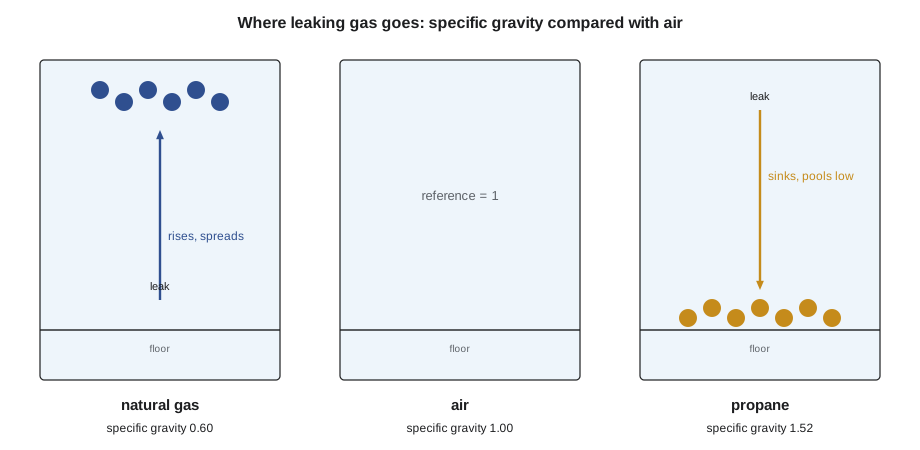
The practical meaning is large. Natural gas leaking indoors rises and mixes with room air fairly quickly; it tends to collect near ceilings, in upper floors and in attic spaces, and outdoors it disperses upward. Propane leaking indoors flows downward like an invisible liquid. It collects in basements, crawl spaces, floor drains, sumps, pits and low corners, and it can travel along the floor to a pilot light or a furnace burner some distance from the leak. A propane leak in a basement may not be smelled upstairs at all.
Because of this, the codes treat propane differently in several ways. Propane appliances generally must not be installed where escaping gas could collect in a pit or below-grade space unless special conditions are met, and propane cylinders are not stored indoors except in very limited cases. Gas detectors and alarms are mounted high for natural gas and low for propane. When a gasfitter searches for a propane leak, the detector goes low; for natural gas it goes high. The exact rules are in the adopted CSA B149.1 and B149.2 editions, and they must be read there rather than from memory.
Specific gravity also affects how gas flows. Pipe sizing tables in the code assume a particular specific gravity, usually 0.60 for natural gas and 1.52 for propane. A heavier gas flows more slowly through the same pipe at the same pressure drop, which is one reason the tables for the two gases are different. You will use those tables in the next course.
Heating value
The heating value of a gas is the amount of heat released when a set amount of it burns completely. In Canada it is given in megajoules per cubic metre (MJ/m³), and appliance input in kilowatts or megajoules per hour; Btu per hour is still widely used on rating plates.
| Gas | Typical higher heating value |
|---|---|
| Natural gas (pipeline) | about 37 to 39 MJ/m³ |
| Propane vapour | about 93 MJ/m³ |
| Liquid propane | about 25.3 MJ per litre |
| Butane vapour | about 121 MJ/m³ |
There are two ways to state heating value. The higher heating value (also called gross) includes the heat given up when the water vapour in the flue gas condenses to liquid. The lower heating value (net) leaves that heat out. For natural gas, the lower value is about 10 parts in 100 less than the higher. North American gas codes, utilities and rating plates use the higher heating value. Condensing appliances recover much of the latent heat in the water vapour, which is why they reach high efficiencies.
Heating value is how a gasfitter connects the gas flow to the heat delivered. If a meter shows how much gas an appliance uses in an hour, multiplying by the heating value gives the input. Lesson 4 shows how to do this by "clocking" the meter. It is also why propane carries about two and a half times the heat of natural gas in the same volume: each propane molecule has three carbon atoms and eight hydrogen atoms to burn, compared with methane's one and four.
Worked problem
Comparing input on two gases
A furnace burner passes 2.5 m³ of natural gas per hour at 37.5 MJ/m³. What is its input in megajoules per hour and in kilowatts? If the same volume of propane at 93 MJ/m³ passed through it, what would the input be?
Show solution
- Natural gas input:
- \[2.5 \times 37.5 = 93.75 \text{ MJ/h} \quad \frac{93.75}{3.6} \approx 26 \text{ kW}\]
- Propane input at the same volume:
- \[2.5 \times 93 = 232.5 \text{ MJ/h} \quad \frac{232.5}{3.6} \approx 65 \text{ kW}\]
Answer: The same volume of propane would deliver about two and a half times the heat, far beyond what the heat exchanger and vent were designed for. In practice the propane orifices are much smaller and the manifold pressure higher, so that the burner passes about 40 in 100 of the volume and the input stays the same.
Flammable limits
A fuel gas burns only when it is mixed with air in the right proportions. Too little gas and the mixture is too lean to burn; too much gas and it is too rich. The lowest concentration that will burn is the lower flammable limit (LFL), also called the lower explosive limit (LEL). The highest is the upper flammable limit (UFL) or upper explosive limit (UEL). The span between them is the flammable range.
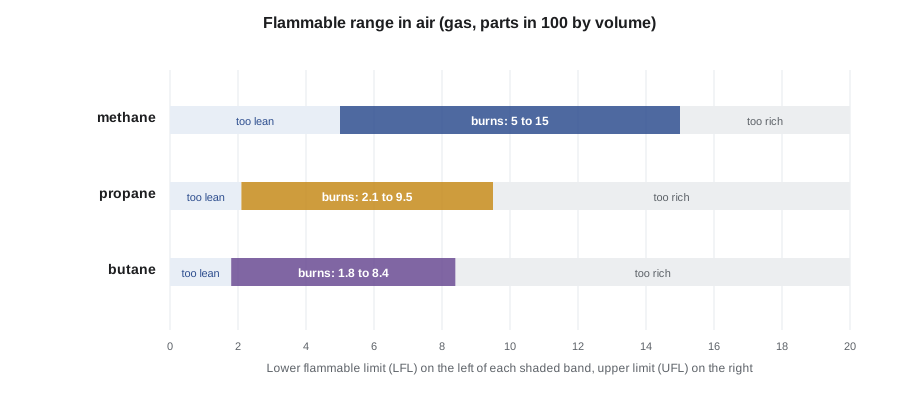
For methane, the range is about 5 to 15 parts in 100 by volume in air. For propane it is about 2.1 to 9.5, and for butane about 1.8 to 8.4. Propane, in other words, becomes flammable at less than half the concentration of methane. Combined with its tendency to pool, that makes a propane leak in a closed space especially dangerous.
A mixture above the upper limit is not safe. A room or pipe full of gas too rich to burn becomes flammable as air leaks in and dilutes it, and somewhere in that mixing zone there is always a band that will ignite. Opening a door on a gas-filled room, or purging a pipe into a room, can create exactly that band.
Worked problem
How much gas reaches the lower limit?
A small utility room is 3 m by 2.5 m with a 2.4 m ceiling. Ignoring air leakage, how much natural gas (LFL 5 in 100) and how much propane (LFL 2.1 in 100) would have to leak to bring the whole room to its lower flammable limit?
Show solution
- Room volume:
- \[3 \times 2.5 \times 2.4 = 18 \text{ m}^3\]
- Natural gas at 5 in 100:
- \[18 \times 0.05 = 0.9 \text{ m}^3\]
- Propane at 2.1 in 100:
- \[18 \times 0.021 \approx 0.38 \text{ m}^3\]
Answer: Less than a cubic metre of natural gas, or well under half that amount of propane, could make the whole room flammable if it stayed mixed. In reality the gas does not mix evenly: natural gas forms a richer layer near the ceiling and propane near the floor, so a flammable pocket forms long before the room average reaches the limit.
Combustible gas detectors used in the trade usually read in parts in 100 of the LFL, not parts in 100 of gas. A reading of 10 on that scale means the mixture holds one tenth of the gas needed to burn; for methane that is 0.5 parts in 100 of gas in air. Safety rules for confined spaces and hot work use these readings, as Lesson 10 explains. Other detectors read in parts per million (ppm) for small leaks. Knowing which scale your instrument shows is essential.
Ignition temperature and flame characteristics
A flammable mixture also needs a source of heat to start burning. The ignition temperature is the lowest temperature at which the mixture ignites on its own. Published values vary with the test method, but natural gas ignites at roughly 540 to 630 °C and propane at roughly 450 to 500 °C. Those temperatures are easily reached by a match, a pilot flame, a spark from a light switch or motor, static electricity, a hot element in a dryer or a cigarette. That is why the first rule in any leak response is to avoid creating sparks or flames.
Once lit, a gas flame has several properties that burner designers work with:
- Flame temperature. A methane flame in air can reach about 1,950 °C in theory. Real burners run cooler because of heat loss and excess air.
- Flame speed. The speed at which a flame front moves through the mixture. Natural gas has a slow flame speed, about 0.4 metres per second (just over a foot per second) in still air, which lets burners hold a stable flame. Hydrogen's flame speed is many times higher, which is why hydrogen blends need attention to flashback.
- Air needed for combustion. About 9.5 volumes of air to burn one volume of methane completely, and about 24 for propane. Lesson 5 explains where those numbers come from.
A related idea, used by engineers and appliance makers, is the Wobbe index: the heating value divided by the square root of the specific gravity. Gases with similar Wobbe numbers deliver similar heat through the same orifice at the same pressure, so utilities watch it when they blend supplies. A gasfitter rarely calculates it but should recognize the term in utility notices and manufacturers' literature.
| Property | Natural gas | Propane | What it means for the gasfitter |
|---|---|---|---|
| Specific gravity | About 0.60 | About 1.52 | Search high for natural gas leaks and low for propane |
| Heating value | About 37.5 MJ/m³ | About 93 MJ/m³ | Different orifices and pressures; convert only with a kit |
| Flammable range | 5 to 15 in 100 | 2.1 to 9.5 in 100 | Propane becomes flammable at a lower concentration |
| Ignition temperature | About 540 to 630 °C | About 450 to 500 °C | Ordinary sparks and flames are hot enough to ignite either |
| Air for complete combustion | About 9.5 volumes | About 24 volumes | Propane appliances need more air per unit of gas |
Back in the truck after the farm call, Luis put it simply: "Every safety rule for propane comes from three facts. It's heavy, it's rich in energy, and it burns at a low concentration. Remember those, and the rules make sense."
Other gases you may meet
Two other gases deserve a short note, because a gasfitter meets them in the field. Hydrogen has a specific gravity of about 0.07, so it rises even faster than natural gas; it burns between about 4 and 75 parts in 100 in air and ignites with very little energy. Its flame is nearly invisible in daylight. Carbon monoxide, the subject of Lesson 7, has a specific gravity of about 0.97, almost the same as air, so it does not rise or sink but spreads through a space. Both behave differently from natural gas and propane, and detectors made for hydrocarbons may not respond to them correctly. Use instruments that are rated for the gas you are looking for.
Knowing the properties of each gas turns rules into reasons. When a manufacturer says to mount a propane detector near the floor, or a code limits propane appliances in pits, the reason is specific gravity. When a converted appliance needs smaller orifices, the reason is heating value. When a technician refuses to open a gas line near a running pilot, the reason is the flammable range and ignition temperature.
Common mistakes
MistakeHolding a detector at head height when looking for a propane leak.
InsteadPropane sinks; search low, near floors, drains and pits.
MistakeTreating a gas concentration above the upper flammable limit as safe.
InsteadRich mixtures become flammable as air mixes in; treat any gas accumulation as dangerous.
MistakeConfusing a reading in parts in 100 of the LFL with parts in 100 of gas.
InsteadCheck which scale the instrument shows before acting on a number.
MistakeUsing the lower heating value from a European data sheet for a North American calculation.
InsteadCodes, utilities and rating plates in North America use the higher heating value.
Summary and key terms
- Specific gravity compares a gas with air: natural gas is about 0.60 and rises, propane about 1.52 and sinks.
- Heating value is the heat released per unit of gas: about 37.5 MJ/m³ for natural gas and about 93 MJ/m³ for propane, on the higher heating value basis.
- A gas burns only between its lower and upper flammable limits: about 5 to 15 in 100 for methane and 2.1 to 9.5 for propane.
- Mixtures above the upper limit become flammable as they dilute.
- Ordinary sparks and flames exceed the ignition temperature of fuel gases.
- Detectors may read in parts in 100 of the LFL or in ppm.
- Specific gravity
- The weight of a gas compared with the same volume of air, which is taken as 1.0.
- Heating value
- The heat released when a set amount of gas burns completely; higher heating value includes the heat of condensing water vapour.
- Lower flammable limit
- The lowest concentration of gas in air that will burn; also called the lower explosive limit.
- Upper flammable limit
- The highest concentration of gas in air that will burn.
- Ignition temperature
- The lowest temperature at which a flammable mixture ignites.
- Wobbe index
- Heating value divided by the square root of specific gravity; gases with similar values are interchangeable at the burner.
Practice problems
Work each problem on paper first, then reveal the answer to check.
Why does a natural gas leak tend to collect near the ceiling?
Show answer
Its specific gravity is about 0.60, so it is lighter than air and rises.
What is the flammable range of propane?
Show answer
About 2.1 to 9.5 parts in 100 by volume in air.
Why is a room full of gas above the upper limit still dangerous?
Show answer
As air mixes in, part of the mixture falls into the flammable range and can ignite.
What does a detector reading of 20 in 100 of the LFL mean for methane?
Show answer
One fifth of the lower limit, or about 1 part in 100 of methane in air.
Which heating value do North American codes and rating plates use?
Show answer
The higher (gross) heating value.
Lesson quiz · 5 questions
Score 60% or more to complete this lesson.
Create a free account to save your progress, take quizzes and earn a certificate.