
GAS-110 · Lesson 4 of 12 · 22 min
Pressure, flow and units in gas work
▶ Video coming soon A video version of this lesson is on the way.
Jonah's first start-up with Rosa was a new furnace in a townhouse. Before she lit it, Rosa connected a digital manometer to the inlet pressure tap on the gas valve. With the burner off, it read 1.80 kPa. When the burner lit, the reading dropped to 1.70 kPa. Then she moved the hose to the outlet tap and adjusted the valve's regulator until the manifold pressure matched the number on the rating plate. Finally she timed the gas meter's test dial with her phone and worked out the furnace's actual input. "Pressure tells you whether the gas can get there," she said. "Flow tells you how much is getting there. You need both."
This lesson explains what pressure is, the units used in gas work, the instruments used to measure it, and how pressure, flow and input relate. These are the measurements a gasfitter takes on almost every call.
What pressure is
Pressure is force spread over an area. Gas in a pipe presses outward on every surface it touches, and that push is what moves gas from the meter to the burner. Gas always flows from a place of higher pressure toward a place of lower pressure, and the bigger the difference, the more gas flows through a given opening.
The air around us has pressure too. At sea level, atmospheric pressure is about 101.3 kPa. It falls with altitude. Most gas gauges are built to read zero when open to the air, so they show how far the gas pressure is above atmospheric. That is gauge pressure. Pressure measured from a perfect vacuum is absolute pressure, which equals gauge pressure plus atmospheric pressure. In Canada, gauge pressure is often written kPa(g) when the distinction matters. Unless a document says otherwise, the pressures in gas codes and on rating plates are gauge pressures.
Units of pressure
Canadian gas work uses the SI unit, the kilopascal (kPa), as the official unit in CSA B149.1. You will still see older units every day, because many manometers, rating plates and manufacturers' instructions show both. The most common are inches of water column (in. w.c.) for low pressures and pounds per square inch (psi) for higher ones. A gas technician must move easily among them.
| From | To | Multiply by |
|---|---|---|
| inches of water column | kilopascals | 0.249 |
| kilopascals | inches of water column | 4.02 |
| psi | inches of water column | 27.7 |
| psi | kilopascals | 6.895 |
| kilopascals | psi | 0.145 |
| millibars | kilopascals | 0.1 |
A useful way to remember the scale: one pound per square inch is a little under 28 inches of water column. The supply pressure to most natural gas appliances, about 7 inches of water column, is about one quarter of a pound per square inch, or 1.75 kPa. That is a very low pressure, which is why gas appliance controls are so sensitive to small changes.
Worked problem
Converting common pressures
Convert a natural gas supply of 7 in. w.c., a propane supply of 11 in. w.c. and an elevated building pressure of 2 psi into the other units.
Show solution
- Natural gas supply:
- \[7 \times 0.249 \approx 1.74 \text{ kPa}\]
- Propane supply:
- \[11 \times 0.249 \approx 2.74 \text{ kPa}\]
- Elevated pressure in inches of water column and kilopascals:
- \[2 \times 27.7 = 55.4 \text{ in. w.c.} \qquad 2 \times 6.895 \approx 13.8 \text{ kPa}\]
Answer: Rounded, these are the familiar 1.75 kPa, 2.75 kPa and 14 kPa that appear on Canadian rating plates and regulator tags.
Measuring pressure
The classic instrument for low gas pressure is the U-tube manometer: a clear tube bent into a U and partly filled with water or a coloured gauge oil. With both ends open, the liquid stands at the same level in both legs. When one leg is connected to gas pressure, the liquid is pushed down in that leg and up in the other. The pressure equals the total difference in height between the two liquid surfaces.
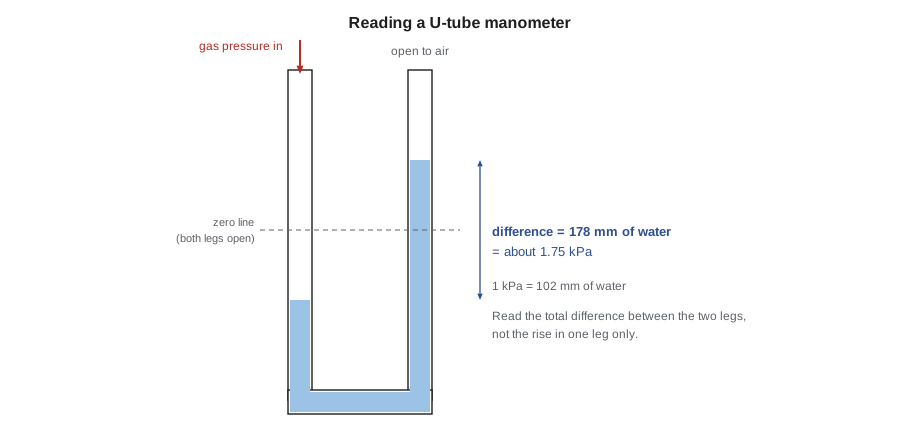
A common mistake is to read only the rise in one leg, which gives half the true pressure. Another is to read the manometer with the tube tilted. Most technicians now use digital manometers, which read directly in the chosen unit, can show two pressures at once and can log readings during a pressure test. They must be zeroed with both ports open before use and checked against a reference regularly.
Higher pressures are read with mechanical gauges. A Bourdon-tube gauge has a curved, flattened tube that straightens slightly as pressure rises and moves a needle through gears. Diaphragm gauges use a flexible disc and are better for low pressures. For pressure testing new piping, the gauge must have a range and resolution suited to the test pressure, so that a small drop can be seen; a gauge whose full scale is many times the test pressure may hide a leak. The adopted code sets the test pressure, duration and gauge requirements, and you will study them in the next course.
Pressure is measured at test ports or pressure taps: small plugged openings on gas valves, regulators and manifolds. The inlet tap shows supply pressure reaching the appliance; the outlet tap shows manifold pressure, the pressure delivered to the burner orifices after the appliance's own regulator. Plugs must be replaced and leak tested after every reading.
Static and operating pressure
Pressure measured with no gas flowing is static pressure (also called lockup when measured downstream of a closed regulator). Pressure measured while appliances are running is operating or dynamic pressure. Operating pressure is always lower than static pressure, because gas flowing through pipes and fittings loses some pressure to friction. The difference is the pressure drop.
Both readings tell a story. A static pressure that is too high may mean a faulty regulator. An operating pressure that falls too far when the burner lights, or when other appliances start, points to undersized piping, a restriction such as a kinked connector or a partly closed valve, or a regulator that cannot supply the load. Appliance makers give an allowable range of inlet pressure, minimum and maximum, and the appliance may not light reliably or burn properly outside it.
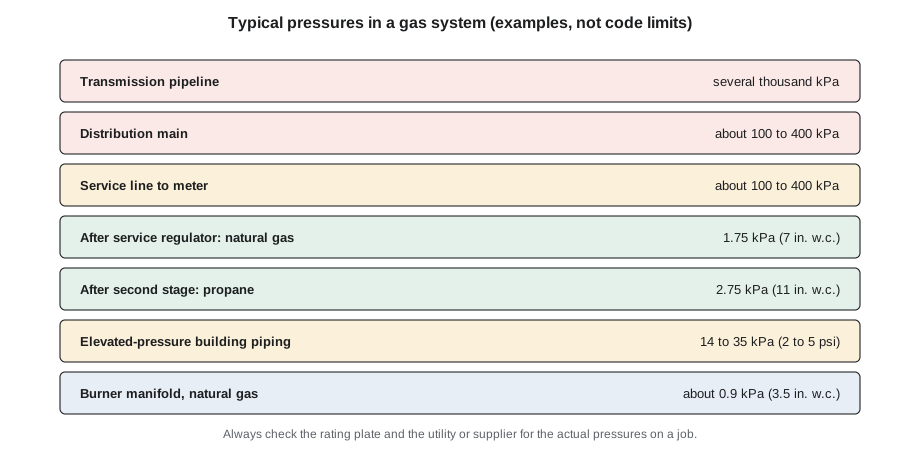
The values in the figure are typical, not rules. Utilities set their own delivery pressures, and many larger buildings now receive gas at an elevated pressure, often 14 or 35 kPa, with a line regulator near each appliance group to drop it to appliance pressure. Propane systems use two stages: a first-stage regulator at the tank reduces tank pressure to about 70 kPa, and a second-stage regulator at the building reduces it to appliance pressure.
Flow and input
Flow is the volume of gas passing a point in a given time, in cubic metres per hour (m³/h). Multiplying the flow by the heating value gives the heat input. A burner's flow is set by the size of its orifices and the manifold pressure: a bigger orifice or a higher pressure lets more gas through.
The gas meter measures flow. Every meter has a small test dial that turns quickly when gas is flowing; its face shows the volume for one revolution. To clock the meter, a technician turns off or holds off every other appliance, lets the one being tested run at full fire, and times one or more revolutions of the test dial. From the time and the dial size, the flow per hour follows.
Worked problem
Clocking a gas meter
Rosa turns off the water heater and lets the new furnace run. The meter's test dial is marked 0.05 m³ per revolution. One revolution takes 72 seconds. The utility's heating value is 37.5 MJ/m³. What is the furnace's input?
Show solution
- Find the number of revolutions in an hour:
- \[\frac{3600}{72} = 50 \text{ revolutions per hour}\]
- Multiply by the dial size to get flow:
- \[50 \times 0.05 = 2.5 \text{ m}^3\text{/h}\]
- Multiply by the heating value to get input:
- \[2.5 \times 37.5 = 93.75 \text{ MJ/h} \approx 26 \text{ kW}\]
Answer: The furnace's input is about 93.75 MJ per hour (26 kW). Rosa compares it with the rating plate. If the measured input is outside the range the manufacturer allows, she checks the manifold pressure and orifices before going further. An over-fired appliance can overheat its heat exchanger and produce carbon monoxide; an under-fired one may condense in its vent.
Clocking works on natural gas meters. Propane systems usually have no meter at the appliance, so input is checked by measuring manifold pressure and confirming the orifice size against the manufacturer's data. On both gases, the measured manifold pressure must match the rating plate or installation manual.
Pressure, flow and altitude
Altitude affects gas work in two ways. Air is thinner at higher elevations, so a burner gets less oxygen per volume of air, and appliances must be derated (their input reduced) above certain elevations according to the manufacturer's instructions and the code. And atmospheric pressure is lower, so absolute pressures change even when gauge readings do not. Hamilton sits well under 300 metres above sea level, so derating rarely applies there, but technicians in the mountains of British Columbia and Alberta deal with it often.
| Measurement | Instrument | What it tells you |
|---|---|---|
| Static inlet pressure | Manometer at inlet tap, burner off | Regulator lockup and supply available |
| Operating inlet pressure | Manometer at inlet tap, burner on | Whether piping and regulator can carry the load |
| Manifold pressure | Manometer at outlet tap, burner on | Pressure delivered to the orifices; set to rating plate |
| Flow and input | Meter test dial and timer | Actual heat input compared with rating |
| Test pressure | Test gauge on new piping | Whether new piping holds pressure without loss |
How a regulator controls pressure
A gas pressure regulator reduces a higher, variable inlet pressure to a lower, steady outlet pressure. Most regulators in gas work use the same three parts: a flexible diaphragm that senses outlet pressure, a spring that pushes against the diaphragm, and a valve linked to the diaphragm that opens and closes the gas passage. When an appliance starts and outlet pressure drops, the spring pushes the diaphragm and opens the valve wider; when the appliance stops and outlet pressure rises, the diaphragm compresses the spring and closes the valve. Turning the adjusting screw changes the spring force and so the outlet pressure.
Three regulator behaviours show up on a manometer. Lockup is the pressure at which the regulator shuts off tightly when flow stops; it is slightly above the set operating pressure. Droop is the small fall in outlet pressure as flow increases toward the regulator's capacity. And creep is a slow rise in outlet pressure with no flow, which means the valve is not sealing, usually from dirt or wear, and the regulator must be repaired or replaced.
The space above the diaphragm must breathe to the atmosphere through a vent. If the vent is blocked by ice, insects, paint or water, the regulator cannot respond and outlet pressure may climb dangerously or fall to nothing. Outdoor regulators are installed with the vent pointing down or protected, and indoor regulators either have a vent limiter or are vented outdoors as the code and manufacturer require. Never paint over or plug a regulator vent.
| Reading on the manometer | Likely regulator condition |
|---|---|
| Steady outlet pressure, slightly higher with no flow | Normal: lockup a little above operating pressure |
| Outlet pressure falls well below setting at full load | Excess droop: regulator too small, inlet too low or restriction |
| Outlet pressure keeps rising with no flow | Creep: valve not sealing; replace or repair |
| Outlet pressure erratic or wildly high | Blocked vent, damaged diaphragm or failed valve; shut off and investigate |
Common mistakes
MistakeReading only the rise in one leg of a U-tube manometer.
InsteadRead the total difference in height between the two liquid surfaces.
MistakeSetting manifold pressure with the burner off.
InsteadSet and check manifold pressure with the burner operating at full input.
MistakeLeaving a test-port plug loose after taking a reading.
InsteadReinstall every plug and leak test it with the appliance running.
MistakeClocking a meter while other appliances are running.
InsteadShut off or hold off all other loads so the dial shows only the appliance being tested.
Summary and key terms
- Pressure is force per unit area, and gas flows from higher to lower pressure.
- Gauge pressure reads zero at atmospheric pressure.
- Canada uses kilopascals officially, alongside inches of water column and psi. One psi is about 27.7 in. w.c. or 6.9 kPa; 7 in. w.c. is about 1.75 kPa.
- U-tube and digital manometers measure low pressures; gauges measure higher ones.
- Static pressure is measured with no flow and operating pressure with flow; the difference is pressure drop.
- Flow times heating value gives input, which can be measured by clocking the meter's test dial.
- Gauge pressure
- Pressure above atmospheric; what most gas gauges show.
- Inches of water column
- A unit of low pressure equal to the pressure that supports a column of water one inch high; about 0.249 kPa.
- Manometer
- An instrument that measures low pressure, by the height of a liquid column or electronically.
- Manifold pressure
- The gas pressure delivered to the burner orifices, downstream of the appliance regulator.
- Static pressure
- Pressure measured with no gas flowing.
- Clocking the meter
- Timing the meter's test dial to find the gas flow and input of an appliance.
Practice problems
Work each problem on paper first, then reveal the answer to check.
What is the difference between gauge and absolute pressure?
Show answer
Gauge pressure reads zero at atmospheric pressure; absolute pressure is gauge plus atmospheric.
About how many inches of water column are in one psi?
Show answer
About 27.7.
Why is operating pressure lower than static pressure?
Show answer
Flowing gas loses pressure to friction in pipes and fittings.
What two numbers do you need to turn a meter's flow into input?
Show answer
The flow per hour and the heating value of the gas.
Why is input on propane appliances usually checked by manifold pressure rather than by clocking?
Show answer
Propane systems usually have no meter at the appliance.
Lesson quiz · 5 questions
Score 60% or more to complete this lesson.
Create a free account to save your progress, take quizzes and earn a certificate.