
FAT-330 · Lesson 9 of 12 · 20 min
Integrated systems testing (CAN/ULC-S1001)
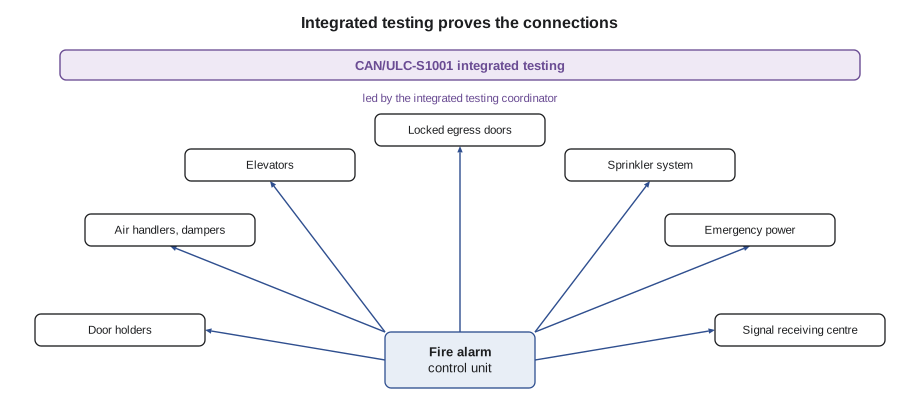
By the third week the north wing's fire alarm is proven: every device, every circuit, every appliance. Now Owen Petrakis takes over the schedule. At 7 a.m. on a Tuesday the north wing's corridors fill with people who don't usually work together: Sasha at the panel, Nadia on the third floor with aerosol and a radio, the controls technician at AHU-N1, the elevator mechanic in the penthouse machine room, the door hardware supplier in the psychiatric unit, Luis at the riser, an electrician at the transfer switch, and Captain Strand with a clipboard. Owen reads the first scenario aloud. 'Smoke, third-floor north corridor. Here's what should happen, in order. Everyone report what you see, and when.' This lesson covers integrated testing: proving that the fire alarm and the systems it controls work together as one.
Why integrated testing exists
Each system in a modern building can pass its own test and still fail as a group. The fire alarm relay changes state, but the air handler's controller ignores it. The damper's actuator works, but the fire alarm sends the close command to a different damper. The elevator recall input works, but the elevator controller was set to recall to the wrong floor. The generator starts, but the fire pump controller doesn't transfer. Each trade tests its own equipment and each passes; the failure is in the connections between them, which nobody owns.
Integrated testing exists to close that gap. It tests the fire protection and life safety systems as a whole, by operating the initiating events that really happen in a fire, such as a detector, a manual station, a sprinkler flow or a loss of power, and watching every system respond, end to end.
What the codes require in Canada
The National Building Code requires that where fire protection and life safety systems are integrated with each other, they be tested together as a whole to CAN/ULC-S1001 to confirm they work as intended (Article 3.2.9.1 for Part 3 buildings). The National Fire Code then requires those interconnections to be tested and maintained to the same standard for the life of the building (Section 6.8). The requirement applies to any building where systems are interconnected, not only to high buildings, so the north wing, which sits just under the high-building threshold, is still covered because its fire alarm controls doors, air handlers, dampers, elevators and locks.
CAN/ULC-S1001 describes initial testing of new installations, testing after modifications, periodic testing (commonly a year after the initial test and then at intervals of no more than five years, as municipal guidance such as the City of Regina's describes) and testing of existing buildings that never had an integrated test.
The integrated testing coordinator and the plan
CAN/ULC-S1001 requires an integrated testing coordinator: a person with knowledge of the codes, the systems involved and how they are tested, who prepares the integrated testing plan, runs the tests and writes the report. On the north wing that is Owen. The coordinator doesn't replace the trades; each trade still operates and tests its own equipment. The coordinator makes sure they test it together, in the right order, against the same expected results.
The plan is the heart of the work. It lists every integrated system, describes how each one is meant to respond to each initiating event, sets out the test procedures and the order of testing, and identifies what will be done to keep the building safe while systems are taken out of their normal state. It must be written before testing, reviewed by the designers and agreed by the trades. Owen's plan for the north wing runs to 46 pages, built around a single table: the functional matrix.
The functional matrix
The functional matrix, also called the cause-and-effect matrix, has a row for each initiating event and a column for each response. Each cell says what should happen: release, stop, close, recall, unlock, transmit. It is the same idea as the sequence of operation the fire alarm designer wrote, extended to every system the event affects.
| Initiating event | Fire alarm | Doors | Air handling | Elevators | Locks | Monitoring |
|---|---|---|---|---|---|---|
| Smoke, 3rd floor corridor | Alert, then alarm | Floor 3 holders release | AHU-N1 stops, floor 3 dampers close | Recall to main floor | Psychiatric unit egress doors release | Alarm transmitted |
| Smoke, elevator lobby floor 1 | Alert, then alarm | Floor 1 holders release | AHU-N1 stops | Recall to alternate floor | None | Alarm transmitted |
| Heat, elevator machine room | Alarm | All holders release | None | Recall, then shunt trip | Stair doors unlock | Alarm transmitted |
| Waterflow, floor 4 | Alarm | Floor 4 holders release | AHU-N2 stops | None | Stair doors unlock | Alarm transmitted |
| Duct detector, AHU-N2 supply | Supervisory | None | AHU-N2 stops | None | None | Supervisory transmitted |
| Loss of normal power | Runs on battery until generator | None | Restart on generator | Lower to main floor, then one car on generator | As designed | Trouble transmitted |
The matrix uses the two-stage sequence: a single detector produces the alert signal and the outputs shown, and the alarm signal follows on acknowledgement timeout or a second device.
Running a scenario
Each scenario is run end to end. The initiating device is operated as it would be in a fire, not by a button at the panel. Every response is observed by a person at the equipment, not only by a status light at a screen, and the time of each response is recorded from the moment the initiating device operated. Owen's procedure for each scenario is:
- Confirm everyone is in position, the building is in the agreed test state and the monitoring station is on test.
- Announce the start and operate the initiating device at a recorded time.
- Each observer radios the moment their equipment responds and what it did.
- Compare each response with the matrix, including timing where the design sets a limit.
- Restore every system and confirm each has returned to normal before the next scenario.
# Integrated test log for one scenario: expected responses and observed times
scenario = "smoke detector 3-022, 3rd floor north corridor"
expected = {"fire alarm alert displayed": 5, "floor 3 door holders released": 10, "AHU-N1 fan stopped": 30,
            "floor 3 smoke dampers closed": 75, "elevators recalled to main floor": 60,
            "psychiatric unit egress doors released": 10, "alarm received at monitoring station": 90}
observed = {"fire alarm alert displayed": 3, "floor 3 door holders released": 4, "AHU-N1 fan stopped": 22,
            "floor 3 smoke dampers closed": 64, "elevators recalled to main floor": 41,
            "psychiatric unit egress doors released": None, "alarm received at monitoring station": 38}
print("scenario:", scenario)
fails = []
for k, limit in expected.items():
    t = observed[k]
    if t is None:
        print(f"  {k:40s} NOT OBSERVED  FAIL"); fails.append(k)
    else:
        ok = t <= limit
        print(f"  {k:40s} {t:3d} s (limit {limit:3d} s)  {'ok' if ok else 'FAIL'}")
        if not ok: fails.append(k)
print("result:", "pass" if not fails else "fail -> " + "; ".join(fails))scenario: smoke detector 3-022, 3rd floor north corridor fire alarm alert displayed 3 s (limit 5 s) ok floor 3 door holders released 4 s (limit 10 s) ok AHU-N1 fan stopped 22 s (limit 30 s) ok floor 3 smoke dampers closed 64 s (limit 75 s) ok elevators recalled to main floor 41 s (limit 60 s) ok psychiatric unit egress doors released NOT OBSERVED FAIL alarm received at monitoring station 38 s (limit 90 s) ok result: fail -> psychiatric unit egress doors released
The psychiatric unit's egress doors don't release. The door hardware supplier checks the lock power supply and finds that the fire alarm relay input was wired to its 'free egress on loss of power' terminal, which releases only when the lock's own supply fails, not on a fire alarm signal. The doors would have stayed locked in a fire. It is corrected the same morning, and the scenario is run again from the start rather than testing only the doors, because the fix involved rewiring inside the lock power supply.
Testing on emergency power
The most demanding scenario is loss of normal power. The electrician opens the normal supply to the north wing at the transfer switch. The fire alarm must carry on without a trouble other than the expected AC loss, on battery until the generator picks up, then on the essential supply. The generator must start and transfer within the time the emergency power standard requires; the elevators must lower to their designated floor and then run one car at a time on generator power as designed; the air handlers must restart in their emergency mode. And while the building is on generator, a fire alarm scenario is run, to prove the system works with the building in that state.
Captain Strand watches this scenario closely. She asks for the time from opening the normal supply to the transfer switch closing on emergency, and for the fire alarm's event log to show the AC loss, the battery operation and the restoration with correct times.
Keeping the building safe during testing
Integrated tests deliberately put systems into abnormal states: doors released, fans stopped, elevators recalled, locks open. On a new building with no occupants the risk is mostly to workers. At Eastview, the north wing connects to an occupied hospital. Owen's plan lists, for every scenario, what is affected outside the north wing and what is done about it: the link corridor doors are watched by security, the elevator recall is limited to north wing cars, the main panel's network is on test so the rest of the hospital doesn't hear signals, and the psychiatric unit, though empty, has security staff at its doors whenever its locks are released. A fire watch covers any area where detection is out of service between scenarios.
The integrated testing report
The report under CAN/ULC-S1001 includes the integrated testing plan, the completed test forms for every scenario, retest forms for failures, and confirmation that each system was individually tested and verified before integrated testing began. It is given to the owner and kept on site, and the building official must accept it before the occupancy permit is issued. Captain Strand will want it at every later integrated test as the baseline.
Worked problem
Elevator recall to the wrong floor
In the scenario for smoke in the first-floor elevator lobby, the elevators should recall to the alternate floor, floor 2, because the main recall floor is where the fire is. They go to floor 1. The fire alarm relay for alternate recall operated. What next?
Show solution
- Record the scenario as failed: alternate recall relay operated, cars went to the main floor.
- The elevator mechanic checks the controller's inputs and finds the alternate and main recall inputs swapped at the controller terminals.
- The mechanic corrects the wiring; Sasha confirms the fire alarm program is unchanged.
- Run both recall scenarios again: the main recall from a floor 3 lobby detector and the alternate recall from floor 1, because the fix affected both.
- Owen records the failure, the cause, the correction and both retests in the report.
Answer: A correction to a shared connection means retesting every scenario that uses it.
Test methods: end to end or by groups
Integrated testing can be done in different ways, and the plan says which. End-to-end testing operates the real initiating device and watches every response, as Owen does for most scenarios. Group testing proves a set of responses in sections, for example operating each relay to prove each damper, then proving separately that the detector operates the relay. Scenario testing strings several events together in the order a real fire would produce them: a detector, then a waterflow, then a manual station. End-to-end is the most convincing; group testing is sometimes the only practical method in a building where some responses can't be safely triggered together. Where the plan uses group testing, it must show how the groups together cover the whole path.
Common mistakes
MistakeStarting integrated tests before each system is individually proven.
InsteadProve each system first; then test them together.
MistakeOperating the initiating event from the panel instead of the device.
InsteadOperate the real device so the whole path is tested.
MistakeWatching responses only on a screen.
InsteadPut an observer at each piece of equipment and record times.
MistakeRetesting only the corrected item after a fix inside shared equipment.
InsteadRerun the whole scenario, and others that share the connection.
MistakeForgetting the occupied building next door.
InsteadPlan the effects of every scenario beyond the test area.
Summary and key terms
- The building code requires integrated systems to be tested together to CAN/ULC-S1001; the fire code requires it to continue.
- An integrated testing coordinator prepares the plan, runs the tests and writes the report.
- The functional matrix lists each initiating event and every system's expected response.
- Each scenario is run end to end, from the real device, with observers at the equipment and times recorded.
- Loss of normal power is tested, with a fire alarm scenario run on generator.
- Failures are corrected and the whole scenario is rerun.
- Integrated testing
- Testing interconnected fire protection and life safety systems together as a whole.
- Integrated testing coordinator
- The person who prepares the integrated testing plan, runs the tests and writes the report.
- Functional matrix
- A table of initiating events and every system's expected response.
- End-to-end test
- A test that starts at the real initiating device and ends at the final equipment response.
- Alternate recall
- Recalling elevators to a different floor when the fire is at the main recall floor.
Practice problems
Work each problem on paper first, then reveal the answer to check.
Why can systems pass their own tests and fail together?
Show answer
The failures are in the connections between systems, which no single trade owns.
What does the functional matrix show?
Show answer
Each initiating event and how every connected system should respond.
Why operate the real initiating device?
Show answer
So the whole path from detection to response is tested.
Why rerun a whole scenario after a fix inside shared equipment?
Show answer
The fix may have changed other responses.
Why test a fire alarm scenario on generator power?
Show answer
To prove the systems work together in the building's emergency power state.
Lesson quiz · 5 questions
Score 60% or more to complete this lesson.
Create a free account to save your progress, take quizzes and earn a certificate.